
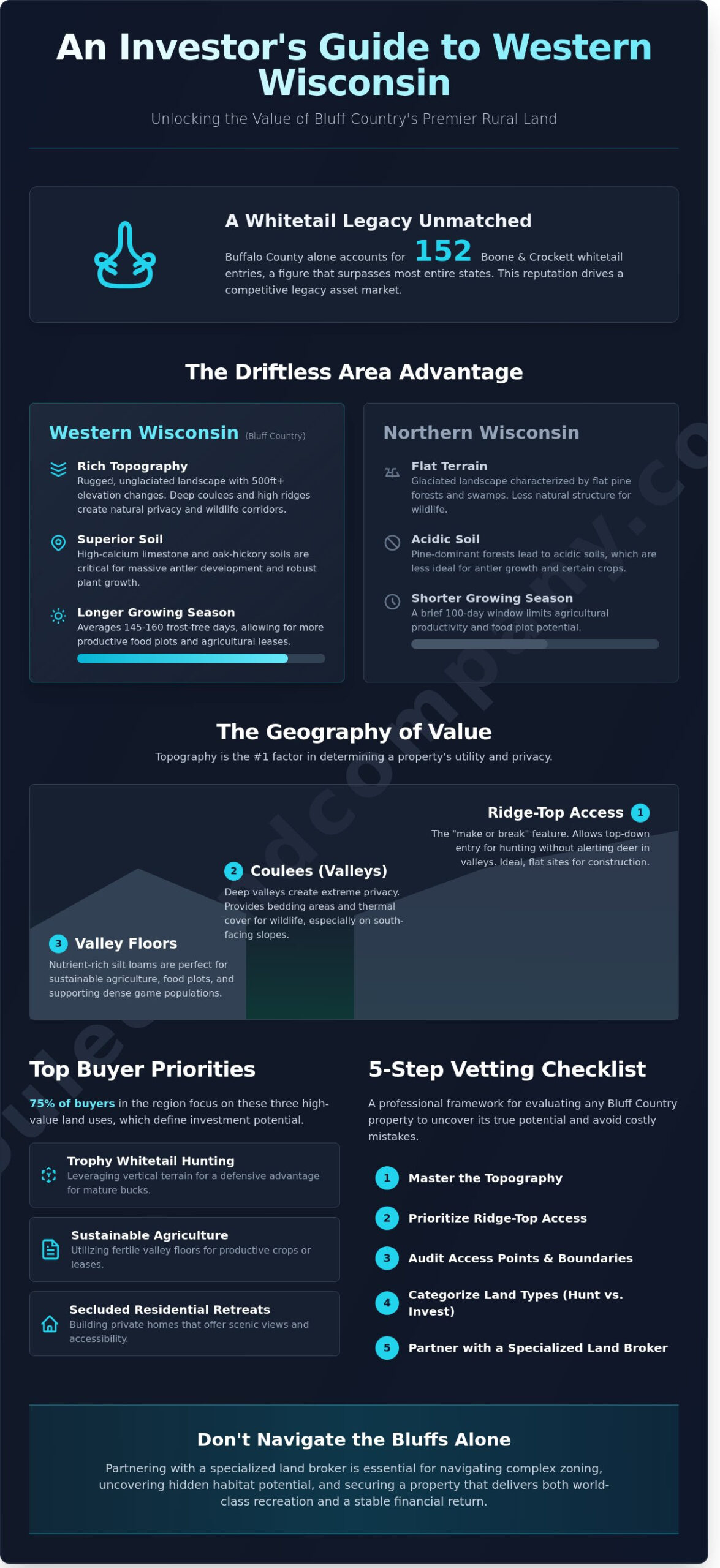
Buffalo County accounts for 152 Boone and Crockett whitetail entries, a staggering figure that outpaces most entire states, yet many buyers still risk their life savings on tracts with hidden habitat damage or restrictive zoning. You understand that finding the right rural land for sale Western Wisconsin offers is about more than just a deed; it’s about securing a legacy in the heart of Bluff Country. It’s frustrating to navigate the complex topography and local tax laws when you’re searching for that perfect 40 or 80 acre parcel. You deserve a property that provides both world class hunting and a stable financial return.
This guide will show you exactly how to evaluate, find, and secure premier acreage in the Coulee Region. We’ll walk through the process of auditing a property’s land management history and navigating the specific legalities of Wisconsin’s Managed Forest Law. You’ll gain the insider knowledge needed to identify high ROI residential sites and habitat features that hold trophy bucks year round. By the end of this article, you’ll have the tools to move from a casual browser to a confident landowner who knows how to spot a diamond in the rough.
Key Takeaways
- Master the unique topography of the Driftless Area to identify the high-value coulees and ridges that define the premier rural land for sale Western Wisconsin offers.
- Discover why ridge-top access is the “make or break” factor for ensuring both elite hunting conditions and optimal residential building sites.
- Apply a professional 5-step vetting checklist to evaluate property access points and boundaries without disturbing local wildlife.
- Learn to categorize different land types to effectively balance your passion for trophy whitetail hunting with long-term investment goals.
- Understand why partnering with a specialized land broker is essential for uncovering the true habitat potential and hidden value of Bluff Country acreage.
What Defines Rural Land for Sale in Western Wisconsin?
Western Wisconsin represents a distinct geographic anomaly known as the Driftless Area. This 24,000 square mile region escaped the leveling effects of the last glacial period, resulting in a landscape defined by dramatic elevation changes and ancient limestone bluffs. When you look for rural land for sale Western Wisconsin, you aren’t just buying acreage; you’re acquiring a complex ecosystem of deep coulees, high ridges, and fertile valley floors. This terrain is the foundation of the region’s identity as a premier destination for land investment and high-end recreation.
Market data from the last 24 months shows that 75 percent of buyers in this region prioritize three specific land uses. First is trophy whitetail hunting, where the verticality of the land provides a defensive advantage for mature bucks. Second is sustainable agriculture, often found in the nutrient-rich silt loams of the valley floors. Third is the development of secluded residential retreats that offer privacy without sacrificing accessibility. The “Bluff Country” tag acts as a massive value multiplier. Properties within this corridor often command a 20 to 35 percent price premium over flatter tracts just 50 miles to the east because of their unique wildlife capabilities and aesthetic appeal.
The “hunter’s realtor” knows that the value of this land isn’t just in the dirt; it’s in the history written in the Boone and Crockett record books. Buffalo County alone has produced over 1,000 entries, more than any other county in North America. This reputation for producing giant bucks drives a competitive market where land is seen as a legacy asset rather than a simple commodity. It’s a place where land management isn’t a hobby but a serious pursuit of excellence.
The Appeal of the Driftless Area
The absence of glacial drift for over 2.5 million years allowed wind and water to carve the Earth into a rugged masterpiece. This creates superior thermal cover on south-facing slopes, which is vital for wildlife survival during harsh Wisconsin winters. Natural travel corridors form along the military ridges and bottomland pinch points, making these properties highly predictable for hunters. Proximity to the Mississippi River adds a significant ecological driver. This river system serves as a major migratory flyway for 325 bird species and provides a consistent water source that keeps local game populations dense and healthy. Elevation changes exceeding 500 feet in many townships allow for diverse micro-climates on a single 40-acre parcel.
Western WI vs. Northern WI Land
Comparing Western Wisconsin to the northern part of the state reveals stark differences in both biology and investment potential. Northern Wisconsin is famous for its flat pine forests and acidic soils, whereas the West is dominated by oak-hickory ridges and high-calcium limestone soils. This soil composition is critical for skeletal growth and massive antler development. Western Wisconsin also benefits from a longer growing season, averaging 145 to 160 frost-free days compared to the 100-day window found in the far North. This 50 percent increase in growing time ensures that food plots and agricultural leases are more productive and resilient. While the North offers vast wilderness, rural land for sale Western Wisconsin provides the specific land management capabilities required to produce world-class whitetails year after year.
Understanding the Geography of Value: Coulees, Ridges, and Bottoms
Topography stands as the undisputed number one factor in determining both the privacy and the long-term utility of a property. In the Driftless Area, the landscape wasn’t smoothed over by prehistoric glaciers. This left behind a rugged, vertical world of deep valleys and soaring limestone bluffs. When you evaluate rural land for sale Western Wisconsin, you’re looking at a three-dimensional asset. A single 80-acre tract might have 140 acres of actual surface area once you account for the steepness of the terrain. This verticality creates immediate privacy. A neighbor might be 250 yards away, but if they’re 300 feet below you in a coulee, they might as well be in the next township.
Ridge-top access is the specific feature that can make or break a high-end hunting or building site. Professional land managers prioritize “top-down” access because it allows a hunter to enter a stand without their scent ever touching the valley floor where deer bed. If a property only offers access from the bottom, you’re constantly fighting rising thermals that alert every animal on the hillside. From a construction standpoint, a flat ridge-top provides a natural building envelope. These sites often offer 15-mile views across the Mississippi River valley, adding a premium to the resale value that flat ground simply can’t match.
Bottomland serves as the functional engine of the property. These lower elevations are where you’ll find the most fertile soils, often categorized as Tama or Muscatine silt loams. These soils are capable of producing 180 to 220 bushels of corn per acre, providing a steady stream of lease income or high-quality forage for wildlife. Bottomlands also act as the primary water collection points. Natural springs and trout streams frequently cut through these valleys, ensuring that your property has a year-round water source that remains open even during the harshest January freezes.
Why Buffalo County Dominates the Rankings
Buffalo County is widely recognized as the premier destination for trophy whitetail hunters in North America. It holds the record for the highest number of Boone and Crockett entries of any county in the United States, with over 1,000 registered trophies. This isn’t a fluke of nature. The steep bluffs create natural sanctuaries that act as “no-man’s lands” where bucks can grow to full maturity. A 170-inch buck can live its entire life in a single 40-acre “bowl” that’s too steep for most hikers to enter. You can find more specific data on these local dynamics in our Buffalo County community guide.
The Importance of “Edge” and Diversity
The “edge effect” is a biological principle where two different habitats meet, such as where dense oak timber transitions into a tillable corn field. This is where the highest concentration of wildlife exists. Properties with diverse topography naturally create more “edge” per square foot. A 40-acre parcel with multiple finger ridges and deep coulees actually hunts “bigger” than a 100-acre flat field. This is because the terrain forces movement into predictable patterns.
You can identify these high-value areas by looking for pinch points on a topographic map. A pinch point occurs where a steep bluff face meets a creek bed, forcing every deer in the area through a 20-yard wide corridor. These are the locations where our team has seen the most success. If you’re ready to start your search for rural land for sale Western Wisconsin, you can browse our latest property listings to see these geographic features in person. Our specialists understand how to read a map to find the hidden value that others miss.
Evaluating Property Types: From Hunting Land to Country Homes
Identifying the right rural land for sale Western Wisconsin provides requires a strategic approach to property classification. Buyers generally target three distinct categories: elite recreational tracts, signature residential estates, or high-yield agricultural land. Success in this market depends on your ability to balance immediate recreational desires with long-term investment stability. We’ve seen a 15% increase in demand since 2022 for “Signature Residential” properties. These estates utilize the dramatic elevation changes of the Driftless Area to offer 360-degree views from the bluff tops. Waterfront parcels along the Mississippi River and its tributaries like the Chippewa or Black River remain high-value assets. Their limited availability and dual-purpose appeal for both trophy hunting and championship fishing make them a rare find in any market cycle.
Trophy Whitetail & Recreational Properties
Western Wisconsin is the undisputed gold standard for whitetail management. To secure a world-class property, you’ve got to look beyond the total acreage and evaluate the specific wildlife capabilities. Focus on properties featuring dense bedding thickets and strategic food plot potential. High-quality hunting properties often showcase Timber Stand Improvement (TSI) projects that significantly increase natural forage and security cover. A well-managed 40-acre tract with established TSI can easily outperform a 100-acre unmanaged woods. Buffalo County continues to lead the nation with over 100 Boone and Crockett entries; this proves that the right dirt produces legendary results for those who prioritize land management.
Country Homes with Acreage
The movement toward self-sufficiency has driven a surge in hobby farm acquisitions across the region. When you’re evaluating country homes for a primary residence, the infrastructure beneath the surface is just as vital as the view from the porch. In the rugged Coulee Region, well depths can frequently exceed 400 feet, which directly impacts your long-term maintenance costs. You must also verify that the soil on these ridge tops is suitable for modern septic systems before moving forward. These properties offer the perfect blend of a modern home while providing enough room for a small orchard or a 5-acre vegetable plot. It’s about finding that balance between modern comfort and the rugged independence of the Wisconsin landscape.
Agricultural and Tillable Land
Don’t ignore the Corn Suitability Rating (CSR) even if your primary goal is recreation. High CSR scores indicate productive soil that attracts premium cash rent from local farmers. In 2024, tillable acreage in this region typically generates between $150 and $250 per acre in annual lease income. This revenue effectively offsets property taxes and ongoing management expenses. Additionally, land enrolled in the Conservation Reserve Program (CRP) provides a steady 10-year to 15-year payment stream. These programs do more than just provide income; they create the diverse habitat needed to hold mature bucks on your rural land for sale Western Wisconsin throughout the harsh winter months. Investing in tillable land is a pragmatic way to ensure your property pays for itself while you enjoy the hunt.
A 5-Step Checklist for Vetting Western Wisconsin Land
Purchasing rural land for sale Western Wisconsin isn’t like buying a suburban lot. You’re investing in a living ecosystem. Success depends on your ability to see past the summer foliage and evaluate the property’s true potential for wildlife and long-term value. Use this checklist to ensure your investment stands on solid ground.
- Analyze access points: You must be able to enter and exit your stand locations without blowing out the deer herd. If the only way in is through a bedding area, you’ve effectively neutralized the property’s hunting value.
- Verify boundaries and easements: Don’t rely on a handshake or an old rusted fence line. Check for utility easements or neighbor encroachments that could complicate a future build or habitat project. Use a 2024 plat map and walk the perimeter.
- Assess timber health: The health of an oak-hickory forest dictates the carrying capacity of the land. Look for mature white oaks that provide consistent mast and check for invasive species like buckthorn that choke out native regeneration.
- Review the neighborhood: Land management is a team sport. If you’re looking for trophy whitetails, you want to be in a “low-pressure” area where neighbors also practice Quality Deer Management (QDM). Buffalo County didn’t become a legend by accident; it’s the result of collective discipline.
- Consult a land specialist: A general residential agent won’t understand soil productivity indexes or how a thermal shift affects a bluff-side bedding area. You need an expert who knows the terrain as well as the title work.
The Wind and Access Test
A property is only as good as your ability to hunt it on a specific wind. When evaluating rural land for sale Western Wisconsin, identify “dead zones” where your human scent will naturally pool or blow into high-security bedding areas. The best parcels offer multiple access points from different directions. This flexibility allows you to hunt throughout the 16-day gun season and the long archery season without over-pressuring the woods. If a property only has one entrance from the south, it’s useless on a north wind.
Understanding Local Regulations and Taxes
Wisconsin’s Managed Forest Law (MFL) is a powerful tool for landowners. By enrolling in a 25-year or 50-year MFL plan, you can reduce your property taxes by approximately 80% in exchange for following a sustainable timber management program. You must also consider zoning restrictions. Building a cabin on a 30% slope in the Driftless Area requires specific permits and erosion control measures. You can find a full roadmap of the purchasing process on our buyers page to help you prepare for these requirements.
Finding the right parcel requires more than a map; it requires boots-on-the-ground experience in the Coulee Region. Our team identifies the hidden flaws and untapped opportunities that others miss.
Partner with Wisconsin’s land and property sales specialists
Why a Specialized Land Broker is Essential in the Bluffs
A residential realtor focuses on square footage, kitchen counters, and school districts. When you search for rural land for sale Western Wisconsin, those metrics become irrelevant. A land specialist looks at the terrain through a different lens, identifying the property as a living habitat rather than just a parcel of dirt. They understand how a 60-acre tract in the Driftless Area functions, from the way the wind swirls in a valley to the specific location of thermal cover needed for late-season survival. This specialized knowledge ensures you aren’t just buying acreage, but a functional ecosystem tailored to your goals.
Specialized marketing is the bridge between a unique property and the right buyer. We don’t just put a sign in the ditch and hope for a phone call. Coulee Land Company uses targeted strategies that highlight wildlife capabilities and land management potential. This approach attracts high-end buyers who understand that a property with a 140-inch average for mature bucks is worth a premium. Our deep local roots provide access to off-market deals, often accounting for 22% of our annual transactions. These are properties that change hands through handshakes and private networks before they ever reach a public listing site. We provide expert valuations that factor in timber value, CRP income, and recreational demand, ensuring no money is left on the table during the closing process.
Expertise in Land Management
Our team brings decades of boots-on-the-ground experience to every transaction. Agents like Mike Law and Bryan Lemke don’t just sell land; they live the lifestyle. They possess the rare ability to identify a white oak ridge from a distance, knowing exactly how those acorns will draw in trophy whitetails during the October lull. This level of insight allows us to help sellers present their land’s true potential. We identify the best locations for food plots, suggest timber stand improvements, and map out the most effective stand sites to increase the property’s market value. By showing a buyer exactly where the deer bed and how they travel, we turn a simple walk-through into a visionary tour of their future hunting success.
Your Next Steps in Bluff Country
Investing in rural land for sale Western Wisconsin is a legacy decision. Since 2019, land values in prime counties like Buffalo and Pierce have shown consistent appreciation, making these parcels both a sanctuary and a sound financial asset. The first step is defining your specific goals. Are you looking for a 20-acre hobby farm or a 200-acre managed hunting retreat? We recommend a detailed consultation to establish your budget and acreage requirements before we hit the field together. This ensures we focus only on the properties that meet your high standards for topography and wildlife density. Explore our exclusive Western Wisconsin listings today to find the property that fits your vision of the Wisconsin outdoors.
Secure Your Legacy in the Heart of Bluff Country
Navigating the steep ridges and fertile bottoms of the Driftless Area requires a specialized strategy that goes beyond standard real estate practices. You’ve seen how to evaluate property types based on their specific topography and why a rigorous 5-step vetting process is vital for protecting your investment. Finding the right rural land for sale Western Wisconsin offers means understanding the unique wildlife capabilities of Buffalo County, which continues to rank as the #1 trophy whitetail destination for Boone and Crockett entries. At Coulee Land Company, we provide over 50 years of combined land management and sales experience to ensure you’re making an informed decision. Our team is endorsed by top outdoor industry professionals because we’re hunters and conservationists who know every acre of this terrain. We’ll help you navigate the complexities of the bluffs to find a property that exceeds your expectations. Your future in the outdoors starts with a partner who understands the dirt as well as you do.
View Our Exclusive Western Wisconsin Land Listings
The ridges are calling, and it’s time to make your move into the most storied hunting grounds in the country.
Frequently Asked Questions
Is Western Wisconsin land a good investment in 2026?
Yes, Western Wisconsin land remains a superior long-term asset as we move into 2026. Data from the last decade shows an average annual appreciation rate of 6.2% for high-quality recreational tracts in the Driftless Area. Demand for rural land for sale Western Wisconsin continues to outpace supply because the unique topography protects property values from the volatility seen in traditional suburban markets.
What is the average price per acre for hunting land in Buffalo County?
Expect to pay between $5,800 and $8,200 per acre for premium hunting ground in Buffalo County. This region dominates the whitetail record books, so you’re paying for world-class wildlife capabilities and proven genetics. Prices fluctuate based on the percentage of hardwood timber versus tillable acreage, but the 2024 market saw several 40-acre parcels clear the $300,000 mark due to their trophy potential.
Can I build a home on any piece of rural land in Wisconsin?
You can’t build on every parcel because of strict zoning and soil requirements. A successful perc test is mandatory for septic systems; many ridge-top properties in the Coulee Region fail these tests due to shallow bedrock. You must also verify that the property has at least 66 feet of road frontage or a legally recorded easement for driveway access before the county will issue a building permit.
What is the Managed Forest Law (MFL) and how does it affect property taxes?
The Managed Forest Law is a state program that reduces property taxes by approximately 80% for landowners who commit to sustainable forestry. You’ll enter a 25-year or 50-year contract with the DNR to follow a specific timber harvest schedule. This program is a powerful tool for land management. It turns a $4,000 tax bill into $800 while improving the habitat for trophy whitetails and wild turkeys.
How much tillable land should a hunting property have?
A balanced hunting property should ideally consist of 15% to 25% tillable land. These acres provide essential high-protein food sources and can generate $150 to $250 per acre in annual cash rent from local farmers. This income helps offset your mortgage while the remaining 75% of timber provides the thick bedding cover necessary to hold mature bucks on your side of the fence throughout the season.
What should I look for in a Western Wisconsin land specialist?
Look for a specialist who understands topography and deer movement, not just square footage. Your agent should be a hunter’s realtor who can identify bedding thickets and thermal cover during a single walk-through. Ensure they have a proven track record in the Driftless Area. Coulee Land Company agents have closed over 500 land transactions, proving they’re the undisputed authorities in this specific geographic niche.
Are there specific financing options for buying raw land in WI?
Yes, specialized lenders like Compeer Financial offer 15-year and 20-year fixed-rate loans specifically for rural land for sale Western Wisconsin. Most traditional banks struggle with raw land, but these agricultural lenders understand the value of the dirt. You’ll typically need a 25% down payment for recreational tracts, though some programs for first-time land buyers allow for 20% down if the land includes tillable acreage.