
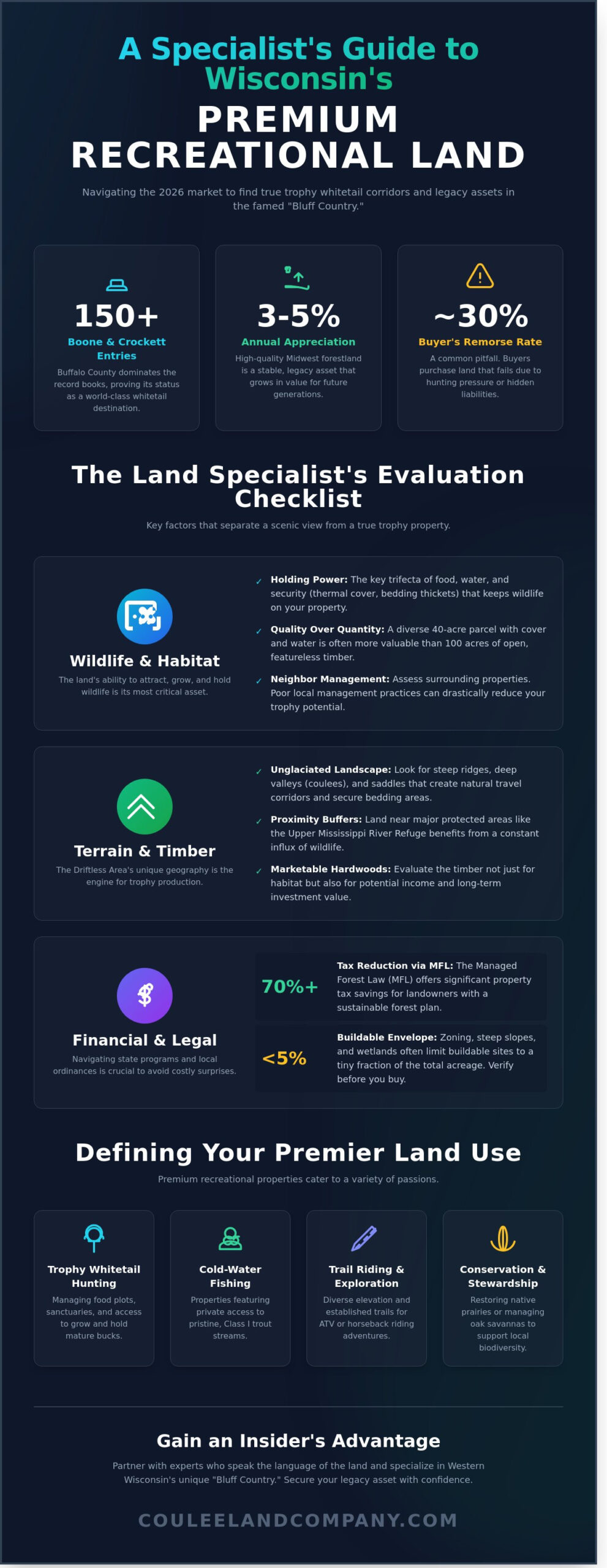
Buffalo County dominates the Boone and Crockett Record Book with more than 150 entries, proving that the right ridge in Western Wisconsin isn’t just land; it’s a legacy. You’ve likely spent years dreaming of a property where the neighbors respect the fence line and the age structure of the buck herd is actually managed. It’s a common frustration to realize that nearly 30% of buyers end up with land that looks good on paper but fails to produce due to poor local hunting pressure or complex tax liabilities. When you’re scouting recreational properties Wisconsin has to offer, you need an expert eye to spot the difference between a scenic view and a true trophy whitetail corridor.
We understand that owning a piece of the famed Bluff Country is about securing a tangible asset for your family and establishing a premier managed habitat. This guide provides the professional framework you need to identify high-value tracts, evaluate land worth across specific counties, and navigate the nuances of the 25 or 50 year Managed Forest Law contracts. You’ll learn exactly how to vet a property’s wildlife capabilities and secure the finest recreational land from the Mississippi River valley to the deep timber of the Northwoods.
Key Takeaways
- Understand why premium land in the Driftless Area is viewed as a legacy asset that offers enduring value and security in the 2026 market.
- Navigate the unique geography of Buffalo County to identify the premier recreational properties Wisconsin provides for world-class trophy whitetail hunting.
- Learn to use a land specialist’s checklist to evaluate complex terrain features like ridges, coulees, and marketable hardwood timber.
- Discover the strategic path to ownership, from defining your primary land-use goals to securing specialized rural financing.
- Gain an insider’s advantage by learning how to speak the language of the land alongside experts who specialize in Western Wisconsin’s “Bluff Country.”
What Defines Premium Recreational Properties in Wisconsin?
Owning recreational properties Wisconsin isn’t just about purchasing acreage; it’s about acquiring a specialized asset class that demands a hunter’s eye and a land manager’s precision. We define recreational land as property where the primary value stems from its natural features and wildlife capabilities rather than its agricultural yield or residential development potential. While a farmer looks at soil productivity ratings, a savvy land buyer looks at thermal cover, bedding thickets, and travel corridors. This distinction is vital because the highest and best use of a rugged ridge in Buffalo County is vastly different from a flat cornfield in the central plains.
The “Legacy Asset” mindset has taken a firm hold of the market as we move through 2026. Wisconsin land remains a premier investment because it’s a finite resource with a proven track record of stability. Historically, high-quality forestland in the Midwest has seen steady appreciation rates between 3% and 5% annually. Beyond the balance sheet, the emotional ROI provides the true motivation for most buyers. There’s a profound sense of pride in owning a piece of the Driftless Area, where the unique topography offers world-class hunting opportunities that you simply can’t find elsewhere. You’re not just buying dirt; you’re securing a heritage for your children and grandchildren.
Premium recreational use in our region typically falls into four categories:
- Trophy Whitetail Hunting: Properties designed with food plots, sanctuary zones, and strategic stand sites to grow and hold mature bucks.
- Cold-Water Fishing: Parcels featuring Class I trout streams that meander through valley floors.
- Trail Riding and Exploration: Land with established logging roads and diverse elevation changes for ATVs or horseback riding.
- Conservation and Stewardship: Acreage dedicated to restoring native prairies or managing oak savannas to support local biodiversity.
The Hunting Land vs. General Recreation Divide
Don’t be fooled by a low price tag. “Cheap” land often carries hidden costs that erode your long-term enjoyment and investment value. We’ve seen many buyers regret purchasing landlocked parcels or tracts with poor neighbor land-use patterns. If the surrounding owners aren’t practicing quality deer management, your ability to harvest trophy whitetails diminishes. A superior property must have “holding power,” which is the ability to provide security and food that keeps wildlife on your side of the fence. A 40-acre parcel with thick bedding cover and a year-round water source is often more valuable than 100 acres of open timber with no internal diversity.
Wisconsin’s Unique Land Designations
Understanding the financial logistics of recreational properties Wisconsin requires a deep dive into state-specific programs. The Managed Forest Law (MFL) is a critical tool for landowners, as it can reduce property tax burdens by 70% or more in exchange for following a sustainable forest management plan. However, you must also navigate local zoning ordinances. Just because a parcel is 80 acres doesn’t mean you can build a cabin anywhere you like. Steep slopes and wetland setbacks often limit buildable sites to less than 5% of the total acreage. We help buyers identify these specific “buildable envelopes” early in the process to ensure their vision for a lodge or basecamp is actually achievable under current county regulations.
The Geography of Success: Why Location is Everything
Western Wisconsin’s Bluff Country isn’t just a scenic backdrop for a weekend getaway. It’s a biological engine that produces some of the finest whitetail deer habitat on the planet. The Driftless Area escaped the last glacial period, leaving behind a rugged terrain of steep ridges and deep valleys that defines the recreational properties Wisconsin buyers covet most. This unglaciated landscape provides more than just beauty; it offers the thermal cover and security that mature bucks require to reach their full potential. The Mississippi River corridor acts as a massive travel artery, funneling diverse genetics and providing nutrient-rich forage that isn’t found in the sandy soils of the state’s central plains.
The 240,000-acre Upper Mississippi River National Wildlife and Fish Refuge creates a permanent buffer of wild land that spills into private holdings. This proximity to massive blocks of protected habitat ensures a steady influx of wildlife onto neighboring private parcels. When evaluating a tract, savvy buyers look for the transition zones where river bottom hardwoods meet agricultural plateaus. These edge habitats are the most productive areas for both hunting and wildlife viewing. Managing these steep woodlots requires a specific strategy, and many successful owners utilize resources for sustainable forest management to maximize timber value while enhancing bedding cover for trophy class animals.
Buffalo County: The Whitetail Capital
Buffalo County stands alone in the record books. It consistently leads the nation in Boone and Crockett whitetail entries, with over 1,350 total entries recorded as of 2025. The unique topography consists of high ridges and deep “coulees” that create natural sanctuaries where bucks can easily avoid human pressure. This verticality effectively doubles the huntable acreage of a property by creating distinct layers of habitat. If you want to understand the local market nuances, you should explore our Buffalo County community expertise to see why these parcels are considered the gold standard of land investment.
Regional Variations in Land Value
In 2026, land values in Western Wisconsin have reached new benchmarks. Prime recreational land in the Driftless now commands between $8,500 and $12,000 per acre, depending on the percentage of tillable soil. The Northwoods offers a different experience, characterized by vast pine forests and glacial lakes. While the Northwoods is excellent for bear hunting and water recreation, its land values often sit 35% lower than the Driftless due to lower trophy deer densities. The price gap is largely driven by the “Big Three” counties: Buffalo, Trempealeau, and La Crosse.
- Sleeper Counties: Richland and Vernon counties offer nearly identical topography to Buffalo but often at a 20% discount.
- The Twin Cities Influence: Properties within a 90-minute drive of Minneapolis or St. Paul, particularly in Pierce and St. Croix counties, see a 15% price premium due to high demand from commuters.
- Madison Proximity: Iowa and Sauk counties have seen a 10% surge in value over the last 18 months as Madison-based buyers seek weekend retreats.
The data shows that proximity to major metros drives price, but topography drives the quality of the hunt. If you’re looking for a long-term investment that pays dividends in both memories and appreciation, you can view our current land listings to find a property that fits your specific goals. Choosing the right county is the first step toward building a legacy on the land.
Evaluating a Property: The Land Specialist’s Checklist
Analyzing the topography of Western Wisconsin is the first step in a successful purchase. You’re looking for the classic ridge and valley system known as “Bluff Country.” Ridges provide primary bedding areas, while coulees act as thermal sinks and travel routes. A property with a 300 foot elevation change offers significantly more hunting diversity and wind-management options than flat ground. When we walk recreational properties Wisconsin buyers are considering, we look for these structural advantages first.
Timber value is a critical component of your investment. Marketable hardwoods like White Oak and Black Walnut are financial assets that grow over time. A single high quality veneer Walnut tree can fetch over $1,200 at current mill prices. However, you also need “dirty” cover. High stem density, roughly 1,500 to 2,000 stems per acre, provides the security that trophy bucks require to move during daylight hours. We look for a balance of 60 percent marketable timber and 40 percent thick bedding cover.
Water features dictate wildlife movement patterns year round. A spring-fed creek that remains open in 10 degree January weather keeps deer on your land when neighboring ponds freeze solid. River frontage, particularly along the Mississippi or Chippewa corridors, provides a natural barrier that funnels movement and offers additional recreational value for fishing and trapping.
Food plot potential depends entirely on soil quality and sunlight. We look for at least 5 percent tillable acreage to support a sustainable herd. In the Driftless Area, Fayette silt loam is the gold standard soil type. It holds moisture well and supports high-protein forage like alfalfa or brassicas. If the soil pH is below 6.0, you’ll need to factor in the cost of lime applications, which often run $35 to $50 per ton delivered.
Wildlife Capabilities & Habitat Health
A healthy deer herd leaves physical evidence. We look for 4 inch diameter rubs and active community scrapes that indicate mature buck presence. On a topographical map, we identify natural funnels where two ridges pinch down to a 30 yard gap. Thermal cover is the final piece of the puzzle. Stands of Norway Spruce or native Cedars are vital for winter survival when Wisconsin temperatures drop below zero for extended periods.
Infrastructure and Access
The “bones” of a property determine its daily usability. A well maintained 2 mile trail system saves you roughly $2,500 per mile in clearing and grading costs. We check for 200 amp electrical service at the road and ensure the soil can pass a perc test for a private septic system if you plan to build a cabin. Access should always be from the downwind side of your primary hunting spots. View our current hunting properties for sale to see how we prioritize these infrastructure standards in every listing. Choosing recreational properties Wisconsin with established access points ensures you don’t blow out the woods before you even reach your stand.
The Path to Ownership: Buying Wisconsin Land in 2026
Securing high-quality recreational properties Wisconsin offers requires more than a simple search; it demands a tactical execution plan. By 2026, the market for “Bluff Country” acreage has become increasingly competitive, making a structured approach essential for success. You aren’t just buying dirt; you’re investing in a legacy that requires careful navigation from the first map view to the final closing signature.
- Step 1: Define your primary goal. You must decide if you’re chasing 170-class trophy whitetails in Buffalo County or seeking a quiet family retreat near the Mississippi River. A property managed for maximum deer recruitment looks very different from one designed for trail riding and cabin sites.
- Step 2: Secure specialized financing. Traditional 30-year fixed mortgages rarely apply to raw land. You’ll likely need a land loan from a rural lender, which often requires a 20% to 30% down payment and specific terms for unimproved acreage.
- Step 3: Conduct a “boots-on-the-ground” site visit. Digital maps tell only half the story. You need to walk the ridge tops and valley floors with a specialist who understands thermal cover, bedding thickets, and how wind currents move through the coulees.
- Step 4: Navigate the offer and contingency process. Buying raw land involves specific safeguards. Your offer should include contingencies for soil perc tests for future septic systems, boundary surveys to resolve decades-old fence line disputes, and clear access easements.
- Step 5: Develop a long-term land management plan. Ownership is the beginning, not the end. Successful owners plan their habitat improvements five to ten years in advance to maximize both the sporting value and the resale potential of the investment.
Financing and Legal Considerations
Land loans differ significantly from residential financing because banks view raw land as a higher risk. Most rural lenders in Wisconsin look for strong credit and a clear plan for the property’s use. You’ll also need a fresh survey; 40-acre parcels often have boundary discrepancies that haven’t been addressed since the 1970s. Title insurance is non-negotiable to protect against ancient mineral rights or timber liens. Read these essential tips for recreational land buyers to understand the nuances of rural contracts.
The Role of Land Management
True stewardship turns a standard woods into a wildlife powerhouse. Timber Stand Improvement (TSI) involves removing low-value species to allow sunlight to reach the forest floor, which stimulates the growth of woody browse and bedding cover. Implementing a strategic food plot system ensures deer stay on your side of the fence during the late season. We recommend working with local DNR foresters or private wildlife biologists to enroll in programs like the Managed Forest Law (MFL), which can provide significant property tax relief while improving the health of your timber. These professionals help you balance ecological health with your specific hunting goals.
The right property is waiting in the bluffs, but it won’t stay on the market long. Connect with a Wisconsin land specialist to start your search with the “hunter’s realtor” today.
Why Coulee Land Company is Your Expert Guide
Finding the right recreational properties Wisconsin offers requires more than a standard real estate license. It demands an intimate understanding of topography, timber stands, and whitetail biology. At Coulee Land Company, we’ve earned the title of the “Hunter’s Realtor” because we don’t just walk the boundaries; we analyze the land’s soul. Our team views a property through the eyes of a land manager, identifying the subtle pinch points and hidden bedding areas that a traditional agent would overlook. We’ve spent decades in the woods, and that experience translates into a massive advantage for our clients.
Our roots run deep into the soil of Western Wisconsin and the rugged Driftless Area. This isn’t just a market to us; it’s our backyard. We understand that purchasing land is an investment in a legacy. Whether you’re looking for a 40-acre honey hole or a 500-acre managed estate, we focus on properties that will provide value for generations. Our deep local connections often grant our clients exclusive access to off-market and signature listings before they ever hit the public portals. We prioritize quality over quantity, ensuring every acre we represent meets our high standards for wildlife potential and long-term appreciation.
Meet Our Land Specialists
Our specialists are the undisputed authorities in Buffalo County and the surrounding “Bluff Country.” This region is world-renowned for its genetics, and we know exactly how to find the parcels that produce. We don’t guess; we use high-tech mapping software and local intel to evaluate every ridge and valley. You can connect with Mike Law or Bryan Lemke to start your search with experts who live the lifestyle every day. We provide a level of technical analysis that includes:
- Detailed soil productivity ratings for food plot planning.
- High-resolution thermal mapping to identify bedding thermal cover.
- Strategic access planning to ensure you can hunt any wind direction.
- Analysis of neighboring land use to protect your borders.
Selling Your Wisconsin Property
When you’re ready to move on to your next adventure, we make sure your land stands out in a crowded market. We don’t just list recreational properties Wisconsin; we tell their story. Our marketing strategy reaches a national audience of serious hunters and conservationists who value habitat quality. We use professional media, including drone cinematography and high-end photography, to showcase the “habitat storytelling” of your land. We highlight the years of management, the trophy history, and the hidden potential that justifies a premium price. If you want to maximize your return, you should sell your land with the specialists who understand its true worth. We’ve helped hundreds of sellers achieve record prices by targeting the right buyers with the right message. Our results speak for themselves, backed by a track record of successful closings in the state’s most competitive hunting counties.
Secure Your Legacy in the Heart of Bluff Country
Owning land in Western Wisconsin isn’t just a real estate transaction; it’s an investment in a lifestyle defined by the pursuit of trophy whitetails. You’ve learned that Buffalo County remains the undisputed leader in the Boone and Crockett Record Book, offering a unique topography that creates world-class hunting opportunities. Success in 2026 requires more than just a map. It demands a rigorous evaluation of wildlife capabilities and a deep understanding of land management principles that we’ve refined over 20 years in the field.
When you’re ready to search for recreational properties Wisconsin, you need a partner who speaks the language of the outdoors. Coulee Land Company is endorsed by outdoor television’s leading experts because we deliver results that go beyond the closing table. Our team specializes in the rugged bluffs of Western Wisconsin, ensuring you find a property with the superior habitat required for mature bucks. Don’t settle for a generalist when you can work with Wisconsin’s Land & Property Sales Specialists.
Browse Our Exclusive Wisconsin Recreational Listings
Your piece of the legendary Coulee Region is waiting for you to claim it.
Frequently Asked Questions
How much does recreational land cost per acre in Wisconsin in 2026?
Projections for 2026 indicate that recreational land in Wisconsin will average between $4,500 and $7,500 per acre depending on the specific region and habitat quality. Prime hunting ground in the Driftless Area often commands a 15% premium over state averages due to high demand for bluff country terrain. Buffalo County prices typically exceed $8,200 per acre because of its world-class reputation for producing giant bucks.
What is the best county in Wisconsin for hunting trophy whitetails?
Buffalo County remains the undisputed leader for trophy whitetails, holding the record for the most Boone and Crockett entries in the United States. This specific region of Western Wisconsin produces 30% more record-book bucks than neighboring counties like Trempealeau or La Crosse. The steep ridges and deep coulees provide the perfect thermal cover and security needed for bucks to reach maturity at 5 or 6 years old.
Can I build a house on land designated as recreational or Managed Forest Law (MFL)?
You can build a home on land designated as recreational, but land enrolled in the Managed Forest Law program has strict building restrictions. MFL rules generally prohibit any structure with a footprint exceeding 100 square feet unless you withdraw that specific acreage from the program. Withdrawing land requires a fee based on 5% of the assessed value, so you should consult with the Wisconsin DNR before you break ground.
What should I look for when buying land specifically for deer hunting?
When evaluating recreational properties Wisconsin offers, you must prioritize the three pillars of habitat: food, water, and security cover. Look for a property where at least 40% of the acreage consists of thick bedding cover like cedar swamps or brushy hillsides. Strategic access is also vital; you need at least two entry points to account for different wind directions to avoid spooking mature bucks during your hunt.
Is recreational land in Wisconsin a good long-term investment?
Wisconsin land is a resilient long-term investment that has seen an average annual appreciation rate of 6.2% over the last decade. Unlike volatile stocks, physical land provides a tangible asset that you can enjoy while its value grows. Market data from the Wisconsin Department of Revenue shows that rural land values in the Western Coulee region have outpaced inflation by 4% since 2018, making it a stable wealth-building tool.
How do I find out if a property has public access or is landlocked?
You can determine if a property is landlocked by reviewing the county plat map or the digital records at the local Register of Deeds office. A legal easement must be recorded on the deed for any property that does not share a border with a public road. Approximately 10% of rural parcels in Wisconsin lack deeded access, which can decrease the market value of the property by 30% or more.
What is the difference between a land specialist and a regular real estate agent?
A land specialist understands soil types, timber value, and wildlife biology, while a regular agent often focuses on residential square footage and school districts. Our team at Coulee Land Company evaluates the wildlife capabilities of a property using topographic maps and aerial imagery. We identify 160-class buck potential where a standard agent might only see a stand of trees. We speak the language of the hunter.
Do I need a special permit to hunt on my own private property in Wisconsin?
You still need a valid Wisconsin hunting license and the appropriate tags to hunt on your own private property. While you do not need a special permit to access your own land, you must follow all DNR season dates and bag limits. Wisconsin law requires every hunter to carry their Go Wild digital or paper license, even if they are sitting in a blind on their own 40-acre parcel.