
The 5.7 million acres of public access in the Badger State often carries the highest price tag in terms of missed opportunities and ruined opening days. When you’re weighing public land hunting vs buying private land wisconsin, you’re really deciding between the uncertainty of a crowded trailhead and the precision of a managed sanctuary. We understand the frustration of finding a stranger’s stand on the very ridge you spent 40 hours scouting during the summer. You want to manage the soil, plant the clover, and know exactly which mature whitetails are moving through your timber without worrying about outside pressure.
This 2026 guide delivers an authoritative comparison of these two paths to help you secure your hunting future. You’ll learn how private ownership in legendary regions like Buffalo County provides the control necessary to grow trophy bucks and build a lasting family legacy. We’ll examine the pragmatic realities of land management, the shifting dynamics of Wisconsin’s deer herds, and the steps required to move from a public land wanderer to a master of your own acreage in the heart of Bluff Country.
Key Takeaways
- Identify the strategic trade-offs of hunting Wisconsin’s public acres versus the management control required to consistently harvest 160-inch whitetails.
- Evaluate the financial benefits of public land hunting vs buying private land wisconsin, including how the Managed Forest Law can dramatically reduce your tax burden.
- Discover why 2026 is a pivotal year for recreational land values in the Bluff Country and how to secure a high-appreciating hard asset.
- Learn how to transition from a hunter to a land manager by creating year-round sanctuaries that hold mature bucks on your property through every season.
- Understand the critical importance of partnering with a specialized broker who hunts the land they sell to ensure your investment meets its true wildlife potential.
The Wisconsin Hunting Landscape: Public Access vs. Private Ownership
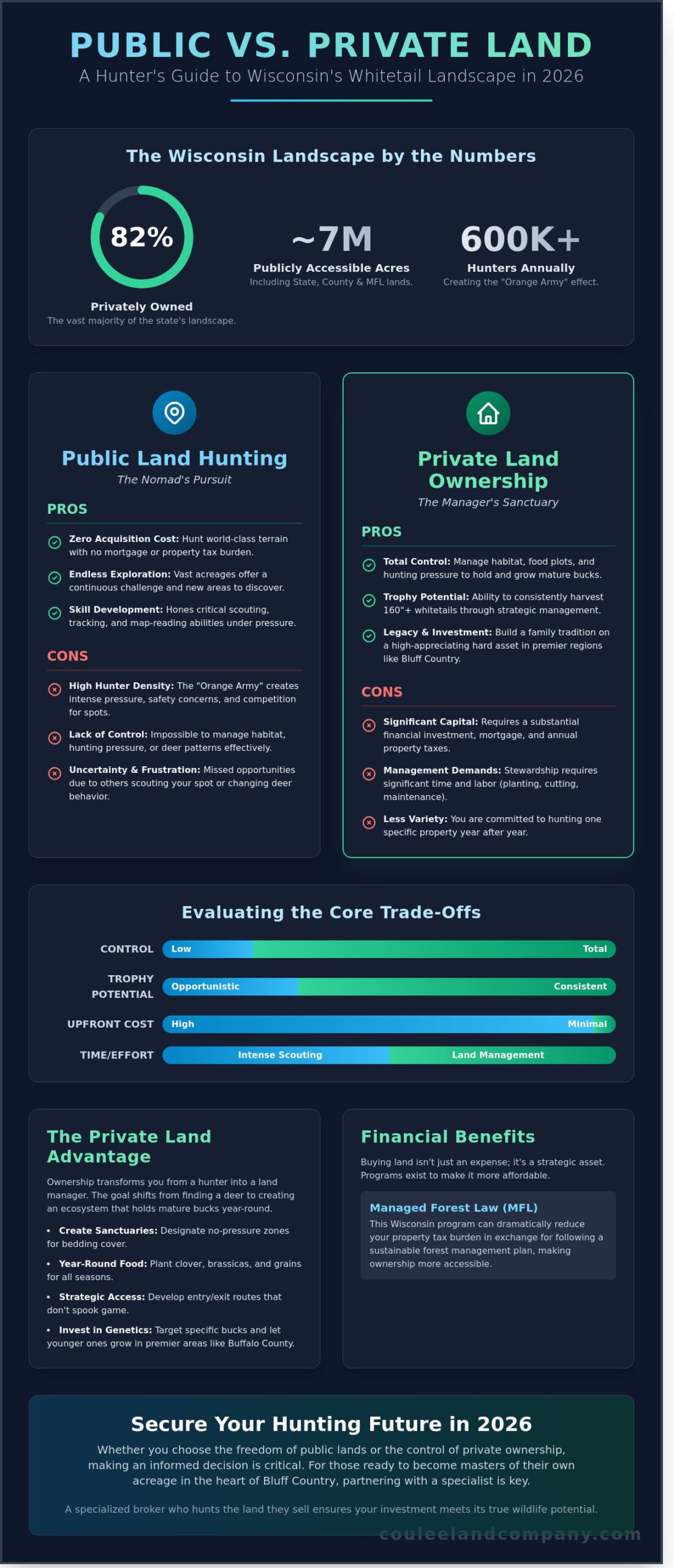
Wisconsin’s hunting identity is split between two distinct worlds. While the state boasts roughly 7 million acres of Public Land, a staggering 82% of the landscape is privately owned. This creates a fascinating dynamic for the 600,000 hunters who hit the woods each fall. Choosing between public land hunting vs buying private land wisconsin isn’t just about where you park your truck. It’s about how you value your time and your goals for the season.
The public land hunter in 2026 is a nomad. They thrive on the challenge of outworking the competition across vast acreages. Conversely, the land manager mindset focuses on stewardship and legacy. They aren’t just hunting; they’re engineering an ecosystem. This decision often boils down to a trade-off between time and money. Public land is accessible but demands weeks of scouting to find a mature buck. Private land ownership requires capital, yet it grants you total control over hunting pressure and habitat quality.
To better understand the trade-offs between these two approaches, watch this comparison:
Understanding Wisconsin’s Public Land Categories
Wisconsin’s public access is diverse. State Forests and Wildlife Areas form the DNR’s core holdings, providing high-quality habitat near major population centers. In the Northwoods, County Forests offer massive, contiguous tracts where you can truly disappear. Programs like the Voluntary Public Access (VPA-HIP) and Open Managed Forest Law (MFL) are equally vital. These are private lands where owners receive tax incentives to allow public hunting, effectively expanding the footprint for those willing to do the research.
The Rise of Private Land Management in the Coulee Region
Western Wisconsin, specifically the Coulee Region, has become the premier destination for private land investment. This area’s rugged topography creates natural funnels and thermal hubs that trophy whitetails love. We’ve seen a massive shift from simply “buying a woods” to building a dedicated whitetail sanctuary. Specialized hunting properties differ significantly from residential real estate. They’re appraised based on soil quality for food plots, bedding cover, and historical trail camera data. In places like Buffalo County, which leads the nation in record-book entries, owning land isn’t just a hobby; it’s a strategic investment in world-class genetics and a proven way to master public land hunting vs buying private land wisconsin dynamics.
Public Land Hunting in Wisconsin: Freedom or Frustration?
Wisconsin offers more than 6 million acres of accessible ground, providing a vital training ground for the next generation of hunters. It’s the place where many of us first learned to read topographical maps and identify heavy bedding thickets. When weighing the choice of public land hunting vs buying private land wisconsin, the most immediate draw is the low barrier to entry. You don’t need a massive down payment to step into the woods; you just need a valid tag and a sturdy pair of boots. This accessibility is essential for hunter recruitment and honing the scouting skills required to find success in pressured areas.
The reality of the “Orange Army” during the traditional November 9-day gun season often tests a hunter’s patience. High hunter density in popular Wildlife Areas creates a high-pressure environment where safety is a constant consideration. You’ll often find yourself in a first-come, first-served race to the trailhead, sometimes arriving at 4:00 AM only to find three other trucks already parked. This lack of control makes patterning mature bucks incredibly difficult. A 160-inch whitetail is a master of its environment, and its patterns change the moment a stranger walks through its bedding area at mid-morning.
Pros of the Public Pursuit
- Zero acquisition cost: You can hunt world-class terrain without the burden of property taxes or mortgage payments.
- Endless exploration: The vast acreage allows for a “mobile” hunting style. You can hunt the rugged Mississippi river bottoms one weekend and trek through northern cedar swamps the next.
- Diverse ecosystems: Detailed maps and regulations for these regions are readily available through Wisconsin Public Access Lands, which serves as a primary resource for planning your season.
Cons of the Public Pursuit
Public land hunting comes with strict legal limitations that prevent you from improving the habitat. You cannot plant food plots, perform Timber Stand Improvement (TSI), or install permanent water holes to hold deer on the property. You’re hunting the land exactly as it is, not as it could be under professional management. The physical toll is also significant. Without the ability to use ATVs or private trails, every harvest becomes a grueling “walk-in” recovery. Dragging a trophy buck two miles through a marsh is a task that quickly loses its charm as the years pass. If you’re ready to move beyond the crowds and start building your own legacy, looking into prime Wisconsin hunting properties can offer the control you’ve been missing.
Success on public ground requires a level of grit and adaptability that few other pursuits demand. While the freedom to roam is a hallmark of the Wisconsin experience, the frustration of uncontrollable variables often leads serious hunters to consider the long-term benefits of land ownership.
The Private Land Advantage: Management and Trophy Potential
Owning your own ground is the only definitive way to consistently grow and harvest 160+ inch whitetails. While public land offers vast space, it lacks the one thing trophy bucks require most: predictable security. When you control the gate, you control the pressure. Choosing between public land hunting vs buying private land wisconsin often comes down to your long-term goals for trophy quality. The power of a 365-day sanctuary is a total game changer. By designating 25% of your acreage as a human-free zone, you fundamentally change how deer use the landscape. They don’t just pass through; they live there. This is especially evident in the Buffalo County region. Here, private land owners have mastered the art of letting bucks reach the 5.5 and 6.5-year-old age classes required for record-book status. Beyond the hunt, it’s about the legacy. You aren’t just buying dirt; you’re securing a heritage for your family to hunt for generations.
Biology and Habitat Management
Real success starts with increasing the carrying capacity of your soil. Effective land management requires a year-round commitment to nutrition that goes beyond a simple clover patch. You need to balance high-protein food plots with high-quality natural browse. Research from the UW-Madison Extension Forestry highlights how diverse forest structures are essential for maintaining healthy wildlife populations. Implementing strategic timber harvests creates the thick bedding cover that holds mature bucks on your side of the fence. This proactive approach ensures your property provides everything a deer needs, making it the preferred destination in the neighborhood.
The ‘Bluff Country’ Edge
Western Wisconsin’s topography is a biological gift to the private landowner. The steep ridges and deep coulees allow a 40-acre tract to hunt like an 80-acre piece because of how the terrain segments the land. You can use thermal hubs and ridge tops to outmaneuver the wind, a luxury rarely found when competing with dozens of other hunters on public ground. This unique geography explains why record-book entries dominate areas with high private ownership. When you own the ridge, you own the movement. The comparison of public land hunting vs buying private land wisconsin is a choice between participating in the hunt and controlling the outcome.
Financial and Practical Realities: Is Buying Right for You?
The choice between public land hunting vs buying private land wisconsin often comes down to a balance sheet. While public land offers millions of acres for the price of a tag, private ownership is a strategic investment in a hard asset. Wisconsin recreational land has shown resilient growth; according to the USDA 2023 Land Values Summary, Wisconsin agricultural land values increased by 12.8% in a single year. This appreciation makes high-quality hunting ground a powerful hedge against inflation and stock market volatility. You aren’t just buying a place to sit in a tree; you’re securing a tangible piece of the Driftless Area that historically gains value while providing world-class recreation.
Wisconsin Property Taxes and the MFL Program
Property taxes can be a hurdle for land buyers, but Wisconsin’s Managed Forest Law (MFL) program changes the math. By enrolling your acreage, you can reduce your property tax bill by 80% or more in exchange for following a sustainable forestry plan. You must choose between “Open” and “Closed” status. Open MFL allows public access for hunting and fishing, which defeats the purpose of private ownership for most. Closed MFL allows you to restrict access entirely, though it carries a slightly higher per-acre fee than the Open status. MFL ‘Closed’ status is the gold standard for private trophy management. These 25-year or 50-year commitments ensure your timber stays healthy and your tax burden remains manageable while you grow older with the land.
ROI Beyond the Harvest
Owning land in the Bluff Country offers diverse revenue streams that public land can’t match. Timber harvests are a primary source of periodic income, especially on tracts with mature Red Oak or White Oak. Many owners also utilize agricultural leases, where local farmers pay for tillage rights or you receive payments through the Conservation Reserve Program (CRP). These payments often cover the annual carrying costs of the property. To find tracts with the best wildlife capabilities and financial upside, it’s essential to consult with Wisconsin land specialists who understand soil productivity and timber stand values.
Practical ownership involves costs that go beyond the mortgage. You’ll need to budget for equipment like ATVs or small tractors for food plot work. Liability insurance for hunting land is relatively inexpensive but necessary. Financing these dreams also differs from buying a home. Most land loans require a 20% to 35% down payment and may feature shorter amortization periods. When you evaluate public land hunting vs buying private land wisconsin, remember that the private route requires more upfront capital but builds long-term equity that a public land tag never will.
View our current Wisconsin land listings and start your ownership journey today.
Securing Your Future in the Bluff Country
The year 2026 marks a critical juncture for Wisconsin land values. As recreational demand continues to surge and inventory in premier regions like Buffalo County remains tight, the window to secure high-quality acreage is narrowing. Deciding between public land hunting vs buying private land wisconsin often comes down to a choice between temporary access and permanent legacy. While public ground offers vast space, it lacks the ability to influence the habitat or manage the age structure of the local deer herd.
Transitioning from a public land wanderer to a private land steward changes your entire perspective on the season. You stop reacting to the movements of other hunters and start dictating the movements of the wildlife. Owning the dirt beneath your boots provides a level of peace of mind that no public tract can match. It’s the security of knowing your favorite stand won’t be occupied and your food plots will be waiting exactly where you planted them. This shift from hunter to manager is where the true reward of land ownership begins.
Why Coulee Land Company?
We operate as Wisconsin’s Land & Property Sales Specialists because we live the lifestyle we sell. Our “Hunter’s Realtor” approach means we evaluate every tract through the lens of a sportsman. We don’t just look at property lines; we analyze soil quality for food plots, prevailing winds for stand placement, and thermal bedding cover to ensure your investment produces trophy whitetails. Our roots run deep in the Bluff Country, particularly in Buffalo County, which consistently dominates the Boone and Crockett Record Book.
Our team consists of experts who understand the unique wildlife capabilities of Western Wisconsin. Agents like Mike Law and Bryan Lemke bring decades of boots-on-the-ground experience to every transaction. They recognize the difference between a simple piece of woods and a high-performance hunting property that will hold mature bucks year-round.
Taking the Next Step
The path to ownership starts with a clear vision of your goals. Whether you’re looking for a rugged ridge-top or a secluded valley, you can begin your search by browsing our curated list of hunting properties. We recommend scheduling a professional land tour to understand a property’s true potential. Seeing the topography in person allows you to visualize pinch points and access routes that maps simply cannot capture. Successful land ownership begins with a broker who understands whitetail biology as well as they understand real estate law. Contact us today to start building your legacy in the heart of the Bluff Country.
Claim Your Stake in the Bluff Country
Choosing between public land hunting vs buying private land wisconsin is a decision that defines your future in the outdoors. While public tracts offer immediate access, they can’t match the strategic advantages of a managed private property where you control the habitat. Buffalo County currently holds the title for the most Boone and Crockett record entries in the United States, making it the premier destination for hunters seeking world-class whitetails.
Coulee Land Company specializes in these elite Buffalo County trophy properties, offering unmatched expertise in MFL programs and long-term land management. Our team is endorsed by recognized outdoor industry leaders because we’re hunters first and realtors second. We’ll help you navigate the complexities of land ownership to ensure your investment produces results season after season. It’s time to stop searching for the perfect spot and start building it on your own terms.
View Our Exclusive Wisconsin Hunting Land Listings
Your dream of owning a piece of the legendary Bluff Country is within reach, and we’re ready to help you secure your legacy today.
Frequently Asked Questions
Can I hunt on private land in Wisconsin without owning it?
Yes, you can hunt on private land by using the DNR’s Voluntary Public Access (VPA-HIP) program or by securing written permission from the owner. Currently, over 30,000 acres are enrolled in VPA-HIP across 40 counties. This offers a middle ground when weighing public land hunting vs buying private land wisconsin. It’s a great way to access prime cover without the upfront investment of a mortgage.
What is the Managed Forest Law (MFL) and how does it affect my taxes?
The Managed Forest Law is a tax incentive program that reduces property taxes by an average of 80 percent for landowners who practice sustainable forestry. You must enroll for either a 25 or 50 year period and follow a written management plan. This program is a cornerstone for those looking to maximize their land’s wildlife capabilities while keeping annual carrying costs manageable.
Is it better to buy land next to a Wisconsin State Forest?
Buying land bordering a Wisconsin State Forest is a strategic move that provides a permanent buffer and increases the effective size of your hunting grounds. If you own 40 acres next to the 5,000 acre Coulee Experimental State Forest, you benefit from the massive habitat block while maintaining your own private sanctuary. This positioning often leads to higher encounters with mature trophy whitetail bucks.
How much does an acre of hunting land cost in Buffalo County, WI?
Land prices in Buffalo County are among the highest in the state because the region consistently produces more Boone and Crockett record book entries than any other U.S. county. While prices fluctuate, 2024 market data shows that premium Bluff Country parcels command a significant premium over neighboring counties. Investing here means you’re buying into the most elite whitetail genetics in North America.
Do I need a special license to hunt on my own private land in Wisconsin?
You must possess a valid Wisconsin hunting license and the appropriate tags even when hunting on your own private property. The state retains ownership of all wildlife, so you’re required to follow all DNR season dates and bag limits. Whether you’re on the 9 day firearm hunt or late season archery, your Go Wild account must be current before you step into the stand.
What are the biggest risks of buying recreational land for hunting?
The biggest risks include purchasing landlocked parcels without legal easements or buying land with restrictive conservation easements that prevent habitat improvements. You should also check for high voltage power line easements or hidden environmental liabilities. We recommend a 100 percent thorough title search and a physical inspection to ensure the property meets your specific land management goals.
How does the Wisconsin DNR’s VPA-HIP program work for landowners?
The VPA-HIP program provides financial incentives to private landowners who open their property to public hunting, fishing, or trapping. Landowners receive annual payments funded by the USDA Farm Bill, typically ranging from $3 to $15 per acre depending on the habitat quality. It’s a flexible option for those weighing public land hunting vs buying private land wisconsin who want to offset ownership costs.
Can I build a cabin on land that is enrolled in the MFL program?
You aren’t allowed to build any permanent, habitable structures on land actively enrolled in the MFL program. To build a cabin, you must withdraw at least one acre from the program. This process involves paying a $300 withdrawal fee and potentially a withdrawal tax, which is calculated based on the years the land was enrolled and the tax savings received.