
Owning your own piece of Wisconsin’s famed hunting grounds is the ultimate dream for any serious outdoorsman. The vision of managing your own habitat for trophy whitetails is powerful, but that dream is anchored by a significant financial reality: the annual tax bill. For many landowners, understanding the complexities of property taxes on hunting land Wisconsin requires expert knowledge, and the fear of a surprise assessment can be a major source of stress. It’s the one variable that can complicate the true cost of ownership and create uncertainty around your investment.
As Wisconsin’s Land & Property Sales Specialists, we believe that a sound investment starts with absolute clarity. This guide is designed to provide just that. We will break down exactly how your hunting property is assessed and, most importantly, detail the powerful tax-saving programs available to you, like Managed Forest Law (MFL). You will gain a confident understanding of the pros and cons, empowering you to lower your annual costs without sacrificing the control and privacy of your land. By the end, you’ll have the knowledge to manage your tax burden effectively or evaluate a new property with the sharp eye of an informed buyer.
Key Takeaways
- Understand Wisconsin’s “Use-Value Assessment” system, the baseline for how your rural property is taxed based on its use, not its market price.
- Discover how state-run programs like the Managed Forest Law (MFL) can dramatically lower the property taxes on hunting land Wisconsin landowners pay each year.
- Weigh the critical trade-off between significant tax savings and maintaining exclusive hunting rights on your private sanctuary.
- Learn how to identify if a tax program aligns with your land management goals before you buy or enroll a property.
- Recognize why a land specialist is essential for navigating the complexities of these programs during a real estate transaction.
How Wisconsin Property Taxes Are Calculated for Hunting & Recreational Land
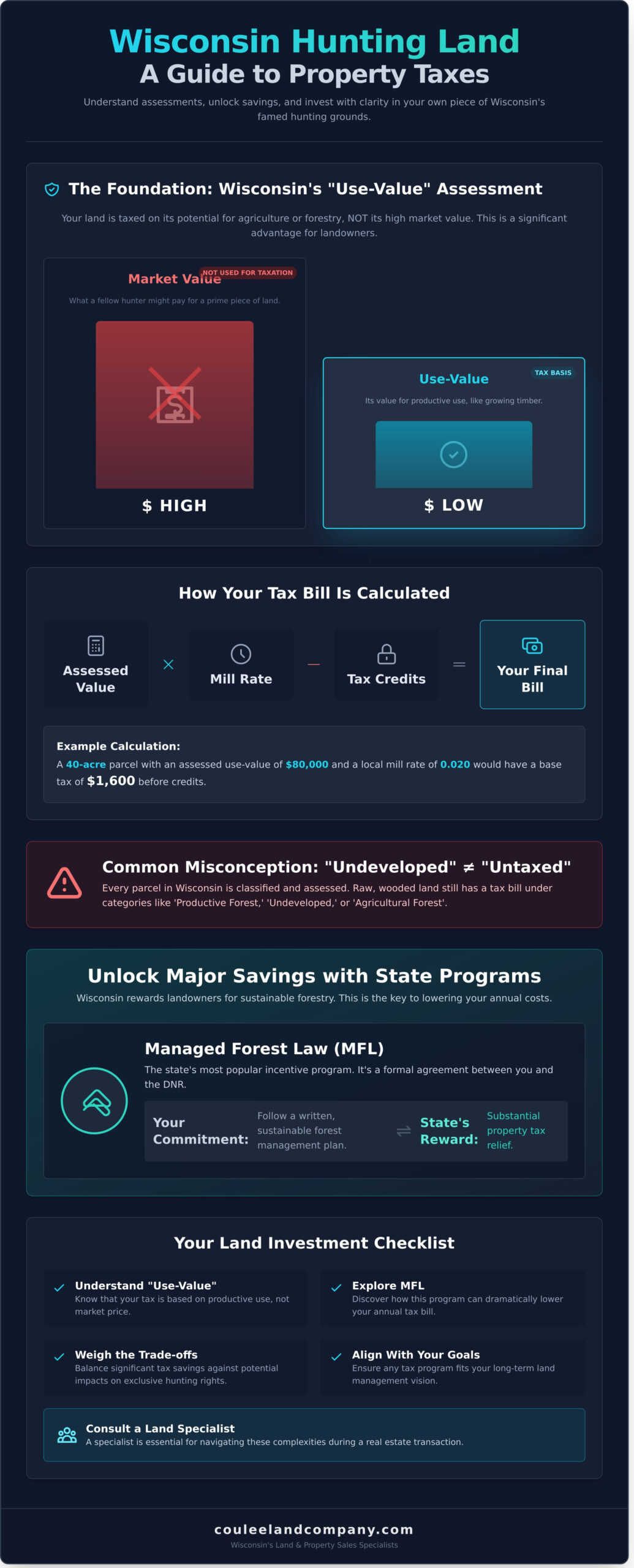
As Wisconsin’s Land & Property Sales Specialists, one of the first questions we address with clients is how property taxes on hunting land wisconsin are determined. The state operates on a ‘Use-Value Assessment’ system for most rural land. This is a significant advantage for landowners. Instead of taxing your property based on its high market value-what a fellow hunter might pay for a prime piece of Bluff Country-the state taxes it based on its potential for agricultural or forestry production. This method almost always results in a lower assessed value and a more favorable tax bill compared to residential properties.
For a deeper look into how Wisconsin’s system compares and functions, this overview provides excellent context:
This use-value system applies to most of the Wisconsin hunting properties we represent. However, the final amount you pay can vary significantly. Each county, township, and school district sets its own tax rate, known as a mill rate. This means two identical parcels in different locations, like Buffalo County versus a neighboring county, can have different tax liabilities.
Understanding Your Property Tax Bill
Your tax bill is a straightforward calculation based on three key components. This is a fundamental concept in the system of Property tax in the United States and is applied locally in Wisconsin.
- Assessed Value: The value assigned to your land based on its use (e.g., productive forest).
- Mill Rate: The tax rate per $1,000 of assessed value. If the total rate is 0.022, that’s $22 per $1,000.
- Tax Credits: State-funded credits, like the School Levy Tax Credit, that reduce your final bill.
Example: A 40-acre parcel with an assessed use-value of $80,000 and a local mill rate of 0.020 ($20 per $1,000) would have a base tax of $1,600 ($80,000 x 0.020) before any credits are applied. You can find official tax information for any specific parcel on its county’s Land Information or Treasurer’s website.
Why ‘Undeveloped’ Doesn’t Mean ‘Untaxed’
A common misconception among first-time land buyers is that a raw, wooded parcel has a negligible tax bill. This is incorrect. Every piece of land in Wisconsin is classified and assessed. Your property will fall into a category like ‘Productive Forest Land,’ ‘Undeveloped,’ or ‘Agricultural Forest,’ each carrying its own tax obligation. This baseline tax is precisely why savvy landowners explore state-sponsored programs to actively manage their land and significantly lower their annual tax burden, a topic we’ll cover next.
Wisconsin’s Key Tax-Saving Programs: MFL and FCL Explained
For savvy landowners, understanding how to lower the carrying costs of a property is just as important as knowing its trophy potential. Fortunately, Wisconsin offers powerful incentives to encourage sustainable forestry, which directly translates into significant savings on your tax bill. These programs are a cornerstone of managing the financial aspects of property taxes on hunting land wisconsin. The Wisconsin Department of Natural Resources (DNR) administers two primary programs designed for this purpose: the modern Managed Forest Law (MFL) and its predecessor, the Forest Crop Law (FCL).
The core principle behind both programs is a simple, powerful partnership: in exchange for a landowner’s commitment to sound forest management, the state provides substantial property tax relief. This not only makes land ownership more affordable but also enhances the timber value and wildlife habitat of your property for generations to come.
What is the Managed Forest Law (MFL)?
The Managed Forest Law is the state’s current and most popular forestry incentive program. Think of it as a formal agreement between you and the DNR to manage your forestland responsibly. To qualify, landowners must meet a few key requirements, including a written management plan that outlines a schedule for sustainable harvesting and forest health practices. These programs are governed by specific Wisconsin forest property tax laws that detail the significant financial incentives available. The commitment is substantial, as contracts are established for either 25 or 50 years.
- Minimum Acreage: At least 10 contiguous acres of forestland are required for enrollment.
- Management Plan: A DNR-approved plan is mandatory, guiding your land management activities.
- Long-Term Commitment: The 25 or 50-year contract length means this is a decision that will impact the property for decades.
What is the Forest Crop Law (FCL)?
The Forest Crop Law was the original forestry tax program in Wisconsin, established long before the MFL. While FCL is now closed to new enrollments, thousands of acres across the state are still operating under active FCL contracts. As a buyer, you may encounter properties subject to these older agreements. The principles are similar to MFL-promoting sustainable forestry for tax benefits-but the specific rules, tax rates, and public access requirements can differ. It is critical to understand the terms of an existing FCL contract before purchasing an enrolled property.
A Deep Dive into MFL: The Hunter Landowner’s Dilemma
For any serious hunter or land investor in Wisconsin, the Managed Forest Law (MFL) program is the single most powerful tool for managing land ownership costs. It presents a fundamental choice: accept significant reductions in your property taxes in exchange for a commitment to sustainable forestry. This is the heart of the hunter landowner’s dilemma, a critical decision that balances financial pragmatism with the deep-seated desire for privacy and exclusive use of your prime hunting grounds.
The number one question we hear from clients revolves around public access. The fear of losing exclusive hunting rights is a major hurdle for many landowners considering MFL. However, this concern is based on a misunderstanding of the program’s flexibility. The state of Wisconsin recognizes the value of private land stewardship and gives you, the landowner, a critical choice at the time of enrollment. You are in complete control of whether the public can access your land.
MFL-Open vs. MFL-Closed: The Critical Difference
Understanding this distinction is essential to leveraging the MFL program to your advantage. You can even designate some of your acreage as Open and some as Closed, creating a custom solution that perfectly fits your management goals and financial needs.
- MFL-Open: This option provides the absolute lowest property tax rate. In exchange, the enrolled land must be open to the public for recreational activities, including hunting, fishing, hiking, and cross-country skiing.
- MFL-Closed: For a slightly higher (but still significantly reduced) tax rate, you can keep up to 160 acres completely closed to public access. This allows you to gain tax relief while maintaining the total privacy and hunting exclusivity you desire.
Key MFL Requirements: What You’re Committing To
The tax savings from the MFL program are not a free pass; they are an incentive for proactive land management. The cornerstone of this agreement is the Forest Management Plan, a detailed blueprint created with a certified forester. According to the official Wisconsin’s Managed Forest Law (MFL) program guidelines, this plan outlines required practices such as timber harvests and invasive species control, many of which directly improve wildlife habitat and the long-term health of your property. It’s a long-term commitment, as the MFL contract is tied to the land for 25 or 50 years and transfers to the new owner upon sale. Finally, when you conduct a timber harvest as required by your plan, a 5% yield tax is paid on the revenue generated. This structure is key to lowering the annual carrying costs and overall property taxes on hunting land wisconsin.
Is Enrolling in a Tax Program Right for Your Hunting Property?
Choosing whether to enroll your property in a tax savings program like Managed Forest Law (MFL) is a critical decision that balances financial benefits against land-use control. There is no single right answer; the best path depends entirely on your personal goals for the property. Analyzing your priorities between maximum savings and maximum privacy is a key part of the process for our land buyers and a crucial step for any landowner.
Scenario 1: The Private Hunting Retreat
If your primary goal is creating a sanctuary with total privacy and complete control over wildlife management-from food plot placement to hunting pressure-then MFL requires careful consideration. MFL-Closed offers significant savings but mandates a DNR-approved management plan. You must weigh if those savings justify the long-term commitment and loss of some autonomy. For many, the standard Use-Value Assessment provides the ultimate freedom, despite the higher tax bill.
Scenario 2: The Timber & Hunting Investment
For landowners who view their property as a dual-purpose asset for both timber income and world-class hunting, the MFL program is a powerful tool. The required forest management plan directly aligns with the goal of generating revenue from timber harvests. In this case, the substantial reduction in property taxes on hunting land wisconsin can be used to offset other costs, such as planting, trail maintenance, or habitat improvements for trophy whitetails.
Impact on Property Value and Resale
An MFL designation is a double-edged sword at resale. The dramatically lower taxes are a major selling point that attracts savvy buyers. However, the long-term contract and its associated restrictions can be a deterrent for others. Generally, a property in MFL-Closed is more attractive to hunting buyers than one in MFL-Open due to the public access requirement. It is absolutely essential for a potential buyer to review the specific MFL contract, its expiration date, and its obligations before making an offer. Navigating these details is where an expert land specialist proves invaluable.
How to Navigate Tax Laws When Buying or Selling Wisconsin Land
Understanding the intricate details of Wisconsin’s land tax programs is not a footnote in a real estate transaction-it’s a critical factor that defines the long-term value and obligations of your investment. This is where a specialized land agent proves indispensable. A general residential realtor may see a tract of timber, but we see a complex asset with specific tax implications. The team at Coulee Land Company, including specialists like Bryan Lemke, lives and breathes these details. We are hunters, landowners, and land management experts who possess the deep, authentic knowledge required to guide you with confidence.
For Buyers: Analyzing a Property’s Tax Status
Due diligence is the foundation of a sound land purchase. When you work with us, we go beyond the surface to uncover the full story of a property’s tax status. Our expertise in navigating the complex world of property taxes on hunting land wisconsin ensures you have absolute clarity before you commit. We provide hands-on assistance by:
- Pulling official DNR records to verify a property’s precise Managed Forest Law (MFL) status, including whether it is enrolled as Open or Closed.
- Conducting a thorough review of the existing Forest Management Plan, so you understand your future obligations for timber harvests and land stewardship.
- Helping you calculate the true, long-term cost of ownership by factoring in MFL fees, potential yield taxes, and withdrawal penalties.
For Sellers: Marketing Your Enrolled Land
If your property is enrolled in a program like MFL, its lower tax rate is a powerful selling point-if marketed correctly. We know how to frame this benefit to attract savvy buyers who appreciate the financial advantages. Our team excels at clearly communicating the specifics of your management plan and contract terms, turning potential complexities into compelling features. We ensure that buyers see the value not just in the land itself, but in the thoughtful stewardship and tax savings you’ve established. Learn more about our superior approach to selling your unique property.
Mastering Your Wisconsin Land Investment: The Final Word on Taxes
Owning a piece of Wisconsin’s hallowed hunting ground is a significant investment, and managing it effectively is key to its long-term value. As we’ve explored, understanding the nuances of tax assessment and strategically evaluating programs like MFL are not just financial decisions-they shape your entire ownership experience. The right strategy balances significant tax savings with your personal vision for wildlife management, ensuring your property remains the legacy you envision. This knowledge is paramount when navigating the complexities of property taxes on hunting land wisconsin.
The complexities of land ownership don’t have to be a barrier to your dream. As Wisconsin’s trusted Land & Property Sales Specialists, our deep expertise in MFL, land management, and the unique character of the Bluff Country is your greatest asset. Trusted by hunters and land investors alike, we are the hunter’s realtor. When you’re ready to make your move, let our team guide you. Find your perfect Wisconsin hunting property with the experts at Coulee Land Company.
Frequently Asked Questions About Wisconsin Hunting Land Taxes
How much are property taxes on an acre of woods in Wisconsin?
The standard tax rate for an acre of woods varies dramatically across Wisconsin, often ranging from $20 to over $100 per acre depending on the county and assessed market value. Understanding the local mill rates is essential. For landowners focused on wildlife and timber, programs like Managed Forest Law (MFL) offer a superior alternative, significantly lowering the annual holding costs. These programs are a key strategy when evaluating property taxes on hunting land wisconsin.
What is the MFL tax rate per acre in Wisconsin for 2026?
The Wisconsin DNR sets Managed Forest Law rates in five-year periods. For the period covering 2023-2027, which includes 2026, the rates are fixed. Land enrolled as MFL-Open, which allows public access, is taxed at $2.59 per acre. Land designated as MFL-Closed, which remains private, is taxed at a rate of $10.38 per acre. These predictable rates provide a significant financial advantage for savvy landowners managing their property for the long term.
Can I post ‘No Trespassing’ signs on my MFL land?
You can absolutely post your land if it is enrolled in the MFL-Closed category. This designation is designed for landowners who want the tax benefits while maintaining exclusive access for their private hunting and recreational use. Conversely, if your acres are in the MFL-Open category, you are required to permit public access for hunting, fishing, and hiking. Choosing the correct designation is a critical decision that aligns with your specific goals for the property.
What happens if I want to withdraw from the MFL program early?
Withdrawing from an MFL contract before its 25 or 50-year term expires incurs significant financial penalties. The landowner is responsible for paying a withdrawal tax, which is calculated based on the property’s value, plus a $300 administrative fee. This is designed to ensure landowners are committed to the long-term forest management goals of the program. It is a serious commitment that should be carefully considered before enrolling your prime hunting property.
Does building a cabin or home affect my MFL enrollment?
Yes, constructing a building has a major impact. Land with buildings is not eligible for MFL, so you must withdraw the acreage where the structure is located from the program. This action will trigger a withdrawal tax and fees for that specific portion of the land. We advise clients to carefully plan any construction and consult with a DNR forester to ensure they remain in compliance and understand the full financial implications for their property.
How do I find out if a property is enrolled in MFL or FCL?
The most reliable method is to use the Wisconsin DNR’s online tools. Their “Private Forest Lands Open for Public Recreation” web mapping application allows you to search for and view parcels currently enrolled in MFL-Open and the older Forest Crop Law (FCL) program. For properties in MFL-Closed, which are not public, a formal inquiry with the county tax lister or the seller’s agent is the best way to confirm enrollment status.
Can I enroll land in MFL if it’s not in a designated forest area?
Eligibility for the MFL program depends on the land’s characteristics, not its location in a “designated” forest. To qualify, you must own a minimum of 20 contiguous acres, and at least 80% of that acreage must be productive forest capable of growing commercial timber. This makes the program accessible to landowners across Wisconsin, from the Northwoods to the famed Bluff Country, as long as their property meets these crucial forestry standards.