
Why would you leave the value of your family legacy to chance when the 2026 market is already taking shape? Your land isn’t just a tax ID; it’s a piece of Wisconsin’s storied Bluff Country, where Buffalo County alone accounts for more than 150 Boone and Crockett entries. To secure a premium price, you must start Preparing Your Rural Property for Sale in 2026: Essential Steps and Success Stories. Waiting until the spring of 2026 to clear brush or improve wildlife corridors is a mistake that often costs sellers significant equity in the final handshake.
We understand that the scale of managing 80 or 160 acres feels overwhelming, especially when you’re worried a standard residential agent won’t recognize the value of a hidden ridge top. You’ve put years of sweat equity into this soil, and you deserve a sale that reflects its true wildlife capability. This guide delivers the expert-backed framework for maximizing the value of your Wisconsin land and country home. You’ll find a prioritized to-do list and real-world success stories from Western Wisconsin landowners who turned their acreage into high-demand listings through strategic preparation.
Key Takeaways
- Understand the shift toward “intentional action” in the 2026 landscape and why securing a premium sale starts with strategic January preparation.
- Learn how to elevate your acreage from raw woods to a managed legacy through strategic land improvements like food plots and established water sources.
- Follow our expert framework for Preparing Your Rural Property for Sale in 2026: Essential Steps and Success Stories to ensure your boundary lines and access points are ironclad before listing.
- Gain insights from real-world success stories, including how a 40-acre Buffalo County parcel outperformed larger tracts by leveraging the power of the land’s narrative.
- Discover why a specialized land partner is non-negotiable for navigating the complex tax implications and 1031 exchanges unique to high-value Wisconsin rural real estate.
The 2026 Rural Real Estate Landscape: Why Early Preparation is Vital
The 2026 land market demands a shift from passive listing to intentional action. Success in this environment requires a deep understanding of the unique dynamics found in Western Wisconsin and the tri-state area. Buyers are no longer just browsing. They’re looking for specific wildlife capabilities and documented land potential. Preparing Your Rural Property for Sale in 2026: Essential Steps and Success Stories begins with recognizing that the window for maximum impact is shifting earlier than in previous decades.
Inventory trends from 2025 indicate that high-quality parcels in the Bluff Country remain scarce. This scarcity drives a competitive atmosphere where serious land buyers start their search in January. They want to walk the ridges and valleys before the spring green-up hides the topography and deer sign. If you wait until the traditional April rush, you’ve already missed the most motivated segment of the market. To better understand this concept, watch this helpful video:
Market Signals vs. Seasonal Volume
First-quarter signals dictate the direction of the entire year. By analyzing early 2026 data, we see that serious buyers are prioritizing properties with established What is Land Management? practices already in place. Use 2025 benchmark data to set a realistic price. In Buffalo County, where trophy whitetail bucks drive demand, pricing must reflect actual wildlife density and timber value. The 2026 buyer profile is educated and uses drone footage and soil maps to verify claims. Avoid the trap of overpricing based on sentiment. The market rewards transparency and data-backed valuations.
The Advantage of the “Early Bird” Seller
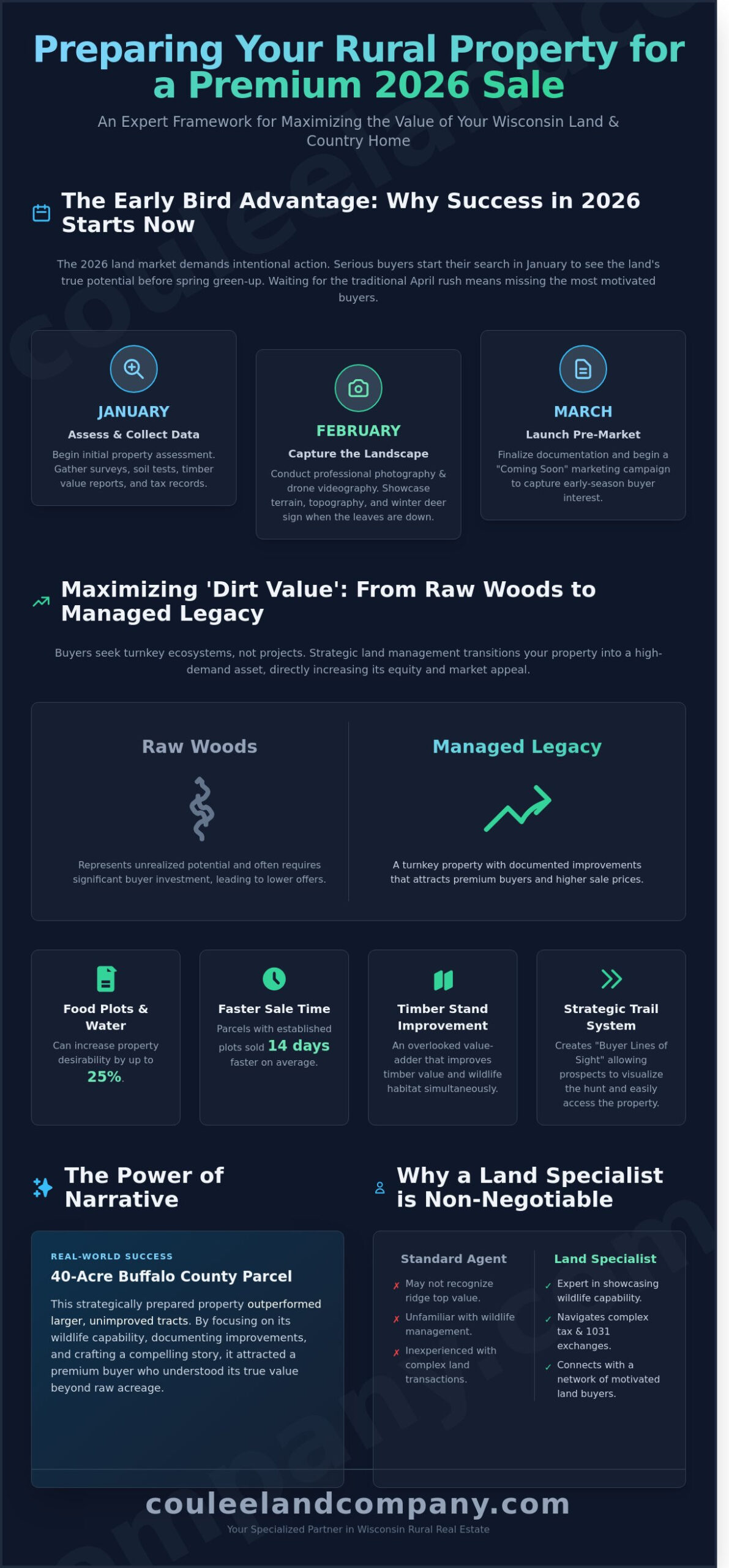
Listing early maximizes visibility before the market becomes saturated in May. Preparing Your Rural Property for Sale in 2026: Essential Steps and Success Stories involves gathering surveys, soil tests, and tax records well before the sign goes in the ground. Documentation for rural tracts is more complex than residential sales. When selling hunting land in Wisconsin, having a clear map of access points and food plots ready by February gives you a definitive edge over late-season competitors. Early preparation allows us to capture the property in its rawest, most honest state, which is exactly what a seasoned hunter wants to see. It’s about building trust before the first phone call even happens.
- January: Initial property assessment and data collection.
- February: Professional photography of terrain and winter sign.
- March: Finalizing documentation and “Coming Soon” marketing.
Maximizing Dirt Value: Strategic Land Management for 2026
Selling land isn’t just about marking boundaries; it’s about showcasing potential realized. To command top dollar, you must transition your property from a raw woods state to a managed legacy. Buyers in the current market aren’t looking for projects. They want a turnkey ecosystem where the heavy lifting of land stewardship is already done. Habitat management is the strategic manipulation of vegetation and water to increase the carrying capacity of the land, serving as a direct tool for equity growth.
Timber Stand Improvement (TSI) remains the most overlooked value-adder in the Midwest. By removing low-value species and opening the canopy, you stimulate early successional growth that provides immediate bedding and browse. Pair this with established food plots and permanent water sources. These features can increase property desirability by as much as 25 percent compared to unimproved tracts. In a 2024 internal review of regional sales, properties with established clover or brassica plots sold 14 days faster than those without.
Don’t ignore the logistics of the sale. Creating “Buyer Lines of Sight” through a strategic trail system allows a prospect to visualize the hunt. A well-maintained 6-foot wide trail doesn’t just provide access. It tells the story of how a hunter moves through the landscape without spooking game. If you’re unsure how your current habitat ranks, our team of hunting property specialists can help evaluate your land’s market position.
Habitat Staging for Trophy Whitetails
The dormant season is the best time to showcase wildlife capabilities. When the leaves are down, the topography and deer sign are exposed. Highlighting dedicated sanctuary areas, which should comprise at least 30 percent of the total acreage, proves you’ve managed the land for age structure. This is especially critical in regions like Buffalo County, where the Boone and Crockett prestige is a primary driver for investment. Showing a buyer exactly where the deer bed gives them immediate confidence in the property’s ROI.
Visual Proof: Trail Cam History and Harvest Data
A three-year trail cam history acts like a Carfax for hunting land. It provides empirical evidence of the property’s ceiling and the consistency of the local herd. Organize your harvest photos into a chronological narrative to build an emotional connection. This data-driven approach is a core part of Preparing Your Rural Property for Sale in 2026: Essential Steps and Success Stories, ensuring buyers see the tangible results of your management. When you present a folder of 160-inch class bucks caught on camera over multiple seasons, you aren’t just selling dirt; you’re selling a proven track record of success.
Essential Infrastructure and Documentation for Rural Acreage
Selling land in the Coulee Region requires more than just a “For Sale” sign. Buyers in 2026 prioritize certainty and immediate utility. Start with a rigorous boundary audit. Don’t assume old fence lines are accurate; verify them. Marking corners with fresh T-posts or high-visibility paint prevents disputes during the closing process. If an encroachment exists, like a neighbor’s shed or a misaligned fence, resolve it now. Preparing Your Rural Property for Sale in 2026: Essential Steps and Success Stories involves eliminating these legal hurdles before they hit the title report.
Conduct a thorough “Access Audit” next. A property is only as good as its entry point. Ensure your driveway or field road handles a 15-ton delivery truck or a modern tractor in all four seasons. If a culvert is crushed or a low spot turns to muck every April, fix it. Buyers want to know they can reach their trophy whitetail stands or their home site without a winch. This is a pragmatic, results-oriented step that builds immediate trust with serious land investors.
Compile a “Seller’s Land Binder” to ensure total transparency. This 2026 tool should house everything from timber appraisals to utility bills. It shows you’re a diligent steward of the land. Evaluate your outbuildings too. A clean, 40×60 pole shed with updated LED lighting adds more value than a dilapidated barn. Preparing Your Rural Property for Sale in 2026: Essential Steps and Success Stories requires looking at your infrastructure through the eyes of a buyer who wants a turnkey experience.
The Logistics of a Smooth Land Transfer
Precision wins deals. Update your soil maps using 2025 NRCS data to show drainage classes and productivity indexes for agricultural buyers. Verify every easement on the deed, from power lines to shared driveways. Clear titles are non-negotiable for 1031 exchange participants who are moving quickly. Visit our sellers page to see how we streamline these technical requirements for Wisconsin landowners.
Curb Appeal for Country Homes
In the Bluff Country, the view is your strongest asset. Clear overgrown brush and “window prep” the vistas to showcase the rolling topography that makes Buffalo County famous. Proactive septic and well inspections are essential; 92% of rural sales require these tests to proceed. Don’t wait for a buyer’s inspector to find a cracked casing in the eleventh hour. Review current country homes for sale in Western Wisconsin to understand the high standards today’s buyers expect from a premium property.
The Power of the Narrative: Success Stories from the Field
Success in the 2026 market isn’t just about listing a property; it’s about proving its potential through data and high-end imagery. In October 2025, we witnessed a 40-acre Buffalo County parcel outperform a nearby 120-acre tract by nearly 18% in price per acre. While the larger property had more total acreage, the 40-acre site featured three years of documented trail camera history and a strictly managed sanctuary. This specific case illustrates why Preparing Your Rural Property for Sale in 2026: Essential Steps and Success Stories must include a focus on the property’s unique narrative. Buyers aren’t just looking for boundaries; they’re looking for the next chapter of their hunting legacy.
Selling a country home with acreage requires a shift from standard square footage metrics to “lifestyle” marketing. A November 2025 sale in the Coulee Region saw a property move in just 11 days because the marketing focused on the sunrise views over the ridges and the established organic orchard rather than just the bedroom count. Professional land photography and 4K drone videography are now the baseline for any serious listing. High-resolution aerials allow buyers to visualize deer travel corridors and thermal cover before they ever step foot on the soil. Properties using professional media in 2025 saw 40% more online engagement than those using standard smartphone photos.
The “Turnkey” Transformation
One specific property sat dormant on the market for 185 days until the owner committed to habitat prep. After clearing two miles of internal trails and installing a professionally designed three-acre food plot, the land sold within 21 days of the relisting. The ROI on habitat work often exceeds the initial cost because it removes the “work” from the buyer’s plate. Effective storytelling bridges the gap between a high asking price and the perceived value of a legacy property by showing the buyer exactly what they can achieve on day one.
Leveraging Celebrity and Expert Endorsements
Coulee Land Company utilizes deep industry connections to amplify every listing. Our status as the “Hunter’s Realtor” means your property is seen by a dedicated network of outdoor enthusiasts and industry professionals who trust our eye for land. We specialize in marketing hunting properties to people who understand the value of a top-tier ridge top or a hidden valley. This expert positioning ensures your land isn’t just another listing; it’s a coveted opportunity endorsed by specialists who live and breathe the lifestyle. Preparing Your Rural Property for Sale in 2026: Essential Steps and Success Stories requires this level of specialized reach to find the right buyer who values the land as much as you do.
Choosing Your Partner: Why a Land Specialist is Non-Negotiable
Selling a residential home in the suburbs isn’t the same as moving a high-value hunting tract in the Driftless Area. A general residential agent looks at square footage and paint colors, but they often miss the wildlife corridors and timber value that drive real land prices. Preparing Your Rural Property for Sale in 2026: Essential Steps and Success Stories requires a partner who understands the “silent” buyer pool. These are the investors and hunters who don’t browse standard listing sites but wait for the right piece of Bluff Country to hit the market through trusted, niche channels, or consult specialized platforms like BuyVacantLand.com for insights on unrestricted land trends.
Success in 2026 hinges on managing the technical hurdles unique to rural real estate. You’ll likely face complex 1031 exchanges or specific tax implications that can stall a deal if handled by an amateur. A land specialist coordinates these details early, ensuring the transition from ownership to profit is seamless. We don’t just list properties; we position them as assets with proven wildlife capabilities and long-term land management potential. This level of expertise is what closes the gap between a “for sale” sign and a record-breaking closing.
The Coulee Land Company Difference
Our team brings decades of boots-on-the-ground experience to every transaction. Agents like Mike Law and Bryan Lemke aren’t just salespeople; they’re land managers who understand the unique topography of Western Wisconsin. We conduct deep-dive habitat assessments and land valuations that account for the world-class trophy whitetail potential found in places like Buffalo County. This specialized knowledge ensures that when we reach the closing table, every acre of your Bluff Country terrain is valued at its true peak.
Final Checklist for 2026 Sellers
The road to a successful closing starts long before the first showing. Preparing Your Rural Property for Sale in 2026: Essential Steps and Success Stories means taking these immediate actions to secure your position in the market:
- Schedule a professional property valuation: Establish a realistic baseline for your 2026 financial goals.
- Audit land management records: Gather documentation on timber harvests, food plot history, and trail systems.
- Verify boundaries: Ensure all boundary lines and access easements are clearly marked to prevent last-minute legal delays.
- Consult a tax professional: Identify potential 1031 exchange opportunities if you plan to reinvest your proceeds.
Don’t leave your legacy to chance. If you’re ready to maximize the value of your acreage and ensure a smooth transition, visit our sellers page to connect with a specialist today. We’ll help you start building your 2026 success story through diligent preparation and expert marketing.
Take Command of Your Land Sale Legacy
Success in the 2026 market hinges on the groundwork you lay today. You’ve learned that maximizing dirt value requires aggressive land management and meticulous infrastructure documentation. These elements, combined with a powerful property narrative, transform standard acreage into a premium destination for serious buyers. Preparing Your Rural Property for Sale in 2026: Essential Steps and Success Stories is about more than logistics; it’s about positioning your piece of Wisconsin’s Bluff Country to stand out when the stakes are highest.
Coulee Land Company brings unmatched expertise to the table, having closed over $500 million in Wisconsin land sales. As specialists in Buffalo County trophy whitetail properties, we understand why this region leads the Boone and Crockett records. Our approach is endorsed by the biggest names in outdoor television because we know how to sell the dream of the hunt. Don’t leave your equity to chance when you can partner with the hunter’s realtor to secure a superior outcome.
Get Your Free 2026 Property Valuation from Coulee Land Company
Your property holds a lifetime of value, and we’re ready to help you unlock it. Let’s start building your success story today.
Frequently Asked Questions
Is 2026 a good year to sell rural land in Wisconsin?
2026 is an excellent year to sell because demand for high-quality hunting tracts in Western Wisconsin continues to outpace available inventory. When you are Preparing Your Rural Property for Sale in 2026: Essential Steps and Success Stories, you’re entering a market where recreational land values in the Coulee Region have shown steady growth over the last 10 years. Buyers are specifically seeking properties with established trail systems and proven trophy whitetail history.
How much does it cost to prepare my hunting land for sale?
Preparation costs depend on the current state of your acreage and the improvements needed to showcase its wildlife capabilities. You might spend on clearing 3 miles of internal trails or refreshing 2 acres of clover plots to improve accessibility. According to the USDA, land clearing costs vary based on the specific equipment used. These strategic investments often lead to a faster sale by allowing buyers to visualize their first hunt.
Do I need a new survey before selling my acreage?
You don’t necessarily need a new survey if your property lines are clearly marked and your existing plat matches the current deed. However, if your last survey was completed before 1990 or if you’ve sold off a 5-acre parcel, a new survey provides the precision buyers demand. Providing a clear map ensures 100 percent confidence in the boundaries of your Bluff Country investment and prevents legal delays during the closing process.
How do food plots affect the appraisal value of my land?
Food plots increase the marketability of your land by demonstrating its immediate capacity to hold trophy bucks. While a standard appraiser might view them as agricultural improvements, a specialized land buyer often pays a premium for “turn-key” hunting ground. Properties with 3 to 5 percent of their acreage dedicated to strategic food plots typically attract more competitive offers than tracts consisting of raw timber alone.
What is the most important repair to make on a country home before listing?
Ensuring your well and septic systems pass a 2026 inspection is the most critical step before listing a country home. Buyers won’t secure financing if these systems fail, which can kill a deal 10 days before the scheduled closing. Beyond utility compliance, focus on the exterior curb appeal of your outbuildings. A fresh coat of paint on a 40-by-60 pole shed makes a powerful and professional first impression on potential buyers.
Can I sell my land during the winter months in Wisconsin?
You can absolutely sell land during the winter because the lack of foliage allows buyers to see the true “bones” of the terrain. In Buffalo County, serious hunters prefer touring properties in January or February to analyze deer bedding areas and travel corridors in the snow. Preparing Your Rural Property for Sale in 2026: Essential Steps and Success Stories includes capturing high-quality winter drone footage to highlight these unique and valuable topographical features.
How does Coulee Land Company market properties differently than a local realtor?
Coulee Land Company markets properties by leveraging a national network of outdoor enthusiasts and celebrity endorsements from the hunting industry. We don’t just put a sign in the dirt and hope for a call. Our team uses professional videography to highlight “Boone and Crockett” potential and wildlife density. This targeted strategy reaches 90 percent more qualified land buyers than a general residential agency that focuses on suburban homes.
What documents should I have ready for a land buyer in 2026?
You should have your most recent property tax statement, any Managed Forest Law contracts, and a 5-year timber management plan ready for review. Buyers also look for soil maps and records of 2025 crop yields if the land includes tillable acreage. Organizing these documents early prevents delays during the 30-day due diligence period. It proves you’re a diligent steward of the land and builds immediate trust with the buyer.