
Most anglers see the Mississippi River as a chaotic maze of current and barge traffic, but for the seasoned veteran, Pool 4 is the undisputed heavyweight champion of the Midwest. Every March, the 44-mile stretch from Lock and Dam 3 down to Alma becomes the epicenter of Pool 4 walleye fishing, where landing a 10-pound trophy isn’t just a dream; it’s a documented reality for those who know where to look. You’ve likely felt the frustration of jockeying for position among 300 boats at the dam or second-guessing your boat’s position on a treacherous wing dam that could claim your lower unit.
We’re going to help you cut through the noise and master the specific tactics needed to navigate these waters with confidence. You’ll learn how to decode the complex border regulations between Wisconsin and Minnesota and identify the precise timing of seasonal migrations. This guide provides the current-seam strategies and backwater secrets you need to find solitude and success in the heart of our legendary Bluff Country.
Key Takeaways
- Understand the unique “no-close” season on this 44-mile stretch of the Mississippi River that makes it a premier year-round destination for serious anglers.
- Identify high-percentage structures like wing dams and riprap shorelines to consistently locate trophy walleye throughout the changing river conditions.
- Master the specific seasonal tactics for Pool 4 walleye fishing, including vertical jigging the spring run and transitioning to deep-water patterns in the summer heat.
- Navigate reciprocal licensing and crowd management strategies to ensure a productive and hassle-free experience on these legendary border waters.
- Learn how securing a permanent base camp in Bluff Country provides both a superior lifestyle and a rare investment opportunity in scarce riverfront property.
What Makes Pool 4 Walleye Fishing a World-Class Experience?
Pool 4 walleye fishing represents the pinnacle of river angling in the Upper Midwest. This legendary 44-mile stretch of the Mississippi River begins at Lock and Dam 3 near Red Wing, Minnesota, and winds down to Lock and Dam 4 in Alma, Wisconsin. It’s a region where the water’s power meets the rugged majesty of the Bluff Country. For the team at Coulee Land Company, this isn’t just a map coordinate; it’s our backyard. We understand that the draw of these waters is as much about the scenery as it is about the strike. The massive limestone cliffs provide a vertical scale to the landscape that makes every drift feel like an expedition into a prehistoric wilderness.
One primary factor sets this fishery apart from almost any other in the region. Because it serves as border water between Minnesota and Wisconsin, Pool 4 benefits from a continuous, “no-close” fishing season for walleye and sauger. When inland lakes are locked in ice or closed for the spring spawn, the tailwaters of Red Wing remain open. This creates a unique opportunity for anglers to target trophy fish during the late winter and early spring windows. It’s a pragmatic advantage that turns this stretch into a year-round destination for those who aren’t afraid of a little river ice or a brisk March morning.
The experience is defined by several key characteristics:
- Unrivaled Access: Multiple well-maintained launches in Red Wing, Bay City, and Alma ensure you’re never far from the action.
- Consistent Flow: The river’s current keeps the water oxygenated and the fish active even in extreme weather.
- The Scenery: Fishing under the shadows of 400-foot bluffs offers a perspective you won’t find on a flat prairie lake.
- Diverse Habitat: From the churning tailwaters to the expansive depths of Lake Pepin, the river provides a variety of technical challenges.
The Geography of a Trophy Fishery
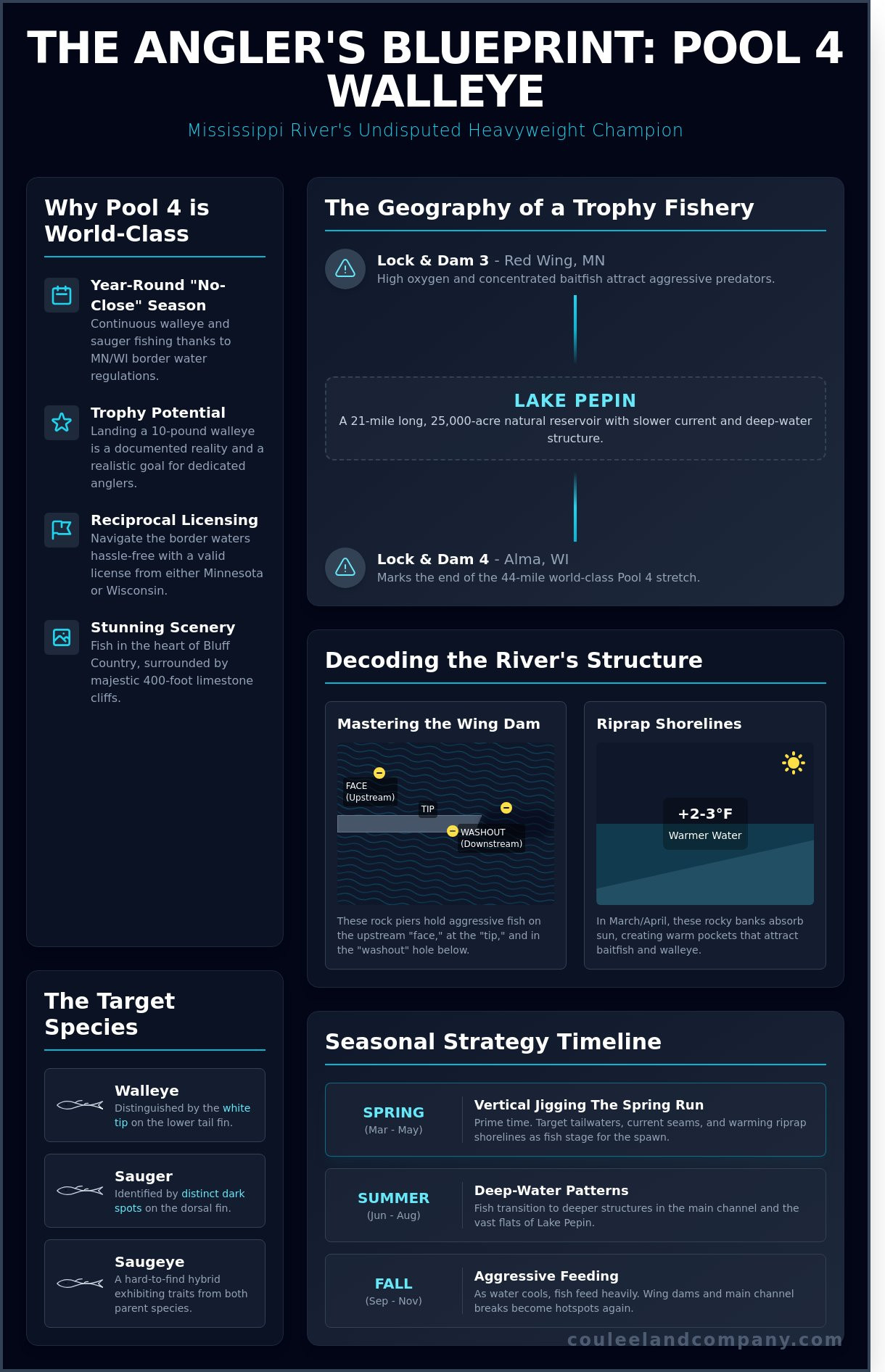
Understanding the physical layout of Pool 4 is the first step toward a successful trip. The river isn’t a uniform pipe; it’s a complex system of side channels, backwaters, and main channel borders. The dams at the “head” of the pool act as biological magnets. They concentrate baitfish like gizzard shad and emerald shiners, which in turn draws in the predators. Oxygen levels are highest here, creating a high-energy environment where fish are often more aggressive. Mid-pool, the river expands into Lake Pepin. This 21-mile natural widening slows the current significantly, acting as a massive reservoir that holds enormous schools of fish. It’s a 25,000-acre playground where deep-water structure and current breaks create perfect holding patterns for giant walleyes.
Target Species: More Than Just Walleye
Anglers here pursue what we call the “Three-Headed Monster.” While Pool 4 walleye fishing is the main attraction, you’re just as likely to hook into a hard-fighting Sauger or a hard-to-find Saugeye. Distinguishing between them is vital for both regulations and bragging rights. Sauger are typically smaller and feature distinct dark spots on their dorsal fins, while Walleyes lack these spots but possess a signature white tip on the lower lobe of their tail. The trophy potential here is staggering. Based on current DNR netting surveys, 10-pound walleyes are a highly realistic goal for the 2026 season. As stewards of the Bluff Country, we advocate for selective harvest. Releasing those large “trophy” females ensures the 2026 spawning class remains robust, preserving this world-class resource for the next generation of river rats.
Navigating the Terrain: Wing Dams, Riprap, and Current
Successful Pool 4 walleye fishing requires a deep understanding of the river’s structural blueprint. This isn’t a static environment. The Mississippi River is a moving puzzle of rock, silt, and current. Expert anglers focus on the 20-mile stretch between Lock and Dam 3 and the foot of Lake Pepin, where the habitat changes every few miles. You’re looking for riprap shorelines in March and April. These rocky banks absorb the spring sun, warming the adjacent water by 2 or 3 degrees. This slight temperature spike draws in baitfish and the hungry walleye following them. When the current picks up and flow rates exceed 25,000 cubic feet per second, the main channel becomes a treadmill. Fish move to the backwaters or the soft side of current seams to conserve energy. You’ll find active walleye tucked into eddies where the water rolls back upstream, creating a natural conveyor belt of food.
Mastering the Wing Dam
Wing dams are the most iconic structures on the river. These rock piers extend from the shoreline toward the channel to direct flow. To fish them effectively, you must understand their three distinct parts. The “face” is the upstream side where the current first hits the rocks. This high-pressure zone holds the most aggressive fish. The “tip” is the furthest point into the channel, often holding the largest residents. Finally, the “scour hole” sits just off the tip where the water has carved a deep pocket. Use your GPS anchor, like a Minn Kota Spot-Lock, to hold your boat 30 feet above the dam. This allows you to cast jigs or crankbaits onto the rocks and work them back into the strike zone. Safety is paramount here. Keep your sonar running to avoid hitting rocks that sit just 2 feet below the surface during low-water cycles.
Lake Pepin vs. The River Stretch
The transition from the river to Lake Pepin changes your entire strategy. In the river stretch below Red Wing, precision is the priority. You’ll spend your time vertical jigging in 10 to 15 feet of water, keeping your line perfectly straight to feel the subtle “thump” of a 28-inch walleye. Once you move into the 21-mile expanse of Lake Pepin, the game shifts to volume. Trolling the massive flats with lead core line is the standard approach for covering ground. You’re looking for the “Mud Line” where the Chippewa River dumps silt into the main pool. This creates a distinct visual barrier where walleye hide to ambush emerald shiners. Many of our clients who look for premium riverfront properties prioritize these transition zones because they offer year-round access to the best fishing spots in the Coulee Region. Whether you’re pulling plugs in the lake or bouncing hair jigs in the current, reading the water’s clarity and speed is the difference between a limit and an empty livewell.
- The Face: Best for active, feeding fish in high current.
- The Scour Hole: Holds resting fish during mid-day lulls.
- Current Seams: Look for the “slick” water next to ripples to find ambush points.
- Riprap: Target these areas when water temperatures hit 42 degrees in early spring.
Seasonal Tactics: A 2026 Calendar for Success
Pool 4 walleye fishing represents the pinnacle of river angling in Western Wisconsin, requiring a tactical approach that respects the Mississippi’s power. To master this stretch of water in 2026, you must align your strategy with the river’s biological clock. Success isn’t about luck; it is about positioning yourself where the current and temperature dictate the fish must be. Our team at Coulee Land Company understands that the land and the water are inextricably linked, and the same diligence we apply to Bluff Country real estate applies to dissecting these river patterns.
Spring Fever: The Peak of the Action
Success in March and April centers on the five-mile stretch below Lock and Dam 3. As water temperatures climb from 34 to 42 degrees, walleyes congregate in massive numbers for their annual spawn. You need heavy 1/4-ounce or 3/8-ounce hair jigs to maintain verticality in the 3-mph current. Purple and white combinations or “chartreuse-orange” patterns consistently outperform other colors during the 2024 and 2025 seasons. Precision is vital because the strike is often subtle. Feeling the “thump” is an art form; it is that split second when a walleye inhales the jig against the heavy pressure of the flow. The pre-spawn window stands as the single most critical timeframe for anglers targeting 10-pound trophy walleyes in the shadow of the Red Wing dam.
- Top Baits: Hand-tied hair jigs, 3-inch paddletails, and oversized fathead minnows.
- Key Structure: Scoured holes near the dam and the first three major points downstream.
- Technique: Vertical jigging while using the bow-mount trolling motor to match the current speed exactly.
As water temperatures cross the 70-degree mark in June, the fish abandon the deep dam areas. They move toward the 40-plus wing dams that line the main channel between Red Wing and Lake City. During these summer months, the most aggressive fish sit right on the “tip” of the wing dam where the current breaks. Use a three-way rig with a willow leaf blade or a crawler harness to pick these structures apart. You’ll find the most active schools in 12 to 18 feet of water, specifically where the river current creates a visible boil over the rocks.
Fall Transitions and Trolling Techniques
October marks a shift toward the “numbers” game in the Bluff Country reaches of the river. As the shad move into the backwaters and side channels, Pool 4 walleye fishing transitions into a high-speed pursuit. Trolling crankbaits allows you to cover miles of water to locate roaming schools that are fattening up for winter. In the 2025 fall season, 75 percent of the tournament-winning bags came from anglers pulling lead-core lines through the deep transitions of the main channel. Use line counter reels to ensure your bait stays exactly 2 feet off the bottom; this precision is the difference between a limit and an empty livewell.
- Color Selection: Match the hatch with silver, blue, and “chrome-shad” finishes to mimic emerald shiners.
- Depth Control: Use #7 flicker shads or deep-diving minnow baits to reach the 14-foot to 22-foot strike zone.
- Speed: Maintain a consistent 2.2 miles per hour to trigger reactionary strikes from cooling fish.
Even when the mercury drops in December and January, the river remains a land of opportunity. The tailrace below the dam rarely freezes, providing open-water access throughout the winter. Use “Jig-N-Raps” or heavy blade baits with a sharp, vertical snap to trigger lethargic fish. While the air temperature might be 15 degrees, the water stays a constant 32 to 34 degrees, keeping the walleyes stacked in the deep, slack-water eddies. This is the season for the dedicated few who value the quiet majesty of the river as much as the catch itself.
Crowd Management and Regulations on Pool 4
Pool 4 is the undisputed “Everest” of Midwest river traffic, especially when the spring run peaks in March and April. You aren’t just battling the current; you’re managing a landscape filled with hundreds of other anglers chasing the same trophy. Finding solitude on a busy Saturday requires a strategic shift away from the tailwaters. While 75% of the fleet huddles within a mile of the Red Wing dam, savvy anglers push south toward the 792 mile marker. The backwaters and secondary channels near the Tiffany Bottoms offer a sanctuary for those who value a quiet drift over a crowded “community hole” experience.
Staying legal on these waters requires a firm grasp of the reciprocal agreement between Wisconsin and Minnesota. This legal framework allows you to fish the entire pool, from bank to bank, with a valid license from either state. However, this privilege ends at the railroad tracks that parallel the river on both sides. If you step off the boat to fish a culvert or a creek mouth past those tracks, you must hold a license for the state you’re standing in. For the 2026 season, the DNR has maintained strict biological safeguards to protect the population. The daily bag limit for Pool 4 walleye fishing is 4 fish in total. Every keeper must meet the 15-inch minimum length requirement, and the “one over 20” rule remains in effect. This means you can only keep a single fish exceeding 20 inches per day, ensuring the heavy-bodied spawners stay in the system to support future year classes.
Where to Launch: Wisconsin vs. Minnesota
Launch logistics can make or break your morning. The Red Wing public ramp often sees 180-minute wait times during the peak spring window, making the Bay City ramp a superior alternative for accessing the upper pool delta. If you’re focusing on the southern reaches, the Nelson and Alma launches provide efficient access to the tailwaters of Lock and Dam 4. Local experts often bypass the 50-boat queues at major marinas by using smaller, gravel landings tucked into the sloughs; these “hidden gems” save time and keep your focus on the water rather than the parking lot.
The “Hunter’s Realtor” Approach to Etiquette
Authentic river etiquette is about more than just being polite; it’s about maintaining the integrity of the hunt. When you approach a wing dam that already has a boat positioned on it, don’t crowd their line. A 100-yard buffer is the standard for professional conduct. If you’re fishing the “Community Hole” near the dam, maintain a consistent trolling speed and follow the established rotation of the fleet. Wakes are a major point of contention in the tight confines of the river. Dropping off plane 200 yards before you reach a group of anchored boats isn’t just a courtesy, it’s a safety necessity that prevents gear damage and swamping. Success in Pool 4 walleye fishing comes to those who respect the resource and their fellow anglers with the same diligence they’d show on a trophy buck hunt in Buffalo County.
Owning land along these legendary waters is the ultimate goal for any serious outdoorsman. Contact our land specialists to find your own piece of Western Wisconsin riverfront today.
The Ultimate Next Step: Owning a Piece of the River
Pool 4 walleye fishing is more than a seasonal hobby; it’s a lifestyle that draws thousands of anglers to the Mississippi River every spring. While day trips provide a temporary fix, the most successful fishermen realize that having a permanent base camp in Bluff Country is the real secret to mastering these waters. Owning a river retreat allows you to monitor water levels and clarity in real time, ensuring you’re on the boat when the bite turns on at 5:30 AM. Beyond the immediate convenience, waterfront property in Western Wisconsin represents a finite investment. Private river frontage is increasingly scarce. In certain high-demand stretches of the Upper Mississippi, less than 15% of the shoreline is available for private ownership. This scarcity ensures that your investment remains protected as demand for recreational land continues to climb.
Integrating a riverfront lot with the region’s legendary hunting potential creates a powerhouse property. In Buffalo County, the same bottomland timber that provides access to the river serves as a primary corridor for trophy whitetails. The connection is clear: world-class fishing enhances the overall value of hunting land, making it a year-round asset. You aren’t just buying a place to park a boat; you’re securing a legacy property in a region that dominates the record books. Buffalo County has produced more Boone and Crockett entries than any other county in the United States, and that pedigree extends to the water’s edge.
Waterfront Properties in Western Wisconsin
The allure of Buffalo County lies in its unique geography where massive limestone bluffs meet the expansive Mississippi River. When you browse our latest waterfront properties, you’ll find land where the big bucks meet the big river. Finding the right lot requires technical knowledge that goes beyond a standard real estate license. You must evaluate river access, bank stability, and elevation data. We specifically look for properties positioned safely above the 100-year flood plain. Most local building codes require structures to sit at least 2 feet above the base flood elevation. This ensures your river retreat stays dry during the spring melt while maintaining proximity to the best Pool 4 walleye fishing holes.
- Direct Access: Look for lots with existing rip-rap or stable banks for private dock placement.
- Elevation: Prioritize “high bank” lots that offer views without the constant threat of seasonal rising water.
- Zoning: Ensure the land is zoned for your specific needs, whether it’s a seasonal camper or a permanent cabin.
Your Local Land Specialists
Navigating the complexities of riverfront real estate requires a team that knows the current as well as the soil. Our agents, including Mike Law and Bryan Lemke, are more than just salesmen. They are lifelong outdoorsmen who fish these same wing dams and hunt these same ridges. This firsthand experience allows them to identify “sleeper” properties that others might overlook. At Coulee Land Company, we don’t just sell land; we live the lifestyle every day. We understand the nuances of local zoning, wildlife capabilities, and the specific mechanics of Pool 4 walleye fishing. If you’re ready to stop dreaming and start owning, contact us for a buyer’s consultation today. Let’s find the piece of Bluff Country that belongs to you.
Claim Your Stake in the Driftless Region
Pool 4 walleye fishing offers more than just a seasonal limit; it’s a gateway to the finest river ecosystem in the Midwest. Success on these waters requires mastering the 100+ wing dams and the complex current breaks that define the Mississippi River landscape. Following the 2026 seasonal calendar ensures you’re on the bite whether it’s the spring run or the late autumn trophy hunt. While the river belongs to everyone, owning a basecamp in the heart of Western Wisconsin Bluff Country transforms a weekend trip into a legacy. As specialists in this specific territory, we bring deep local knowledge of both land and water to every transaction.
Our team is endorsed by outdoor television professionals who demand the same excellence in land management that they do in their gear. Buffalo County continues to dominate the Boone and Crockett Record Book for whitetails, making it the premier destination for hunters who also value world-class fishing access. Don’t settle for being a visitor when you can be a steward of the land. View our exclusive Buffalo County and Waterfront listings today and secure your place in the hills. The river is calling, and your perfect property is waiting.
Frequently Asked Questions
Do I need a Minnesota or Wisconsin fishing license for Pool 4?
You can use either a valid Minnesota or Wisconsin fishing license to fish the main channel and connected backwaters of Pool 4. This reciprocity agreement allows anglers to launch from either shore and fish the entire pool between the high water marks. It’s a standard rule for border waters that simplifies logistics for anyone targeting Pool 4 walleye fishing opportunities along this 44-mile stretch of river.
What is the best time of year to catch a 10-pound walleye on Pool 4?
The prime window for landing a 10-pound trophy walleye on Pool 4 is between February 15 and April 15. During this pre-spawn period, heavy females move toward the Lock and Dam 3 tailwaters. Data from local tournaments shows that 70 percent of fish over 28 inches are caught during these 60 days. You’ll find these giants holding in 12 to 22 feet of water.
Can I fish Pool 4 safely in a small 14-foot boat?
You can fish Pool 4 in a 14-foot boat, but you must limit your travel to days with wind speeds under 10 miles per hour. Lake Pepin can produce 3-foot swells that easily swamp small vessels. Stick to the protected river stretches near Everts Resort or the backwater sloughs. Safety gear like a 1,500 GPH bilge pump is mandatory for these smaller crafts in moving water.
What are the current walleye size limits for the Mississippi River in 2026?
For the 2026 season, the daily bag limit for walleye and sauger is 4 fish in combination with a 15-inch minimum length for walleye. Only 1 walleye over 20 inches may be kept per day. These regulations protect the 2018 and 2019 year classes which are currently reaching trophy sizes. Always check the 2026 Minnesota-Wisconsin Border Waters regulations pamphlet for any mid-season adjustments or emergency closures.
Where is the best place to launch a boat on the Wisconsin side of Pool 4?
The Bay City boat launch is the premier access point on the Wisconsin side for quick entry into the upper reaches of Pool 4. It features a 3-lane concrete ramp and parking for 40 rigs. If you’re looking to buy land in this region, you’ll appreciate that this location provides a 15-minute boat ride to the most productive wing dams on the river. It’s the most reliable Wisconsin access point.
Are there any specific “no-wake” zones I need to be aware of on Lake Pepin?
Lake Pepin enforces strict no-wake zones within 100 feet of any shoreline, dock, or anchored vessel. Specific 5-mile-per-hour zones are marked with regulatory buoys at the Lake City Marina and the Pepin public pier. Violating these zones carries a 175 dollar fine in 2026. These rules ensure safety in high-traffic areas where wind and current already create challenging conditions for boaters and property owners.
How do wing dams differ from traditional lake structure for walleye?
Wing dams are man-made rock structures built perpendicular to the shore to divert current into the main channel, unlike natural reefs or drop-offs. These 100-foot rock piles create unique “slack water” pockets where walleyes wait for baitfish. Successful Pool 4 walleye fishing requires precise boat positioning to cast jigs onto the upstream face of these rocks. Expert anglers focus on the first 3 feet of the rock edge.
What is the “no-close” season and does it apply to all fish species?
The “no-close” season refers to the continuous open season for walleye, sauger, and northern pike on the Mississippi River border waters. This regulation doesn’t apply to all species, as lake sturgeon and paddlefish have strictly defined seasons and harvest tags. You can target walleyes 365 days a year here. This unique rule makes the region a top destination for year-round outdoor enthusiasts and land owners who value consistent river access.