
The smartest land investors aren’t looking deep in Minnesota’s northwoods for record-book whitetails. They’re focusing their search just miles from the Mayo Clinic, where the unique pressures of urban expansion are creating a whitetail paradise. It’s a landscape where rich agricultural land meets suburban sanctuary, and the genetic potential for producing mature bucks is staggering.
You’ve likely seen the challenges. The search for premium Olmsted County Minnesota hunting land for sale can feel like a battle against Rochester’s growth, with per-acre prices soaring past $20,000 and fierce competition from agricultural buyers. It’s easy to think the dream of securing a true legacy property in this coveted region is slipping away.
This 2026 investor’s guide is your strategic advantage. We will reveal exactly how Olmsted County’s unique ‘urban-edge’ geography produces world-class bucks and provide the roadmap to securing a premier hunting parcel. Inside, you’ll discover the specific biology of these deer, how to identify land with both recreational and long-term investment value, and the precise steps to acquire your own piece of this whitetail haven.
Key Takeaways
- Learn how the ‘Rochester Effect’ creates low-pressure sanctuaries that consistently produce trophy-class whitetails on adjacent private lands.
- Understand why the ‘Tillable Ratio’ is the key metric that dictates land value in Olmsted County and how it compares to neighboring areas.
- Discover the critical 5-step checklist for evaluating Olmsted County Minnesota hunting land for sale, including how to properly vet neighboring hunters and verify legal access.
- Get an inside look at how a specialist ‘Hunter’s Realtor’ uncovers exclusive, off-market tracts that general real estate agents never see.
Why Olmsted County Minnesota Hunting Land is a 2026 Priority
When you hear “Olmsted County,” your first thought is likely the world-renowned Mayo Clinic in Rochester. But for the serious land buyer and hunter, the county’s true value lies just beyond the city limits. This is where the rich, flat prairies of southern Minnesota begin to fracture, giving way to the steep, wooded bluffs that define the western fringe of the Driftless Area. This unique geography creates a powerhouse for wildlife, making the search for Olmsted County Minnesota hunting land for sale a top priority for savvy investors looking ahead to 2026.
The post-2020 surge in demand for recreational property hasn’t faded; it has solidified. People are seeking tangible assets that provide both a financial return and a personal escape. Olmsted County delivers on both fronts, offering a rare combination of accessibility and premier hunting opportunities. To see exactly what makes this landscape so productive, take a look at a property that embodies these key features:
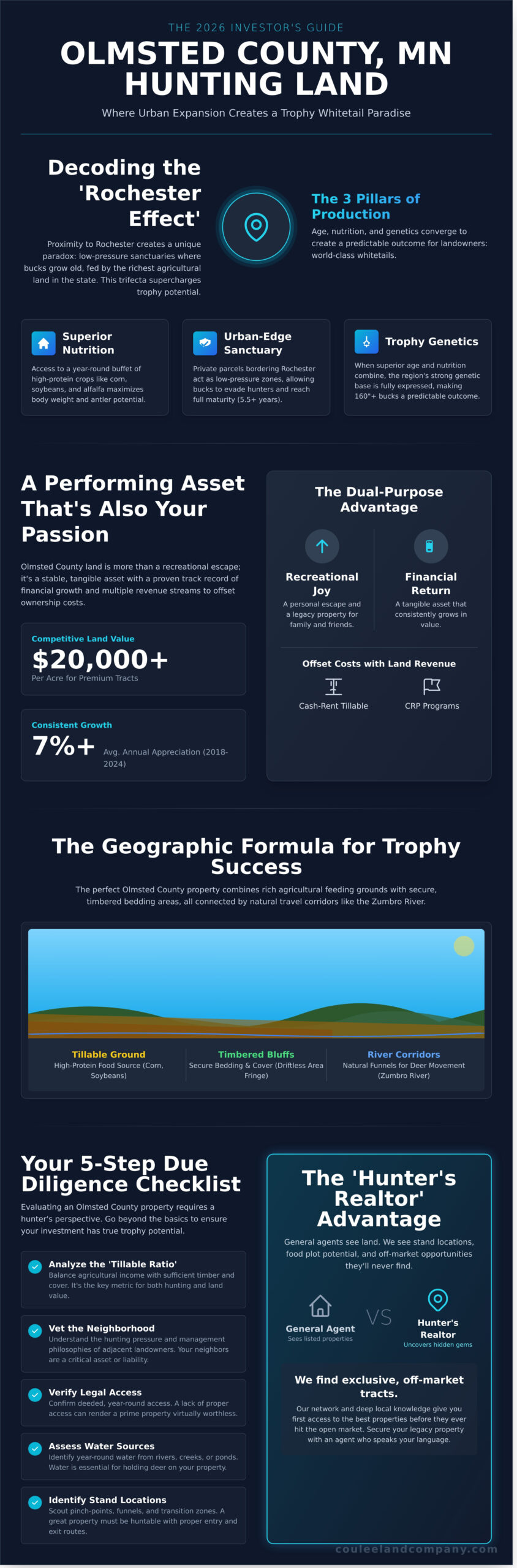
What sets this region apart is the ‘Urban-Edge’ advantage. Unlike remote wilderness tracts, land here benefits from its proximity to Rochester. This creates a mosaic of private sanctuaries where limited hunting pressure allows whitetail bucks to reach maturity. The perfect habitat is a mix of fertile, tillable ground providing high-protein food sources like corn and soybeans, bordered by steep timbered ridges that offer bedding cover and security. This is the exact formula for growing and holding trophy-class deer.
The Geography of Olmsted County Hunting
The county’s topography is defined by its water and its transition zones. The Zumbro River and its many tributaries serve as natural travel corridors, funneling deer movement between feeding and bedding areas. Geographically, this is where the vast central plains meet the rugged Driftless Area, a region untouched by the last glaciers. This unique geological history gives Olmsted County, Minnesota its signature landscape. The ‘Rochester Buffer’ effect is real; private parcels surrounding the city often become low-pressure zones where bucks can evade hunters and grow to an older age class, a key ingredient for a trophy-managed property.
Investment Value vs. Recreational Joy
Owning a piece of Olmsted County is more than just a place to hunt; it’s a sound financial decision. Recreational and agricultural land in Southeast Minnesota has demonstrated consistent growth, with appreciation rates averaging over 7% annually between 2018 and 2024. Many properties feature productive tillable acres that can be cash-rented to local farmers or enrolled in programs like CRP (Conservation Reserve Program). This agricultural income provides a reliable revenue stream that significantly offsets the costs of ownership, including property taxes and land management improvements. This dual-purpose value makes your passion a performing asset. Understanding how to leverage these benefits is a critical part of the buying process, and you can explore effective search strategies on our Buyers page.
Decoding the ‘Rochester Effect’ on Trophy Whitetails
Serious whitetail hunters understand a fundamental truth: age, nutrition, and genetics are the three pillars of trophy buck production. In Olmsted County, a unique convergence of factors, which we call the ‘Rochester Effect,’ supercharges all three. This phenomenon creates an environment where 160-inch-plus bucks are not just a possibility; they are a predictable outcome for the landowner who understands the landscape. It’s a paradox of modern hunting where some of the most reclusive, mature whitetails live within sight of Minnesota’s third-largest city.
The foundation of this effect is nutrition. Olmsted County’s rich, dark soils, part of the famously productive Upper Midwest agricultural belt, produce high-protein crops like soybeans and alfalfa alongside energy-rich corn. This isn’t marginal deer habitat; it’s a year-round buffet that allows bucks to maximize their genetic potential for antler growth. A buck living on the fringe of Rochester has access to a diet that rivals the most intensely managed properties in the country, leading to superior body weights and exceptional antler mass.
Psychologically, these urban-adjacent bucks are a different breed. They are conditioned to the sounds and smells of human activity, using city parks, corporate campuses, and sprawling residential lots as impenetrable sanctuaries. They learn to treat the sound of a passing car as white noise and the sight of a person walking a dog as non-threatening. This creates a ‘mega-buck’ that is bold yet intolerant of direct hunting pressure, making the parcels of Olmsted County Minnesota hunting land for sale that border these zones incredibly valuable.
Sanctuary Dynamics and Bedding
The key to hunting these giants is identifying the ‘no-pressure’ zones they use for core bedding areas. By mapping city limits, parks, and large, unhunted private parcels, you can predict their travel corridors with stunning accuracy. Your best opportunity is to position stands on the first food source or pinch point just outside these sanctuaries. It’s a game of interception, catching a mature buck as he leaves his safe zone to feed, and it requires a deep understanding of local ordinances. Knowing the specific archery-only boundaries detailed in the official Minnesota hunting regulations is the first step to legally and effectively hunting these transition zones. Furthermore, Rochester’s 2026 Comprehensive Plan outlines specific corridors for urban expansion, which will inevitably shift deer movement and create new, dynamic hunting opportunities on the city’s fringe.
Genetic Potential of Southeast MN
While Buffalo County, Wisconsin, rightfully dominates the Boone and Crockett record books, Southeast Minnesota possesses an equally potent genetic base. The proximity to the massive Whitewater Wildlife Management Area ensures a deep and diverse gene pool, acting as a reservoir for top-tier whitetail genetics that spill over into surrounding private lands. This isn’t just theory; it’s proven by the caliber of bucks harvested annually. The ‘Driftless’ genetic pool, a unique lineage of whitetails from the unglaciated regions of MN, WI, and IA, is projected by national conservation groups to produce over 40% of the Boone & Crockett entries for the upper Midwest by 2026. Finding a property that leverages these genetics is the ultimate goal. Our team specializes in identifying these unique parcels; view our current Olmsted County listings to see the ‘Rochester Effect’ in action.
Evaluating Olmsted County Land: What $20,000+ Per Acre Buys You
Seeing a price tag of $20,000 or more per acre for hunting land can be jarring, especially when properties in other states seem more affordable. In Olmsted County, this premium price is a direct reflection of the region’s incredibly productive agricultural soil. Unlike the rugged, timber-dominant tracts found elsewhere, Southeast Minnesota land value is fundamentally tied to its income potential from farming. This reality shapes every single transaction.
The core metric you must understand is the ’tillable ratio’. A 100-acre parcel with 80 acres of high-quality cropland will be priced as prime farmland, period. The 20 acres of woods and water you want for hunting are along for the ride. This is a stark contrast to neighboring Fillmore County, where the dramatic bluff topography creates a lower tillable ratio and, consequently, more properties priced purely for their recreational value. The value here is driven by agricultural productivity; the latest Olmsted County land use data from the USDA shows the market value of agricultural products sold in 2022 exceeded $285 million, directly impacting the base price of every acre. While Dodge and Mower counties share this agricultural pricing pressure, Olmsted’s proximity to a major medical hub adds another layer of cost.
Price Drivers in Southeast Minnesota
Beyond the soil quality, three factors dictate the final price. First is the “Rochester Premium,” a noticeable price jump for any parcel within a 15-mile radius of the city limits. Second is access; direct county road frontage is valuable for farming and potential building sites, but a secluded property with deeded easement access might offer superior, undisturbed hunting. Finally, turnkey properties with established food plots, extensive trail systems, and permanent blinds command a higher price because they represent years of strategic land management already completed.
Olmsted vs. Buffalo County (WI)
Many serious hunters weigh opportunities in Minnesota against those across the river in Wisconsin’s famed whitetail country. While Olmsted County produces fantastic deer, the “Bluff” intensity of Buffalo County, WI, creates a completely different style of hunting focused on dramatic funnels and pinch points. Tax implications also differ, and out-of-state landowners should consult a professional to compare the property tax burden. For those chasing Boone and Crockett class bucks, it’s worth exploring the unique terrain detailed in our Buffalo County community guide to truly understand the difference.
Finally, buyers must face the 2026 reality of land financing. With the next Farm Bill on the horizon and interest rates remaining elevated, lenders are scrutinizing loans for purely recreational properties. Securing financing for non-income-producing land is more challenging than ever. Buyers searching for Olmsted County Minnesota hunting land for sale must get pre-approved and be prepared for terms that differ from a standard residential mortgage. It’s a competitive market where cash and solid financing make all the difference.
The 5-Step Due Diligence Checklist for Hunting Properties
Finding the perfect piece of Olmsted County Minnesota hunting land for sale goes far beyond identifying a promising spot on a map. True value is uncovered through rigorous due diligence. Skipping this process is the single biggest mistake a buyer can make, potentially turning a dream property into a decade-long headache. This professional checklist covers the critical factors our land specialists evaluate to ensure you’re investing in a premier hunting parcel, not just a plot of dirt.
Before you even walk the property lines, your investigation must begin with legal access. A property without clear, deeded access recorded with the county is a non-starter. Don’t rely on a verbal “handshake agreement” with a neighbor for an easement; that can vanish the day the property sells. We meticulously review title work and survey history to confirm your legal right to enter your land, 365 days a year, without dispute.
Analyzing the Neighborhood
Your property doesn’t exist in a vacuum. The hunting pressure and management philosophy of your neighbors directly impacts the quality of your herd. Using satellite imagery from platforms like onX Hunt, we can often identify “brown-is-down” properties versus neighbors practicing Quality Deer Management (QDM). This intel is invaluable, but nothing replaces on-the-ground knowledge. A dedicated specialist agent builds relationships and understands the local hunting culture in a way no map ever could. This becomes even more critical with Minnesota’s updated trespassing laws taking full effect in 2026, which will require explicit permission to enter any private land.
Assessing Terrain and Habitat
Olmsted County’s bluff country terrain creates a dynamic environment for whitetails, and understanding how they use it is key. We analyze topography to locate crucial thermal cover on north-facing slopes, which hold snow longer and offer deer refuge from winter winds. Conversely, south-facing slopes provide vital early-season food sources and late-season bedding areas. The region’s ridge systems create natural funnels that dictate deer movement. A pinch point in bluff terrain is a natural constriction, like a saddle between ridges or a narrow bench on a steep hillside, that forces deer to travel through a predictable, confined area. Identifying these locations is fundamental to a successful hunting strategy.
Soil quality is the engine that drives your property’s wildlife potential. In Minnesota, we use the Crop Productivity Index (CPI) to measure this. A parcel with tillable acres boasting a CPI of 85 or higher can support high-yield destination food plots like corn and soybeans. Land with a lower CPI, perhaps in the 60-75 range, is still excellent for creating kill plots with clover, chicory, or brassicas. Knowing these numbers prevents you from overpaying for ground that can’t support your management goals.
Finally, a property’s timber composition represents both immediate financial value and long-term habitat opportunity. We assess the current timber value and, more importantly, its potential for Timber Stand Improvement (TSI). TSI is the practice of strategically managing your woods to improve wildlife habitat. This could involve removing undesirable species to promote oak growth for mast production or hinge-cutting non-commercial trees like box elder to create dense bedding cover. A well-executed TSI plan can dramatically increase the number of mature bucks your land can hold.
This level of detailed analysis is what separates an average property from a legacy hunting tract. Contact a Coulee Land Company specialist today to evaluate the true potential of your next hunting property.
Why Coulee Land Company is the Hunter’s Choice in Olmsted
Finding the right piece of hunting land is more than a transaction; it’s the fulfillment of a lifelong dream. Anyone can sell you a parcel with a legal description, but it takes a true land specialist to find you a property with a legacy. At Coulee Land Company, we are not just real estate agents. We are the Hunter’s Realtor. Our philosophy is simple: we walk the ridges, we don’t just drive the road. This means we put boots on the ground for every property, analyzing the topography for pinch points, identifying ideal food plot locations, and understanding the wildlife habitat long before you ever see the listing.
Our deep roots in Southeast Minnesota’s outdoor community give our clients a distinct advantage. We maintain an exclusive network of landowners, providing access to premier off-market hunting tracts that never appear on public websites. This insider access is crucial in a competitive market. Our proven track record speaks for itself, from securing 20-acre hobby farms perfect for a family retreat to brokering the sale of 500-acre trophy estates destined to produce record-book whitetails. We understand the unique qualities that make a property exceptional, and we know how to find it.
Expertise That Goes Beyond the Closing Table
Our commitment to your success extends far beyond the final signature. We help you unlock the full potential of your property from day one. During a showing, we’re not just pointing out boundary lines; we’re helping you visualize a food plot in that hidden clearing or the perfect oak tree for a morning stand. This is the value of working with agents who live the lifestyle. Our team is composed of seasoned hunters and land stewards like Bryan Lemke, individuals who manage their own properties for trophy wildlife and bring that firsthand knowledge to your search.
“The team at Coulee didn’t just sell me land; they helped me find my dream dirt. They saw the potential for travel corridors and bedding areas that I completely missed on the aerial map. Their insight was invaluable, and they connected me with a local TSI expert who has already transformed my woods. You can’t get that service anywhere else.”
– Mark P., Rochester, MN Landowner
After the sale, our relationship continues. We connect our clients with our trusted network of local habitat specialists, from foresters who can develop a Timber Stand Improvement (TSI) plan to contractors who specialize in creating world-class food plots and water sources.
Your Next Steps in Olmsted County
When you are ready to begin your search for Olmsted County Minnesota hunting land for sale, taking the right first steps is critical. A successful land purchase begins with preparation, and our team is here to guide you through the entire process. We ensure you are positioned to act decisively when the perfect property becomes available.
- Set Up a Custom Alert: The best properties often sell within days. Contact us to create a personalized property alert, so you are notified the moment a new Olmsted County listing that matches your specific criteria hits the market, or even before.
- Prepare Your Financing: Securing a loan for raw land requires a different approach than a traditional home mortgage. We connect our clients with trusted land-specific lenders who understand the nuances of rural financing and can get you pre-approved quickly.
Your legacy property in the heart of Minnesota’s bluff country is waiting. Take the first step with a team that shares your passion and has the expertise to make your vision a reality. View our current hunting property listings and contact us today to begin your journey.
Secure Your 2026 Hunting Legacy in Olmsted County
The window of opportunity is clear. As we’ve detailed, the “Rochester Effect” continues to drive land values, with prime parcels now commanding over $20,000 per acre. This isn’t just a purchase; it’s a strategic 2026 investment in a region renowned for its Boone and Crockett potential. Successfully acquiring the right piece of Olmsted County Minnesota hunting land for sale demands more than just capital; it requires the diligent, 5-step approach we’ve outlined and a partner who intimately understands this unique market.
You don’t have to navigate this complex landscape alone. Coulee Land Company has specialized in this iconic Bluff Country terrain since our inception. Our deep expertise in both the Minnesota and Wisconsin land markets is precisely why top outdoor industry professionals consistently endorse our team. We aren’t just agents; we are the hunter’s choice, dedicated to turning your vision of a trophy property into a deed in your hand.
Are you ready to make your move? Find Your Perfect Olmsted County Hunting Property with the specialists who live and breathe this land. Your future hunting camp starts here.
Frequently Asked Questions About Olmsted County Hunting Land
Is Olmsted County better for deer hunting than Buffalo County, WI?
No, Buffalo County, Wisconsin remains the undisputed king for producing trophy whitetail bucks. While Olmsted County offers solid hunting opportunities, it doesn’t compare to the record books. Buffalo County has produced over 100 Boone and Crockett entries, a number that solidifies its reputation as the nation’s top destination. For hunters whose primary goal is a record-book whitetail, the famed “Bluff Country” of Western Wisconsin is the superior choice.
What is the average price per acre for hunting land in Olmsted County in 2026?
We project the average price for quality hunting land in Olmsted County will range from $8,500 to $10,500 per acre by 2026. This forecast is based on an anticipated 4-6% annual appreciation from 2024 values. Prices on the higher end of this range will feature a mix of mature timber and tillable acreage for food plots or income. Parcels that are exclusively wooded or have limited access will fall on the lower end of the spectrum.
Can I build a cabin or home on my hunting land in Olmsted County?
Yes, building a cabin or home is generally possible, but it depends entirely on the property’s specific zoning classification. You must verify the parcel’s status with the Olmsted County Planning Department before purchasing. Many rural properties require specific permits for septic systems, which often involves a soil percolation test, and you may need a separate permit for driveway access. It’s critical to complete this due diligence before you buy.
How do Rochester’s city limits affect deer hunting regulations?
Hunting within Rochester’s city limits is severely restricted, as city ordinance Chapter 4-1 broadly prohibits the discharge of firearms. This effectively eliminates gun hunting. The only exception is the city’s highly controlled archery hunt program, which requires special permits for designated areas. For true hunting freedom, you must purchase a property located outside the city’s jurisdiction where state regulations are the primary authority.
What are the property tax benefits for agricultural land in Minnesota?
Minnesota’s Green Acres Program, governed by statute 273.111, provides a significant tax benefit for qualifying agricultural land. This program allows the land to be valued based on its agricultural use rather than its higher potential market value for development. This tax deferment can result in thousands of dollars in annual savings, making it a powerful financial tool for landowners who maintain their property for agricultural or timber production.
Are there public hunting lands in Olmsted County to supplement my private tract?
Yes, Olmsted County has several public hunting areas that can perfectly supplement your private land. These include state-run Wildlife Management Areas (WMAs) like the Oak Savanna WMA and portions of the Root River County Park. While these public tracts are a great asset for the area, owning your own private Olmsted County Minnesota hunting land for sale gives you complete control over habitat management and hunting pressure, a priceless advantage.
What should I look for in a Southeast Minnesota ‘trophy’ property?
A premier Southeast Minnesota trophy property requires three key elements: diverse habitat, a year-round water source, and secluded access. Look for properties with south-facing slopes for winter bedding, hardwood ridges that act as travel corridors, and established food plots or tillable acres. A creek or pond is essential. The best parcels are those with deeded access tucked away from road pressure, allowing bucks to reach maturity without disturbance.
How do I get a free valuation for my Olmsted County land?
You can receive a free, no-obligation valuation by contacting a land specialist who is an expert in the recreational market. Unlike a standard residential realtor, a land agent analyzes recent sales of comparable hunting tracts, assesses current timber values, and evaluates the property’s wildlife capabilities. They understand the unique features that create value for a hunter and can provide a truly accurate market analysis based on real-world experience.