
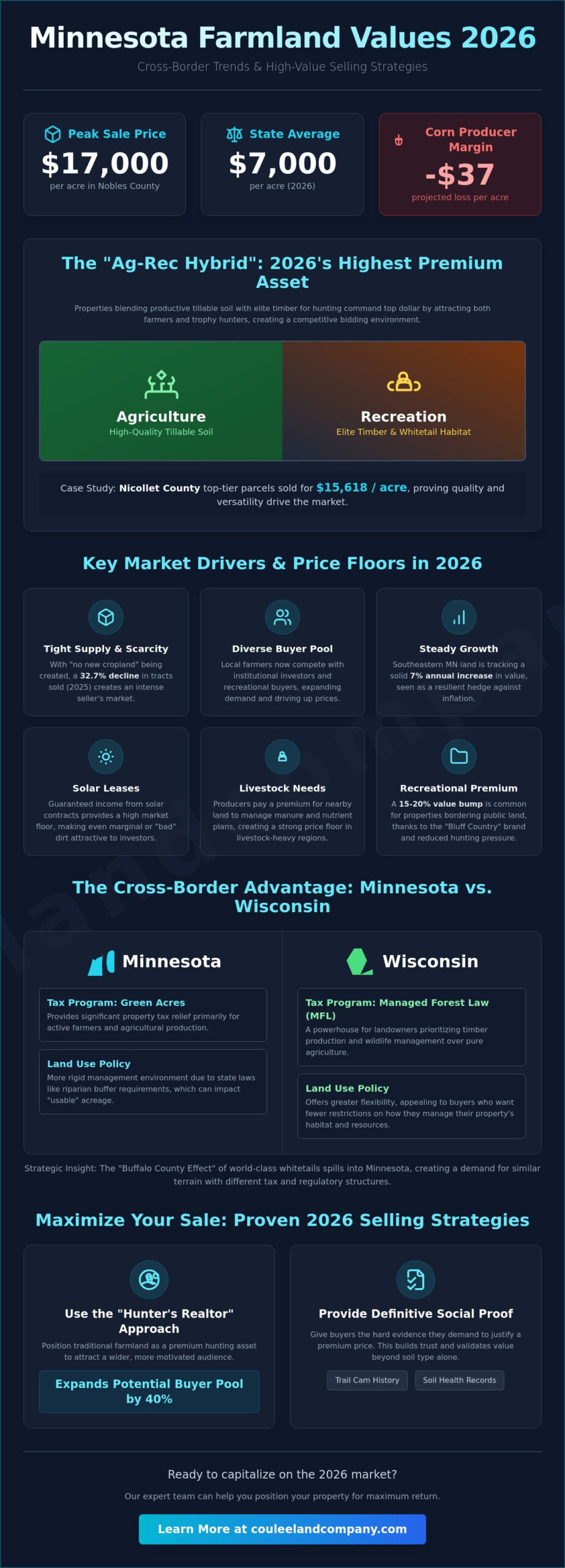
In January 2026, a single 141 acre tract in Nobles County commanded a staggering $17,000 per acre, even as corn producers faced projected losses of $37 per acre for the season. You’ve likely noticed this strange disconnect where commodity markets struggle while the demand for quality dirt remains white-hot. It’s natural to feel uncertain about whether to hold your ground or capitalize on these prices, especially when you’re weighing the regulatory differences between Minnesota and Wisconsin. This deep dive into Minnesota Farmland Values in 2026: Cross-Border Trends and Selling Strategies gives you the clarity needed to make a high-stakes decision.
We’ll show you how to identify the “sweet spot” for selling hybrid ag-recreational land that appeals to both producers and trophy whitetail hunters. You’ll get a clear look at why the state average hit $7,000 per acre this year and how to leverage cross-border tax advantages to keep more of your equity. We are breaking down the 2026 price benchmarks and the exact marketing tactics required to maximize your property’s value in a shifting market.
Key Takeaways
- Identify why the highest premiums in 2026 are reserved for “Ag-Rec Hybrid” properties that pair productive tillable soil with elite timber edges.
- Learn how limited supply and the “no new cropland” reality are creating price floors in our guide to Minnesota Farmland Values in 2026: Cross-Border Trends and Selling Strategies.
- Compare the financial impact of Minnesota’s Green Acres program against Wisconsin’s land use structures to protect your long-term equity.
- Discover how the “Hunter’s Realtor” approach expands your potential buyer pool by 40% by positioning traditional farmland as a premium hunting asset.
- Master the use of trail cam history and soil health records to provide the definitive social proof that trophy whitetail hunters and farmers demand.
Stability and Scarcity: The State of Minnesota Farmland Values in 2026
The “Ag-Rec Hybrid” is the defining asset class for Minnesota Farmland Values in 2026: Cross-Border Trends and Selling Strategies. We are seeing a massive premium for properties that combine high-quality tillable soil with mature timber edges. While pure cropland remains valuable, the dual-purpose nature of these tracts attracts both agricultural producers and serious trophy hunters, creating a bidding environment that pure commodity land can’t match. In January 2026, top-tier parcels in Nicollet County sold for $15,618 per acre, proving that quality and versatility drive the market even when corn margins are tight.
A critical floor for these prices is the simple fact that no new cropland is being created. Supply remains remarkably tight; the volume of cropland tracts sold in parts of the state declined by 32.7% in 2025 compared to the previous year. This scarcity shifted the buyer profile significantly. While local farmers still look to expand for the next generation, they now compete with institutional investors and recreational buyers who view Minnesota’s agricultural economy as a resilient hedge against inflation. Benchmark growth for Southeastern Minnesota land is currently tracking at a solid 7% annual increase as we move through 2026.
Regional Variations Across the Gopher State
Geography dictates the ceiling of your sale price. Southeastern Minnesota, or the “Bluff Country,” behaves differently than the flat expanses of the Red River Valley because it offers superior hunting properties and scenic diversity. Proximity to the Twin Cities and Rochester adds a “lifestyle” premium to these acres, where a 40 acre parcel is often valued more for its building site and whitetail potential than its bushel yield. In contrast, Southwestern Minnesota land values are tied more directly to the 40% increase in average values seen between 2021 and 2025.
The Livestock and Solar Influence
In livestock-heavy regions, the need for manure application acres keeps a firm grip on price floors. Producers are willing to pay a premium for nearby ground to manage their nutrient plans effectively. Simultaneously, solar leases are emerging as a safety net for marginal land. These long-term contracts provide a guaranteed income stream that can make a lower-quality parcel more attractive to investors, ensuring that even “bad” dirt has a high market floor in 2026. If you’re looking to capitalize on these trends, our expert team can help you position your property for maximum return.
The Cross-Border Advantage: Comparing Minnesota and Wisconsin Land Dynamics
Owning land on the border means understanding two very different playbooks. While the USDA farmland value data shows consistent statewide growth, the local reality is often driven by the “Buffalo County Effect.” This legendary reputation for world class whitetails doesn’t stop at the river; it bleeds directly into Minnesota’s bluff country, where savvy buyers look for the same terrain features at a different tax threshold. When analyzing Minnesota Farmland Values in 2026: Cross-Border Trends and Selling Strategies, it’s clear that Minnesota’s riparian buffer laws create a more rigid management environment compared to the flexibility found in Wisconsin’s land use policies. These regulatory hurdles can impact the “usable” feel of a property, making it vital to understand local ordinances before you list.
Tax Implications for Cross-Border Landowners
Tax structures often decide which side of the border a buyer lands on. Minnesota’s Green Acres program provides significant relief for active farmers, but Wisconsin’s Managed Forest Law (MFL) is a powerhouse for those prioritizing timber and wildlife management. If you are moving capital through a 1031 Exchange, the ability to transition from a high yield tillable tract in Minnesota to a premier recreational property in Wisconsin is a strategic move we often facilitate. Understanding these nuances helps you protect your equity and maximize your long term returns.
The Recreational Premium
Properties that share a border with public timber or state parks consistently see a 15% to 20% value bump. This recreational premium is a hallmark of the region. Buyers aren’t just paying for the dirt; they’re paying for the “Bluff Country” brand and the relief from hunting pressure that public borders provide. Whether you are looking at hunting properties in Wabasha County or a dream tract in Buffalo County, that proximity to vast timber is a blue-chip investment. If you’re curious how your specific border tract stacks up, getting a professional valuation can provide the local data you need to sell with confidence.
2026 Selling Strategies: Positioning Your Land for Maximum Market Value
To capture the full potential of Minnesota Farmland Values in 2026: Cross-Border Trends and Selling Strategies, you have to look beyond traditional agricultural buyers. We’ve found that marketing a property as a dual-purpose asset increases the potential buyer pool by 40%. This “Hunter’s Realtor” approach targets high-net-worth individuals who want a return on their investment through tillable rent while chasing trophy whitetails in the fall. By highlighting wildlife capabilities alongside soil productivity, you aren’t just selling dirt; you’re selling a lifestyle that investors are willing to pay a premium for in 2026.
Success in this market relies on providing definitive social proof. For a farmer, that means yield maps and soil health records. For a hunter, it’s a multi-year trail cam history that proves the land’s ability to produce mature bucks. Documenting your land management efforts creates a transparent value proposition that general realtors often overlook. We recommend focusing on the Q3 and Q4 window for listing. This timing captures the excitement of the harvest and the peak of hunting season, allowing buyers to see the land’s performance in real-time. For more on these profit-maximizing tactics, see our guide on Selling Hunting Land in Wisconsin.
High-Tech Marketing for Rural Properties
Static photos don’t cut it anymore. Listings in 2026 require professional drone videography and detailed topographic mapping to show exactly how deer move through the terrain. We use these tools to target digital ads toward metro-based “hobby farmers” who are looking for an escape from the Twin Cities. These buyers prioritize aesthetic beauty and recreational access; they often pay prices that local producers can’t justify based on bushels alone.
Choosing the Right Brokerage
A general residential realtor doesn’t understand the difference between a Class II soil and a bedding thicket. You need a specialist who speaks both languages. Brokers like Mike Law and Bryan Lemke understand how to market a property’s “Boone and Crockett” potential while still respecting the agricultural bottom line. When you work with experts who live and breathe land management, you ensure your property is positioned to win in a competitive market. If you’re ready to see what your land is truly worth, contact us today for a professional valuation.
Secure Your Legacy in the Bluff Country
The 2026 land market demands a specialized approach that balances agricultural yield with elite recreational potential. You now understand how the Ag-Rec Hybrid model and cross-border tax strategies can protect your equity while reaching a 40% larger buyer pool. Successfully navigating Minnesota Farmland Values in 2026: Cross-Border Trends and Selling Strategies requires more than a general realtor; it requires a partner who understands the dirt and the deer. Our team is endorsed by leading outdoor television hosts and remains the undisputed authority on Buffalo County whitetail properties. We bring a level of expertise that generalists simply can’t match, ensuring your property is positioned for a superior return. Take the first step toward a successful sale by securing an expert assessment of your land’s true potential.
Get a Professional Property Valuation for Your MN or WI Land
The right strategy transforms a simple land sale into a landmark legacy. We look forward to helping you achieve the results your hard work deserves.
Frequently Asked Questions
Is Minnesota farmland a good investment in 2026 despite high interest rates?
Minnesota farmland remains a resilient investment in 2026 because the supply of available land is roughly half of what it was in 2021. Even with high interest rates, the 7% year over year growth seen through late 2025 demonstrates that buyers prioritize tangible assets over volatile financial markets. This scarcity creates a solid price floor that protects your capital while providing a reliable income stream from tillable rents.
How do property taxes for farmland in Minnesota compare to Wisconsin?
Minnesota’s Green Acres program provides significant property tax deferral for agricultural land, while Wisconsin utilizes Use Value Assessment to keep taxes low on productive ground. Wisconsin landowners also benefit from the Managed Forest Law for timber tracts, which can offer deeper discounts than Minnesota’s recreational classifications. Navigating these differences is a core part of understanding Minnesota Farmland Values in 2026: Cross-Border Trends and Selling Strategies for multi-state owners.
What is the average price per acre for tillable land in Southeastern Minnesota in 2026?
While the state average sits at $7,000 per acre, Southeastern Minnesota’s Bluff Country commands much higher premiums due to its superior terrain. In January 2026, a 53 acre parcel in Goodhue County sold for approximately $13,000 per acre, reflecting the intense demand in this specific region. These values often exceed the $7,600 per acre benchmarks seen in central counties like Stearns, driven by the unique recreational appeal of the area.
How does the presence of trophy whitetails impact the appraisal of agricultural land?
The presence of trophy whitetails and documented wildlife capabilities can increase the appraisal of agricultural land by 15% to 20%. In the 2026 market, buyers are increasingly looking for properties where the hunting potential matches the bushel yield. Professional marketing that includes trail cam history and habitat management records can push a final sale price well beyond the standard tillable soil averages found in state reports.