
For those who dream of owning a slice of Wisconsin’s famed bluff country, the burden of property taxes can be a serious obstacle. You see a path to significant savings, but the complexities of the managed forest law wisconsin program can feel like navigating a dense thicket in the dark. Questions about 25 or 50-year commitments, the real difference between ‘Open’ and ‘Closed’ designations, and how enrollment impacts your ability to sell can stop a dream dead in its tracks. We get it. As the state’s premier land and property sales specialists, we’ve mastered this terrain for hunters and landowners just like you.
This is your complete guide. We’re breaking down the MFL program into plain language, revealing how to unlock its powerful tax benefits while enhancing your property for trophy whitetails and other wildlife. You’ll gain a clear understanding of your responsibilities and learn the critical factors for confidently buying or selling MFL land, turning that potential headache into a powerful asset for your investment.
Key Takeaways
- Unlock significant property tax reductions by understanding the financial benefits and long-term obligations of the MFL program.
- Grasp the critical difference between MFL Open and MFL Closed to make the single most important decision regarding public access to your property.
- Navigate the complexities of buying or selling land already enrolled in the managed forest law wisconsin program, as the designation transfers with the deed.
- Learn the essential steps for successful enrollment, including the development of a sustainable forestry plan with a professional forester.
What is the Managed Forest Law (MFL)? The Basics for Landowners
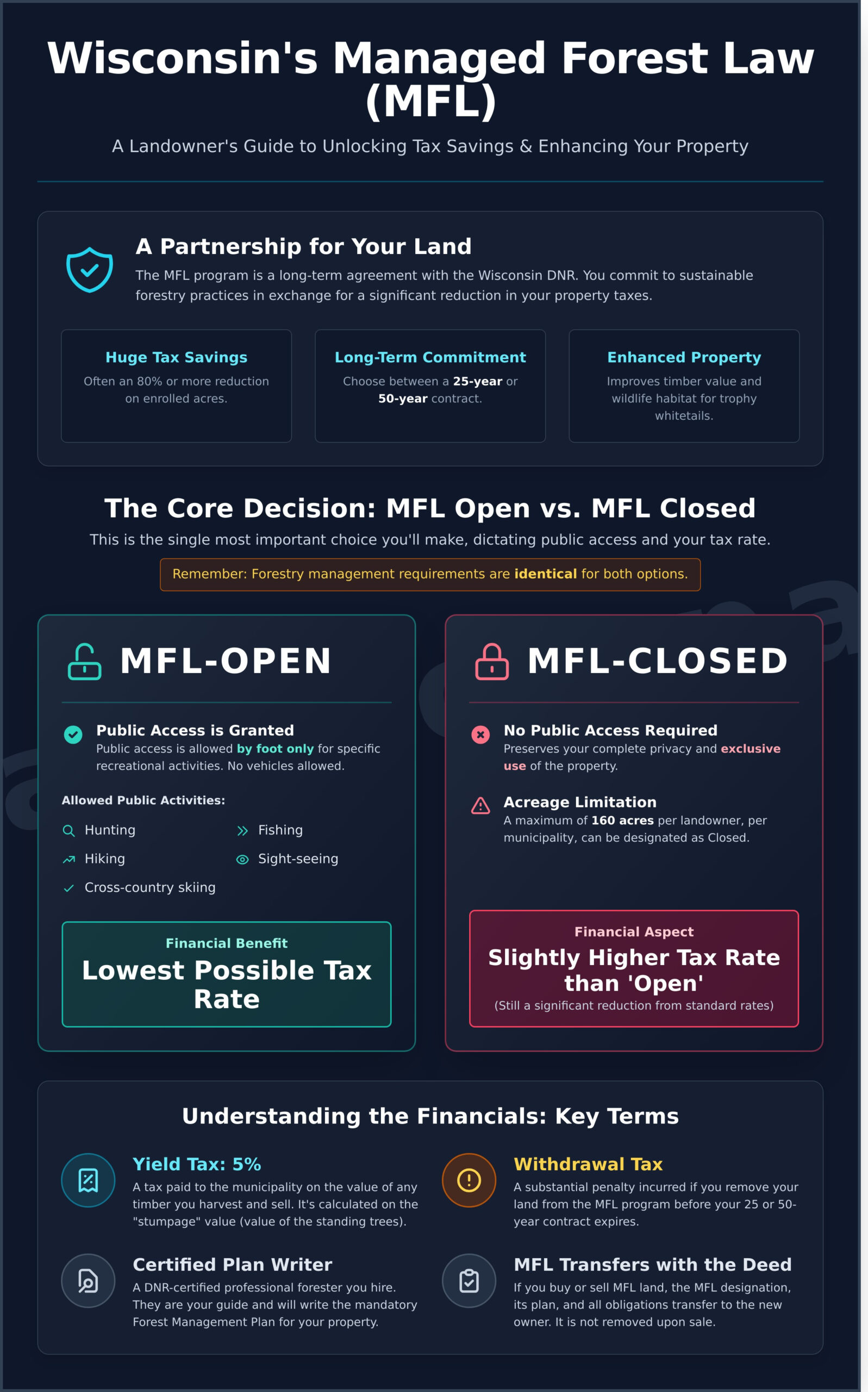
For serious Wisconsin landowners, the Managed Forest Law (MFL) is a powerful tool. It’s a partnership program designed to give you a significant property tax reduction in exchange for practicing sustainable forestry. At its core, the MFL is an agreement between you and the Wisconsin Department of Natural Resources (DNR) to manage your woodlands for the long term. This commitment not only lowers your holding costs but also enhances your property’s timber value and wildlife capabilities, making it a cornerstone of sound land investment in our state.
To better understand how this program directly benefits landowners, watch this helpful overview:
The Purpose Behind the Program
The MFL program was established with clear, dual goals that benefit both the landowner and the state. Enrolling provides a substantial property tax incentive, often reducing your tax bill by 80% or more on the enrolled acres. In return, the program promotes the stewardship of healthy, productive forests. This active management improves wildlife habitat-creating superior conditions for trophy whitetails and other game-and supports Wisconsin’s vital timber and forest products industry.
Your Commitment as a Landowner
Entering the managed forest law wisconsin program is a significant, long-term commitment. Landowners choose a 25- or 50-year contract and agree to follow a detailed Forest Management Plan. This plan, created specifically for your property, acts as your roadmap. It dictates mandatory forestry practices, such as timber thinning or harvesting, that must be completed on schedule to maintain forest health and productivity. This is not a passive program; it requires active participation.
Key MFL Terminology Explained Simply
Understanding the language of MFL is essential for success. Here are the core terms you’ll encounter:
- Certified Plan Writer: A DNR-certified forester who you hire to write your mandatory Forest Management Plan. They are your professional guide through the process.
- Yield Tax: A 5% tax paid to the municipality on the value (stumpage) of any timber harvested and sold from your MFL-enrolled land.
- Withdrawal Tax: A substantial penalty tax incurred if you remove your land from the MFL program before the contract expires.
- Mandatory Practices vs. Allowed Activities: Your plan will list mandatory practices (like a required harvest) that must be done, alongside allowed activities (like creating food plots or trails) that you can do to enhance your property.
- Cutting Notice: A form you must file with the DNR before beginning any timber harvest to report the products and volume you intend to cut.
The Core Decision: MFL Open vs. MFL Closed
When enrolling your property in the managed forest law wisconsin program, the most critical decision you will make is designating your land as either “Open” or “Closed.” This single choice dictates public access rights and directly impacts your annual property tax savings. It’s crucial to understand that the forestry management requirements-the sustainable harvesting and habitat improvement practices-are identical for both designations. The only difference is whether the public is allowed on your land, a choice for which the state provides a direct financial incentive.
Understanding MFL-Open Lands
Designating your land as MFL-Open grants public access by foot for specific recreational activities. These include:
- Hunting
- Fishing
- Hiking
- Sight-seeing
- Cross-country skiing
Importantly, you are not required to grant vehicular access. In exchange for allowing this public use, you receive the lowest possible property tax rate under the program. This option is often a good fit for absentee landowners or investors whose primary goal is maximizing the financial benefits of land ownership.
Understanding MFL-Closed Lands
Choosing MFL-Closed means no public access is required for any purpose, preserving your complete privacy and exclusive use of the property. While you still receive a significant tax reduction compared to standard rates, the annual tax rate is higher than MFL-Open lands. Landowners should also be aware of an acreage limitation: a maximum of 160 acres per municipality can be designated as Closed. For owners of prime hunting properties, this is almost always the preferred choice, as it secures exclusive rights to manage and hunt their deer herd without public interference.
How to Make the Right Choice for Your Goals
The right choice hinges on a simple trade-off: privacy versus tax savings. Before committing, consider how you, your family, and your friends intend to use the property. If your vision is a private hunting retreat for creating and pursuing trophy whitetails, the higher tax rate for the Closed designation is a sound investment in exclusivity. If your goals are more financially driven and you don’t mind public foot traffic, the MFL-Open option provides the greatest tax relief. For detailed rules on enrollment, consult the official Managed Forest Law Program page directly from the Wisconsin DNR.
Enrolling in MFL: Eligibility and the Application Process
Enrolling your property in the managed forest law Wisconsin program is a strategic decision that aligns long-term timber and wildlife goals with significant tax savings. The process is straightforward but requires careful planning and professional guidance. It’s a commitment to sound land stewardship, and understanding the steps from the outset ensures a smooth journey to DNR approval. The entire process, from hiring a forester to final approval, can take several months, so starting well before the deadline is essential.
Does Your Property Qualify for MFL?
Before you begin, your land must meet specific criteria set by the DNR. This initial assessment is the foundation of a successful application.
- Acreage Requirement: Your property must contain at least 20 contiguous acres.
- Productive Forest: A minimum of 80% of the acreage must be classified as ‘productive forest’-land capable of producing commercial wood products. This is a key distinction for the DNR.
- Other Land: The remaining 20% can include wetlands, open fields, or land under buildings. While structures themselves are excluded from MFL and taxed at the local rate, the land they occupy can count toward this non-productive allowance.
Working with a Certified Plan Writer (CPW)
Your most critical first step is partnering with a DNR-Certified Plan Writer (CPW). This professional forester is your expert guide, responsible for creating the cornerstone of your application: the forest management plan. They will walk your property, inventory its timber and habitat resources, and collaborate with you to outline a schedule of practices that meets both your land management objectives and state requirements. As the landowner, you are responsible for the cost of the CPW’s services.
Submitting Your Application to the DNR
With a robust management plan in hand, you can complete the application. The full package submitted to the state includes the official application form, your comprehensive management plan, and a detailed property map. All materials must be submitted by the strict annual deadline of June 1st. A local DNR forester then reviews your plan to ensure it aligns with the sustainable forestry goals of the Wisconsin’s Managed Forest Law (MFL) program. Once approved, the MFL order is recorded for a term of 25 or 50 years and takes effect on January 1st of the following year.
The Financials: Tax Savings, Costs, and Penalties
Enrolling your property in the managed forest law wisconsin program offers a significant financial advantage by drastically reducing your annual property tax burden. However, as Wisconsin’s land specialists, we advise clients to view the program as a comprehensive financial commitment. Understanding the tax savings, associated costs, and potential penalties is crucial for making an informed decision that aligns with your long-term goals for the property.
Calculating Your Property Tax Savings
The core benefit of the MFL program is the direct and substantial reduction in your property taxes. Instead of being taxed at the standard residential or agricultural rate, your land is taxed at a fixed statutory rate. For 2024, those rates are:
- MFL-Open: $2.49 per acre
- MFL-Closed: $10.68 per acre
Consider a hypothetical 80-acre parcel in Bluff Country. Under a standard tax assessment, your annual bill could easily be $4,000 or more. Enrolled in MFL-Closed, that same parcel would cost just $854.40 per year, dramatically lowering your holding costs and making long-term ownership far more sustainable.
Understanding Yield Tax and Other Costs
While property taxes are lower, the MFL program includes other financial components. When you conduct a commercial timber harvest as required by your management plan, a 5% Yield Tax is levied on the stumpage value of the timber. You must also account for the upfront cost of hiring a DNR-Certified Plan Writer to create your forest management plan and any future costs associated with completing mandatory practices, such as tree planting or invasive species control.
Withdrawal Tax: The Cost of Breaking a Contract
The MFL program is a legally binding contract for 25 or 50 years, and the state enforces this commitment with a significant withdrawal tax. This penalty is designed to recoup the tax benefits you received, plus interest. If you sell a portion of the land or decide to exit the program early, the financial penalty can be substantial. It’s essential to view enrollment as a serious, long-term strategy for your property, not a short-term tax fix. Our team at Coulee Land Company can help you evaluate if a property’s MFL status aligns with your investment and recreational goals.
Buying and Selling Land in the MFL Program
A parcel enrolled in the managed forest law wisconsin program carries its designation with it upon sale. This creates unique opportunities and responsibilities for both parties involved in the transaction. Understanding the nuances of this transfer is critical to a successful sale, ensuring the land’s legacy and your investment are protected from the outset.
Advice for Buyers Considering MFL Land
For a buyer, due diligence is paramount when a property is enrolled in the MFL program. Before making an offer, you must understand exactly what you are purchasing. Key steps include:
- Request the MFL Management Plan: This document is the blueprint for the property’s future. Review it to understand long-term forestry goals and your obligations.
- Identify Upcoming Harvests: The plan will detail any mandatory harvesting practices. Knowing these timelines is crucial as they can impact timber value, access, and wildlife habitat.
- Confirm Public Access Status: Verify if the land is designated ‘Open’ or ‘Closed’ to the public. This has significant implications for your privacy and hunting strategy.
Navigating these details requires specialized knowledge. Consulting with an expert who understands the program is a crucial step for serious land buyers looking to invest in Wisconsin’s finest properties.
How to Successfully Sell Your MFL Property
For sellers, the MFL designation is a powerful marketing tool. The significantly lower property taxes are a key benefit that attracts savvy investors and outdoorsmen. To leverage this advantage, have all MFL documents, including the management plan and DNR correspondence, organized for prospective buyers. The transfer itself involves specific DNR forms and timelines. Partnering with a specialist who understands the intricacies of the managed forest law wisconsin program ensures a seamless transaction for all land sellers.
Transfer of Ownership: Options for the New Owner
Upon purchasing an MFL property, the new owner has a critical decision. The MFL order automatically transfers, and the new owner can simply continue with the existing plan, enjoying the tax benefits. However, the DNR provides a one-time option: within the first year of ownership, the new owner may request to withdraw the land from the program. This action incurs a withdrawal tax but provides total freedom from MFL obligations, which is a common consideration for buyers in premier hunting destinations like Buffalo County who may have different land management goals.
Mastering MFL: Your Partner in Wisconsin Land Ownership
Understanding the Managed Forest Law is a critical step for any serious landowner. The program presents a powerful opportunity for significant tax savings, but it demands a clear understanding of your long-term commitment, the crucial differences between MFL Open and Closed, and the specific requirements for buying or selling enrolled land. Making the right choices ensures your property’s legacy and enhances its wildlife capabilities for generations to come.
Navigating the details of the managed forest law wisconsin is where expert guidance becomes invaluable. As Wisconsin’s Land & Property Sales Specialists, Coulee Land Company has a proven track record with complex land transactions and unmatched expertise in Western Wisconsin’s famed Bluff Country. Whether you’re looking to purchase your dream hunting parcel or sell a legacy property, we have the specialized knowledge to guide you through every step. Explore our exclusive Wisconsin property listings today.
Let us help you confidently secure your piece of the Wisconsin outdoors.
Frequently Asked Questions About Wisconsin’s Managed Forest Law
How much money can I actually save on property taxes with MFL?
The savings are substantial and represent one of the primary benefits of the program. Instead of being taxed on market value, your land is taxed at a low, flat rate per acre. For 2023, MFL-Open land was taxed at $2.59/acre and MFL-Closed at $10.36/acre. For a 100-acre parcel, this can translate into thousands of dollars in annual savings, making the dream of owning a large tract of prime Wisconsin hunting land far more affordable.
Can I build a house or cabin on my MFL land?
You cannot build on the acreage actively enrolled in MFL, but you can plan for your dream hunting cabin. The program allows you to exclude up to five acres from the MFL contract specifically for buildings. This excluded parcel is then taxed at the normal local rate, while the remainder of your property continues to receive the significant MFL tax break. It’s the perfect strategy to secure your hunting camp without sacrificing the program’s financial advantages.
What happens if I need to sell my MFL property before the contract ends?
Selling an MFL property is a common and straightforward process. The MFL order is attached to the land, not the owner, so the contract and its management plan automatically transfer to the new buyer upon sale. The new owner simply assumes the responsibilities for the remainder of the 25 or 50-year term. As land specialists, we ensure this transfer is handled seamlessly, preserving the land’s tax benefits and management legacy for the next steward.
Do I have to let the public hunt on my MFL-Closed land?
Absolutely not. This is a critical distinction that makes the MFL-Closed option so valuable for serious hunters and landowners. On MFL-Closed land, you retain exclusive rights for all recreation, including hunting, fishing, and hiking. Public access is only mandated for lands enrolled as MFL-Open. Choosing the “Closed” designation ensures your property remains your private sanctuary for managing and pursuing trophy whitetails, giving you complete control over your investment.
What are the biggest mistakes landowners make with the MFL program?
The most common mistake is failing to strictly follow the mandatory forest management plan. Missing a required timber harvest or neglecting a scheduled practice can trigger significant financial penalties or even forced withdrawal from the program. Another pitfall is not fully appreciating the long-term commitment of the contract. Understanding every detail of the managed forest law wisconsin program from the outset is essential for a successful and rewarding ownership experience.
How does MFL affect my ability to get a mortgage for a property?
While an MFL designation doesn’t prevent you from securing a mortgage, lenders will view the order as an encumbrance on the title due to its long-term land use restrictions. Because of this, it is crucial to work with a lender who is experienced with rural and recreational land transactions. They understand the value and structure of MFL agreements and can navigate the financing process far more effectively than a conventional residential lender.