
Most hunters see the steep bluffs of Western Wisconsin as a physical obstacle, but the most successful land managers see them as a predictable roadmap for trophy whitetails. You already know that finding the right dirt in the Driftless Area feels harder than ever as land prices in the region continue to trend upward based on 2024 market data. If you don’t want to fall into the trap of buying a “dead” parcel with poor access, you need a strategy built on boots-on-the-ground intelligence. Our guide to Local Hunting Locations in Pepin County: Deer Patterns and Land Buying Tips provides the roadmap you need to navigate this competitive landscape with confidence.
We’ll help you master the “River-to-Ridge” deer patterns that define Pepin County while providing expert strategies for securing high-value hunting land in Wisconsin’s Bluff Country. You’ll learn how to identify specific corridors that funnel mature bucks and understand the shifting 2026 land market dynamics. We’re moving beyond basic real estate to look at the specific wildlife capabilities of the terrain. By the time you finish reading, you’ll be equipped to find a property that doubles as both a premier hunting destination and a solid financial investment for your future.
Key Takeaways
- Decode the unique “River-to-Ridge” topography where the Mississippi meets the bluffs to predict trophy whitetail movement with precision.
- Learn to evaluate the critical ratio of tillable land to timber to ensure your property has the superior wildlife capabilities required for consistent success.
- Master Local Hunting Locations in Pepin County: Deer Patterns and Land Buying Tips to identify high-value tracts featuring natural funnels and pinch points.
- Understand why a specialized land broker is essential for identifying “deer dirt” value and avoiding the common pitfalls of general real estate listings.
- Discover the professional “boots-on-the-ground” strategies used to verify property potential and secure your legacy in Wisconsin’s famed Bluff Country.
Mastering Pepin County’s “River-to-Ridge” Deer Patterns
Pepin County stands as a cornerstone of Wisconsin’s Driftless Area. This region is where the massive Mississippi River valley collides with rugged interior bluffs, creating a biological powerhouse for whitetail growth. For hunters researching Pepin County, Wisconsin, this geography is the foundation of trophy potential. It’s part of the famous “Golden Triangle,” a specific zone where superior genetics and mineral-rich soil produce Boone and Crockett entries with startling frequency. We see mature bucks utilize this steep elevation to evade pressure, making it a top priority for those seeking Local Hunting Locations in Pepin County: Deer Patterns and Land Buying Tips.
To better understand the dynamics of hunting pressure in these diverse landscapes, watch this helpful video:
Neighboring public lands, such as the 13,000-acre Tiffany Wildlife Area, act as a vital buffer for private parcels. These large tracts absorb high volumes of hunting pressure, effectively pushing older, more reclusive bucks onto managed private hunting properties that offer better security and food sources.
The Science of the Bluff: Bedding and Feeding Cycles
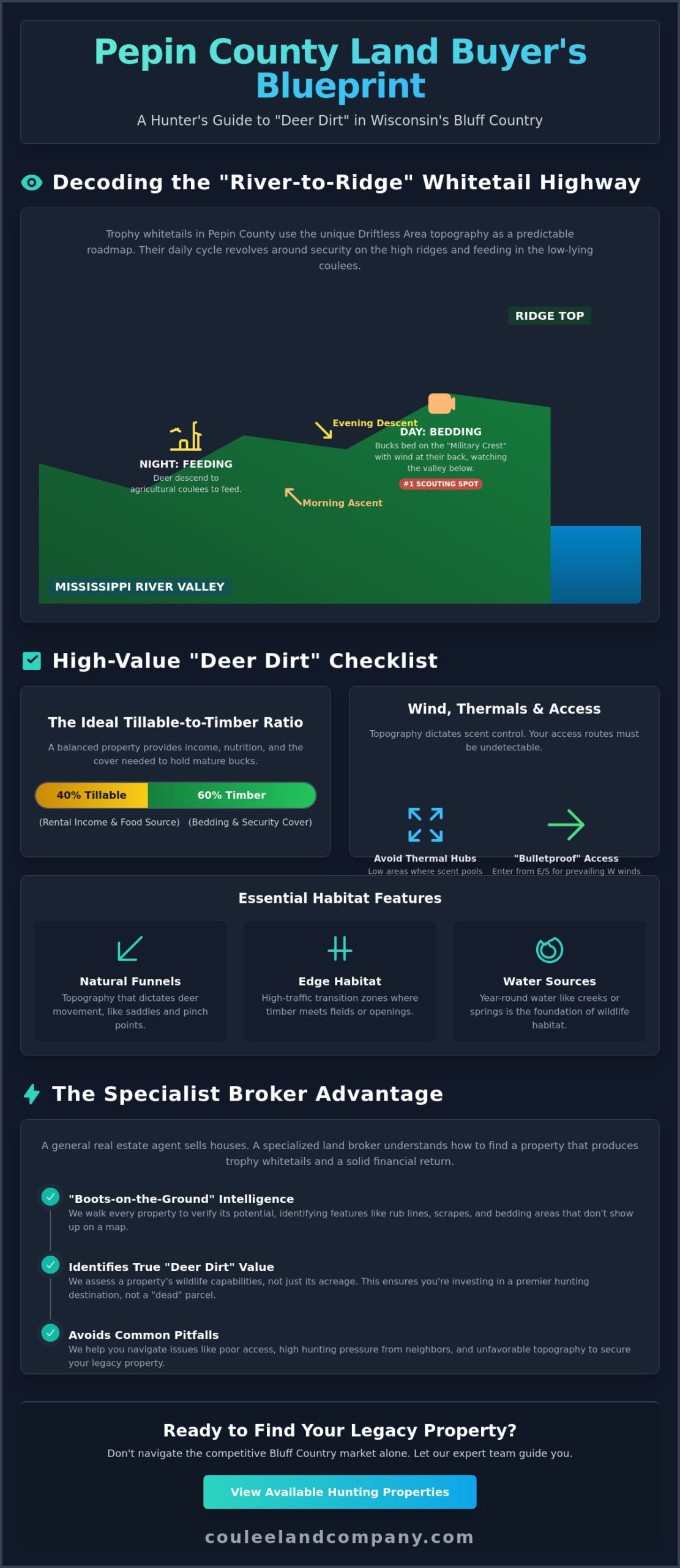
The topography here dictates every movement a deer makes. Whitetails bed on the high, secluded ridges during the day and descend into the agricultural coulees at night to feed. A military crest is a flat shelf located roughly two-thirds of the way up a ridge that allows bucks to bed with the wind at their back while visually monitoring the valley below. This specific terrain feature is the number one place to scout for heavy rub lines and primary scrapes in Pepin County.
Thermal Hubs and Wind Direction Strategy
Wind is either your greatest enemy or your best ally in the bluffs. Converging valleys create thermal hubs, which are low-lying areas where cooling air pools and traps scent in unpredictable swirls during the evening. You’ve got to identify properties that allow for bulletproof access. This means being able to reach your stand from the east or south when prevailing westerly winds are blowing. Expert land selection focuses on parcels where the topography ensures your scent stays far away from sensitive bedding thickets.
Strategic Land Buying Tips for the Pepin County Market
Investing in the right parcel requires more than a map; it demands an eye for topography and biological potential. For 2026 buyers, the most sought-after tracts feature a balanced ratio of roughly 40 percent tillable acreage to 60 percent timber. This mix provides immediate rental income and essential nutrition while maintaining the heavy cover required to hold trophy bucks. When evaluating Local Hunting Locations in Pepin County: Deer Patterns and Land Buying Tips, prioritize properties with natural funnels and pinch points created by the steep bluff topography. These geographic features simplify land management by dictating deer movement, making it easier to position stands for any wind direction. You can see these features in action by browsing our current hunting properties in the region.
Edge habitat is another critical factor that drives both property value and hunting success. The transition zones where timber meets field are high-traffic areas for whitetails. Properties with high edge to acre ratios typically produce more consistent sightings. Before finalizing any purchase, ensure you’re familiar with the latest Wisconsin deer hunting regulations to understand how local harvest quotas might affect your long-term management goals. This knowledge is vital for anyone looking to build a legacy property in the Driftless Area.
Assessing Wildlife Capabilities and Habitat Diversity
A premier listing must offer year-round water sources, whether it’s a secluded spring or a creek bottom. These water features are the foundation for successful food plots for whitetail deer. However, the most valuable part of a Pepin County property is often the unhuntable sanctuary. Establishing a 5 to 10 acre zone that remains completely human-free ensures that mature bucks feel secure enough to stay on your land during the high-pressure November seasons.
The 2026 Pepin Real Estate Landscape
Pepin County has seen a 15 percent increase in land values over the past year, yet it remains a hidden gem for those looking for elite hunting ground. While it offers similar bluff-country genetics, prices are often more accessible when you compare with Buffalo County land for sale. This price gap provides a unique opportunity to build equity while chasing world-class whitetails. If you’re ready to find your own piece of the bluffs, our team can help you identify a tract with the right Local Hunting Locations in Pepin County: Deer Patterns and Land Buying Tips to meet your goals. You might even want to start your search today to get ahead of the spring rush.
Securing Your Legacy: Navigating the Purchase Process
Buying a property in Pepin County requires a strategy that goes beyond a standard real estate transaction. You’re investing in a legacy that depends on specific habitat features. A general realtor might show you the property lines, but they often overlook the “deer dirt” value. They don’t see the pinch points or the hidden thermal cover that holds mature bucks during a late-season freeze. You need a land specialist broker in Wisconsin who walks the ridges with you. This boots-on-the-ground approach ensures you identify the best Local Hunting Locations in Pepin County: Deer Patterns and Land Buying Tips before signing a contract.
During your walk-through, verify easement access and investigate timber value. Many Pepin County tracts feature high-quality hardwoods that provide immediate equity. Check the status of any Conservation Reserve Program (CRP) contracts; these affect your management options and tax liabilities. Understanding Wisconsin deer hunting regulations is also vital to ensure the land’s layout aligns with legal stand placement and harvest goals. When you’re ready to offer, remember that Western Wisconsin is competitive. Successful buyers lead with clean, well-funded offers that respect the local market’s pace.
Why the “Hunter’s Realtor” Persona Matters
Coulee Land Company agents aren’t just salespeople; they’re obsessed hunters who vet every listing for trophy potential. They evaluate bedding security and food plot potential using years of personal experience in the field. This insider perspective is essential for evaluating Local Hunting Locations in Pepin County: Deer Patterns and Land Buying Tips for actual wildlife capabilities. For a broader look at the market, explore our listings for buying hunting land in Wisconsin.
Financial Planning for Recreational Acreage
Financing rural land differs from a standard residential mortgage. Lenders often require larger down payments for vacant acreage, but the long-term ROI makes it a sound play. Improving the habitat through strategic timber harvests or food plot installation significantly boosts the property’s worth. Our clients often find that selling hunting land in Wisconsin yields impressive returns once these enhancements are established and documented. A well-managed property in the Driftless Area maintains its value because the demand for world-class hunting ground never wavers.
Claim Your Stake in Pepin County’s Bluff Country
Owning a piece of the driftless region is about more than just acreage; it’s about understanding how trophy whitetails utilize the specific “River-to-Ridge” corridors. You’ve now gained the tactical knowledge needed to identify these movement patterns and navigate the strategic purchase process required to secure a hunting legacy. Mastering Local Hunting Locations in Pepin County: Deer Patterns and Land Buying Tips is your foundation for success in a region known for producing world-class bucks.
Coulee Land Company has facilitated over $500,000,000 in Wisconsin land sales, earning endorsements from the most respected personalities in outdoor television. We don’t just sell dirt; we specialize in 170″+ whitetail properties that offer superior wildlife capabilities and long-term value. Our team’s deep roots in land management ensure you aren’t just buying a property, you’re investing in a proven hunting destination.
Take the next step toward owning the premier ground you’ve always envisioned. View our exclusive Pepin County hunting land listings and let’s find the ridge that defines your next season. The big woods are calling, and your perfect property is waiting for you.
Frequently Asked Questions
Is Pepin County good for deer hunting compared to Buffalo County?
Pepin County offers world-class trophy potential that rivals Buffalo County at a more accessible entry point. While Buffalo County holds the record for most Boone and Crockett entries, Pepin shares the same limestone-rich soil and bluff topography that produces massive antler growth. Hunters often find 150-class bucks here with less hunting pressure. It’s a premier destination for those researching Local Hunting Locations in Pepin County: Deer Patterns and Land Buying Tips.
What is the average price per acre for hunting land in Pepin County in 2026?
Market projections based on Wisconsin Department of Revenue historical data suggest average prices for high-quality bluff country will range between $6,200 and $8,500 per acre by 2026. This estimate follows the 9% annual appreciation rate observed in the West Central Wisconsin region over the last five years. Prices vary based on tillable acreage ratios. It’s wise to secure a parcel now to build equity before these projected increases take full effect.
Are there public hunting lands in Pepin County that I can hunt while looking for a private parcel?
You can hunt the Tiffany Wildlife Area, which spans over 13,000 acres along the Chippewa River. This massive tract provides ample room for scouting and hunting while you evaluate Local Hunting Locations in Pepin County: Deer Patterns and Land Buying Tips. The terrain is diverse, featuring bottomland hardwoods and rugged ridges. It’s an excellent place to observe local deer movement and age structures before you commit to a private land purchase.
What should I look for in a land specialist when buying in the Wisconsin bluffs?
Select a specialist who has personally closed at least 50 transactions in the Driftless Area and understands specific bluff country dynamics. They must explain how thermal cover and ridge-top access affect hunting success. A true expert identifies a property’s wildlife capabilities beyond simple acreage. Look for a professional who uses advanced mapping software to show you 10 years of historical deer patterns and local harvest data before you make an offer.