
Consider this: Buffalo County, with a population of just over 13,000, has dominated the Boone and Crockett record book for typical whitetails since 2012, producing more entries than any other county on the planet. This single fact fuels the dreams of serious hunters and outdoorsmen nationwide. You’ve likely pictured yourself on a crisp November morning overlooking a deep coulee, but that vision often comes with tough questions about the realities of the terrain, the responsibilities of land stewardship, and the local economy. It’s completely understandable to feel a mix of powerful ambition and practical uncertainty when you think about making this legendary landscape your home.
This guide was built by Wisconsin’s Land & Property Sales Specialists to eliminate that uncertainty. We are pulling back the curtain on what living in bluff country wisconsin truly entails, from its world-class wildlife to its unique real estate opportunities. Inside, you will get a clear, expert roadmap to the Driftless lifestyle, gain the confidence to choose the right county for your specific goals, and receive a proven plan for securing your perfect country home or premier hunting plot. This is your definitive guide to turning the Bluff Country dream into your 2026 reality.
Key Takeaways
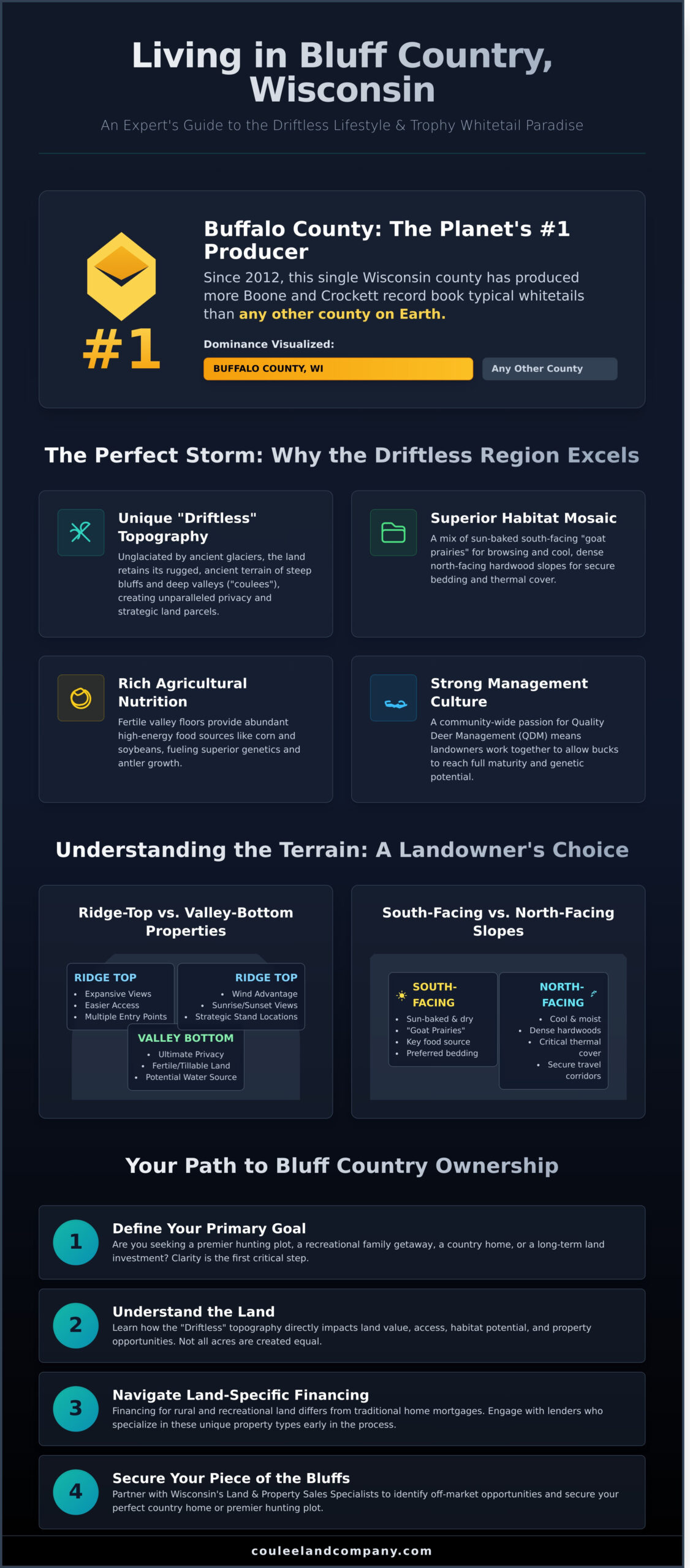
- Learn how the unique “Driftless” topography of bluffs and coulees directly impacts land value and creates distinct property opportunities.
- Discover the specific habitat and geographical factors that make this region a world-renowned destination for trophy whitetail hunting.
- Get a clear breakdown of the practical realities of living in bluff country wisconsin, from choosing between ridge-top vs. valley properties to managing winter conditions.
- Identify the critical first steps for securing your own property, including how to define your primary goal and navigate land-specific financing.
What is Bluff Country Wisconsin? Defining the Driftless Identity
When you consider living in bluff country wisconsin, you’re choosing a landscape with a distinct and powerful identity. This isn’t the Wisconsin of flat farm fields. This is the Driftless Area, a region defined by what didn’t happen here. During the last Ice Age, the colossal glaciers that flattened much of North America split and flowed around this territory, leaving its ancient, rugged topography intact. This geological anomaly created a landscape of deep valleys and limestone bluffs that feels more like Appalachia than the Midwest. The unique character of the Driftless Area is the foundation for everything that makes this region a premier destination for landowners and serious hunters. It’s a land that demands respect and rewards those who understand it.
The Geography of the Coulee Region
The defining features of Bluff Country are its coulees. A “coulee” is a deep, steep-sided valley carved by water, creating a secluded environment. For a landowner, this topography provides unparalleled privacy and strategic advantages. A 40-acre parcel here can feel like a secluded kingdom, with towering ridges obscuring it from the world. The mighty Mississippi River forms the region’s western border, a powerful force that has sculpted the landscape and serves as a major waterfowl flyway. By 2026, the Driftless Area remains an unglaciated island of rugged terrain, a geological artifact preserved in the heart of the Midwest. This terrain is the primary asset, offering a mix of tillable valley floors and wooded hillsides ideal for superior land management.
This dramatic topography also creates a mosaic of micro-climates that drive the area’s incredible biodiversity. South-facing slopes bake in the sun, creating dry “goat prairies” deer love to browse. Conversely, the cool, moist, north-facing slopes harbor dense stands of hardwoods, providing critical thermal cover and secure bedding areas for mature whitetails. This diversity of flora is a direct result of the unglaciated land, providing a rich tapestry of habitat that supports a wildlife population unmatched in the state. For a hunter, understanding these subtle environmental shifts is the key to consistently harvesting trophy-class animals.
A Brief History of Life in the Bluffs
The history of the Driftless Area is a story of adaptation. Early settlers were drawn to the fertile soil in the valley bottoms, but the steep, rocky ridges were largely left to timber. This challenging terrain, once an obstacle, became the region’s greatest preservation tool. It prevented the large-scale farming that transformed surrounding landscapes, conserving huge tracts of hardwood forest. Over the last 50 years, the region’s identity has shifted from a purely agricultural base to a world-class recreational hub. This is especially true for whitetail hunting; Buffalo County has dominated the Boone and Crockett record book for typical whitetails since the organization began tracking county data in the 1980s.
This unique history has cultivated a distinct small-town culture. Communities like Alma, built vertically between the bluffs and the Mississippi River, and Viroqua, a vibrant hub for organic farming, reflect the region’s independent spirit. They’ve evolved from simple farm-and-river towns into destinations for those seeking an authentic connection to the land. The decision of living in bluff country wisconsin is often a choice to embrace this heritage: a life tied to the seasons, the topography, and the rich outdoor traditions that this incredible landscape has nurtured for generations.
The Outdoor Legacy: Why Hunters and Nature Lovers Call This Home
The spirit of Western Wisconsin’s Bluff Country is etched into its very landscape. This isn’t a region you simply inhabit; it’s a place you actively engage with. The steep, wooded bluffs and fertile valley floors don’t just create a stunning backdrop, they dictate a way of life centered on the outdoors. For those who feel a deep connection to the land, this is more than a home. It’s a legacy. This connection fosters a powerful “Land Management” mindset, where residents are not just occupants but dedicated stewards of the natural resources that make this area a world-class destination.
The Trophy Whitetail Capital
There’s a reason Buffalo County is legendary in the hunting community. It consistently produces more Boone and Crockett record book whitetails than any other county in North America. This isn’t an accident. It’s the result of a perfect storm of superior genetics, rich agricultural nutrition, and a deeply ingrained culture of Quality Deer Management (QDM). Here, hunting is a shared passion that unites the community, with neighbors and friends working toward a common goal: growing and sustaining a healthy, mature deer herd. This dedication makes finding premier hunting properties here the pursuit of a lifetime for serious sportsmen.
This commitment to the land extends far beyond just the fall hunting seasons. Local landowners understand that creating superior wildlife capabilities is a year-round endeavor. It involves strategic food plot placement, timber stand improvement, and creating sanctuaries that allow bucks to reach their full genetic potential. Many landowners actively collaborate with conservation groups and utilize resources like the Wisconsin DNR’s Landowner Incentive Program to enhance habitat not just for deer, but for all native wildlife. This proactive stewardship is the true secret behind the region’s success and is a core value for anyone considering a future here. Understanding this intricate ecosystem is precisely what our team of land specialists brings to every client relationship.
Beyond the Hunt: Year-Round Recreation
While the whitetail is king, the opportunities for outdoor immersion are boundless. The unique karst geology of the Driftless Area creates a network of spring-fed creeks, resulting in hundreds of miles of designated Class I and Class II trout streams teeming with native brook and brown trout. Fly fishing these cold, clear waters is a cherished local pastime.
The landscape offers a different adventure for every season:
- Scenic Drives: Cruise the legendary Great River Road, designated an All-American Road, for breathtaking views of the Mississippi River and its towering bluffs, especially during the vibrant autumn color change.
- Hiking and Foraging: Explore thousands of acres of public land or develop trails on your own property, discovering everything from morel mushrooms in the spring to wild berries in the summer.
- Bird Watching: The Mississippi Flyway is a major migratory corridor, making the region a paradise for birders. In winter, hundreds of bald eagles congregate near open water below the river’s dams.
This philosophy of immersion is the essence of living in bluff country wisconsin. It’s about more than just seeing the beauty; it’s about fishing its streams, hiking its ridges, and becoming part of its enduring outdoor legacy.
Navigating the Real Estate Market in Western Wisconsin
Securing your own piece of the Driftless Area is a unique pursuit, far different from a typical suburban home purchase. The dream of living in bluff country wisconsin often comes down to two distinct property archetypes: the secluded ridge-top home with commanding views or the classic valley farmstead nestled among rolling hills. Each offers a profoundly different experience, and understanding the nuances of the land is the first step toward making a sound investment in this legendary terrain.
The value of property here is measured in more than just square footage; it’s measured in quality acreage. In the 2026 market, buyers are placing a premium on parcels with diverse topography, mature timber, and established water sources. It’s crucial to distinguish between buying raw land versus a home with land. A raw parcel is a blank canvas, offering total freedom to build and manage for optimal wildlife capabilities, though financing often requires a down payment of 20-25%. A home with existing acreage provides immediate lodging, but requires careful evaluation to ensure structures don’t impede your hunting or land management strategies.
Finding the Perfect Country Home
A bluff-side residence presents a classic trade-off: breathtaking views versus practical accessibility. A winding, steep driveway might be scenic in July but presents a significant challenge in a January ice storm. For any rural property, thorough well and septic inspections are absolutely non-negotiable. These systems are your lifeline, and our specialists work with trusted local inspectors to ensure they are sound. Our exclusive portfolio of country homes for sale features properties that have been carefully vetted for these exact considerations.
Investing in Buffalo County and Beyond
For serious whitetail hunters, Buffalo County remains the undisputed “Gold Standard,” consistently dominating the Boone and Crockett record book. This reputation drives property values and ensures a stable, long-term investment. Yet, the rugged terrain that produces these trophy bucks also complicates property lines. A simple map doesn’t capture the reality of steep, wooded ravines. An expert survey is essential to truly understand your boundaries and access points. To see why this area is legendary, explore our detailed Buffalo County community page.
Ultimately, navigating this complex market demands more than a standard real estate agent; it requires a land specialist. A true land specialist understands how a south-facing slope impacts deer bedding, the value of a white oak stand, and the intricacies of navigating access easements. They see the potential that others miss. The long-term value of these properties is supported by the region’s stable local economies, a focus of resources like the University of Wisconsin-Madison’s Community Economic Development program. Working with a specialist isn’t just a good idea; it’s the only way to ensure your investment aligns perfectly with your vision for living in bluff country wisconsin.
The Four Seasons of the Bluffs: Practical Realities
The allure of Wisconsin’s Driftless Area is undeniable, with each season painting the landscape in a new, dramatic light. But the practical experience of living in bluff country wisconsin requires a deep understanding of the land’s rhythm and a willingness to work with it. This isn’t just about enjoying the view; it’s about mastering the unique challenges and opportunities presented by the coulees and ridges year-round.
Winter in the coulees is a test of preparation. With average seasonal snowfall in Buffalo County exceeding 45 inches, a steep, winding driveway becomes a significant logistical challenge. A four-wheel-drive vehicle isn’t a luxury; it’s a necessity. The same goes for a tractor with a blower or a heavy-duty snowblower, as waiting for a plow service deep in a valley isn’t always a viable option. Spring arrives with the celebrated “Green-Up,” a visual spectacle that also signals the start of critical outdoor activities. As the snow melts, it’s the prime time for shed hunting and scouting deer trails before the foliage obscures them. This period leads directly into the spring turkey season, which typically opens for Zone 1A hunters in mid-April, drawing enthusiasts into the awakening woods.
Summer cloaks the Driftless in a thick, lush canopy, driven by humidity levels that often push dew points into the high 60s and low 70s. This dense forest cover provides exceptional thermal protection for wildlife, creating the superior habitat that makes this region legendary. Then comes fall, the season that defines the Bluff Country experience. The vibrant explosion of color across the ridges is the backdrop for the main event: the whitetail rut. From late October through mid-November, the region’s world-class bucks are on the move, and the unique topography of funnels and pinch points creates unparalleled hunting opportunities.
Managing Land Through the Seasons
Active land management is the key to maximizing your property’s potential. Winter’s frozen ground and clear sightlines make it the ideal season for Timber Stand Improvement (TSI), from hinge-cutting non-beneficial trees to create bedding cover to removing invasive buckthorn. Come spring, attention turns to food plots. Soil tests should be conducted by mid-April to prepare for planting clover and chicory mixes in May, followed by brassicas like turnips and radishes in late July for a critical late-season food source. Based on NOAA’s long-range forecasts, the anticipated early spring thaw in 2026 will likely shift the optimal window for frost-seeding clover forward by nearly two weeks.
Community and Rural Infrastructure
The rugged beauty of the coulees presents unique infrastructure challenges. For years, poor connectivity was a given, but options have improved dramatically. Starlink now offers reliable high-speed internet with download speeds of 50-150 Mbps, making it a game-changer for remote properties. In some valleys, local fiber from providers like Vernon Communications Co-op delivers superior, low-latency service. Navigating property taxes is another crucial aspect of land ownership here. Enrolling your parcel in Wisconsin’s Managed Forest Law (MFL) program can reduce your tax liability by over 80% in exchange for following a sustainable forest management plan. Our team specializes in identifying properties with MFL plans already in place. View our current listings to find a property that’s already optimized for tax efficiency and wildlife.
Making the Move: How to Secure Your Piece of the Bluffs
The dream of owning a piece of this legendary landscape is powerful. But turning that dream into a deed requires a specific strategy. It’s a process that goes far beyond a typical home purchase, demanding an understanding of the land, the financing, and the unique character of the terrain. Securing your own slice of heaven here means making a series of smart, informed decisions from the very start.
Your first step is to define your mission. Are you seeking a primary residence with panoramic coulee views, a weekend retreat to escape the city, or a pure hunting property managed for trophy whitetails? The answer dictates everything. A full-time home requires proven year-round access, septic suitability, and utility availability. A hunting parcel, however, might prioritize seclusion, diverse habitat, and access points that favor stealthy entry to your deer stand. Don’t waste time looking at properties that don’t match your core objective.
Securing financing for raw land isn’t like getting a standard mortgage. You’ll need to work with lenders who specialize in rural and agricultural properties, and you should expect to put down a significant deposit, often 20% to 35%. Getting pre-approved with a land-savvy lender before you even start your search gives you immense leverage. It proves you’re a serious buyer ready to act when the perfect property, one that truly fits your vision for living in bluff country wisconsin, hits the market.
Digital maps and drone videos are useful tools, but they will never replace the intelligence you gather with your own two feet. A “boots on the ground” tour is non-negotiable. You need to walk the property lines, identify pinch points for deer travel, find hidden springs, and feel the grade of the access trails yourself. Is the south-facing slope ideal for a food plot? Does the timber have marketable value? These are questions you can only answer by kicking the dirt and reading the land’s story firsthand.
This hands-on approach is exactly why you need a broker who speaks the language of the land. A conventional real estate agent sees acres and price tags. A true land specialist sees wildlife potential, timber value, and the subtle topographical features that make a property a whitetail paradise. They don’t just sell property; they understand what makes it huntable and what it takes to manage it for generations.
The Coulee Land Company Difference
Our agents are “Hunters Realtors” for a reason. We live here, we hunt here, and we manage our own properties here. We don’t just assess a property’s market value; we evaluate its “wildlife capability.” This unique expertise is why landowners also trust us when it’s time for selling your land; they know we’ll connect it with a buyer who sees its true potential.
Your First 90 Days in Bluff Country
Once you close the deal, the real work and reward begins. Your first priority should be connecting with neighbors and local conservation groups. After that, it’s about getting the right tools for the job. Essential equipment for a new bluff country owner often includes:
- A reliable UTV or ATV for accessing remote areas.
- A quality chainsaw for clearing trails and managing timber.
- A compact tractor with implements for creating food plots.
The journey of owning property here is one of the most rewarding experiences an outdoorsman can have. Ready to start yours? Contact our team of specialists today.
Secure Your Piece of the Driftless Legacy
The Driftless Area offers more than just stunning topography; it’s a lifestyle defined by a rugged connection to the land, its hardworking communities, and its four distinct seasons. From the quiet patience of a winter tree stand to the vibrant life of a summer food plot, this is a place of purpose. For serious hunters, this region, anchored by Buffalo County which has produced more Boone and Crockett entries than any other county in the world since 2012, presents an unmatched opportunity. The dream of living in bluff country wisconsin is an attainable goal, but it demands expert guidance to navigate its competitive land market.
That’s where our expertise becomes your advantage. As Wisconsin’s Land & Property Sales Specialists, we don’t just sell parcels; we provide the insight that turns a good property into a legendary one. We have a deep, firsthand understanding of land management and the wildlife capabilities of each unique property. Endorsed by leading outdoor television personalities who trust our knowledge, our team specializes in the trophy whitetail properties that define this region. Start your journey to owning a piece of Bluff Country, view our listings today.
Your legacy in the bluffs is waiting.
Frequently Asked Questions About Living in Bluff Country
What exactly is considered “Bluff Country” in Wisconsin?
Bluff Country is the popular name for Wisconsin’s Driftless Area, a unique region in the western part of the state that glaciers missed over 10,000 years ago. This lack of glacial flattening resulted in a dramatic landscape of steep, forest-covered bluffs, deep river valleys known as “coulees,” and fertile agricultural land. It primarily includes counties like Buffalo, Trempealeau, Vernon, and Crawford, defined by the rugged terrain bordering the Mississippi River.
Is Buffalo County really the best place for deer hunting in the world?
Yes, Buffalo County is undisputedly the world’s top producer of trophy whitetail deer. As of 2023, it holds more Boone and Crockett Club record book entries for whitetails than any other county on the continent. The region’s unique topography of bluffs and valleys, combined with rich agriculture, creates the perfect habitat and genetics for growing world-class bucks. This is why hunters from across the globe dream of owning land here.
What are the challenges of building a home on a bluff?
Building on a bluff presents unique challenges, primarily related to site access, soil stability, and foundation costs. Constructing a driveway on a steep grade requires specialized excavation, and a geotechnical soil report, often costing $2,000 to $5,000, is essential. Foundation costs can increase by 20-30% compared to a flat lot due to the need for engineered footings and retaining walls to ensure long-term structural integrity against erosion.
How do property taxes work for recreational land in Wisconsin?
Property taxes on recreational land can be significantly reduced through Wisconsin’s Managed Forest Law (MFL) program. If you own at least 10 contiguous acres of woodland, you can enroll in a 25 or 50-year plan. By following a sustainable forest management plan, landowners can see their property tax liability on enrolled acreage decrease by over 80%, making land ownership far more affordable while improving wildlife habitat.
Are there good schools and hospitals in the Bluff Country region?
Absolutely. The region offers excellent rural schools and access to world-class healthcare. School districts like Westby and Viroqua consistently perform well above state averages. For medical needs, residents have access to major, award-winning facilities, including Gundersen Health System in La Crosse and Mayo Clinic Health System, which has multiple locations throughout the area. You don’t have to sacrifice quality amenities for a rural lifestyle.
What is the best time of year to view land for sale in the Driftless Area?
The best time to view land is in the late fall, from October to November, or early spring, from March to April. With the leaves off the trees, you get an unobstructed view of the land’s topography. This reveals the property’s true contours, potential building sites, and crucial deer travel corridors like saddles and benches. It’s the only way to accurately assess the wildlife capabilities and layout of a property before you buy.
Do I need a special vehicle to live in the coulees during winter?
A four-wheel drive or all-wheel drive vehicle isn’t just a luxury; it’s a necessity for winter in the coulees. While county road crews are excellent, the steep grades on local roads and private driveways become hazardous with snow and ice. The region receives an average of over 40 inches of snow annually. A capable vehicle with good winter tires ensures you can safely and reliably access your property throughout the entire winter season.
How does living in Bluff Country differ from living in Northern Wisconsin?
The key difference is the topography and the lifestyle it creates. The experience of living in Bluff Country Wisconsin is defined by its dramatic elevation changes, offering world-class whitetail hunting due to the natural funnels. Northern Wisconsin is characterized by its vast, flatter forests and thousands of lakes, making it a premier destination for fishing, boating, and bear hunting. Your choice depends on whether your passion lies in the pursuit of trophy bucks or big water.