
Did you know that in Wisconsin, receiving more than $2,000 in annual income for the use of your property for hunting means you are no longer protected by the state’s Recreational Use Statute? It’s a sobering reality for landowners who view their acreage as a legacy to be protected for the next generation. You want to generate passive income from your ground, but the fear of a single hunting accident lawsuit threatening your family farm is enough to keep any property owner up at night. It’s a common concern, especially when you’re unsure if a standard homeowners policy offers any real protection for commercial activities.
This guide will show you how to shield your property assets and maximize your leasing income through the right liability insurance for hunting leases. We’ll break down the specific coverage limits required in 2026, explain how to structure your lease to mitigate risk, and show you exactly what to look for when vetting a hunting club’s insurance. You’ll gain a clear roadmap for turning your land into a protected, high-value asset that delivers both trophy whitetails and financial security.
Key Takeaways
- Understand why exceeding the $2,000 annual income threshold in Wisconsin strips away your recreational immunity and makes specialized protection essential.
- Learn why standard farm policies often exclude commercial activities and how to secure proper liability insurance for hunting leases with a $1,000,000 per-occurrence floor.
- Discover the critical requirement of being named as an “Additional Insured” on your hunters’ policy to ensure your personal assets are fully shielded from third-party claims.
- See how professional risk management and documented insurance requirements can enhance your property’s marketability and long-term investment value.
- Master the essential criteria for vetting hunting clubs and lease structures to attract high-quality lessees who respect your land and your legacy.
Why Liability Insurance is Mandatory for Wisconsin Hunting Leases
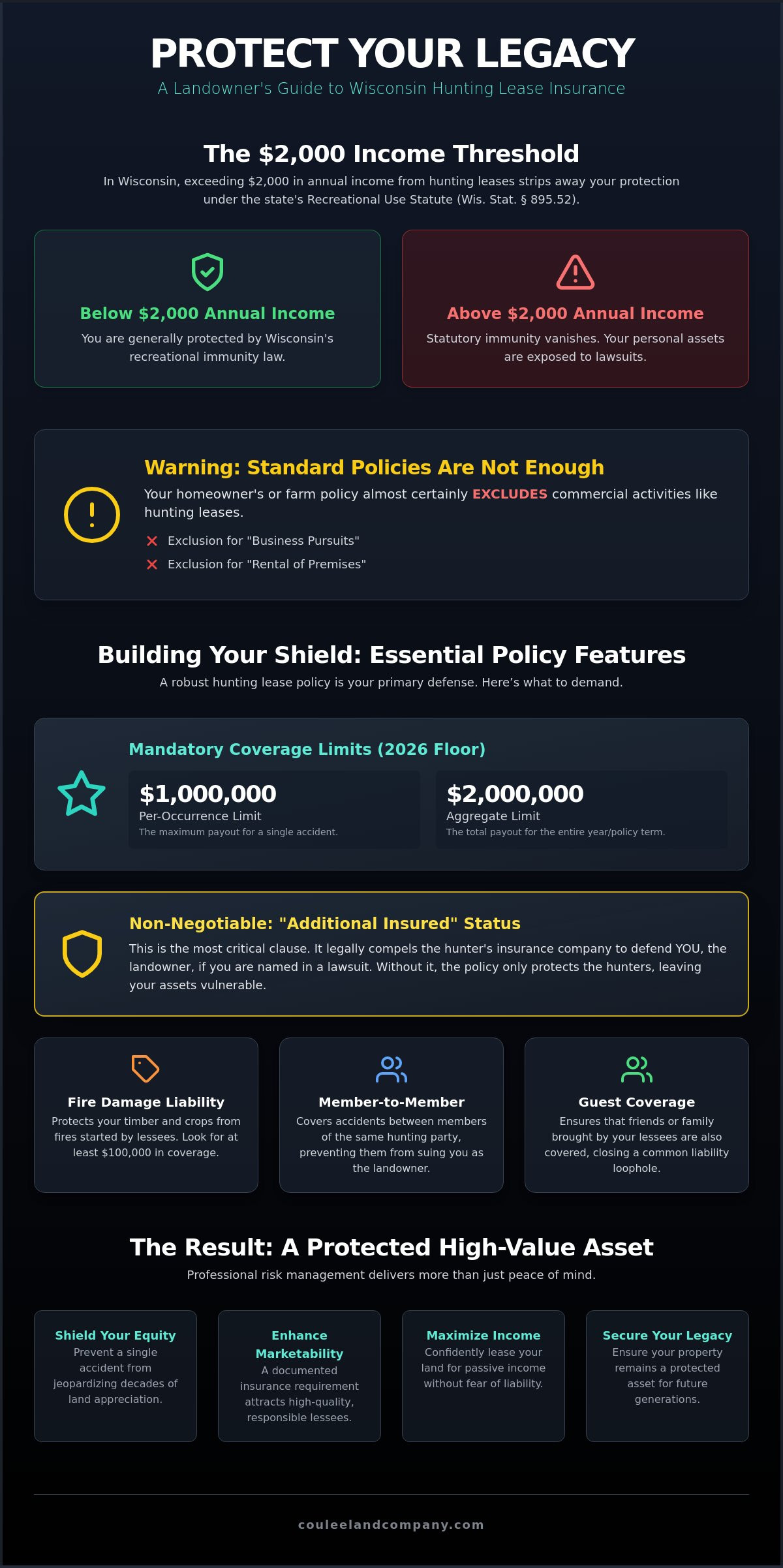
Hunting lease liability insurance isn’t just another line item on a balance sheet; it’s a specialized shield designed to cover bodily injury and property damage during recreational activities. For any property owner, understanding liability insurance is the first step in professional land management. While Wisconsin’s recreational immunity law (Wis. Stat. § 895.52) offers some baseline protection, it’s far from a “get out of jail free” card. As of July 2026, if you collect more than $2,000 in annual leasing income, that statutory immunity vanishes. You’re suddenly exposed to the full weight of a personal injury lawsuit without the state’s protection.
To better understand this concept, watch this helpful video:
The Gap in Standard Farm and Homeowners Policies
Most landowners mistakenly believe their existing farm or homeowners policy covers hunters. It doesn’t. Standard policies almost universally contain exclusion clauses for “business pursuits” or the “rental of premises.” The moment money changes hands for access, the insurance company classifies the activity as commercial. Without dedicated liability insurance for hunting leases, you’re left to defend claims out of your own pocket. A specialized policy fills this gap, covering member-to-member incidents and guest-related accidents that standard residential carriers won’t touch.
Protecting Your Equity in High-Value Bluff Country Land
In the rugged terrain of Western Wisconsin, the stakes are exceptionally high. The steep ridges and deep coulees that make Buffalo County WI land for sale so desirable also increase the profile of inherent risk. A single fall from a tree stand or an ATV accident on a vertical slope can lead to a massive legal judgment. If you aren’t properly insured, a lawsuit can result in a lien against your property, jeopardizing decades of land appreciation and family equity. Experts like Mike Law and Bryan Lemke understand that protecting your legacy requires a professional risk management strategy that accounts for the unique topography of the Bluff Country.
Essential Features of a Robust Hunting Lease Policy
Selecting the right liability insurance for hunting leases requires moving beyond the price tag to examine the specific endorsements that protect your land equity. In 2026, the industry floor for coverage is $1,000,000 per occurrence. This limit ensures that if a catastrophic event occurs, the policy is robust enough to cover legal defense fees and settlements without exhausting the funds immediately. You should also verify an aggregate limit of at least $2,000,000, which provides a secondary layer of safety for multiple incidents within a single season.
A non-negotiable requirement for any landowner is “Additional Insured” status. This specific designation ensures that the insurance company defends you directly if you’re named in a lawsuit resulting from the hunters’ actions. Without this, the policy only shields the club or individual lessees, leaving your personal assets vulnerable. When reviewing a guide to hunting lease agreements, you’ll find that professional managers prioritize this clause to create an airtight legal perimeter around the property owner.
Beyond bodily injury, look for Fire Damage Liability and Member-to-Member coverage. Fire damage protection, often capped at $100,000, is vital for shielding your timber stands and standing crops from accidental blazes started by lessees. Member-to-Member coverage is equally critical. It ensures that if one club member accidentally injures another, the policy responds, preventing the injured party from seeking damages from you as the landowner. This cross-liability protection is a hallmark of a professional-grade policy.
Evaluating Policy Limits and “Guest” Clauses
Understanding the difference between occurrence and aggregate limits is key to managing risk. An occurrence limit is the maximum paid for a single accident, while the aggregate is the total the policy pays for the entire year. If you permit your lessees to bring family or friends, ensure the policy includes specific guest coverage. Accidents don’t always involve the primary leaseholder, and you don’t want a gap in protection just because a visitor was involved.
What to Look for in a Certificate of Insurance (COI)
A Certificate of Insurance is the physical document that serves as proof of coverage and must be in your hands before anyone sets foot on the property. When you receive this document, verify these specific details:
- Policy Dates: Ensure they cover the entire duration of the hunting season.
- Landowner Name: Your name or LLC must be explicitly listed as an “Additional Insured.”
- Exclusion-Free Language: Check that there are no exclusions for common activities like using treestands or ATVs.
Managing these details correctly ensures your ground remains a high-value asset for years to come. If you’re looking to expand your portfolio, browsing premium hunting properties can give you a better sense of how professional management impacts land value.
Integrating Insurance into Your Land Management Strategy
View liability insurance for hunting leases as a foundational pillar of your property stewardship rather than a mere administrative burden. When you treat your acreage as a professional enterprise, you elevate its standing in the eyes of both the community and the market. This disciplined approach is a critical component of land management for trophy whitetails, as it ensures that the hunters accessing your ground are vetted, serious, and committed to following your specific management goals. High-quality lessees who respect the resource are far more likely to comply with insurance requirements, creating a partnership based on mutual respect for the land’s legacy.
Drafting the Lease Agreement: Insurance Requirements
Your written agreement should serve as your primary defense. Beyond requiring a policy, your lease must include robust “Hold Harmless” and indemnification clauses. These legal tools are essential for managing liability on private lands by shifting the financial responsibility of a lawsuit from the owner to the lessee. Additionally, mandate that any policy providing coverage cannot be canceled or modified without at least 30 days’ written notice to you. This prevents a club from letting their coverage lapse mid-season without your knowledge, ensuring your protection remains continuous.
How Professional Management Increases Land Value
A documented history of safe, insured leasing acts as a powerful proof of concept for future buyers. It demonstrates that the property can generate consistent recreational income without exposing the owner to ruinous risk. When you decide to move on to your next investment, having these records in place makes your tract significantly more marketable. Professional buyers look for managed risks, and you can see how we highlight these professionally managed tracts on the Coulee Land Company sellers page. Ultimately, an airtight lease backed by the right insurance is a signal of a premium asset. Consult with a land specialist like Mike Law or Bryan Lemke and an insurance professional to ensure your ground is fully protected.
Securing Your Legacy Through Professional Stewardship
Protecting your family land equity requires a shift from reactive worry to proactive management. By securing specialized liability insurance for hunting leases and integrating robust indemnification clauses into your agreements, you transform potential risks into a professional income stream. A well-documented history of insured leasing doesn’t just provide peace of mind today; it builds tangible market value for tomorrow. This pragmatic approach separates casual landowners from serious stewards who understand the true worth of their ground.
At Coulee Land Company, we’ve built a reputation as the undisputed authority in Western Wisconsin land management. Our team specializes in Buffalo County trophy whitetail properties, and our expertise is frequently featured in major outdoor media outlets. We understand that your ground is more than just acreage. It’s a dream and a long-term investment that deserves diligent protection. Ready to find your next trophy tract? View our exclusive Wisconsin hunting land listings to see how we market high-value properties with professional precision.
Your land is your legacy. With the right protection in place, you can focus on the hunt and the stewardship that makes these natural landscapes so special.
Frequently Asked Questions
Does hunting lease insurance cover trespassers who get hurt on my land?
No, hunting lease insurance specifically covers the actions of the lessees and their permitted guests rather than trespassers. While it won’t pay medical bills for someone on your land illegally, it often provides a legal defense for the landowner if a trespasser alleges that hunting-related hazards caused their injury. For broader protection against trespasser claims, you should maintain a separate general liability or farm policy alongside your lease-specific coverage.
Who should pay for the insurance: the landowner or the hunting club?
The hunting club or individual lessees typically pay the premium for liability insurance for hunting leases as part of their access agreement. This is an industry standard that shifts the cost of risk management to the party using the land for recreation. You should mandate that the hunters provide a certificate of insurance naming you as an “Additional Insured” before the season begins, ensuring your protection comes at no out-of-pocket cost to you.
What is “Cross-Liability” and why do I need it in my hunting lease policy?
Cross-liability coverage ensures that the policy responds if one insured party, such as a club member, sues another member for an accident. Without this feature, the insurance company might deny a claim between two people named on the same policy. For a landowner, this is vital because it prevents an injured hunter from seeking damages from you when their own club’s policy fails to cover a peer-to-peer incident.
Can I be sued if I allow someone to hunt on my land for free in Wisconsin?
Yes, you can still be sued even if you don’t charge a fee, although Wisconsin’s Recreational Use Statute offers robust immunity for landowners who allow free access. Statutory immunity isn’t an absolute shield. While the law is designed to protect you, it doesn’t prevent someone from filing a lawsuit that you must then pay to defend. If your annual income from recreational use remains below the $2,000 threshold, you retain this protection, but a policy is still prudent.