
Imagine standing on the edge of a 40-acre ridge in Buffalo County, watching a trophy whitetail buck cross your line, only to realize you can’t legally step foot on that ground because a neighbor blocked the old logging trail. For many hunters, the dream of owning a piece of the Bluff Country turns into a nightmare when they discover they lack legal access to landlocked property wisconsin. It’s a frustrating reality that can slash property values by 30% or more and leave your investment sitting idle. You’ve worked hard for your land, and you deserve to enjoy every acre without asking for permission from a difficult neighbor every time you want to head to the stand.
We understand that the complexities of Wisconsin property law can feel overwhelming when you’re just trying to protect your legacy. This 2026 guide delivers the exact legal pathways and negotiation strategies you need to secure permanent access to your dirt. You’ll learn how to utilize Wisconsin Statute 82.27 to your advantage and discover why professional land management starts with a clear deed. We’re going to show you how to move from a restricted parcel to a fully accessible hunting asset without jumping straight into a costly courtroom battle.
Key Takeaways
- Distinguish between mere physical trails and recorded legal rights to ensure your access to the woods is permanent and legally protected.
- Follow a proven roadmap to secure legal access to landlocked property wisconsin through professional title verification and strategic neighbor negotiations.
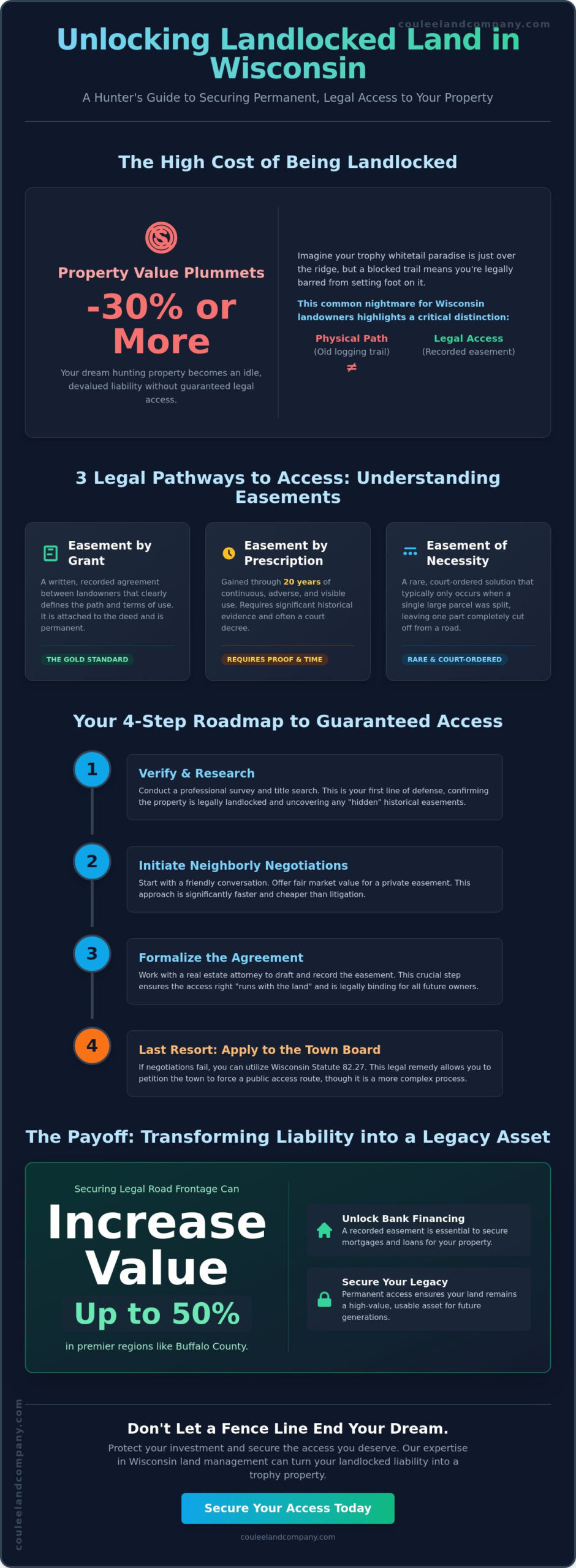
- Discover how establishing legal road frontage can increase your property’s market value by up to 50% in premier regions like Buffalo County.
- Understand why a recorded easement is the essential key to unlocking bank financing and securing mortgages on landlocked parcels.
- Learn the specialized legal pathways required to transform landlocked liabilities into high-value, accessible trophy whitetail properties.
Understanding Landlocked Property and Easement Laws in Wisconsin
Owning a piece of Wisconsin’s famed Bluff Country is a dream for many trophy whitetail hunters, but that dream can quickly sour if you can’t reach your ridge top legally. In the context of Wisconsin real estate, landlocked property refers to a parcel that lacks any legal right of access to a public highway. It’s vital to recognize the difference between physical access and legal access. You might find a well worn trail leading to your back forty, but without a recorded right to use it, you effectively have no way to reach your land without risking a trespass citation. This distinction is the bedrock of property ownership in the Badger State.
To better understand how these rights function on the ground, watch this expert breakdown:
Western Wisconsin’s rugged terrain, particularly in counties like Buffalo and Trempealeau, frequently creates scenarios where steep coulees and deep valleys isolate prime ground. A common misconception among buyers is that the state provides an automatic right of way. In reality, obtaining legal access to landlocked property wisconsin requires proactive legal steps. There is no inherent right to cross a neighbor’s land just because yours is stranded. Understanding Easements is the first step in protecting your investment and ensuring your property remains a functional asset for years to come.
Common Types of Legal Access: Easements Explained
- Easement by Grant: This is the gold standard for any land buyer. It is a written, recorded agreement between neighbors that clearly defines the path and terms of use. It stays with the deed.
- Easement by Prescription: Under WI Statute 893.28, access is gained through 20 years of continuous, adverse, and visible use. This requires significant evidence of historical passage and often involves a court’s decree.
- Easement of Necessity: These are rare, court ordered solutions. They typically only occur when a single parcel was split into multiple pieces by a previous owner, leaving one part completely cut off from the road.
Why a Title Search is Your First Line of Defense
Before closing on any hunting properties, a professional title search is mandatory. This process uncovers “hidden” easements that aren’t physically visible on the terrain, such as old utility rights or forgotten cartways. In Western Wisconsin, title insurance acts as your primary shield. It protects you from future access disputes and ensures your right to reach those high value hunting grounds is secure. Don’t rely on a handshake deal when the value of your land depends on the legal right to step foot on it.
How to Secure Legal Access to Landlocked Land: A Step-by-Step Guide
Securing legal access to landlocked property wisconsin requires a blend of technical verification and diplomatic strategy. We follow a proven four-step process to resolve these bottlenecks and protect your investment in the Bluff Country. First, you must conduct a professional survey and title search. This confirms the property is truly landlocked and ensures no historical easements exist in the chain of title that were simply forgotten over decades of ownership changes.
Once the status is confirmed, follow these steps to establish access:
- Initiate neighborly negotiations to purchase a private easement for a fair market price.
- Formalize agreements with a real estate attorney to ensure the easement “runs with the land,” meaning it stays with the property regardless of who owns it in the future.
- Apply to the Town Board if negotiations fail, utilizing specific legal remedies to force a public access route.
The Art of the Neighborly Negotiation
A handshake and an honest conversation over a fence line often yield better results than a legal summons. Starting with a friendly approach is significantly cheaper than litigation. When offering compensation, value the easement based on the specific advantages it brings to your acreage. We often recommend using a land specialist broker as a neutral third party to facilitate these deals. A broker acts as a professional bridge, keeping emotions out of the conversation and ensuring the terms align with current market standards for Western Wisconsin land.
Utilizing Wisconsin Statute 82.27: The Town Board Application
If a neighbor refuses to grant access, Wisconsin Statute 82.27 provides a secondary path. This statute allows a landowner to petition the Town Board to lay out a highway to a parcel that is otherwise inaccessible. To qualify, the land must be located within a town and used for agricultural or other specific purposes. The board then applies the “Advantages Test.” This determines if the public and private benefits of the road outweigh the costs to the community.
You must be prepared for the financial reality of this route. The applicant is responsible for all construction and administrative costs associated with the new town highway. This is a calculated investment that transforms a landlocked tract into a high-value asset. If you are currently evaluating a potential purchase, our hunting properties listings feature tracts where access and land management potential have already been vetted by our experts.
Why Legal Access is Critical for Hunting Land Value in Bluff Country
In Buffalo County, the price gap between a landlocked parcel and one with legal road frontage is often 20% to 50% of the total market value. Without a recorded easement, your property is effectively a stranded asset. Most lenders, including specialized agricultural banks, won’t issue a mortgage on landlocked property without documented access. Relying on a neighbor’s handshake agreement is a high-stakes gamble. If that neighbor sells or passes away, your access can vanish overnight. Securing legal access to landlocked property wisconsin isn’t just a convenience; it’s the foundation of your investment’s liquidity.
Beyond the financial implications, access dictates your success as a hunter. Managing for trophy whitetails in the Coulee Region requires “clean” access. This means having the legal right to enter and exit your stands from specific directions based on the wind without spooking deer. If you’re forced to use a single, suboptimal entry point because it’s the only one your neighbor allows, you’ll likely burn out your best spots before the rut even begins.
Access and Land Management for Wildlife
Effective Wisconsin land management for wildlife requires more than a foot trail. You need to move tractors, no-till drills, and lime trucks to establish high-quality food plots. If you can’t get heavy equipment onto the site, your ability to perform timber stand improvements or maintain thermal cover is severely limited. Legal control over your entry points ensures these long-term habitat projects remain viable for decades.
The Broker’s Perspective: Buying Landlocked Land
Smart buyers identify red flags early in the due diligence period. If a seller can’t produce a recorded easement or a deeded strip of land, it’s often a reason to walk away. Coulee Land Company agents specialize in navigating these complex access hurdles in Western Wisconsin. We help you determine if a property is a “diamond in the rough” with a fixable access issue or a legal nightmare to avoid. Learn more about our specialized buying services for hunting land to ensure your piece of Bluff Country is a sound investment.
Claim Your Piece of the Wisconsin Bluffs
Securing legal access to landlocked property wisconsin is the most critical step in protecting your investment and ensuring your hunting legacy. You now understand how Wisconsin Chapter 82 statutes provide a framework for access, but you also know that proactive easement negotiations are vital for maintaining the high land values found in Buffalo County. This region consistently leads the nation in Boone and Crockett whitetail entries, making legal entry a non-negotiable requirement for any serious land manager in 2026. Coulee Land Company specializes in Western Wisconsin’s Bluff Country, bringing a level of expertise endorsed by the industry’s top outdoor television hosts. We don’t just sell dirt; we provide the foundation for your future hunts. Take the next step toward owning a property that delivers on its promise of world class wildlife and long term security. Looking for land with guaranteed access? View our exclusive Wisconsin listings.
Your journey to owning the perfect hunting tract starts with verified access and expert guidance. We’re ready to help you navigate the terrain.
Frequently Asked Questions
Does Wisconsin law guarantee access to landlocked property?
Wisconsin doesn’t provide an automatic right of access to landlocked parcels. You won’t find a “right to roam” here. Instead, owners must secure a private easement through negotiation or petition the Town Board under Wisconsin Statute 82.27. This statutory process is often a last resort for hunters and landowners because it’s complex and requires the petitioner to prove the land is truly inaccessible to the public.
Can a neighbor block me from my landlocked property in Wisconsin?
A neighbor can legally block you from crossing their land if you lack a recorded legal easement. Even if your family has used a specific logging trail for 30 years, a verbal “handshake deal” won’t hold up in court against a new property owner. Securing legal access to landlocked property wisconsin requires a written document filed with the County Register of Deeds to ensure your path to the woods remains permanent.
How much does it cost to get a legal easement in Wisconsin?
Costs for legal access vary based on the method used and the terrain of the Bluff Country. While a private easement purchase depends on the neighbor’s price, a formal application under Statute 82.27 forces the applicant to pay for all road construction and administrative fees. These projects frequently exceed $20,000 and can climb above $50,000 if the topography requires significant grading or culvert installation to meet town road standards.
What is the difference between an easement and a right-of-way?
An easement is a legal right to use another person’s land for a specific purpose, while a right-of-way is a specific type of easement used for travel. For a hunter in Buffalo County, an easement might cover utility lines or drainage. A right-of-way specifically grants the authority to drive across a neighbor’s property. It’s vital to understand this distinction for maintaining legal access to landlocked property wisconsin without infringing on ownership rights.