
Holding onto a prime piece of Buffalo County dirt while property taxes climb can feel like a losing game, but the obvious choice to cash out might actually be the most expensive mistake you make this year. If you think liquidating your acreage is the only way to capture today’s high valuations, you’re missing a strategy that seasoned land managers use to drive prices even higher. Deciding between leasing vs selling hunting land wisconsin requires a cold, hard look at your long-term goals and the current 2026 market dynamics.
We understand the pressure of rising carrying costs and the nagging fear that the land market peak is behind us. This strategic guide compares immediate equity gains from a sale against the steady, passive income of a high-quality hunting lease to reveal the most profitable path for your dirt. You’ll discover how to leverage current 7.8 percent appreciation rates in Western Wisconsin while using a lease to build the trophy resume that future buyers will pay a premium for.
Key Takeaways
- Analyze the record-breaking valuations across the Driftless Area to determine if your acreage is positioned for a peak-market exit in 2026.
- Compare the annual passive income potential of prime Bluff Country timber leases against the high-yield returns of agricultural cash rents.
- Evaluate the critical factors in the leasing vs selling hunting land wisconsin debate, including liability protections and Managed Forest Law (MFL) tax implications.
- Learn how the “Hybrid Approach” uses a multi-year lease to build a documented trophy whitetail history, significantly increasing your eventual sale price.
- Access a 5-step strategic checklist designed to align your property’s unique attributes with your specific financial and legacy goals.
The Financial Crossroads: Immediate Equity vs. Annual Cash Flow
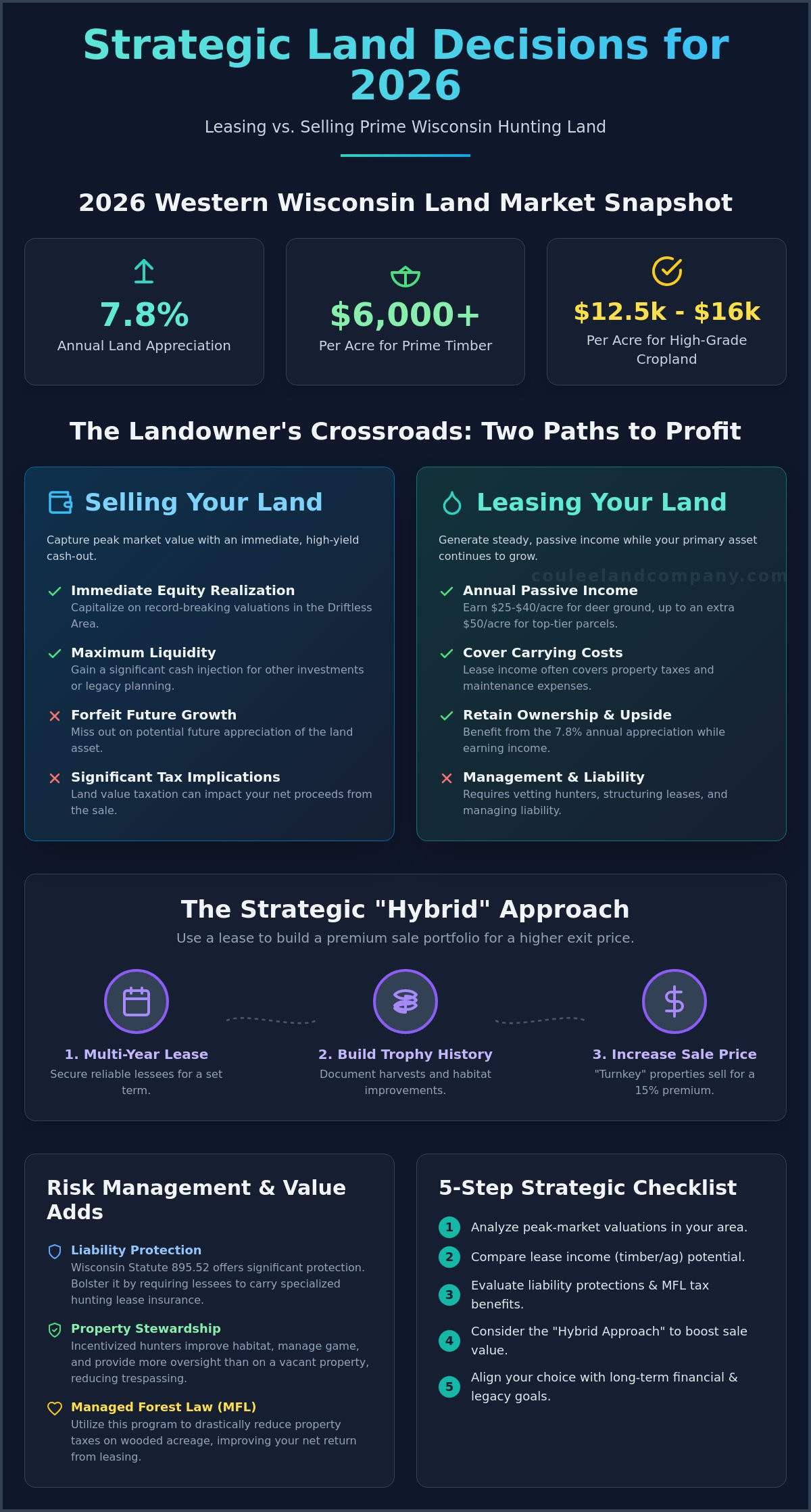
Wisconsin’s Driftless Area has transformed into a financial powerhouse for landowners. As of 2026, Western Wisconsin land appreciation is projected at a robust 7.8 percent, outpacing the state average and creating a massive equity cushion for long-term owners. This surge in value forces a critical evaluation of leasing vs selling hunting land wisconsin. You must decide if the immediate liquidity of a record-breaking sale outweighs the steady, reliable cash flow of a managed lease. Realizing these gains requires understanding land value taxation and how it impacts your net bottom line when the closing papers are signed.
To better understand the nuances of generating income from your ground, watch this helpful video:
2026 Wisconsin Land Value Benchmarks
Buffalo County remains the crown jewel of the Midwest. High-value hunting tracts here often command premiums that exceed $6,000 per acre for prime timber, while high-grade cropland in the state is projected to range between $12,500 and $16,000 per acre this year. These valuations are a double-edged sword; rising property taxes are eroding the traditional “buy and hold” strategy. For many, the choice to sell your Wisconsin land is driven by the need to capture peak equity before tax burdens outpace annual growth.
The ROI of Leasing as a Holding Strategy
Leasing serves as a powerful defensive play for those not ready to exit the market. Quality deer ground in Wisconsin currently fetches between $25 and $40 per acre, while recreational leases on top-tier parcels can push an additional $50 per acre into your pocket. This income often covers the annual tax bill and basic maintenance. Utilizing the Managed Forest Law (MFL) program further sharpens this strategy by drastically reducing property taxes on wooded acreage. When weighing leasing vs selling hunting land wisconsin, remember that a lease preserves your future upside while providing immediate relief from carrying costs. You must balance this 3 to 5 percent yield against the potential returns of reinvesting sale capital into other high-growth assets.
The Landowner’s Dilemma: Risk Management and Property Integrity
Opening up your private ground to others often triggers a visceral concern about property damage and unauthorized access. However, the choice between leasing vs selling hunting land wisconsin doesn’t have to be a compromise on your peace of mind. Managed access through a formal lease actually provides more oversight than leaving a property vacant, where trespassing often goes unnoticed for months. By establishing clear harvest goals and boundary expectations, you transform your acreage from a passive holding into a strictly governed asset that is actively protected by those who value it most.
A well-structured lease does more than pay the property taxes; it functions as a professional management tool. When hunters have skin in the game, they’re incentivized to pass on younger bucks and improve habitat quality through food plots and timber stand improvements. This stewardship directly impacts your bottom line. Data shows that “turnkey” hunting properties with documented harvest history and established infrastructure sell for a 15 percent premium over raw, unmanaged land. High-quality agricultural land prices in Wisconsin reflect this trend, where utility and proven production drive the highest bids in the marketplace.
Securing Your Liability in 2026
Liability remains the top objection for landowners, yet Wisconsin Statute 895.52 offers significant legal protection for those opening land for recreational use. In 2026, relying solely on a general umbrella policy isn’t enough to protect your legacy. You should require lessees to carry specialized hunting lease insurance that names you as an additional insured. Vetting your hunters is equally vital. We recommend an interview process that prioritizes local references and a shared philosophy on game management to ensure your dirt is respected by every person who crosses the fence line.
The Strategic Exit: Using a Lease to Build a Sale Portfolio
If your ultimate goal is to exit the market, think of your lease as a multi-year marketing campaign. Every trail camera photo of a 160-inch buck and every documented harvest adds tangible value to your property’s trophy resume. This historical data removes the guesswork for future buyers and justifies a higher asking price. If you’re curious about how these factors influence your market position, you can learn How to Value Recreational Land for Sale to see where your property stands. Our team of authorized land specialists can help you document this growth to ensure you don’t leave money on the table when you finally decide to list.
Making the Final Move: When to Hold, Lease, or Sell
Determining the optimal path for your acreage requires aligning your immediate financial needs with the long-term potential of the land. While the 2026 market offers record-breaking valuations, the decision between leasing vs selling hunting land wisconsin isn’t always a binary choice. Many sophisticated landowners now utilize a hybrid strategy: they lease the property for two to three years to establish a documented “trophy resume” before listing. This approach allows you to collect annual income while simultaneously building the proof of giant whitetails that justifies a top-tier asking price in the Driftless Area.
The 5-Step Landowner Decision Framework
- Step 1: Define Your Horizon. Do you need immediate liquidity for a 1031 exchange, or is your goal to offset rising property taxes while the land appreciates?
- Step 2: Evaluate Management Capacity. Leasing requires vetting hunters and enforcing contracts. If you prefer a “hands-off” exit, a clean sale is often the superior route.
- Step 3: Analyze the 2026 Upside. With Western Wisconsin appreciation projected at 7.8 percent, holding for another 24 months could significantly increase your net proceeds.
- Step 4: Audit Property Infrastructure. Does your land have the food plots and trail systems that command a 15 percent sale premium, or should you lease it while these improvements mature?
- Step 5: Get a Professional Valuation. Surface-level estimates from general realtors often ignore the “dirt value” of trophy potential. Secure a detailed market analysis from Coulee Land Company specialists to see your true numbers.
Why Regional Expertise Matters
General real estate agents often treat a timber tract like a suburban lot, completely missing the nuances of Buffalo County land dynamics. They don’t understand how a specific ridge top or a hidden thermal hub impacts the huntability and value of your ground. Professional land specialists like Mike Law or Bryan Lemke bridge this gap by speaking the language of both high-stakes real estate and elite game management. Whether you choose to lease for the short term or execute a record-breaking sale, having a partner who understands the unique heartbeat of Bluff Country ensures your legacy is protected and your profit is maximized. Reach out today for a confidential consultation to determine the best move for your Wisconsin dirt.
Securing Your Legacy in Wisconsin’s Bluff Country
The choice between leasing vs selling hunting land wisconsin ultimately rests on your personal timeline and the specific financial goals you have for your acreage in 2026. Whether you decide to capture immediate liquidity at today’s record-breaking valuations or implement a multi-year lease to build a documented trophy resume, your strategy must be data-driven. We’ve analyzed how the right management approach can transform a standard timber tract into a high-demand asset that commands a significant market premium. Your land is more than just property; it’s a financial and recreational engine that requires expert tuning to reach its full potential.
Don’t leave your property’s valuation to chance with a general realtor who doesn’t know a bedding thicket from a brush pile. As dedicated specialists in Buffalo County, the undisputed #1 trophy whitetail county in the nation, we bring a results-oriented track record to every transaction. We possess a deep understanding of Bluff Country topography and the precise management tactics required to maximize your net proceeds. If you’re ready to see what your dirt is truly worth in this competitive market, Get a Free Property Valuation and Strategic Consultation today. Let’s work together to ensure your Wisconsin ground performs exactly the way you need it to.
Frequently Asked Questions
How much can I charge for a hunting lease in Wisconsin per acre in 2026?
Quality deer ground in Wisconsin typically fetches between $25 and $40 per acre for the 2026 season. High-demand tracts in the Driftless Area can command even higher premiums, especially when recreational leases add an additional $25 to $50 per acre to the total. Factors like established food plots, trophy harvest history, and exclusive access to prime timber drive these rates toward the top of the market range.
Does leasing my land for hunting make it harder to sell later?
Strategic leasing actually makes a property more attractive to buyers by establishing a documented track record of trophy whitetail production. In the current market, turnkey properties with proven trail camera data and harvest records often sell for a 15 percent premium over raw ground. A well-managed lease proves the land’s recreational utility and removes the financial uncertainty that often accompanies unmanaged acreage.
Do I need special insurance if I lease my Wisconsin land for hunting?
You should require all lessees to carry specialized hunting lease insurance that names you as an additional insured to provide protection beyond your standard umbrella policy. While Wisconsin Statute 895.52 offers robust liability protection for landowners who open their ground for recreational use, professional insurance ensures you aren’t personally responsible for legal defense costs. This extra layer of security is a standard requirement for any professional land management strategy.
What are the tax implications of selling my hunting land vs. leasing it?
Selling your acreage triggers capital gains taxes on the asset’s appreciation, whereas lease income is generally treated as ordinary income. When evaluating the choice of leasing vs selling hunting land wisconsin, it’s vital to consider how programs like the Managed Forest Law (MFL) or agricultural use-value assessments impact your annual bill. Holding the land allows you to benefit from 7.8 percent regional appreciation while lease income offsets your carrying costs.