
You’ve found what looks like the perfect tract of Wisconsin hunting land. The aerials are promising and the acreage is right, but can the agent on the sign truly see its potential? Can they walk the property with you and identify crucial travel corridors, potential food plot locations, and the real wildlife capabilities that create a legacy property? This is where the critical debate of land specialist vs realtor comes into sharp focus, because not all representation is created equal when your dream is on the line.
Buying raw land, especially in the famed hunting grounds of Western Wisconsin, is a far more complex transaction than buying a home. It requires a deep, boots-on-the-ground understanding of topography, habitat, access rights, and land management principles. In this guide, we will break down the crucial differences between a general realtor and a true land specialist, empowering you to avoid costly mistakes, make an informed investment, and secure the hunting property you’ve always envisioned.
The Fundamental Divide: Generalist Realtor vs. Niche Land Specialist
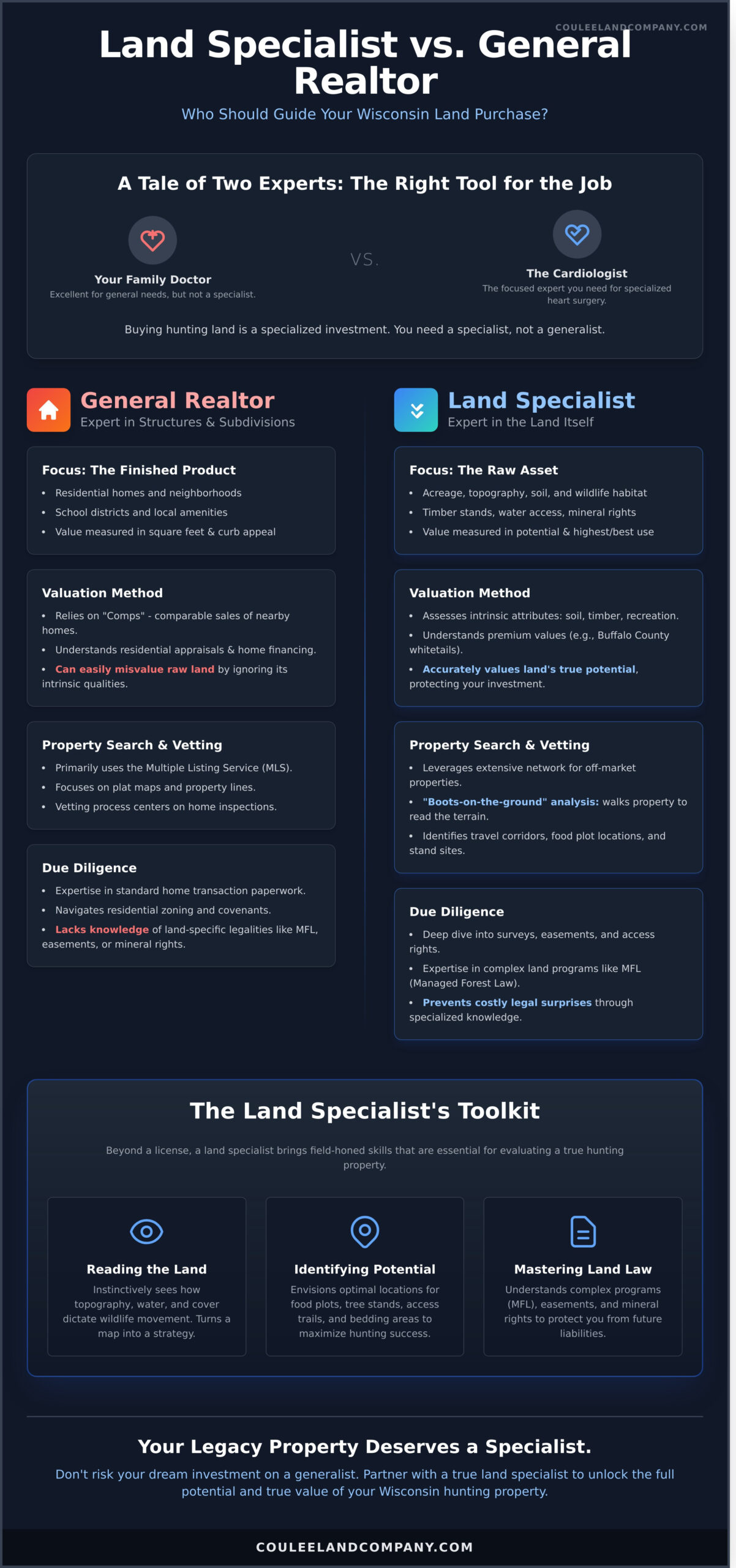
When you need specialized heart surgery, you don’t call your family doctor. You seek out a cardiologist-a specialist with deep, focused expertise. The same logic applies when you’re buying or selling rural land. While both are licensed professionals, the distinction in the land specialist vs realtor debate comes down to this fundamental difference: one is a generalist, the other is a niche expert.
The traditional Real estate agent is an expert in structures and the communities built around them. Their primary focus is on residential homes, navigating the world of neighborhoods, school districts, and finished properties. A land specialist, however, is an expert in the land itself-its intrinsic value, its potential, and its highest and best use. When you buy a parcel of land, you are investing in a raw asset, not just a structure with curb appeal. This requires a guide who understands the earth, not just the house sitting on it.
What a Residential Realtor Excels At
A residential realtor is the undisputed expert in the suburban and urban marketplace. Their knowledge is critical for transactions involving finished homes, where value is tied to features inside and around the house. Their world is measured in square feet and property lines defined by fences.
- Navigating neighborhood markets, school districts, and home comps.
- Marketing finished homes through the MLS, professional staging, and photography.
- Understanding home inspections, residential appraisals, and traditional home financing.
- Advising on factors like commute times, local amenities, and curb appeal.
The World of the Land Specialist
In the crucial comparison of a land specialist vs realtor, the specialist’s domain begins where the pavement ends. We operate in a world where value is determined by acreage, topography, soil quality, and wildlife capabilities. We see a property not just for what it is, but for the legacy it can become-a premier hunting tract, a productive farm, or a family retreat.
- Analyzing acreage, topography, soil types, and wildlife habitat.
- Understanding land-specific value drivers like timber stands, water access, and mineral rights.
- Navigating complex issues like easements, surveys, zoning, and land use regulations.
- Assessing a property’s potential for trophy whitetails and effective land management.
Key Differences in Expertise: A Head-to-Head Comparison
While both a general realtor and a land specialist are licensed to sell real estate, their expertise is tailored for entirely different assets. A generalist focuses on structures and subdivisions; a specialist focuses on the soil, timber, and soul of a property. This distinction is crucial when considering the land specialist vs realtor debate. True land experts often pursue advanced training, earning credentials like the Accredited Land Consultant (ALC) designation to master the unique variables of rural and recreational properties.
The difference in approach directly impacts the outcome of your investment, from valuation to the final closing. Let’s break down the critical areas where a specialist’s knowledge provides a superior advantage.
Market Knowledge and Valuation
A residential realtor determines value using comparable sales (comps) of nearby homes. This method fails when applied to raw land, as it overlooks the very elements that create its true worth. A land specialist assesses a property based on intrinsic attributes: soil productivity, the volume and species of marketable timber, and its unique recreational potential. They understand why a parcel in the heart of Buffalo County-an area that dominates the whitetail entries in the Boone and Crockett Record Book-commands a premium for its proven ability to produce trophy bucks. A realtor, lacking this specific insight, could easily undervalue a hunter’s paradise or overvalue a property with limited wildlife capabilities.
Property Search and Vetting
Finding the right piece of ground is rarely as simple as searching the Multiple Listing Service (MLS), a tool designed for homes, not habitats. A land specialist operates far beyond the MLS, leveraging an extensive network of landowners and off-market connections to uncover properties that never become public listings. More importantly, their vetting process is hands-on. We don’t just look at a plat map; we put boots on the ground to walk the property, reading the terrain, identifying pinch points for deer travel, and envisioning optimal locations for food plots, tree stands, and access trails. This is a level of diligence a typical realtor simply isn’t equipped to provide.
Due Diligence and Legal Complexities
The paperwork for a land purchase extends far beyond a standard home inspection report. The critical difference in the land specialist vs realtor discussion often comes down to navigating these complexities. A land specialist dives deep into the details that can make or break your investment: verifying surveys, untangling access easements, clarifying water and mineral rights, and understanding local zoning. In Wisconsin, this includes a profound understanding of programs like the Managed Forest Law (MFL), which has significant tax and land-use implications. This specialized expertise is your greatest defense against costly legal surprises after the sale.
The Land Specialist’s Toolkit: Skills a Realtor Simply Doesn’t Have
When considering the land specialist vs realtor debate, it’s crucial to understand that the difference goes far beyond a job title. A true land specialist brings a unique toolkit to the table-a collection of hard-earned skills that a residential realtor simply does not possess. These aren’t just selling points; they are the essential instruments for making a sound investment and turning a good piece of ground into a legendary hunting property.
Reading the Land Like a Hunter
A land specialist doesn’t just see acres on a plat map; they read the landscape like a seasoned hunter. They can walk a property and immediately identify the subtle funnels and pinch points that dictate deer movement. They see the south-facing slopes for bedding areas, the oak ridges for mast crops, and the hidden travel corridors connecting food to cover. This isn’t knowledge from a textbook-it’s an instinct honed by thousands of hours in the field, understanding how topography, water sources, and timber quality converge to create superior wildlife habitat.
Understanding Habitat and Improvement Potential
Where a typical agent sees a fallow field or a thick stand of timber, a specialist sees untapped potential. Their expertise extends into active land management, allowing them to envision what a property could become. They provide superior counsel on:
- Strategic placement of food plots to draw and hold trophy whitetail bucks.
- Implementing Timber Stand Improvement (TSI) to enhance both forest health and wildlife habitat.
- Designing sanctuary areas to give deer the security they need to reach maturity.
This vision is key to maximizing not only your hunting success but also the long-term financial value of your investment.
Navigating the ‘Unseen’ Value
The true value of a hunting property often lies in factors invisible to the untrained eye. A specialist navigates the complex web of government programs, conservation easements, and tax incentives that can significantly impact a property’s cost and utility. This level of expertise is often formalized through rigorous training, leading to designations like the Accredited Land Consultant (ALC), which a general realtor rarely pursues. Furthermore, their value is magnified by their network-trusted connections with local foresters, surveyors, and habitat consultants who can help you execute your vision. This is the critical distinction: one sells property, the other provides a lifetime of expertise.
The High Cost of Using the Wrong Agent for Your Land Purchase
Purchasing your dream property is one of the most significant investments you’ll ever make. This is where the debate of a land specialist vs realtor becomes more than just a choice-it becomes a critical decision that can either secure your legacy or lead to financial disaster. Choosing an agent without specialized land expertise isn’t just a risk; it’s a gamble with devastatingly high stakes. The right agent isn’t a cost, but an investment in certainty and success.
Risk 1: Overpaying for a ‘Pretty’ but Unproductive Property
A residential realtor might tour a property and see a beautiful rolling hill with a scenic view, pricing it accordingly. But a land specialist sees what isn’t there: poor soil unsuitable for food plots, a lack of thermal cover to hold deer in winter, or no south-facing slopes for bedding. You could easily overpay for a parcel that looks good on a postcard but will never hold the trophy whitetail bucks you’re after. A specialist ensures you’re investing in true, measurable recreational value, not just a view.
Risk 2: Discovering Hidden Access or Title Issues
Imagine closing on your perfect remote hunting tract, only to discover the “road” you used to get there is an informal path across a neighbor’s land-not a legal, deeded easement. You are now the proud owner of a landlocked property. Or worse, you find out a timber company owns the rights to harvest your woods. These are catastrophic and costly mistakes that a generalist might overlook, but a land specialist is expertly trained to identify and prevent them through meticulous due diligence.
Risk 3: Missing Out on the Perfect Property
The best hunting properties in Wisconsin’s famed Bluff Country often trade hands without ever hitting the open market. These deals happen through a trusted, personal network of landowners, farmers, and serious outdoorsmen-a network that residential realtors simply don’t have. By working with a general agent, you are only seeing a fraction of the available inventory. The property you’ve been dreaming of could be sold before you ever knew it existed, all because your agent wasn’t in the right circles.
Ultimately, the consequences of using the wrong agent can haunt you for decades. When you evaluate a land specialist vs realtor, you are choosing between proven expertise and unnecessary risk. Protect your investment and your dream by partnering with a team that lives and breathes Wisconsin land. Explore our properties and see the difference a specialist makes.
Why Wisconsin Land Buyers Partner With a Coulee Land Company Specialist
Throughout this guide, we’ve detailed the critical differences in the land specialist vs realtor debate. The choice boils down to partnering with a generalist or entrusting your legacy to a dedicated expert who lives and breathes the land you covet. At Coulee Land Company, we are those experts. Our entire business is built on the specialized knowledge, authentic passion, and proven results that a standard real estate agent simply cannot provide.
We Don’t Just Sell Land-We Live It
Our team is comprised of passionate hunters, devoted conservationists, and seasoned land managers. We don’t just understand the obsession with trophy whitetails and the legacy of Wisconsin’s Bluff Country-we share it. This isn’t a job; it’s our lifestyle. We provide granular insights on deer travel corridors, soil quality for food plots, and timber value that only come from a lifetime spent walking these woods, managing these habitats, and waiting in these deer stands.
Unmatched Expertise in Western Wisconsin
Our focus isn’t diluted by national ambitions; it’s laser-focused on the unique hunting and recreational properties of Western Wisconsin. We are the undisputed authority on Buffalo County and the surrounding region, an area that dominates the whitetail entries in the Boone and Crockett Record Book. Our unparalleled network of buyers, sellers, local contractors, and wildlife experts gives our clients a decisive advantage, ensuring they see the best properties first and get the most value from their investment.
A Proven Track Record of Success
The trust placed in us by the hunting community-from local landowners to the hosts of major outdoor television shows-is our greatest asset. There’s a reason we’re known as “the hunter’s realtor.” Our success is measured not just in acres sold, but in the dreams we help realize. The discussion of a land specialist vs realtor becomes clear when you see the consistent, superior results our clients achieve.
Don’t risk your dream property on an agent who doesn’t understand its true worth. Partner with a true Land Specialist today.
Your Wisconsin Legacy Demands an Expert Partner
When it comes to purchasing land in Wisconsin, the choice is clear. A generalist realtor simply cannot match the deep, specialized knowledge of a land specialist. From understanding soil types and timber value to identifying prime hunting locations and navigating complex zoning laws, the right expertise is not just an advantage-it’s essential to protecting your investment and realizing your vision.
The debate of land specialist vs realtor isn’t about finding any agent; it’s about securing a true partner who understands the soul of the land. At Coulee Land Company, we are those partners. As passionate hunters and dedicated land managers, we possess unrivaled expertise in Wisconsin’s famed ‘Bluff Country,’ specializing in the trophy whitetail properties that define this legendary region.
Don’t leave the most important purchase of your life to chance. Connect with Wisconsin’s Land & Property Sales Specialists to find your perfect property. Your piece of the Wisconsin dream is waiting.
Frequently Asked Questions
Can a regular real estate agent legally sell land?
Yes, any licensed real estate agent can legally facilitate a land transaction. However, the critical difference lies in specialized expertise. A general realtor understands homes, whereas a land specialist possesses deep knowledge of zoning, easements, soil types, timber value, and wildlife capabilities. For a serious investment in hunting or recreational property, this specialized insight is not just a benefit-it’s essential for making a confident and successful purchase in Wisconsin’s famed Bluff Country.
Are land specialists more expensive than realtors?
No, the commission structure for a land specialist is typically the same as a traditional realtor’s, and it is almost always paid by the seller. The true value comes from the specialist’s expertise, which can save you from costly mistakes and uncover hidden potential in a property. An expert who understands land management and trophy whitetail habitat doesn’t cost you more; they protect your investment and enhance its long-term value, ensuring you get the superior property you’ve been dreaming of.
What specific questions should I ask when interviewing an agent to buy land?
To identify a true expert, go beyond standard questions. Ask about their personal hunting experience and knowledge of land management for wildlife. Inquire about their track record with properties similar to yours and their familiarity with local programs like Managed Forest Law (MFL). A crucial question is: “Can you walk this property and identify key habitat features like travel corridors, bedding areas, and potential food plot locations?” Their answers will quickly reveal their depth of knowledge.
How is financing for raw land different from a home mortgage?
Financing for raw land is fundamentally different. Lenders often consider it a higher-risk investment, which means they typically require larger down payments-often 20% or more. The loan terms may be shorter and interest rates slightly higher than a conventional home mortgage. A knowledgeable land specialist has established relationships with lenders who are experienced in financing rural and recreational properties, which is a significant advantage for navigating this unique process successfully.
Does a land specialist also help with selling my property?
Absolutely. A land specialist is your most powerful asset when selling. We don’t just list your land; we market its unique story and hunting potential to a highly targeted audience of passionate outdoorsmen. Our understanding of what makes a property a trophy-producing parcel allows us to highlight value that a general agent would overlook. This is a key factor in the land specialist vs realtor discussion, as our specialized marketing ensures your property reaches qualified buyers and commands its true maximum value.
What is the most common mistake people make when buying hunting land?
The single most common mistake is focusing on a cabin or structure instead of the quality of the land itself. Buyers can be captivated by a turnkey camp and overlook critical flaws like poor access for hunting, significant pressure from neighbors, or a lack of quality deer habitat. An expert land specialist guides you to prioritize the land’s core wildlife capabilities first, ensuring your investment aligns with your long-term goals for creating a premier hunting property.