
Most land buyers view a state park boundary as a potential liability for trespassing, but for the strategic sportsman, it’s actually the ultimate force multiplier for growing and holding trophy class whitetails. You’ve likely spent years dreaming of a private sanctuary where your backyard feels like it stretches for thousands of acres, yet you’re often held back by concerns over public hunting pressure or complex DNR regulations. These common fears often stop buyers from pursuing the most valuable land for sale near state parks wisconsin, missing out on unique habitat advantages that only a park border provides.
This guide will show you how proximity to Wisconsin’s state parks can enhance your land’s recreational value, wildlife potential, and long-term investment security. With 2025 data showing land bordering public areas averaging $14,054 per acre, the market for 2026 remains a strong play for the diligent investor looking for high-quality recreational tracts. We’ll explore the sanctuary effect that creates an infinite backyard feel and review the 2026 hunting season dates, including the November 21 gun opener, to help you maximize your new property. This is your roadmap to understanding the current market and the specific DNR rule updates that safeguard your private retreat.
Key Takeaways
- Learn how sharing a border with state acreage creates an “infinite backyard,” giving you private access to thousands of acres while maintaining your own secure home base.
- Discover how to leverage the “Sanctuary Effect” to grow and hold mature, trophy-class whitetails that use state park habitat as a safe haven.
- Evaluate why land for sale near state parks wisconsin offers superior long-term investment security through permanent conservation buffers.
- Gain professional strategies for managing public hunting pressure and preventing trespassing to keep your private retreat truly exclusive.
- Understand the critical role of MFL status and boundary surveys when navigating the complexities of purchasing property next to state-owned land.
The Strategic Value of Land Bordering Wisconsin State Parks
Park-adjacent land is defined as private property that shares a physical boundary with state-protected acreage. When you search for land for sale near state parks wisconsin, you aren’t just buying a parcel of dirt. You’re securing a stake in a landscape where the state handles the heavy lifting of habitat management and permanent conservation. This proximity creates an “infinite backyard” effect. You might own 20 or 40 acres, but you gain immediate, walkable access to thousands of acres for hiking, scouting, and fishing. It’s a strategic way to own a private home base while enjoying the scale of a massive estate.
To better understand the potential of these unique Wisconsin tracts, watch this helpful video:
Permanent Conservation Buffers and Property Value
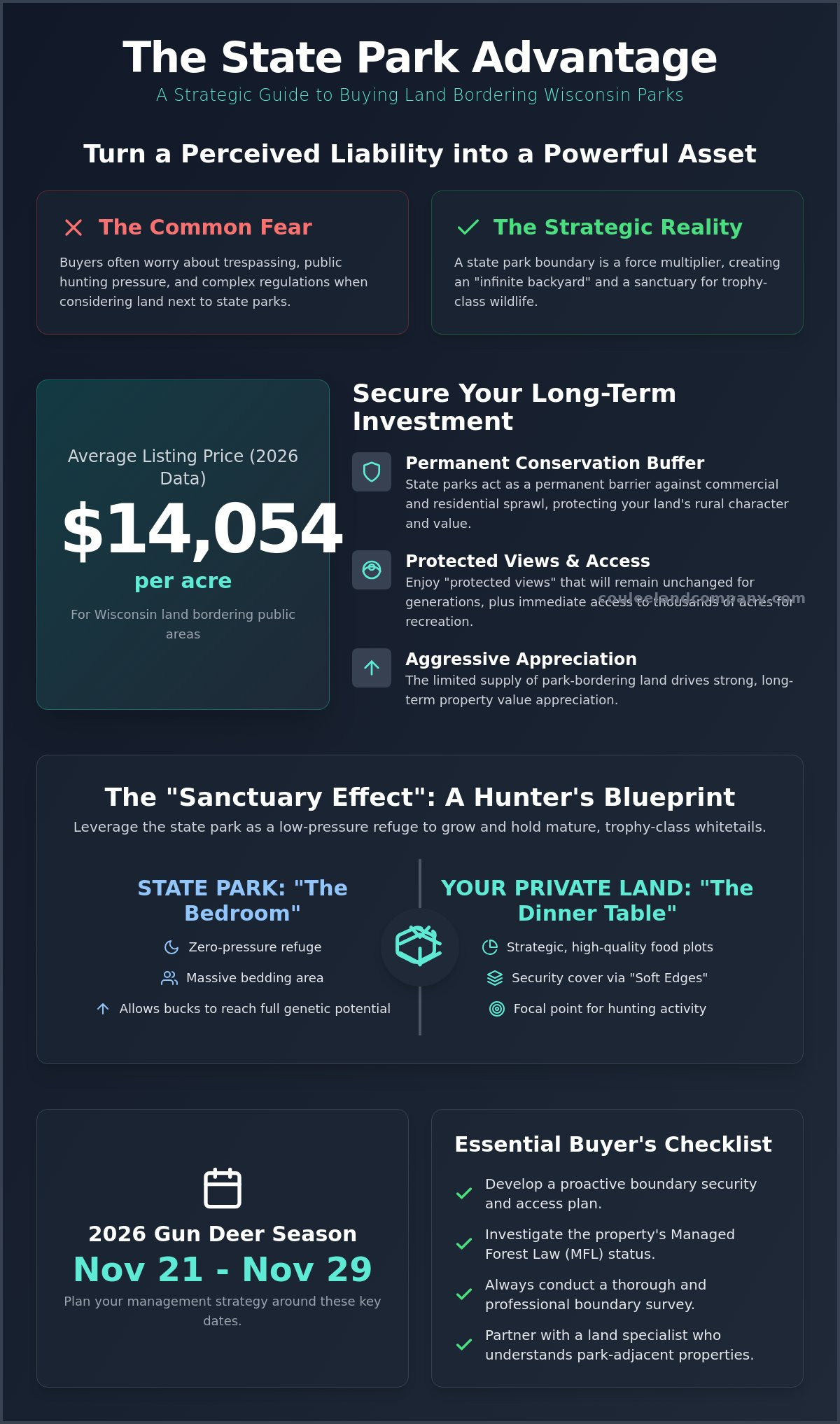
State parks serve as permanent buffers against the commercial and residential sprawl that often degrades rural land values. Unlike property near growing municipalities, these borders won’t eventually turn into subdivisions or industrial sites. This limited supply of park-bordering land drives aggressive long-term appreciation. As of July 8, 2026, the average listing price for Wisconsin land bordering federal, state, or county land reached $14,054 per acre. Buyers aren’t just paying for the acreage; they’re paying for the psychological security of “protected views” that will remain unchanged for generations.
Recreational Synergy: Beyond the Boundary Line
The natural synergy between your private parcel and state-managed forests or prairies improves your local ecosystem. By referencing the comprehensive list of Wisconsin state parks, you can identify regions where the habitat aligns with your specific recreational goals. Properties near Western Wisconsin gems like Perrot or Wyalusing State Parks offer world-class vistas and immediate trail access that would be impossible to replicate on a standalone private lot. If the neighboring park includes river or lake frontage, the market value of waterfront properties in the immediate vicinity often commands a significant premium due to the shared aquatic resources and managed shorelines.
Managing the “Sanctuary Effect”: Hunting Near Public Land
The biggest misconception about owning property next to public land is that you’re inviting constant hunting pressure. In reality, the most successful land managers view these borders as a biological asset. This is primarily due to the “Sanctuary Effect.” While public hunters often stick to easy-access trails, the interior of a state park acts as a massive, low-pressure bedding area. The Sanctuary Effect is the biological advantage created when state-protected acreage serves as a zero-pressure refuge, allowing mature bucks to reach their full genetic potential before stepping onto your private ground.
When you secure land for sale near state parks wisconsin, your goal is to make your private parcel the “dinner table” to the park’s “bedroom.” By strategically placing food plots away from the shared boundary and creating “Soft Edges,” you create a natural transition zone. Soft edges involve feathering the timber line with native grasses and shrubs, which provides security cover and browse. This keeps wildlife on your side of the fence longer, especially during the high-activity 2026 gun deer hunt scheduled for November 21 through November 29.
Leveraging Wisconsin DNR Habitat Management
State-funded timber stand improvement (TSI) within park boundaries often results in healthier forest floors and increased mast production. You can capitalize on this by aligning your own hunting properties management plan with the state’s efforts. When the DNR conducts controlled burns or selective harvests, the flush of new growth attracts deer from miles away. Your private land becomes the focal point for these deer if you offer higher-quality, high-protein food sources that aren’t available in the deep woods of the park.
Privacy and Access Strategies
Managing public pressure requires a proactive approach to boundary security. Using the natural topography of “Bluff Country” is one of the most effective ways to maintain seclusion. Steep ridges and deep coulees act as natural barriers that discourage casual hikers or neighboring hunters from crossing lines. You can further secure your sanctuary by planting thick screens of conifers or tall native switchgrass along the park border. This visual barrier prevents deer from seeing movement on your property and clearly defines your private retreat. If you’re looking for a tract with these specific topographical advantages, exploring our current listings for hunting properties can help you find the right ridge-top or valley floor layout.
Navigating the Purchase: Why a Land Specialist is Vital
Standard real estate platforms often fail to capture the specific nuances of land for sale near state parks wisconsin. While a generic site might list a property’s acreage and tax history, it won’t tell you if a DNR boundary survey is outdated or if a hidden easement allows public access through your private driveway. These technicalities can turn a dream sanctuary into a legal headache. Buying next to state-protected acreage requires an expert who understands the friction points between public and private borders.
Evaluating the Managed Forest Law (MFL) status is another critical step for any 2026 buyer. While Wisconsin taxes land classified as “Undeveloped” at 50% of its fair market value, entering or staying in the MFL program can significantly lower your annual tax burden. However, you must know if the land is designated as “Open” or “Closed” to public access. A land specialist understands these distinctions and ensures your private retreat remains truly exclusive. Standard realtors often miss these details because they focus on price-per-acre rather than the long-term stewardship and hunting value of the tract.
The Coulee Land Company Advantage
Our team brings a level of regional expertise that standard brokers simply cannot match. We specialize in the rugged terrain of Buffalo County and the Mississippi River bluffs, where property values for high-quality recreational land command a premium due to record-breaking whitetail genetics. Agents like Mike Law and Bryan Lemke don’t just look at maps; they walk the ridges to identify bedding areas and natural funnels. For those ready to begin their search, our dedicated team for buyers is prepared to navigate these complex transactions and secure your ideal property.
Identifying “Hidden Gem” Listings
Many of the best tracts bordering state parks never hit the public market. We leverage a deep network of local landowners and conservationists to find off-market opportunities that offer the perfect blend of seclusion and habitat quality. We understand how to evaluate the “Sanctuary Effect” mentioned earlier and apply it to specific parcels that others might overlook. Don’t settle for the leftovers on generic listing sites. We invite you to view exclusive hunting properties that provide the strategic advantage you need for the 2026 season and beyond.
Secure Your Legacy on the Wisconsin Park Border
Owning a tract adjacent to state-managed land is about more than just acreage; it’s about the permanent security of a protected boundary and the unique biological advantage of the sanctuary effect. You’ve seen how these properties act as a force multiplier for habitat value and why a specialized approach to MFL status and boundary surveys is non-negotiable in the 2026 market. By leveraging the state’s habitat management, you can turn your private parcel into a premier destination for mature bucks while enjoying an “infinite backyard” that never faces the threat of development.
Finding the right land for sale near state parks wisconsin requires a partner who truly understands the Mississippi River bluffs and the specific demands of Buffalo County trophy whitetail properties. Coulee Land Company specializes in Western Wisconsin Bluff Country and is proudly endorsed by industry leading hunting experts. We bring the hands-on expertise needed to identify the ridge-top funnels and hidden coulees that define world-class ground. Your dream of owning a private retreat with unparalleled recreational potential is within reach when you have a trusted guide by your side.
Find Your Sanctuary Near Wisconsin State Parks – View Our Listings
The 2026 season is approaching quickly. Take the next step toward securing a legacy property that will provide incredible memories and investment security for decades to come.
Frequently Asked Questions
Is it legal to hunt on my private land if it borders a Wisconsin state park?
Yes, you maintain full legal hunting rights on your private property even when it shares a boundary with state-protected acreage. You must strictly adhere to all Wisconsin DNR regulations and season dates, such as the 2026 gun deer hunt scheduled for November 21 through November 29. It’s critical to ensure no projectiles cross the park boundary, as hunting within most state park limits is either entirely prohibited or restricted to very specific, designated zones and timeframes.
How do I prevent public land hunters from trespassing on my property?
Preventing trespassing requires a proactive combination of legal marking and strategic land management. You should utilize the Wisconsin “Purple Paint Law” and clear signage to establish a visible legal boundary. When searching for land for sale near state parks wisconsin, we recommend choosing tracts with natural topographic barriers like steep bluffs. Planting thick visual screens of spruce or tall native grasses along the border also discourages public land users from wandering onto your private sanctuary.
Does bordering a state park increase my property taxes in Wisconsin?
Proximity to a state park doesn’t trigger a specific tax penalty, but the high market demand for these properties often leads to higher assessed values. Wisconsin has no cap on how much a property’s assessed value can increase annually, meaning assessments closely follow the rising market prices for prime recreational land. To manage this, many owners of land for sale near state parks wisconsin utilize the Managed Forest Law program to reduce their tax burden while maintaining the land’s conservation value.
What are the rules for accessing state park trails directly from my private land?
You cannot legally create private trailheads or unauthorized access points that lead directly from your land into a state park. The Wisconsin DNR requires all visitors to use designated public entry points to manage foot traffic and protect sensitive habitats. Clearing an illegal path or gate through the state boundary can result in significant fines. It’s best to enjoy the “infinite backyard” feel of the park’s interior while respecting the official access rules that keep these natural areas pristine.