
What if the dream of owning a piece of the Mississippi River valley isn’t just about the view, but about understanding that you’re essentially managing a portion of a public park? You’ve likely spent years dreaming of a legacy property where trophy whitetails roam the bluffs and the river provides a constant backdrop for your outdoor pursuits. This is a dual-stake investment where federal waterway laws meet local “Bluff Country” sporting traditions. Understanding the Key Considerations for Buying Mississippi Riverfront Land in Wisconsin is essential to ensure your investment remains a sound asset rather than a regulatory headache.
It’s natural to feel concerned about unbuildable land or shifting erosion risks. This expert guide helps you master the complexities of riverfront ownership, from DNR regulations to trophy whitetail potential. We’ll explore the current buyer’s market where properties average 183 days on the market, explain the 75 foot building setbacks required by law, and reference current costs like the $125.00 La Crosse County permit fee. You’ll gain the clarity needed to secure a premier recreational property that stands the test of time.
Key Takeaways
- Learn how the “Ordinary High Water Mark” dictates your legal building rights and defines the permanent boundaries of your riverfront property.
- Master the Key Considerations for Buying Mississippi Riverfront Land in Wisconsin by navigating the critical layering of state DNR shoreland zoning and local county ordinances.
- Identify the specific bluff topography that creates natural funnels for trophy whitetails and provides elite access to the Mississippi Flyway.
- Compare the long-term ROI of private infrastructure against municipal connections to ensure your waterfront investment remains a sound financial asset.
- Discover how proximity to the historic “Great River Road” corridor influences land appreciation and the future marketability of your recreational acreage.
Navigating the Regulatory Landscape of Mississippi Riverfront Land
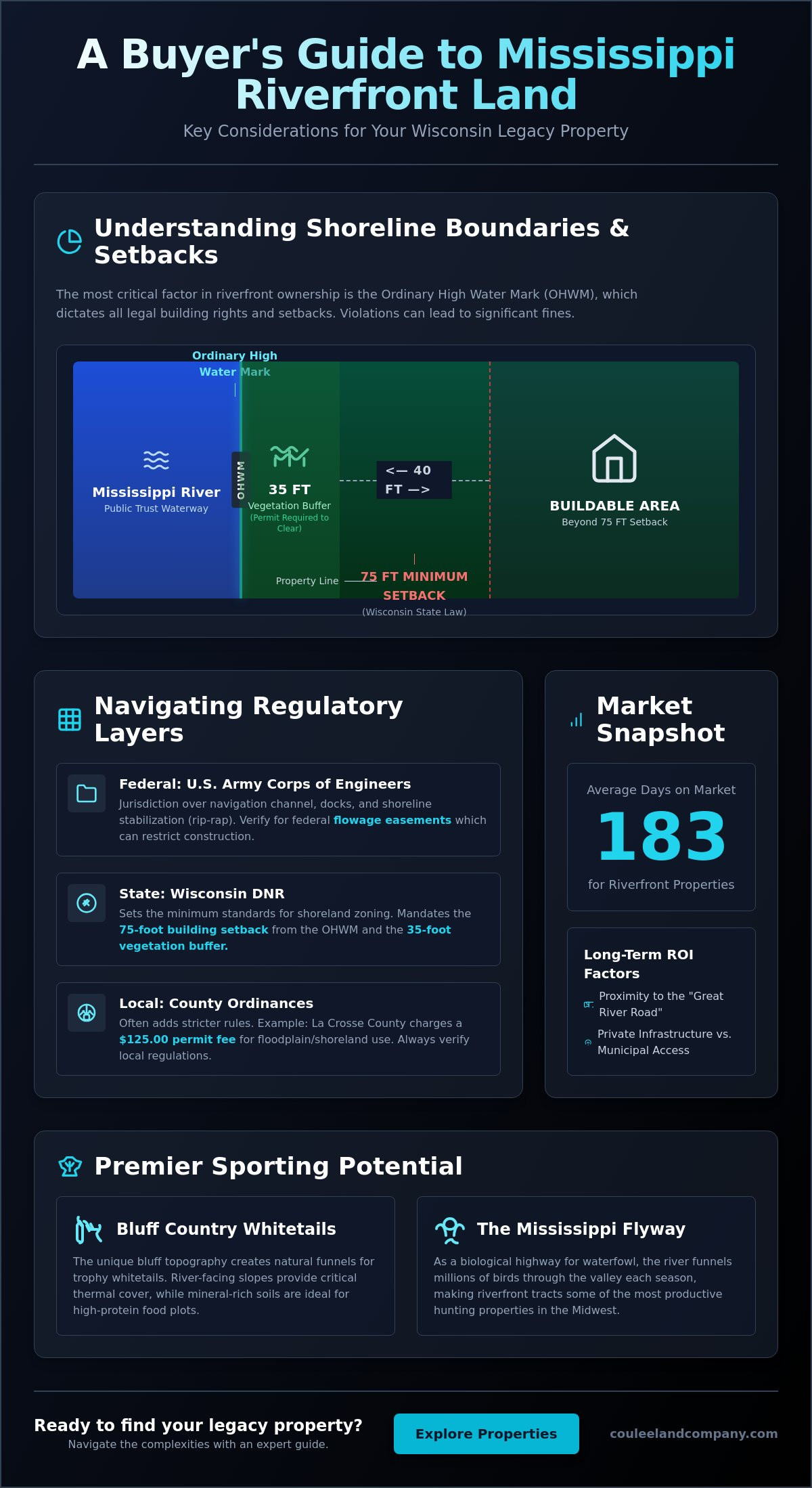
Owning a slice of the Big River requires more than a passion for the outdoors; it demands a firm grasp of the legal boundaries that define the water’s edge. The most critical benchmark for any buyer is the Ordinary High Water Mark (OHWM). This is the point where the presence and action of water are so continuous as to leave a distinct mark on the bank. This mark isn’t just a geographic feature. It is the legal baseline for all building setbacks and determines where your private ownership meets the public trust. Riparian rights in Wisconsin grant landowners the exclusive use of the shore and the right to access navigable waters, provided they respect the public’s right to use the water itself. Mastering these boundaries is one of the Key Considerations for Buying Mississippi Riverfront Land in Wisconsin because it dictates exactly what you can and cannot build.
The Upper Mississippi River is managed through a complex series of locks and dams, creating a pool system that drastically affects water levels and access. Unlike a free-flowing stream, these pools maintain relatively stable depths for navigation. However, they also mean your shoreline might be subject to federal flowage easements. Before you buy, you must verify if the government holds the right to flood your land for river management purposes.
To better understand the nuances of purchasing riverfront acreage, watch this helpful video:
Wisconsin DNR and Shoreland Zoning Standards
Wisconsin state law mandates a minimum 75-foot setback for all structures from the OHWM to protect the river’s ecological health. While the state sets the floor, local counties often layer on stricter ordinances. For instance, as of January 1, 2026, La Crosse County charges a $125.00 fee for floodplain or shoreland land use permits. You must also maintain a 35-foot buffer of natural vegetation. Clearing this vegetation to improve your view without a permit can lead to massive fines and mandatory restoration orders. To see how these regulations look in practice, you can browse our current waterfront properties that meet these rigorous standards.
The Federal Factor: US Army Corps of Engineers
The US Army Corps of Engineers maintains jurisdiction over the main navigation channel and any structures that extend into the water. If you plan to install a dock or implement rip-rap for shoreline stabilization, you’ll need federal approval in addition to state permits. Many Mississippi riverfront tracts are also subject to federal flowage easements, which can restrict permanent construction on low-lying acreage. Thoroughly evaluating the Key Considerations for Buying Mississippi Riverfront Land in Wisconsin requires looking beyond the deed to federal maps to ensure your building site is truly secure.
Evaluating Sporting Potential and River Dynamics
The Mississippi River corridor represents the ultimate intersection of topography and wildlife biology. When you evaluate the Key Considerations for Buying Mississippi Riverfront Land in Wisconsin, you must look at the bluffs as more than just scenery. They are physical funnels that concentrate animal movement. During the rut, mature bucks use the riverfront benches to travel between bedding and feeding areas while staying hidden from the ridge-tops. River-facing slopes provide critical thermal cover during harsh winters, trapping heat from the southern sun and blocking bitter northern winds. The Driftless Area’s unique soil composition, characterized by mineral-rich silt loams, offers an exceptional foundation for high-protein food plots that sustain record-breaking deer.
The river is a biological highway. The Mississippi Flyway serves as a premier resource for waterfowl hunting and conservation, funneling millions of birds through the valley each season. This consistent movement makes riverfront tracts some of the most productive sporting properties in the Midwest.
Bluff Country Whitetails: The River Corridor Advantage
Elevation changes from the river’s edge to the ridge-top create diverse micro-climates and travel corridors. In our Buffalo County community, we see how these vertical landscapes produce world-class genetics year after year. Properties with river-access-only points offer a distinct tactical advantage because they naturally limit hunting pressure from the public and neighboring tracts. If you’re looking for elite hunting properties, prioritize tracts where the topography dictates the hunt.
Managing Erosion and Flooding Risks
Investing in the valley requires a realistic look at water dynamics. You need to distinguish between the 100-year floodplain, which has a 1% annual chance of flooding, and the 500-year floodplain. Understanding climate change risks is vital as weather patterns shift and river crests become less predictable. Native vegetation acts as the primary defense against bluff-side erosion. Deep-rooted species like big bluestem and side-oats grama hold the soil together better than any retaining wall. These environmental factors are vital Key Considerations for Buying Mississippi Riverfront Land in Wisconsin to protect your long-term ROI.
Use this checklist for evaluating soil stability on high-relief lots:
- Observe the angle of repose on existing slopes to check for stability.
- Identify signs of “drunken trees” where trunks lean due to slow soil creep.
- Verify the presence of established perennial ground cover.
- Check local soil maps for high clay content that may increase slip risk during heavy rains.
Practicalities of Ownership: Infrastructure and ROI
Securing a legacy property in the Mississippi valley requires a pragmatic look at both the numbers and the dirt. Proximity to the Great River Road acts as a powerful catalyst for long-term property appreciation, as this National Scenic Byway draws consistent interest from recreational buyers and conservationists alike. In Western Wisconsin, the limited inventory of riverfront tracts drives a reliable return on investment, making these parcels some of the most sought-after assets in the Midwest. When you weigh the Key Considerations for Buying Mississippi Riverfront Land in Wisconsin, the choice between private well and septic versus municipal connections is a primary financial factor. While municipal hookups offer convenience, the independence of a private system on a large acreage tract often provides better long-term value, provided the site passes rigorous environmental testing. You can view exclusive listings to see how these infrastructure variables impact current market pricing.
Access and Buildability in Rugged Terrain
Constructing a driveway on the steep grades of the Mississippi bluffs presents a significant engineering challenge. It’s not just a matter of clearing trees; you must manage water runoff and meet strict county slope requirements to ensure year-round access for emergency vehicles and construction equipment. The rocky, unglaciated soils of the Driftless Area also make perc tests a critical hurdle for any build site. If the ground cannot support a septic system, your residential plans are effectively dead on arrival. For buyers interested in buying a home with acreage, verifying these physical constraints before closing is the only way to protect your capital.
Why a Land Specialist is Critical for Riverfront Deals
A general realtor often lacks the specialized knowledge required to navigate the intersection of sporting potential and regulatory hurdles. You need a broker who understands how to read a DNR zoning map as fluently as they read a whitetail travel corridor. Specialists like Mike Law bring a level of regional expertise that ensures you aren’t just buying land, but investing in a high-performing asset. Having an expert who knows the record-book history of the local bluffs and the intricacies of riparian law is among the most vital Key Considerations for Buying Mississippi Riverfront Land in Wisconsin. Contact our land specialists today to start your riverfront search with a trusted peer who understands the true value of the land.
Secure Your Legacy on the Mississippi River
Owning land along the Big River is a pursuit that blends high-stakes real estate with a deep respect for the outdoors. You now understand how the Ordinary High Water Mark dictates your building footprint and why the vertical funnels of the Driftless Area produce world-class sporting opportunities. Successfully navigating the Key Considerations for Buying Mississippi Riverfront Land in Wisconsin requires a balance of regulatory knowledge and a keen eye for topography. This investment is about more than a boundary line; it’s about securing a piece of the most iconic waterway in North America.
We provide over 20 years of expertise in the Driftless Area land market to ensure your purchase is both sound and rewarding. Our team serves as specialists in Buffalo County trophy whitetail properties, offering hands-on guidance through the complexities of DNR and Corps of Engineers permitting. We understand the land because we hunt it and live on it ourselves. Browse our exclusive Mississippi Riverfront and Bluff Country listings to find the property that fits your vision. Your future on the river starts with the right partner by your side.
Frequently Asked Questions
Can I build a dock on any Mississippi Riverfront property in Wisconsin?
Building a dock is not an automatic right and requires joint approval from the Wisconsin DNR and the US Army Corps of Engineers. Federal jurisdiction over the navigation channel means you must verify that your specific shoreline isn’t restricted by flowage easements or environmental protections. Permits are evaluated based on the dock’s size and impact on the waterway. Ensuring your lot has the physical and legal capacity for such structures is one of the Key Considerations for Buying Mississippi Riverfront Land in Wisconsin.
How does the Wisconsin DNR shoreland zoning affect my ability to clear trees for a view?
Wisconsin shoreland zoning mandates a 35-foot vegetative buffer from the Ordinary High Water Mark where most tree and brush removal is prohibited. You can typically only clear a small viewing corridor that doesn’t exceed 30% of your shoreline’s width. Removing native vegetation without a permit can lead to heavy fines and mandatory restoration orders. These regulations protect the river’s bank stability and prevent the erosion risks that can compromise your property’s long-term value.
Is flood insurance mandatory for all land along the Mississippi River?
Flood insurance is mandatory if you use a federally backed mortgage to purchase land located within a designated Special Flood Hazard Area. Even if you pay cash, maintaining coverage is a prudent risk management strategy for riverfront assets. You should consult current FEMA maps to determine if your building site falls within the 100-year floodplain. Assessing these insurance costs and potential premiums is a vital part of the Key Considerations for Buying Mississippi Riverfront Land in Wisconsin.
What are the specific hunting regulations for river-bottom land vs. bluff-top land?
While statewide seasons apply to both, the Public Trust Doctrine means the public can access river-bottom land up to the Ordinary High Water Mark if they arrive by water. Bluff-top land is generally more secluded and offers private access to trophy whitetail funnels away from public traffic. You must also be aware of specific local ordinances regarding the discharge of firearms near the Great River Road. Understanding these nuances helps you maximize the sporting potential of your acreage.