
In the rugged ridges of Buffalo County, where the Boone and Crockett Record Book lists more trophy whitetail entries than any other county in the nation, the difference between a standard sale and a record-breaking legacy comes down to a single choice. You’ve spent decades managing timber and patterning mature bucks on your piece of Bluff Country. It’s natural to feel anxious about leaving money on the table or getting caught in the weeds of complex rural zoning laws. When you’re evaluating your bottom line, justifying the cost of a land broker becomes a simple math problem once you see the financial spread between a generic listing and a strategically marketed property.
We understand that your land is more than an asset. It’s your legacy. You deserve a stress-free transaction that reflects the true wildlife capabilities of your soil. This article reveals how a specialized expert protects your investment, uncovers hidden value, and secures higher returns than any general realtor can manage. We’ll examine the specific strategies that maximize sale prices in 2026 and show why deep-rooted local knowledge is your most powerful tool in the current market.
Key Takeaways
- Learn why the “infinite variables” of unimproved land require a specialist’s eye to avoid the costly oversights common in standard residential sales.
- Discover how “boots on the ground” evaluation and GIS mapping uncover hidden property value that satellite imagery alone consistently misses.
- Master the “net-to-seller” math by justifying the cost of a land broker whose specialized national marketing can secure a significantly higher sale price.
- See how a “Hunter’s Realtor” leverages trophy whitetail genetics and land management expertise to attract high-value buyers to your Bluff Country acreage.
- Protect your legacy by identifying the legal and financial risks of going solo versus partnering with an expert who understands Wisconsin’s unique terrain.
The Hidden Complexity of Land Transactions vs. Residential Sales
A land broker isn’t just a real estate agent with a pair of boots and a truck. We specialize in non-residential, unimproved, or recreational properties where the true value isn’t found in a kitchen remodel but in the dirt itself. While a standard agent understands the “four walls” of a suburban ranch, a land specialist evaluates the infinite variables of a 160-acre parcel. This includes assessing topography, drainage patterns, and the health of the local ecosystem. Understanding these nuances is the first step in justifying the cost of a land broker for any serious seller or buyer.
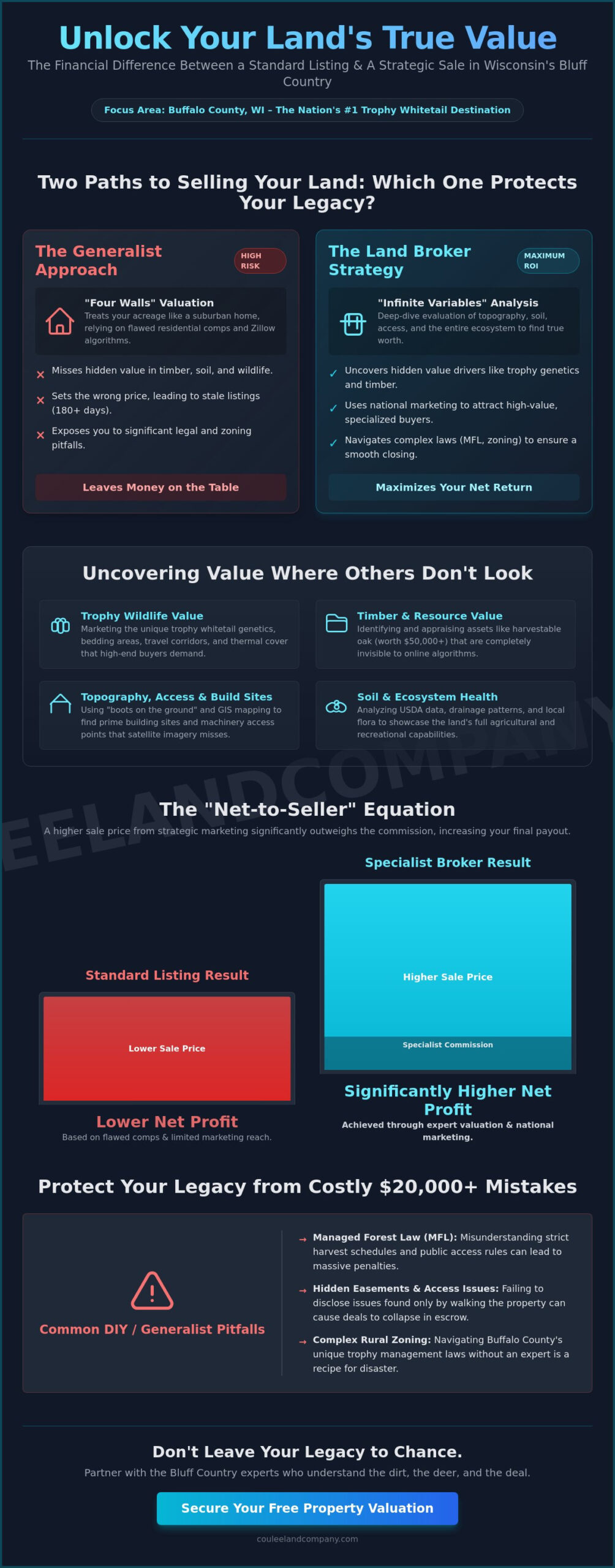
General agents often rely on comparable sales from three-bedroom homes nearby. This method fails in the rugged terrain of Wisconsin’s Bluff Country. Without understanding how a steep ridge affects machinery access or how a secluded valley boosts hunting value, a generalist often sets the wrong price. This leads to stale listings that languish on the market for 180 days or more because they were priced using the wrong metrics. While the duties of a real estate broker include basic market analysis, a land specialist’s analysis goes levels deeper into the specific utility of the acreage.
To better understand how professional valuation impacts your bottom line, watch this helpful video:
Why Zillow and General Realtors Fall Short for Acreage
Algorithms on Zillow don’t walk the timber or check for deer signs. They can’t see the $50,000 in harvestable oak or the specific wildlife bedding areas that make a property a trophy whitetail haven. Coulee Land Company uses specialized land-listing syndicates that reach buyers specifically looking for hunting properties rather than suburban commuters. A generalist might miss a prime building site tucked behind a ridge, leaving significant money on the table that a land expert would have highlighted to maximize the sale price.
The Legal and Zoning Pitfalls of DIY Land Deals
Rural Western Wisconsin has unique hurdles that can tank a deal. Programs like the Managed Forest Law (MFL) significantly impact property taxes but come with strict harvest schedules and public access rules. If you don’t disclose an easement or a hidden access issue, the deal will collapse in escrow. We focus on regions like Buffalo County, where trophy management and specific zoning laws are critical. Justifying the cost of a land broker becomes easy when you realize we prevent these $20,000 legal mistakes before they happen.
Technical Mastery: Mapping, Soil, and Topography Expertise
A satellite photo provides a basic overview, but it can’t reveal the hidden nuances of a 160 acre parcel in Buffalo County. A specialized land broker walks the ridges and valleys to identify bedding areas and travel corridors that digital maps miss. This “boots on the ground” approach is essential for justifying the cost of a land broker because it uncovers value or liabilities that aren’t visible from space. We utilize advanced GIS mapping and aerial topography to pinpoint exactly where a property stands in relation to the surrounding landscape, ensuring you don’t overpay for unusable acreage. Understanding these complexities in land valuation requires a deep dive into USDA data and local market trends that generalist agents simply don’t possess.
Navigating Western Wisconsins Bluff Country Terrain
The Driftless Area presents unique challenges with its steep ridges, deep coulees, and complex thermal cover. Bluff Country is a unique geological region that requires specific valuation techniques. We analyze elevation changes to determine if a property can support trophy whitetails or a viable building site. A broker’s expertise in the Mississippi River corridor identifies how wind currents move through these valleys. We map optimal access points to keep the wind right for hunting, which is often the difference between a successful season and a cleared out ridge. This technical insight ensures you are buying a functional property, not just a beautiful view.
Understanding Soil Quality and Agricultural Potential
Soil is the foundation of any high quality tract. We evaluate land based on Quality Deer Management Association (QDMA) standards to determine how a property will perform under a rigorous management plan. Identifying the difference between Class II and Class III soils is critical for predicting food plot success and long term ROI. Healthy soil directly impacts the wildlife capabilities and the premium market value of hunting properties. By analyzing the productivity index of the dirt, we provide a pragmatic assessment of the land’s true potential. If you want to ensure your investment holds its value for decades, it’s vital to consult with a specialist who understands the dirt as well as the market.
- GIS Mapping: Visualizing boundary lines and terrain features with sub-meter accuracy.
- Thermal Cover: Identifying north-facing slopes that hold deer during harsh Wisconsin winters.
- Access Strategy: Planning entry and exit routes that minimize human pressure on the local herd.
- Soil Analysis: Using historical data to justify the price per acre based on yield and growth potential.
Justifying the cost of a land broker becomes clear when you realize that technical errors in mapping or soil assessment can lead to six figure mistakes. Our team provides the data driven confidence needed to navigate these transactions successfully.
The Wildlife Value: Selling the Trophy Whitetail Potential
A specialized land broker doesn’t just walk a property; they scout it with the precision of a seasoned hunter. They look past the timber value to identify the hidden biological assets that drive premium prices. By evaluating bedding thickets, travel corridors, and natural funnel points, a broker uncovers the true “wildlife capability” of the acreage. This deep-dive assessment is a core part of justifying the cost of a land broker. They aren’t just selling dirt; they’re inventorying the potential for world-class hunting. This professional diligence aligns with the legally mandated duties of a broker to provide expert advice and full disclosure regarding the property’s unique attributes. When a broker “hunts” a property before listing, they gather the data needed to prove its worth to the most discerning buyers in the market.
Selling a high-end hunting tract requires more than a legal description. It demands a narrative of legacy and the promise of a legendary harvest. Brokers use trail camera surveys and historical harvest data to build a profile of the resident herd, proving that the land can produce mature bucks year after year. This evidence transforms an abstract price tag into a tangible investment in a lifestyle that many hunters spend a lifetime trying to achieve.
Quantifying Boone and Crockett Potential in Buffalo County
Buffalo County is the undisputed capital of the whitetail world. It has consistently led the nation in Boone and Crockett record book entries for decades, creating what insiders call the “Buffalo County Premium.” Buyers are willing to pay more for land in this region because of the superior genetics and the culture of trophy management. A broker understands how to leverage these statistics to position a property as a top-tier asset. By showcasing how Buffalo County hunting land acts as a blue-chip investment, they attract serious buyers who recognize that proximity to these genetics is a value multiplier that justifies a higher price per acre.
Strategic Land Management as a Value Multiplier
Raw land is simply a starting point. A property that features established Timber Stand Improvement (TSI) and strategically placed food plots is a “turn-key” asset that commands a premium. These management practices don’t just improve the habitat; they increase the property’s marketability by showing it’s ready to hunt on day one. An expert broker highlights these improvements, explaining how water holes and internal road systems make a 40-acre tract hunt like it’s 80 acres. This specialized knowledge is essential for hunting properties where the layout is just as important as the acreage. Highlighting these strategic assets ensures that the seller captures every bit of value created through their stewardship of the land.
Financial ROI: How Professional Marketing and Negotiation Outperform Commissions
Many sellers hesitate at commission rates, but the “net-to-seller” math tells a clear story. If a specialized broker secures a 10% higher sale price through competitive bidding and superior positioning, that increase more than covers a 6% commission. On a $600,000 parcel, a 10% gain adds $60,000 to the top line. Even after paying the broker, the seller walks away with significantly more than they would have by attempting a solo sale. This reality is central to justifying the cost of a land broker. Beyond the math, the cost of time is a silent profit killer. Rural properties listed without professional representation often languish on the market for 180 days or more. A broker with an active buyer list can often cut that time in half, freeing up your capital for the next investment.
Expanding Reach Beyond Local MLS Listings
A “For Sale” sign on a backroad in Buffalo County only reaches the people driving past it. Our team uses targeted social media campaigns to reach high-intent hunters in Minnesota, Illinois, and Iowa. These out-of-state buyers often have higher budgets and are looking for specific wildlife capabilities that locals might overlook. We leverage a massive database of pre-vetted buyers built over decades of specializing in Wisconsin land. Professional drone video and high-resolution photography do more than show boundaries; they sell the dream of owning a piece of the famed Bluff Country before a buyer even steps foot on the property. This digital-first approach ensures your land is seen by thousands of qualified leads rather than a handful of local neighbors.
The Art of the Land-Specific Negotiation
Negotiating land is fundamentally different from selling a suburban home. It involves 1031 exchanges, complex easements, and buyers who are often emotional about finding their “legacy” hunting ground. Having an expert like Mike Law or Bryan Lemke levels the playing field. They understand how to handle “contingent on sale” offers without stalling the process. They also know the nuances of “as-is” land sales, ensuring you aren’t nickel-and-dimed over minor issues that don’t affect the land’s actual value. Their expertise keeps the deal on track when technical hurdles arise, protecting your interests until the final signature.
Working with a specialist means you aren’t just paying for a listing; you’re investing in a result. The psychology of land buying requires a buffer between the seller and the buyer to keep negotiations pragmatic and focused on the value of the dirt. Justifying the cost of a land broker becomes easy when you see the difference between a low-ball offer from a neighbor and a competitive bid from a national buyer.
Ready to see what your property is worth in the current market? Get a professional valuation from our land specialists today.
Choosing Your Partner in Bluff Country: The Coulee Land Company Standard
Selling premium Wisconsin acreage requires more than a sign in the yard; it requires a “Hunter’s Realtor” who understands why a specific north-facing slope produces world-class whitetails. Justifying the cost of a land broker becomes simple when you calculate the high price of a single mistake. Going solo often leads to significant legal exposure from undisclosed easements or zoning issues that can derail a sale at the eleventh hour. Without a specialist, you risk undervaluing your assets by failing to account for timber quality or the specific trophy potential of your ridges. You also miss out on a curated network of high-intent buyers who don’t browse standard residential sites.
Our approach is strictly hands-on. We don’t rely on satellite imagery alone. We walk every ridge and coulee with you to identify the “sweet spots” that drive up property value. This boots-on-the-ground diligence ensures we can speak with authority to every prospective buyer about the land’s true wildlife capabilities. We treat your property as the unique asset it is, not just another line in a database.
Why a Specialist is Your Best Asset
There is a massive divide between a “transaction coordinator” and a “land consultant.” A coordinator simply manages paperwork, while a land consultant builds a narrative that justifies a premium price point. We leverage deep industry trust and exclusive endorsements from celebrities in the outdoor television world to give your listing immediate prestige. This level of exposure is unattainable for the average seller. To see how our specialized marketing strategy puts your property in front of the right audience, visit our Sellers page for an immediate consultation.
Navigating Your Next Steps with Confidence
Preparing your land for a 2026 market debut starts now. High-value sales in the coming year will depend on documented land management and quality trail camera history from the previous seasons. Our process is streamlined to move you from the first walk-through to the closing table with zero guesswork. We handle the complex mapping, soil analysis, and buyer vetting that often overwhelm private sellers.
- Initial Consultation: We assess the unique “Boone and Crockett” potential of your acreage.
- Strategic Marketing: Your land is featured through our high-authority outdoor channels.
- Expert Negotiation: We secure terms that reflect the true legacy of the property.
Owning land in the Coulee Region is a legacy; selling it should be a triumph. Don’t leave your equity to chance by navigating the complexities of Bluff Country real estate alone. Justifying the cost of a land broker is easy when you see the superior results we deliver. Contact us today for a free, no-obligation property valuation and discover what your land is truly worth in the 2026 market.
Secure Your Legacy in Bluff Country
Selling a property in Western Wisconsin requires more than a simple listing; it demands a technical understanding of soil composition and topography that residential agents don’t possess. When you’re dealing with Buffalo County, the #1 trophy whitetail county in the world, missing a single wildlife corridor or bedding area can cost you significant equity. Justifying the cost of a land broker becomes a straightforward financial decision when you consider our team brings over 50 years of combined experience in Wisconsin land management and sales. We’ve earned the trust of leading voices in the outdoor television industry because we know how to translate raw hunting potential into a premium market price. You deserve a partner who understands the specific value of a ridge top or a hidden food plot. Our marketing strategies ensure your land is seen by the right buyers who respect the Boone and Crockett history of this region.
Your land is a major investment, and we’re here to help you realize its full potential in the woods and at the closing table.
Frequently Asked Questions
Is the commission for a land broker higher than a residential agent?
Commission rates for land transactions are typically higher than residential sales because marketing vacant acreage requires specialized equipment and longer listing periods. While a standard home might sell in 30 days, a 160 acre tract in Buffalo County often requires 6 months of active marketing. Brokers invest in UTVs for showings and high end drone photography to capture the wildlife capabilities of the terrain, justifying these professional costs.
Can I sell my hunting land myself to save money?
You can list land independently, but data from the National Association of Realtors shows that FSBO properties sell for roughly 26% less than agent assisted sales. Justifying the cost of a land broker is easy when you consider that a specialist reaches a national database of 50,000 active hunters rather than just local buyers. We prevent you from leaving thousands of dollars on the table by correctly positioning your trophy whitetail habitat.
What specific certifications should I look for in a Wisconsin land specialist?
Look for the Accredited Land Consultant (ALC) designation, a credential held by less than 1% of all real estate professionals. This certification requires 104 hours of specialized education in areas like land investment analysis and site planning. Our team uses this advanced training to evaluate the 30% of a property’s value that often lies in its timber or specific soil composition, ensuring you receive an accurate valuation.
How does a land broker determine the price per acre for recreational property?
We determine value by analyzing comparable sales within a 5 mile radius and adjusting for specific hunting attributes like bedding areas or water sources. In Western Wisconsin, land values increased by 8% annually between 2020 and 2023. We look at the Boone and Crockett history of the township and the current timber inventory to set a price that reflects the true potential of your Bluff Country acreage.
Will a land broker help with 1031 tax-deferred exchanges?
Yes, our specialists coordinate with Qualified Intermediaries to manage the strict 45 day identification period and the 180 day closing deadline. Successfully executing a 1031 exchange can defer 100% of your capital gains taxes, allowing you to reinvest the full proceeds into a larger or more productive parcel. We ensure every document meets IRS Section 1031 requirements so your transition into a new property stays tax efficient.
Does a land broker handle the property survey and soil testing?
Brokers facilitate these essential steps by hiring licensed Wisconsin surveyors and certified soil scientists to verify boundaries and buildability. A Perc test for a septic system is valid for 3 years in most Wisconsin counties and is vital for buyers planning a cabin. We manage these logistics to ensure the 20 acre or 40 acre parcel you’re buying is exactly what’s described in the deed and local plat books.
What happens if my land has an existing MFL (Managed Forest Law) contract?
The MFL contract remains with the land, and we ensure the new buyer understands the 25 year or 50 year commitment they’re assuming. This program can reduce property taxes by over 80%, which is a massive selling point for many buyers. We provide the specific cutting notices and management plans required by the Wisconsin DNR to ensure a seamless transfer of ownership without triggering any withdrawal penalties.
How long does it typically take to sell a large parcel of land in Buffalo County?
Large parcels in the heart of Buffalo County typically spend between 90 and 180 days on the market. Justifying the cost of a land broker is simple when you see how we use this time to target high net worth hunters who understand that this region dominates the record books. We don’t just wait for a buyer; we actively pitch your land’s superior wildlife capabilities to a curated list of serious outdoorsmen.