
While the S&P 500 swings on a whim, the limestone ridges of Buffalo County remain a steadfast anchor for savvy capital. You’ve probably watched your traditional portfolio react to global instability while the demand for world-class hunting ground only intensifies. If you’re asking is wisconsin land a good investment 2026, the answer lies in the tangible security of the Driftless Area. We understand the frustration of watching prime inventory vanish while management taxes and complexities mount. You want a place where your money is safe, your family can hunt, and the land pays for itself.
We agree that owning a piece of the “Bluff Country” shouldn’t just be a dream; it should be a calculated strategic move. This analysis reveals why Wisconsin’s rugged terrain remains a premier hard-asset hedge and how you can maximize ROI through our triple-threat income model. We’ll explore the specific wildlife capabilities that keep Western Wisconsin at the top of the Boone and Crockett Record Book. You’ll get a clear roadmap for securing annual cash flow from farming and leases while protecting your capital for the long haul.
Key Takeaways
- Learn how Wisconsin’s rural acreage has transitioned into a stable, superior hard-asset hedge against market volatility in the 2026 landscape.
- Master the “Triple-Threat Income Model” to maximize your annual ROI by stacking agricultural rents, conservation programs, and high-demand recreational leases.
- Discover the biological and topographic factors that explain why is wisconsin land a good investment 2026 for those targeting world-class Boone and Crockett whitetails.
- Navigate critical due diligence steps, including Managed Forest Law (MFL) programs and property tax shifts, to safeguard your equity against market risks.
- Gain an insider’s edge by learning why the most lucrative legacy properties are found through “pocket listings” rather than the public MLS.
The 2026 Wisconsin Land Market: A Resilient Investment Landscape
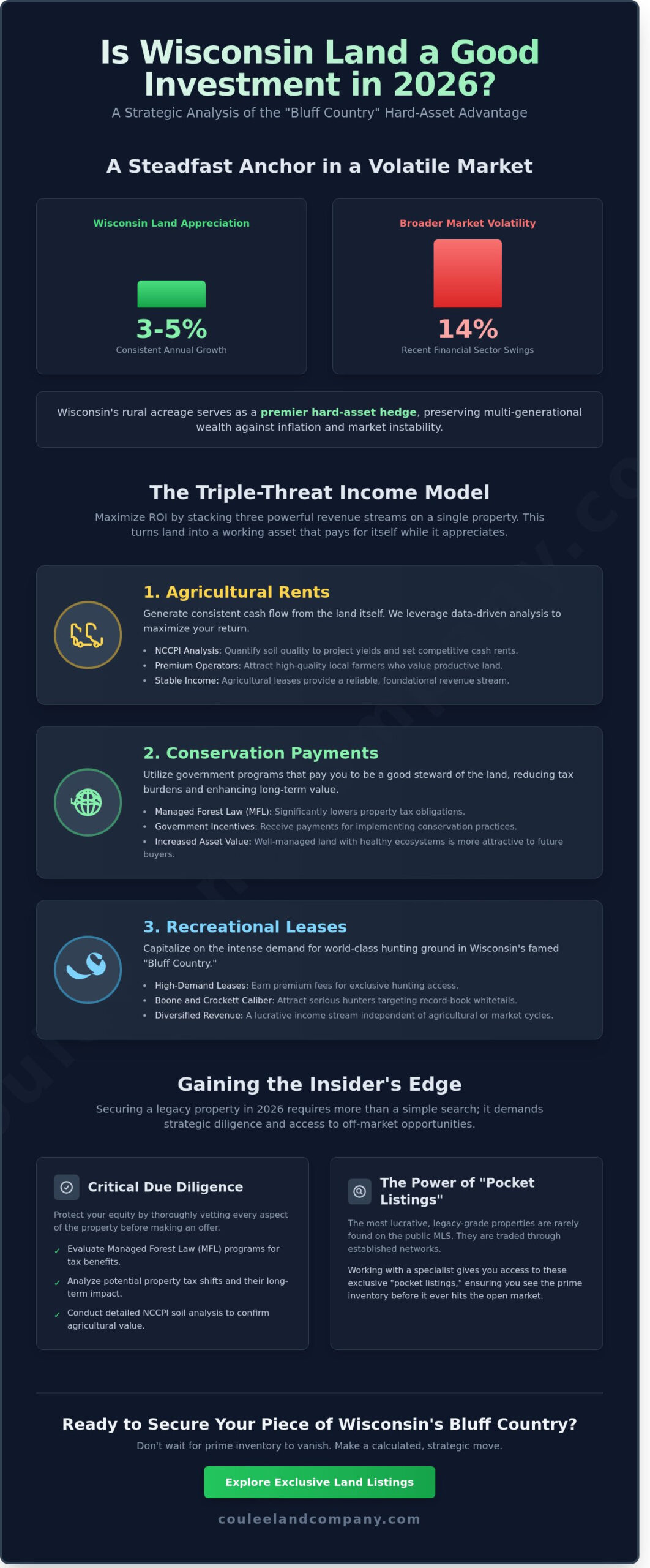
By 2026, the frantic chaos buying that defined the early 2020s has matured into a calculated, strategic environment. Investors no longer scramble for any available acre. Instead, they focus on quality and long-term utility. When asking is wisconsin land a good investment 2026, the answer lies in the asset’s stability. While traditional equity portfolios have faced erratic swings, Wisconsin land has maintained a steady 3% to 5% annual appreciation rate. This consistency provides a critical hard-asset hedge against the 14% market volatility seen in broader financial sectors over the last twenty-four months.
To gain a deeper perspective on current inventory and pricing trends, watch this analysis of the state’s real estate climate:
Owning legacy-grade dirt is a proven method for preserving multi-generational wealth. During inflationary cycles, currency loses value while tangible property retains its worth. For the patient investor, this isn’t about a quick flip. It’s about securing a footprint in a region where the supply of prime land is finite. The primary question for many remains: is wisconsin land a good investment 2026? The data suggests that for those seeking stability rather than speculation, the answer is a resounding yes.
Macro Trends Shaping the Badger State
The rural resurgence sparked in 2020 remains a powerful driver in 2026. High-speed internet expansions have turned Western Wisconsin into a viable home base for remote professionals who prioritize space over city density. This shift keeps land values buoyant, even as institutional buyers increase their presence in the agricultural landscape in Wisconsin. These large-scale players prioritize tillable acreage for its consistent yields, which naturally tightens the supply for individual buyers seeking hunting properties. The 2026 market clearly favors the patient investor who understands that land is a finite resource.
Wisconsin vs. The Midwest: Why the Coulee Region Wins
The Coulee Region stands apart from the flat, monotonous prairies of Iowa or Illinois. The “Bluff Country” of Western Wisconsin offers a unique topographical diversity that attracts both outdoor enthusiasts and conservationists. Areas like Buffalo County and New Richmond continue to serve as high-demand hubs due to their superior infrastructure and proximity to major metro centers. These locations offer the perfect blend of seclusion and accessibility, making them premier targets for land acquisition. Wisconsin land isn’t just a line item on a balance sheet; it’s a tangible piece of the North American hunting heritage.
The Triple-Threat Income Model: Maximizing ROI on Rural Acreage
Owning a piece of the legendary Bluff Country isn’t just a lifestyle choice for the passionate outdoorsman; it’s a sophisticated financial play. To understand why is wisconsin land a good investment 2026, you have to look at the Triple-Threat income model. This strategy involves stacking agricultural cash rent, government conservation payments, and recreational lease income on a single parcel. By diversifying these revenue streams, land owners create a resilient asset that performs regardless of broader market volatility. It’s about turning every acre into a working asset that pays for itself while the land appreciates.
Agricultural Yields and Cash Rent Trends
Smart investors start with the dirt. We use the National Commodity Crop Productivity Index (NCCPI) to quantify soil quality before a single offer is made. This technical index allows us to project bushel yields and set competitive cash rents that attract high-quality local operators. According to recent land value trends, high-quality tillable ground remains the bedrock of rural investment stability. By 2026, precision agriculture and improved drainage systems will likely push rents for Class I and II soils even higher as farmers compete for productive acreage.
For land that isn’t suitable for intensive row cropping, the Conservation Reserve Program (CRP) provides a powerful alternative. These 10 to 15 year contracts offer guaranteed, government-backed checks in exchange for taking environmentally sensitive land out of production. This creates a stable floor for your annual income, confirming that is wisconsin land a good investment 2026 for those who prioritize diversified cash flow. Our team provides knowledgeable guidance on how these programs integrate with your long-term goals.
The Hunting Lease: Monetizing the Recreational Asset
Wisconsin’s reputation for producing giant bucks makes recreational leasing a gold mine. Hunters from across the country pay a massive premium for exclusive access to managed ground in Western Wisconsin. When you improve deer habitat through strategic food plots, timber stand improvements, and secure bedding cover, you aren’t just growing bigger bucks; you’re increasing your annual ROI. A property in Buffalo County, which consistently leads the Boone and Crockett Record Book, commands top-tier lease rates that often cover the property’s annual tax bill entirely.
A property with a proven track record of mature deer and professional management is a highly liquid asset in any market. If you’re considering selling hunting land in Wisconsin, having these documented income streams and a history of trophy whitetails is vital for maximizing your final sale price. You can browse our current hunting properties to see how these superior managed assets compare to raw, unmanaged acreage in the current market.
Why Western Wisconsin’s Bluff Country is the 2026 Investment Gold Standard
Western Wisconsin’s Driftless Area isn’t just a scenic wonder; it’s a financial powerhouse for outdoor enthusiasts and land investors alike. When analyzing if is wisconsin land a good investment 2026, the answer lies in the unique verticality of the Coulee Region. Unlike flat agricultural tracts found in the central part of the state, bluff country offers a scarcity that keeps price floors high. You can’t manufacture more ridge-top views or secluded valley floors. This limited supply, coupled with surging demand for private retreats, makes these acres the gold standard for long-term appreciation.
Privacy has become a high-value commodity in the Midwest. In an increasingly crowded world, a property that offers total seclusion within its own valley is a rare asset. This is why many savvy buyers conclude that is wisconsin land a good investment 2026 when they see the privacy-to-price ratio in the bluffs. These parcels aren’t just dirt; they are defensible assets with built-in scarcity that protects against market volatility.
Buffalo County: The Ultimate Prize
Buffalo County consistently holds the title for the most Boone and Crockett whitetail entries in the nation. This reputation isn’t just for show; it drives real market value. As we approach 2026, $14,000 per acre has become a common baseline for premier hunting parcels with the right mix of cover and tillable ground. This premium creates a “halo effect” that pushes values upward in neighboring Trempealeau and Pierce counties. Investors who find themselves priced out of the core often find exceptional value in these adjacent areas, benefiting from the same world-class genetics and terrain features that made Buffalo County famous.
Topography and Land Management
The rugged terrain of Bluff Country provides structural advantages that flat land simply cannot match. Steep ridges and deep coulees create natural funnels, concentrating deer movement and allowing for higher hunter density without compromising safety or success. Thermal cover found on south-facing slopes ensures herds remain on the property during harsh winters, which is a critical factor for year-round land utility.
Beyond the hunt, the investment value of timber remains a strong pillar of the region’s economy. Implementing a Timber Stand Improvement (TSI) plan increases biodiversity and builds long-term equity in the standing harvest. For those looking to expand their footprint, the Wisconsin DNR provides data on recreational land opportunities that help investors understand the broader landscape of managed habitats. Managing your own parcel with these professional principles ensures the land’s value grows alongside the trees and the trophies. Key management factors include:
- Strategic Food Plot Placement: Utilizing ridge-top flats to keep deer visible.
- Water Source Development: Adding value to dry ridges with ponds or tanks.
- Timber Harvest Cycles: Creating immediate cash flow while improving bedding cover.
Due Diligence and Market Risks: Protecting Your Wisconsin Land Investment
Owning a piece of Wisconsin’s Bluff Country isn’t just about the hunt; it’s a financial play that requires a sharp eye for detail. When evaluating if is wisconsin land a good investment 2026, you’ve got to look past the timber and into the tax records. Success in this market depends on your ability to spot “red flags” before they become liabilities. A property that looks perfect on a map can quickly become a burden if you don’t account for zoning restrictions or hidden easements that limit your ability to build your dream cabin.
Property Taxes and Government Programs
The property tax landscape in 2026 remains a critical factor for land owners. The Managed Forest Law (MFL) program is the most effective tool for reducing your annual carrying costs. By enrolling in MFL, you can see a tax reduction of up to 80 percent. This program isn’t just a tax break; it’s a long-term strategy to improve timber health and wildlife habitat. You must understand the distinction between agricultural use-value assessment and recreational rates. Ag land is taxed based on the income it generates from farming, which is significantly lower than the market-value assessment applied to recreational acreage. Working with a land specialist broker is the only way to ensure your property is classified correctly to maximize your ROI.
Wildlife Health and Market Perception
Chronic Wasting Disease (CWD) is the “elephant in the woods,” but its actual impact on land value is often driven more by perception than reality. While biological concerns exist, the market for high-quality hunting land remains resilient. For the serious hunter, determining if is wisconsin land a good investment 2026 often comes down to the quality of the neighborhood. Smart investors “CWD-proof” their land by creating superior habitat that holds deer and partnering with neighbors who share a commitment to mature buck management. In 2026, land value is increasingly tied to the quality of the surrounding neighborhood and the maturity of the local deer herd. A 40-acre tract in a well-managed area of Buffalo County will always command a premium over a larger, unmanaged parcel elsewhere.
Identifying Red Flags and Zoning
Identifying “Red Flag” properties is a skill built through experience. Access issues are the most common deal-killers. If a property doesn’t have deeded access or a clearly defined easement, its value can plummet. You also need to watch for drainage issues; if 30 percent of a parcel is classified as wetlands, your building site options and food plot locations are severely restricted. Zoning and land-use restrictions in rural Wisconsin are strictly enforced. Some townships have high minimum acreage requirements for building permits, meaning you can’t just put a house on any 5-acre lot you find. You must verify these details with the county zoning office to ensure your vision for the land is legally possible.
Don’t leave your investment to chance; let our experts guide you through the vetting process. Contact Coulee Land Company to find a secure land investment today.
Strategic Acquisition: How to Find Value in a Transitioning Market
To answer the question of whether is wisconsin land a good investment 2026, you have to look at how the best parcels are actually traded. In a high-demand market, the public MLS is often a graveyard for overpriced or picked-over remnants. The real value exists in pocket listings. These are properties sold through private networks before they ever reach a public website. In the Coulee Region, approximately 30 percent of premium timber tracts move through these quiet channels, never appearing on Zillow or national land watch sites.
Evaluating the legacy potential of a property is the difference between a simple purchase and a generational asset. This isn’t a three-year flip. You’re looking for land that will produce trophy whitetails in 2040. This requires analyzing established thermal cover and ensuring that secure access points won’t be compromised by future neighbor developments. A general residential agent won’t understand soil maps or bedding thickets. You need a “Hunter’s Realtor” who views a parcel through the eyes of a land manager, not a suburban developer.
The Specialist Advantage
Specialists like Mike Law or Bryan Lemke identify hidden value in topography that others miss. They understand how a north-facing slope impacts vegetation or how a bench halfway up a bluff creates a natural travel corridor. This boots-on-the-ground scouting is the only way to verify if a property matches its aerial photos. For a detailed look at what to verify during a site visit, our team provides expert guidance on hunting properties to ensure your due diligence is airtight.
Closing the Deal in 2026
Financing for recreational land in 2026 requires working with lenders who understand agricultural and timber values. Most specialized lenders look for a 20 to 30 percent down payment and a clear plan for the land’s management. When you’re ready to make an offer on “Bluff Country” acreage, speed is your greatest asset. High-quality parcels in Western Wisconsin often receive multiple offers within 48 hours of a private notification. Determining if is wisconsin land a good investment 2026 depends entirely on your ability to move quickly when the right dirt becomes available.
Secure Your Legacy in the Heart of Bluff Country
The data confirms that the 2026 market rewards buyers who focus on multi-functional acreage. By utilizing a triple-threat income model, investors can balance agricultural lease yields with the unmatched recreational value of Western Wisconsin. Buffalo County remains the gold standard for high-end acquisitions; it consistently leads the nation in Boone and Crockett whitetail entries. When you evaluate whether is wisconsin land a good investment 2026, the answer lies in the region’s proven history of resilience and long-term growth. Success depends on partnering with specialists who understand both trophy whitetail management and complex market transitions. Coulee Land Company brings a unique perspective as Wisconsin’s Land and Property Sales Specialists, backed by endorsements from top outdoor television personalities. We focus on properties that offer superior wildlife capabilities and sustainable income. Our team helps you navigate due diligence to protect your capital while securing a piece of the world-famous Bluff Country. The opportunity to own high-performing land is available for those ready to act. View our exclusive 2026 Wisconsin land listings today and take the first step toward owning a premier property. You’ve worked hard to reach this point, and your land should reflect that dedication.
Frequently Asked Questions
Is Wisconsin land a better investment than the stock market in 2026?
Wisconsin land offers a tangible hedge against inflation and market volatility that traditional stocks cannot provide. According to the USDA Land Values 2025 report, Wisconsin cropland values increased by 7.7% annually over the last decade. While the S&P 500 fluctuates based on global sentiment, land remains a finite resource with inherent utility. It’s a stable asset for long term wealth preservation that you can actually use and enjoy.
How much does an acre of hunting land cost in Wisconsin in 2026?
High quality hunting land in the Driftless Area typically ranges from $4,500 to $7,500 per acre depending on specific tract features. Factors like road access, timber quality, and proximity to trophy buck corridors drive these figures. In Buffalo County, premium tracts often exceed these averages due to their world class reputation. You should check the latest Wisconsin Department of Revenue sales data for specific township benchmarks to see current local trends.
Does CWD (Chronic Wasting Disease) significantly lower land prices?
Market data shows that CWD hasn’t caused a broad decline in Wisconsin land values over the last five years. Properties in CWD positive counties like Dane and Iowa continue to appreciate at rates similar to the state average. Hunters prioritize superior habitat and genetics over disease presence when selecting acreage. Land with excellent bedding and food plot potential remains in high demand regardless of local CWD status.
What is the “Triple-Threat” income model for land investors?
The Triple-Threat model maximizes ROI by combining cash rent from tillable acreage, timber harvest revenue, and hunting lease income. This strategy ensures your property generates annual cash flow while the land itself appreciates over time. Whether is wisconsin land a good investment 2026 depends on your ability to stack these revenue streams effectively. A 40 acre tract with 15 tillable acres can often cover its own property taxes and insurance costs.
Can I get a tax break for owning hunting land in Wisconsin?
You can reduce your property tax burden by roughly 80% by enrolling in the Managed Forest Law (MFL) program. This program requires you to follow a sustainable timber management plan in exchange for significant tax relief. The 2024 Wisconsin legislative updates maintained these incentives for private landowners. It’s the most effective way to lower the cost of ownership while improving wildlife habitat for trophy whitetails and increasing timber value.
What are the best counties in Wisconsin for land investment right now?
Buffalo, Trempealeau, and Richland counties remain the gold standard for land investment due to their unique topography and trophy buck production. Buffalo County specifically holds more Boone and Crockett records than any other county in the nation. These regions offer the strongest resale value and highest demand from out of state buyers. Strategic investors also look at Vernon and Grant counties for high quality tillable land and slightly lower entry points.
How do I find off-market land deals in Buffalo County?
Finding off-market deals requires deep local roots and a network of specialists who know the terrain. Many of the best properties change hands through private sales before they ever hit a public listing site. We leverage long term relationships with local farmers and landowners to identify these opportunities for our clients. Success in Buffalo County depends on being ready to move quickly when a legacy property becomes available through these private channels.
Should I buy tillable farmland or wooded hunting land for the best ROI?
A hybrid property containing both tillable and wooded acreage typically offers the best return on investment. Tillable land provides immediate annual income through cash rents, which averaged $150 per acre in Western Wisconsin in 2024. Wooded acreage provides the recreational value and potential for long term timber sales. This balance makes is wisconsin land a good investment 2026 for those seeking both lifestyle benefits and consistent financial gains.