
While the stock market fluctuates with every news cycle, the dirt in Buffalo County has produced over 150 Boone and Crockett whitetail entries, more than any other county in the world. For many outdoorsmen, the question isn’t just about the hunt, but whether the land itself can secure their financial future. If you’re wondering is hunting land a good investment in wisconsin, the 2026 data reveals a market that’s as resilient as a mature buck in November. With agricultural land values jumping 9.6% to an average of $7,238 per acre last year, your passion for the outdoors is finally aligning with a smart portfolio strategy.
You’re likely tired of the noise in traditional markets and the increasing crowds on public acreage. You want a legacy asset that offers both exclusive access to trophy whitetails and measurable appreciation. You’ll discover why Wisconsin hunting land remains a premier tangible asset and how to maximize your ROI through strategic land stewardship. We’ll break down the “Bluff Country” premium and explore how programs like the Managed Forest Law can turn a recreational dream into a high-performing reality.
Key Takeaways
- Understand why hunting land serves as a stable tangible asset with lower volatility and stronger historical appreciation than traditional stock market investments.
- Learn why the Driftless Area’s unique topography and world-class trophy whitetail history prove that is hunting land a good investment in wisconsin for long-term equity growth.
- Discover how to generate consistent passive income through tillable acreage rentals and strategic timber stand improvements that pay dividends over time.
- Identify the specific habitat enhancements that transform raw acreage into a high-value, turnkey recreational property sought after by premium buyers.
The Financial Case for Wisconsin Recreational Real Estate
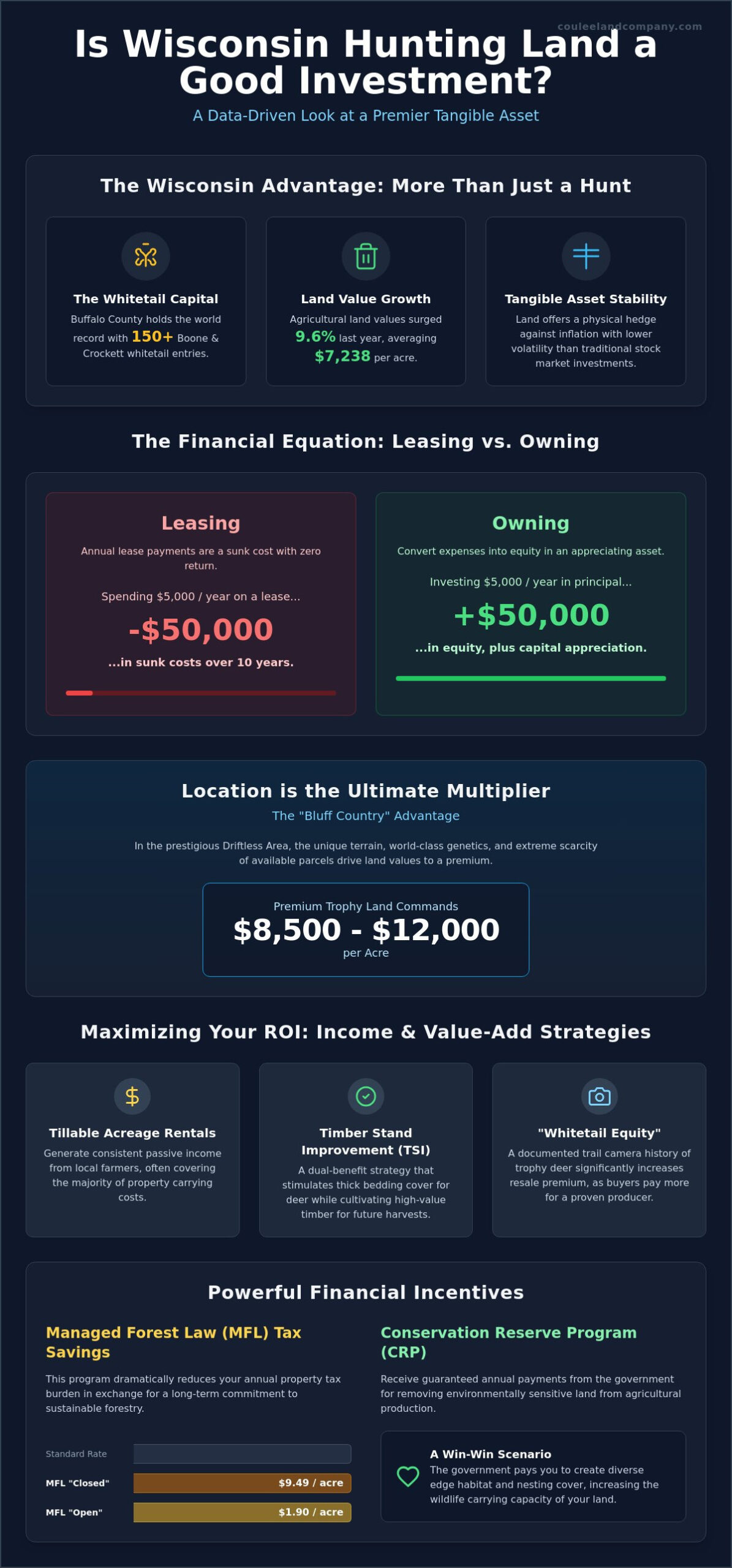
Land is not merely a place to hang a tree stand; it is a hard asset with a finite supply. Unlike digital portfolios or volatile stocks, Wisconsin acreage offers a physical hedge against inflation. When you ask is hunting land a good investment in wisconsin, look at the raw data from 2025. Agricultural land values across the state surged by 9.6%, reaching an average of $7,238 per acre. This growth reflects the foundational strength of Wisconsin’s economy, where agriculture and forestry remain vital pillars. In the prestigious Driftless Area, these values often climb even higher due to the unique terrain and world-class wildlife genetics.
Smart buyers evaluate “Utility ROI” when considering a purchase. If you spend $5,000 annually on a hunting lease, that capital is gone forever. In contrast, purchasing hunting properties allows you to convert that annual expense into equity. Over a decade, you are choosing between $50,000 in sunk costs or $50,000 in principal payments on an asset that is likely appreciating. In high-demand regions like Buffalo County, where premium trophy land can command between $8,500 and $12,000 per acre, the extreme scarcity of available parcels ensures long-term price stability.
The “Dual Dividend”: Recreational Use Meets Capital Appreciation
Owning land provides a lifestyle dividend that a brokerage account simply cannot match. You can’t take your children for a walk through a mutual fund or watch a sunset from a crypto wallet. Land appreciation in Wisconsin has historically outpaced inflation, creating a wealth-building vehicle that you actually get to use. The rise of remote work has intensified this demand, as more professionals seek signature properties where they can manage a business from a home office and be in a stand by late afternoon. This shift has turned rural acreage into a primary asset for those prioritizing both financial security and quality of life.
Maximizing ROI: Income Streams and Value-Add Strategies
Owning high-quality acreage is the first step, but active management is what truly separates a recreational property from a high-yield investment. When assessing if is hunting land a good investment in wisconsin, savvy buyers look beyond simple appreciation to immediate cash flow. Tillable acreage provides consistent annual rental income from local farmers, often covering the majority of carrying costs. According to official USDA land sales data, agricultural integration remains a primary driver of rural property value stability and long-term liquidity.
Strategic habitat work like Timber Stand Improvement (TSI) offers a powerful double-benefit. By selectively thinning the canopy, you stimulate thick bedding cover for mature bucks while simultaneously cultivating high-value timber for future harvests. Additionally, documenting a property’s potential through years of trail camera history creates “whitetail equity.” A proven track record of trophy deer significantly increases your resale premium because buyers pay more for a proven producer. If you are planning an exit strategy, understanding how to go about selling hunting land in wisconsin is essential for capturing that built-in value when you decide to trade up or liquidate.
Leveraging Wisconsin’s Managed Forest Law (MFL) for Tax Benefits
The Managed Forest Law (MFL) is your most effective tool for slashing overhead. For the 2023-2027 cycle, “Closed” land entered after 2004 is taxed at just $9.49 per acre, while “Open” land drops even further to $1.90 per acre. This program requires a long-term commitment to sustainable forestry, but the tax savings are massive compared to standard property rates. Navigating these regulations requires an expert guide to ensure your property remains private while meeting DNR requirements. You can consult with a specialist to see which status fits your long-term privacy and financial goals.
Government Programs: CRP and Conservation Incentives
The Conservation Reserve Program (CRP) serves as another reliable income stream for the diligent landowner. By removing environmentally sensitive land from agricultural production, you receive a guaranteed annual payment from the government for a set contract period. These areas don’t just provide checks; they create the diverse edge habitat and nesting cover that increase the carrying capacity of your land for all game species. It’s a rare scenario where the government pays you to improve your own hunting quality.
Why Location is the Ultimate Multiplier: The Bluff Country Advantage
In the world of recreational real estate, location isn’t just about a zip code; it’s about biology and geology. The Driftless Area of Western Wisconsin offers a rugged topography that simply cannot be replicated elsewhere. This region’s unique “Bluff Country” terrain creates natural funnels and pinch points that concentrate deer movement, making even a small parcel hunt much larger than its acreage suggests. When you ask is hunting land a good investment in wisconsin, the answer often depends on your proximity to these high-value corridors. An analysis of Wisconsin’s recreational real estate shows that counties with strong recreational identities maintain higher resale demand even during broader economic shifts.
Buffalo County remains the gold standard, holding the world record for the most Boone and Crockett whitetail entries. This reputation creates a “halo effect” on property values that generalists often overlook. To find the best opportunities, you need Buffalo County specialists who understand how a specific ridge system or south-facing slope impacts a property’s true worth. You can explore our current list of exclusive hunting properties to see how these topographic advantages manifest in premium listings.
The Scarcity Factor in Wisconsin’s Driftless Area
The geological uniqueness of the Driftless Area makes it a finite and highly sought-after resource. Because this land was never leveled by glaciers, the deep valleys and steep ridges provide the security cover mature bucks require to reach old age. The consistent production of record-book whitetails in Western Wisconsin directly correlates to the unrelenting demand for land in this region, ensuring that your investment is backed by a biological track record that is globally recognized.
Partnering with a Land Specialist vs. a General Realtor
A general realtor might understand square footage and school districts, but they rarely understand bedding thickets or thermal cover. Specialized brokers evaluate a tract based on its recreational value and habitat potential rather than just “dirt value.” This insider knowledge, combined with deep off-market networking, allows specialists to secure high-potential investment tracts before they ever hit the public market. This professional edge is what transforms a simple land purchase into a legacy asset.
Securing Your Legacy in the Driftless Area
Investing in rural acreage is more than a financial transaction; it’s a commitment to the land and your future. We’ve analyzed how tangible asset stability, strategic income through state conservation programs, and the undeniable “Buffalo County Factor” create a unique environment for wealth preservation. Ultimately, determining if is hunting land a good investment in wisconsin comes down to the quality of the dirt and the specialized expertise of your representation.
Our team lives and breathes the world-renowned Bluff Country. As local experts with deep roots in land stewardship, we provide more than just listings. We offer exclusive access to trophy whitetail properties that generalists simply don’t see. By combining a pragmatic focus on ROI with a genuine passion for the outdoors, we help you navigate the nuances of MFL taxes and habitat potential to secure a legacy asset.
Start your search for the perfect Wisconsin investment property today and find the ground that works as hard as you do. The right ridge is waiting for you.
Frequently Asked Questions
Is hunting land in Wisconsin a better investment than farmland?
Hunting land and agricultural acreage often serve different portfolio goals, though the most resilient investments frequently include both. While tillable land provides consistent annual rental income from local farmers, premium hunting tracts in the Driftless Area offer a unique “lifestyle ROI” and scarcity-driven appreciation that row crops can’t match. The 2025 data showed a 9.6% increase in agricultural land values, but trophy-caliber recreational properties in the western bluffs often command even higher premiums due to their world-class wildlife genetics and limited availability.
How much does the Managed Forest Law (MFL) actually save on Wisconsin property taxes?
The MFL program can reduce your property tax burden by 80% or more depending on your specific county and local mill rate. For the current 2023-2027 cycle, “Closed” land entered after 2004 is taxed at a flat rate of $9.49 per acre, while “Open” land drops to just $1.90 per acre. These predictable, low-cost rates are a primary reason why is hunting land a good investment in wisconsin for those looking to minimize the annual carrying costs of a large-scale land holding.
Does Chronic Wasting Disease (CWD) affect the resale value of hunting land?
CWD is a factor in modern deer management, but it hasn’t historically diminished the market value of premier properties in trophy-dense regions. Serious investors prioritize habitat quality, topography, and the proven ability of a tract to produce mature bucks over time. In elite areas like Buffalo County, the demand for exclusive access to the nation’s best whitetail genetics continues to outpace supply, keeping price stability strong despite regional biological challenges.
What is the typical appreciation rate for recreational land in Buffalo County, WI?
Buffalo County land typically appreciates at a rate that exceeds the statewide average because it’s a globally recognized destination. While Wisconsin farm real estate value increased by 4.9% in 2025 according to USDA data, premium parcels in the Driftless Area often see higher gains due to their extreme scarcity. Trophy-caliber land in this specific niche currently ranges from $8,500 to $12,000 per acre, reflecting its status as a premier tangible asset that consistently draws out-of-state capital.