
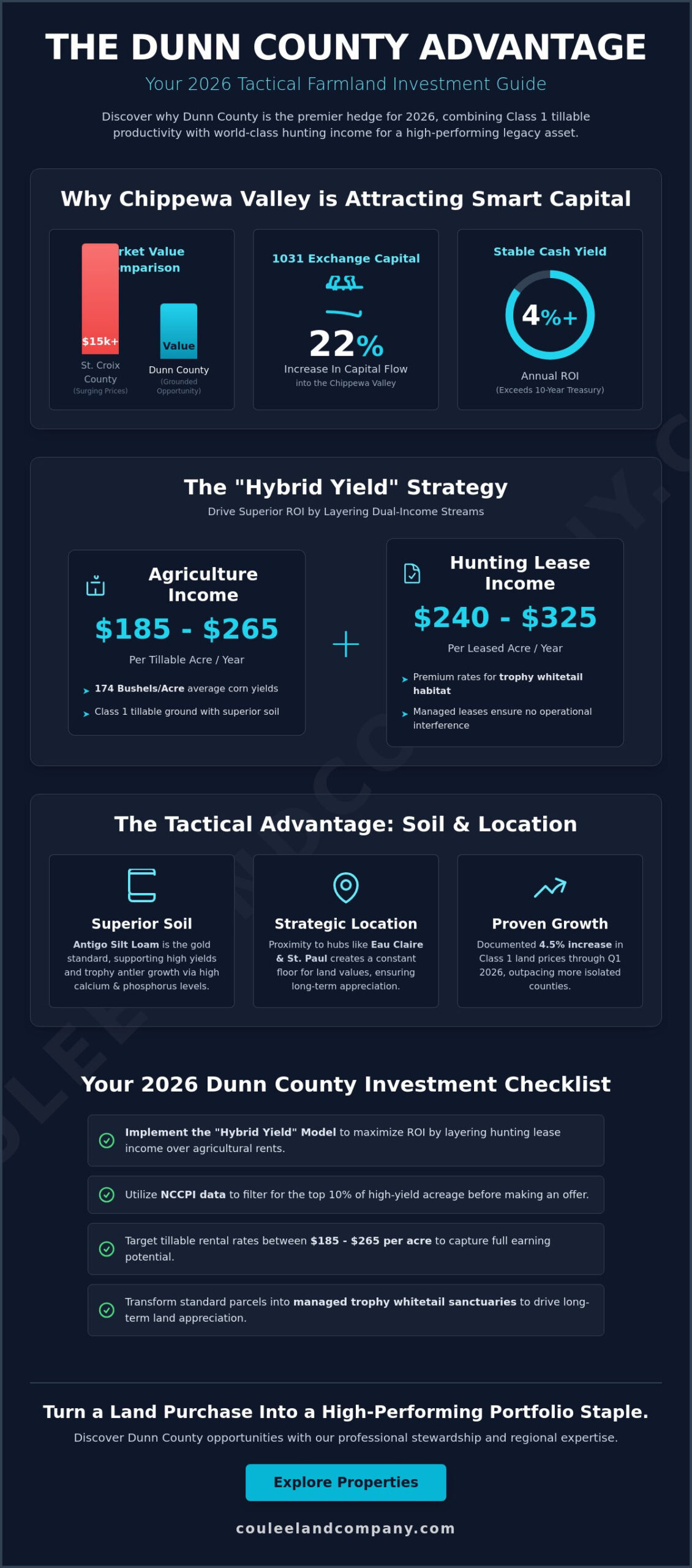
While neighboring St. Croix County farmland prices have surged past $15,000 per acre, a 22% increase in 1031 exchange capital is currently flowing into the Chippewa Valley to capture a more grounded opportunity. You’ve likely watched traditional equities swing wildly and felt the pressure to find a tangible hedge that doesn’t involve overpaying for poor soil. It’s a common challenge to find a property that balances high-yield agricultural returns with the elite recreational value you actually want to own. Understanding the Investment Potential in Dunn County Farmland: Trends and Client Wins is the first step toward securing a legacy asset that performs in every season.
We promise to show you why Dunn County is the premier hedge for 2026, combining Class 1 tillable productivity with world-class hunting income. With prime ground leases fetching up to $325 per acre and corn yields averaging 174 bushels, the math supports a stable 4% plus cash yield. This article previews the specific acquisition strategies our clients use to identify high-quality soils and trophy whitetail habitat; this ensures your land appreciation outpaces the market while providing a sanctuary for the outdoorsman. You will discover how to turn a simple land purchase into a high-performing portfolio staple through professional stewardship and regional expertise.
Key Takeaways
- Understand the “Tactical Advantage” of Dunn County’s diverse topography, which provides a stable hedge against market volatility while supporting both high-yield agriculture and elite wildlife habitat.
- Learn how to implement the “Hybrid Yield” model to maximize your annual ROI by layering premium hunting lease income on top of traditional agricultural cash rents.
- Review real-world case studies demonstrating the Investment Potential in Dunn County Farmland: Trends and Client Wins, including successful 1031 exchanges into high-performing Chippewa Valley assets.
- Discover the strategic steps for transforming a standard agricultural parcel into a managed trophy whitetail sanctuary to drive significant long-term land appreciation.
- Identify the specific 2026 benchmarks for tillable rental rates in Western Wisconsin to ensure your property captures its full earning potential in the current market.
The 2026 Dunn County Land Market: Identifying the Chippewa Valley’s Tactical Advantage
In 2026, the U.S. farmland market is shifting from rapid appreciation toward a period of stabilization, yet Dunn County, Wisconsin remains a standout for tactical investors. While some regions face modest declines, the Chippewa Valley continues to attract capital because it offers a tangible hedge against inflation that traditional equities simply cannot match. The Investment Potential in Dunn County Farmland: Trends and Client Wins is anchored in the region’s diverse topography, which provides a unique “Tactical Advantage” for owners. This landscape allows for high-yield tillable production on the flats while providing the dense thermal cover and travel corridors necessary for mature whitetails. Antigo Silt Loam remains the undisputed gold standard for tillable land here; its superior drainage and nutrient retention support the 174-bushel corn averages seen across the county’s most productive tracts.
To better understand the local demand and how it affects land value, watch this helpful video:
High concentrations of calcium and phosphorus in the soil, typical of the region’s best tillable ground, are the foundational building blocks that allow mature bucks to reach their full genetic potential for antler growth. This direct correlation between soil quality and trophy potential is why elite hunters and agricultural investors often find themselves competing for the same high-quality acreage. It’s a synergy that defines the local market.
Soil Productivity and NCCPI Ratings in 2026
We advise our clients to utilize National Commodity Crop Productivity Index (NCCPI) data to filter for the top 10% of high-yield acreage before making an offer. In 2026, modern precision ag technology is making these tillable pockets even more valuable by maximizing input efficiency on irregular field shapes. This technological edge ensures that even smaller agricultural footprints within a larger hunting tract generate significant cash flow. Data drives these decisions.
The Resilience of the Chippewa Valley Corridor
The proximity to growing hubs like Eau Claire and the easy commute from St. Paul act as a constant floor for land values, driving long-term appreciation that outpaces more isolated counties. When you compare these values to the pricing seen on our Buffalo County community page, it’s clear that Dunn County offers a more accessible entry point for those seeking a balance of agricultural ROI and world-class recreation. This corridor’s resilience is proven by the steady 4.5% increase in Class 1 land prices we’ve documented through the first quarter of 2026. Location remains paramount.
The Hybrid Yield Strategy: Driving ROI with Dual-Income Streams
The most resilient portfolios in 2026 rely on the “Hybrid Yield” model. This isn’t just about collecting a check from a farmer; it’s about layering income streams to exceed the 4% yield of a 10-year Treasury. While 2022 Wisconsin agricultural land prices set the stage for this growth, today’s market requires a more sophisticated approach. In Dunn County, high-quality tillable acres are commanding between $185 and $265 per acre for the 2026 season. By adding a premium hunting lease, which can fetch between $240 and $325 per acre for prime ground, you effectively double your income potential on the same footprint.
Managing these dual leases often raises concerns about liability and property damage. We solve this by vetting hunters through rigorous standards and drafting multi-year agreements that protect your soil and timber. A land specialist ensures the hunting lease doesn’t interfere with the farmer’s operations; this creates a synergistic relationship that benefits everyone. If you’re ready to explore these opportunities, our team can help you identify undervalued tracts that are prime for this strategy.
Calculating Your Total Return on Investment
To determine if a property fits the Investment Potential in Dunn County Farmland: Trends and Client Wins, follow this framework:
- Step 1: Verify crop history and chemical records for the last 3 seasons to ensure soil health and future productivity.
- Step 2: Match the NCCPI data to current cash rent market rates, typically $185 to $265 for top-tier soil in this region.
- Step 3: Appraise the recreational value by analyzing timber quality, water access, and existing deer sign.
Managing the “Second Lease”: Hunting Rights
Demand for private ground has reached an all-time high in 2026 as public land pressure increases. You can significantly boost lease value by performing Timber Stand Improvement (TSI). This practice creates better bedding cover and browse, directly increasing the “trophy” value of your land and the price hunters are willing to pay. If you’re looking for land with this specific potential, browse our current Hunting Properties to see what’s moving in today’s market.
Strategic Acquisitions in Action: Client Wins and Long-Term Appreciation
Real-world success stories prove the Investment Potential in Dunn County Farmland: Trends and Client Wins. We recently guided an investor through a 1031 exchange where they moved capital from a volatile urban commercial asset into a high-performing 120-acre Dunn County tract. This property featured a mix of Class 1 tillable soil and a secluded creek bottom. By securing this land, the client locked in a stable 4.5% annual appreciation rate, matching the county’s Q1 2026 growth, while establishing a private sanctuary that traditional portfolios cannot offer. Our regional experts, such as Mike Law or Bryan Lemke, utilize deep-rooted community ties to identify these off-market opportunities that never see a public listing.
Land is more than a line item on a spreadsheet; it’s a multi-generational legacy. Families are increasingly choosing Dunn County for wealth preservation because it offers a tangible asset that children and grandchildren can actually enjoy. This “Legacy Factor” is a primary driver for the 22% increase in out-of-state capital flowing into the Chippewa Valley this year. Owning a piece of Wisconsin’s finest ground provides a sense of security and connection to the land that a brokerage account simply can’t provide.
Case Study: The 160-Acre Turnaround
One notable client win involved the acquisition of a 160-acre parcel that had been neglected for years. The soil was undervalued despite high NCCPI ratings, and the timber was overgrown with no clear bedding cover. After purchase, we helped the owner implement a strategic land management plan. By improving soil health to reach that 174-bushel corn average and carving out specific sanctuary zones, the property’s appraised value jumped significantly within 24 months. The transformation from a raw agricultural lot to a managed trophy whitetail sanctuary created a high-yield asset that is now the envy of the neighborhood.
Preparing Your Exit Strategy: Maximizing Resale Value
A successful investment requires a clear plan for the day you decide to sell. We encourage our clients to meticulously document yield data and chemical applications to justify a premium price to future agricultural buyers. Equally important is the recreational history. Maintaining a multi-year trail cam library of mature bucks and using professional photography to capture the land’s beauty are essential steps for a high-value exit. When you’re ready to evaluate your property’s current market position, our Sellers page offers the valuation services needed to maximize your return.
Securing Your Legacy in the Chippewa Valley
Dunn County offers a rare combination of agricultural stability and elite recreation that few other regions can match. By leveraging the hybrid yield model and focusing on high-NCCPI soils like Antigo Silt Loam, you transform a simple land purchase into a high-performing asset. The Investment Potential in Dunn County Farmland: Trends and Client Wins is clear for those who act with precision and deep regional expertise. Our team specializes in Western Wisconsin Bluff Country, bringing a proven track record of high-yield 1031 exchanges and world-class trophy whitetail management to every transaction. It’s time to move beyond volatile equities and invest in a tangible asset that you can walk, hunt, and pass down through the years.
Secure your legacy—view our exclusive Dunn County land listings today
The right property doesn’t just provide a financial return; it provides a sanctuary for your family and a home for the wildlife you respect. We’re ready to help you find that perfect balance of productivity and pride of ownership in Wisconsin’s most promising territory. The land is waiting for its next steward.
Frequently Asked Questions
Is farmland in Dunn County a better investment than the stock market in 2026?
Tangible assets like farmland provide a historical hedge against inflation that traditional equities lack in 2026. While the stock market faces volatility, Dunn County ground offers a stable cash yield plus long-term land appreciation. This stability is why the Investment Potential in Dunn County Farmland: Trends and Client Wins continues to attract both institutional and private capital. It’s about wealth preservation and securing a physical asset that inflation doesn’t erode.
How much can I expect to earn from a hunting lease on my Wisconsin farmland?
Premium hunting leases in the Chippewa Valley currently fetch between $240 and $325 per acre for prime ground. Your specific earnings depend on timber quality, water access, and documented trophy deer history. Properties that utilize timber stand improvement and strategic food plots often command the highest rates in the market. This secondary income stream is vital for boosting your overall annual ROI beyond traditional agricultural rents.
What are the property tax implications for agricultural vs. recreational land in WI?
Wisconsin’s Use-Value Assessment significantly reduces property taxes on land that is actively farmed. This assessment is based on the land’s agricultural productivity rather than its market value for development or recreation. You should check with a local assessor to see how specific acreages of timber or non-tillable ground are classified. Maintaining an agricultural component on your property is a strategic way to keep carrying costs low while maximizing your Investment Potential in Dunn County Farmland: Trends and Client Wins.
Can I use a 1031 exchange to purchase Dunn County farmland?
You can absolutely use a 1031 exchange to acquire farmland as long as it meets the like-kind requirement for investment or business use. We’ve seen a 22% increase in out-of-state capital using this tax-deferral strategy to enter the Chippewa Valley region in 2026. Transitioning from high-maintenance commercial units into low-maintenance agricultural land allows you to defer capital gains while securing a legacy asset. It’s a proven path for sophisticated investors to build wealth.