
You might see a lone tom strutting across your ridge in April, but if your land is empty by June, you don’t have a turkey sanctuary; you have a highway. It’s a common frustration for Wisconsin landowners who watch birds disappear into a neighbor’s thickets because their own timber is too choked out to provide floor-level forage or nesting cover. You want to see multiple broods and mature toms year-round, and you know that high-quality habitat is the only way to secure that legacy. Improving turkey habitat on my land is about more than just better hunting; it’s a strategic investment in a market where premium Western Wisconsin acreage is seeing a 7.8% projected growth in value for 2026.
We understand that the Driftless Area requires a specific, vertical approach to land management that leverages ridge-top roosts and valley floor brood cover. In this guide, you’ll discover how to transform your acreage into a premier destination using proven regional strategies, including brush management techniques and EQIP-funded programs that pay between $185 and $420 per acre for habitat restoration. We’ll preview the essential steps to thinning overgrown timber and establishing the diverse cover necessary to hold birds on your property through every season.
Key Takeaways
- Master the “Turkey Math” formula to create a balanced mosaic of mature timber, open grasslands, and dense nesting cover that holds resident birds year-round.
- Learn how to execute a professional timber audit and implement Timber Stand Improvement (TSI) to open the forest canopy and stimulate essential floor-level forage.
- Discover the most effective regional strategies for improving turkey habitat on my land to maximize poult survival and attract dominant toms during the spring season.
- Understand the direct link between documented habitat management and increased property value, turning your acreage into a high-value financial asset.
- Transform your land into a “turn-key” hunting property that stands out to serious buyers by focusing on the unique attributes of Wisconsin’s Bluff Country terrain.
Understanding Wild Turkey Habitat Requirements in the Coulee Region
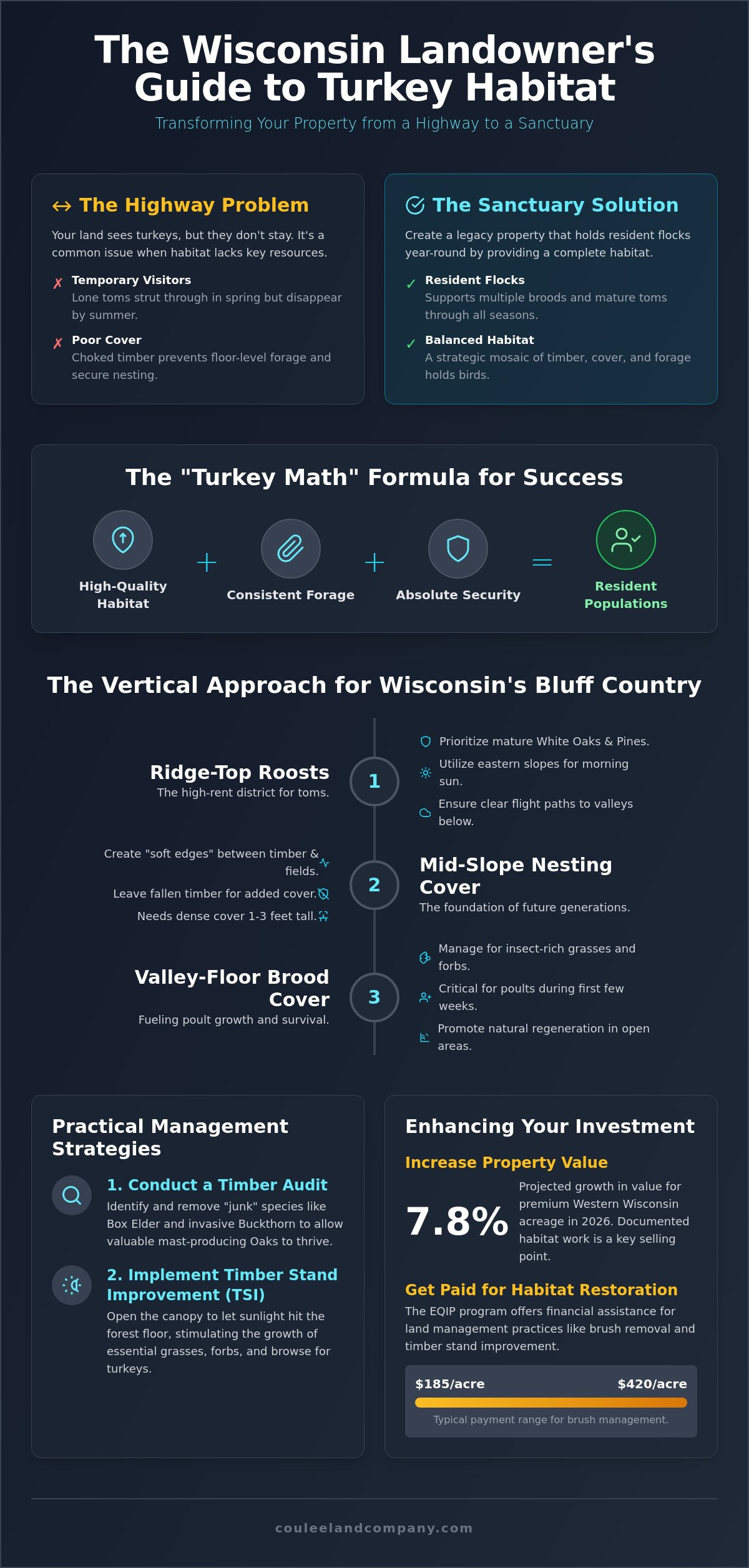
In Western Wisconsin’s Driftless Area, turkeys don’t just exist on a flat plane. They live in a vertical world of steep bluffs and deep coulees. Success in improving turkey habitat on my land starts with understanding that birds require a complex mosaic of mature timber, open grasslands, and dense nesting cover. We view this through the lens of “Turkey Math,” where high-quality habitat plus consistent forage plus absolute security equals resident populations that don’t wander onto the neighbor’s tract. In high-value regions like Buffalo County, this mosaic is the difference between a property that holds birds and one that simply watches them pass through.
To grasp the full scope of wild turkey habitat requirements, you must look beyond the simple presence of trees. True vertical diversity means providing resources at every elevation of the bluff. This includes high ridge-top roosts, mid-slope nesting benches, and valley-floor brood-rearing sites. When these elements are stacked correctly, you create a self-contained sanctuary that supports turkeys through every life stage.
To better understand how these habitat elements influence bird behavior, watch this helpful video:
The Role of Ridge-Top Roosting Sites
Mature hardwoods on eastern slopes are the high-rent district for Wisconsin toms. These slopes catch the first rays of the morning sun, allowing birds to warm up quickly after a cold spring night. Identifying roost trees is a critical first step; look for large white oaks or white pines with heavy horizontal limb structures that can support the weight of multiple birds. It’s vital to maintain a clear flight path for birds to pitch down into valleys. If the understory is too choked with buckthorn or invasive brush, birds will feel trapped and eventually abandon the roost for more open timber.
Nesting Cover: The Foundation of Recruitment
Nesting cover is where many landowners fall short, yet successful recruitment is the only way to ensure the long-term success of improving turkey habitat on my land. A hen needs dense, ground-level vegetation between one and three feet tall to feel secure from predators. This is why edge management along timber lines is critical for hen security. By creating soft transitions between timber and fields rather than hard walls of trees, you provide the screening cover hens crave. Leave fallen timber in place; these logs create a trellis effect for vining plants, which adds a layer of overhead protection that is invisible to hawks but perfect for a nesting hen.
Practical Management Strategies for Improving Turkey Habitat on Your Land
Managing land in the Driftless Area requires a hands-on approach. You can’t just let the woods grow wild and expect top-tier results. Improving turkey habitat on my land starts with a rigorous timber audit. You need to identify “junk” species like box elder or invasive buckthorn that offer zero value to wildlife. Removing these competitors allows your mast-producing White and Red Oaks to thrive. This work often qualifies for financial assistance; for example, the EQIP program in 2026 offers brush management payments between $185 and $420 per acre. This aligns with the Midwestern habitat initiative which emphasizes forest thinning to restore healthy ecosystems.
Timber Stand Improvement (TSI) for Turkeys
Opening the canopy is non-negotiable. We often recommend the “Hack-and-Squirt” method to create immediate canopy gaps. This technique kills undesirable trees while they stand; it provides snag habitat for other species while letting sunlight hit the dirt. In our rugged terrain, natural regeneration often outperforms supplemental planting if the seed bank is healthy. For a deeper look at how these actions benefit multiple game species, see our guide on Wisconsin land management for wildlife. If you’re looking for land with the right “bones” for these improvements, our team at Coulee Land Company can help you find the ideal tract.
Food Plots and “Clover-Bugging” Bonanzas
White clover is the gold standard for spring forage. It provides high-protein greens for hens and attracts the massive insect populations poults need to survive their first few weeks. These “bugging flats” are essential for recruitment. We design “Linear Plots” that follow the contours of the bluffs. These serve as perfect travel corridors and strutting zones for dominant toms. This strategy offers great synergy; your turkey food plots perfectly complement Buffalo County deer hunting tactics by providing year-round nutrition and clear shooting lanes during the fall season.
Enhancing Your Investment: The Link Between Habitat and Land Value
In the competitive Wisconsin real estate market, a property’s value is defined by its performance. Improving turkey habitat on my land is a strategic move that transforms raw timber into a high-demand, “turn-key” hunting property. Buyers in 2026 are increasingly willing to pay a premium for tracts where the labor-intensive work of brush management and forest thinning is already established. When you approach selling hunting land in Wisconsin with a documented history of stewardship, you aren’t just selling a woodlot; you’re selling a proven wildlife sanctuary.
Documented improvements act as the ultimate curb appeal for serious outdoor enthusiasts. With Western Wisconsin land values projected to grow by 7.8% this year, properties with established food plots and diverse cover stand at the top of the market. High-quality hunting land in this region typically commands between $4,500 and $8,500 per acre, and a well-executed management plan is the key to hitting that upper echelon of pricing. Positioning your acreage as a premier sanctuary ensures it attracts top-tier offers from buyers who value the Driftless Area’s unique biological potential.
Increasing Property Marketability
Visual proof is everything in specialized land brokerage. High-definition trail camera photos showing large bachelor groups of toms or multiple broods of poults provide the emotional connection a buyer needs to make a decisive offer. Beyond the wildlife, a functional infrastructure of accessible trail systems and strategically placed “bugging flats” demonstrates that the land is ready to hunt from day one. We recommend consulting with a land specialist from Coulee Land Company to evaluate your tract’s unique potential and ensure your habitat improvements align with what modern buyers are seeking.
The Long-Term ROI of Stewardship
Stewardship is a dual-purpose investment where timber value and wildlife habitat often go hand-in-hand. The long-term ROI of improving turkey habitat on my land is reflected in both the ecological health and the appraised value of the acreage. By favoring mast-producing oaks and thinning out low-value species, you’re increasing the future harvest value of your timber while simultaneously creating the nesting cover turkeys require. This creates a legacy property that retains its value regardless of broader market fluctuations. You aren’t just growing turkeys; you’re cultivating a high-performing financial asset that will serve your family for generations.
Secure Your Legacy in Wisconsin’s Bluff Country
Building a premier turkey property in the Coulee Region is a journey that pays dividends in both the spring woods and your financial portfolio. You now understand that vertical diversity is the heartbeat of a successful tract; it’s about connecting ridge-top roosts with valley brood cover through aggressive timber stand improvement and strategic forage placement. By focusing on improving turkey habitat on my land, you aren’t just creating a sanctuary for wildlife; you are developing a “turn-key” asset that stands apart in a competitive real estate market.
Whether you’re looking to enhance your current acreage or seeking a new property with “good bones,” our team is ready to guide you. We specialize in Buffalo County trophy properties and the unique terrain of Western Wisconsin. Expert agents like Mike Law and Bryan Lemke bring a lifetime of hunting and land management experience to every transaction, ensuring your investment is sound from both a sporting and financial perspective.
Take the next step in your stewardship journey today. View our exclusive Western Wisconsin hunting properties and find the perfect canvas for your conservation efforts. The birds are already there; it’s time to build the property they never want to leave. Your dream of owning a premier wildlife sanctuary is within reach.
Frequently Asked Questions
What is the best thing to plant for wild turkeys in Wisconsin?
White clover is the premier choice for Wisconsin landowners because it provides high-protein forage during the critical spring nesting season. Beyond the greens, clover stands act as “bugging flats” that attract the massive insect populations young poults require to survive their first weeks of life. Establishing these plots in the Coulee Region ensures your property remains a primary destination for hens and their broods throughout the summer months.
How much land do I need to manage for turkeys?
You don’t need a thousand acres to see results; even a 20 to 40 acre parcel can hold resident birds if it provides one of the three critical pillars of habitat. If your acreage offers secure nesting cover, mature roosting timber, or high-quality forage, turkeys will incorporate it into their daily home range. Success in improving turkey habitat on my land often comes down to the quality of the management rather than the total quantity of the acres.
Can I manage for both deer and turkeys at the same time?
Managing for whitetails and wild turkeys is a natural fit, as both species thrive on Timber Stand Improvement and clover-based food plots. The main distinction lies in the understory density. Turkeys require more “open” walking room for travel and predator detection, while deer prefer the thick security of bedding cover. We recommend creating a mosaic of cover types to satisfy the specific security needs of both trophy toms and mature bucks on a single tract.
When is the best time to perform habitat work for turkeys?
Late winter and early spring are the ideal windows for performing Timber Stand Improvement and clearing undesirable “junk” trees. This timing ensures that canopy gaps are open before the growing season begins, allowing sunlight to hit the forest floor immediately for new growth. For food plots in Western Wisconsin, you should wait until the threat of frost has passed in May to ensure successful clover germination and long-term stand health.