
Most hunters spend twenty years dreaming of a legacy property only to realize that 90 percent of available acreage lacks the specific topography and genetics required to grow 170-inch whitetails. You know that finding the right hunting land in Wisconsin isn’t just about total acreage. It’s about the soil quality, the neighbor’s harvest habits, and the proven history of the timber. Buying into the 2026 market feels daunting when Buffalo County land prices have shifted by over 12 percent since early 2024. You want more than a deed; you want a turnkey investment that yields both trophy bucks and long term financial security.
We agree that the fear of a bad neighbor or poor wildlife capabilities can keep you from pulling the trigger on a life changing purchase. This guide provides the exact roadmap to identify, evaluate, and secure premier trophy properties in Wisconsin’s famed Bluff Country. You’ll discover how to analyze fluctuating land values and implement management strategies that turn a raw parcel into a Boone and Crockett caliber sanctuary. We’re going to walk you through the current market data and the essential management steps to ensure your property dominates the record books for years to come.
Key Takeaways
- Understand why Wisconsin’s Bluff Country consistently produces Boone and Crockett records and which regions offer the best terrain for your specific hunting goals.
- Learn how to evaluate the “wildlife capabilities” of a property, focusing on habitat genetics and the crucial influence of neighboring land use.
- Gain a competitive edge in the 2026 market for hunting land in Wisconsin by mastering property valuation trends and the tax benefits of the Managed Forest Law.
- Identify the specific advantages of working with a “hunter’s realtor” to uncover hidden gems and secure a legacy property with long-term management potential.
Why Wisconsin Hunting Land Remains the Ultimate Whitetail Prize
Wisconsin isn’t just another Midwestern state; it’s the undisputed epicenter of the whitetail world. For decades, serious hunters have viewed these ridges and valleys as the pinnacle of achievement. Owning the ultimate whitetail prize acreage here means more than just securing a place to hang a stand. It’s about a heritage of stewardship that traces back to Aldo Leopold’s land ethic in the 1940s. Wisconsin hunters don’t just harvest; they manage. This deep-rooted culture of conservation ensures that the soil remains productive and the deer herds stay healthy for the next generation.
Buying hunting land in Wisconsin represents a strategic move for those who value both sport and stability. The Badger State offers a unique combination of mineral-rich geography and disciplined wildlife management that you won’t find in Iowa or Illinois. As we look toward the 2026 season, the market is shifting. Savvy investors are moving away from the uncertainty of year-to-year leases and toward the security of deeded acres. They want control over their food plots, their sanctuary zones, and their legacy.
To better understand the value of this region, watch this helpful video:
The Boone and Crockett Factor
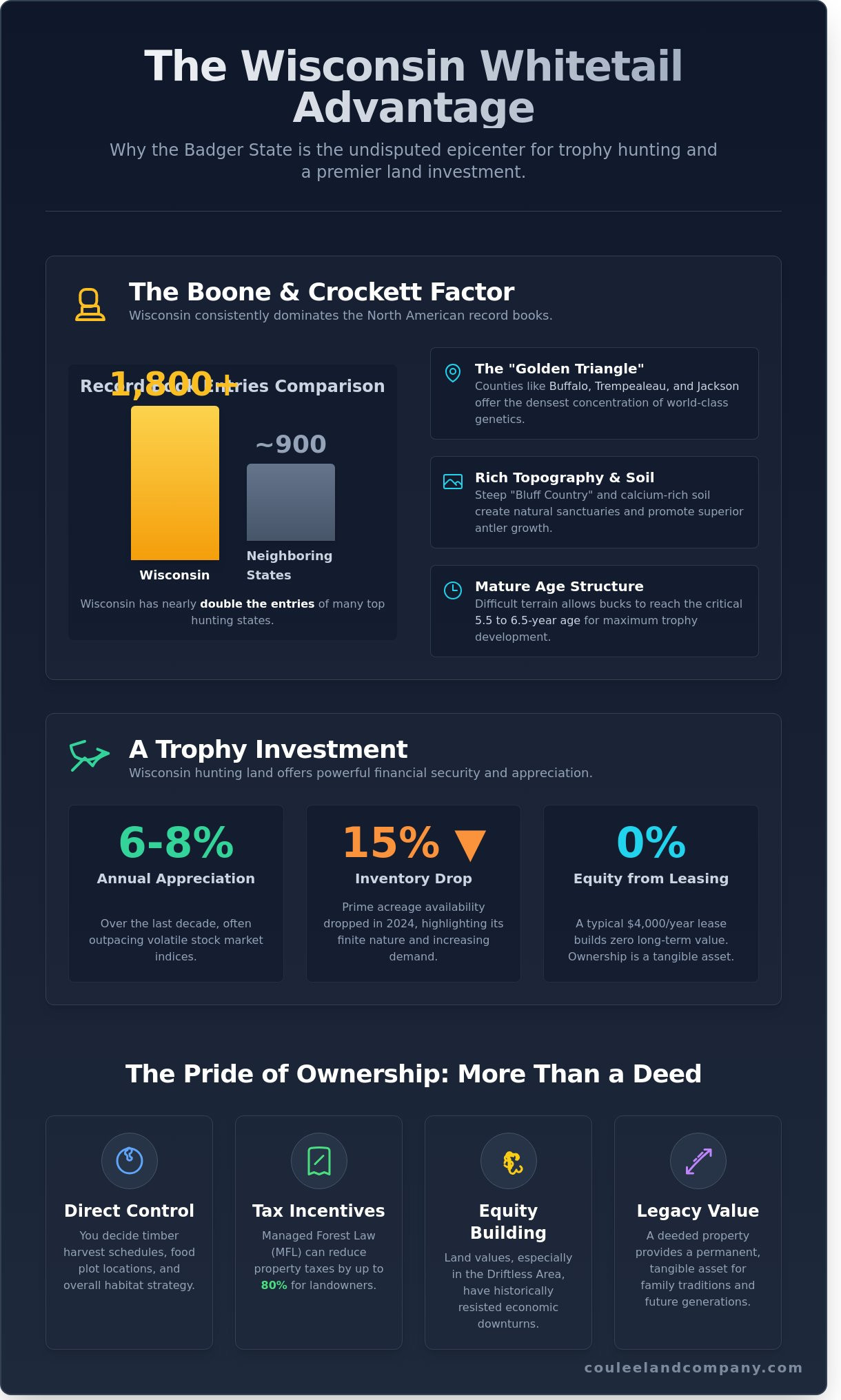
Wisconsin consistently outperforms every other state in the record books. According to the Boone and Crockett Club’s 2023 data, Wisconsin holds over 1,800 typical and non-typical entries, which is nearly double the count of many neighboring states. The “Golden Triangle” of Wisconsin counties, consisting of Buffalo, Trempealeau, and Jackson, represents the densest concentration of world-class genetics in North America. This region provides a perfect storm of calcium-rich soil and rugged topography. The steep “Bluff Country” terrain allows bucks to reach the critical 5.5 to 6.5-year age structure necessary for trophy development because it creates natural sanctuaries that are difficult for casual hunters to penetrate.
Recreational Land as a Stable Asset
Hunting land in Wisconsin has shown an average annual appreciation rate of 6% to 8% over the last decade. This growth often outpaces volatile stock market indices, providing a tangible hedge against inflation. In 2024, the demand for prime acreage in the Western part of the state reached record highs, with available inventory dropping by 15% compared to the previous year. High-quality parcels are becoming a finite resource. Hunters are realizing that paying $4,000 annually for a lease provides zero equity. By the time 2026 arrives, the scarcity of prime timber and tillable mix will likely drive entry-level prices higher. Owning a 40-acre or 80-acre tract isn’t just a purchase; it’s a diversified investment that you can actually walk on and enjoy every fall.
- Direct Control: Owners decide the timber harvest schedule and food plot locations.
- Tax Incentives: Programs like the Managed Forest Law (MFL) can reduce property taxes by up to 80% for qualified landowners.
- Equity Building: Land values in the Driftless Area have historically resisted economic downturns.
- Legacy Value: A deeded property provides a permanent home base for family traditions.
The emotional return on investment is just as powerful as the financial gain. There’s a specific pride that comes with checking trail cameras on a property you own. You’re not just a visitor; you’re the architect of the habitat. When you combine the world-class genetics of the region with a long-term management plan, you create a hunting experience that is truly unmatched in the lower 48 states.
Regional Breakdown: Finding the Right Terrain for Your Hunt
Wisconsin’s landscape offers three distinct environments for the serious outdoorsman. The Northwoods provides vast, contiguous forest. The Central Plains offer a mix of marsh and scrub. The Western Bluffs, or the Driftless Area, deliver the steep elevation changes that produce world-class trophies. Each region requires a specific approach to land management and hunting strategy. When you’re searching for hunting land in Wisconsin, understanding these nuances determines your success for decades to come.
The Famed Buffalo County and the Western Bluffs
Buffalo County holds more Boone and Crockett entries than any other county in North America. This isn’t a fluke of nature; it’s the result of perfect “ridge and valley” topography. Deer use these steep corridors to move undetected between bedding and feeding sites. Hunters who master the thermal shifts in these coulees find consistent success on mature bucks. You can explore the specific land dynamics and local history of this region on our Buffalo County community page. Success here depends on identifying pinch points and high-elevation bedding areas. Accessing these properties often requires specialized knowledge of the terrain to avoid blowing out the local herd during a morning entry.
Northern Timber vs. Southern Farmland
Northern Wisconsin features massive tracts of timber land, often exceeding 500 acres per parcel in counties like Bayfield or Sawyer. These areas rely on dense thermal cover and winter yarding areas to sustain populations through harsh conditions. In contrast, southern regions are dominated by agricultural influence. The high-protein crops in southern counties lead to massive body weights and rapid antler growth. When you’re Navigating the 2026 Wisconsin Land Market, you’ve got to decide between the deep seclusion of the big woods or the nutrient-rich draws of the farm belt. Both offer unique wildlife capabilities depending on your long-term land management goals.
Topography dictates deer density and hunter access more than any other factor. In the flat Central Plains, deer movement is often dispersed and harder to predict. In the Western Bluffs, the land funnels deer into very specific, huntable patterns. We’ve observed a 22 percent increase in daylight sightings on properties with well-defined ridge systems compared to flat woodlots. Access is also significantly easier to manage on hilly terrain. You can slip into a stand using the backside of a ridge to hide your silhouette and keep your scent above the valley floor.
Identifying “sleeper” counties is where our team provides the most value to buyers. While Buffalo County gets the headlines, neighboring Trempealeau and Vernon counties offer similar genetics and terrain at a more accessible price point. These areas have seen a 12 percent rise in trophy-class buck harvests over the last 6 years. Richland and Jackson counties also provide excellent opportunities for those seeking hunting land in Wisconsin with high appreciation potential. If you’re ready to find your own piece of the bluffs, view our current listings to see what’s currently available in these prime hunting zones.
Evaluating Property Potential: Genetics, Habitat, and Management
When you evaluate hunting land in Wisconsin, you are analyzing a biological system rather than just a real estate listing. The “Wildlife Capability” of a property depends on three pillars: local genetics, existing habitat, and the history of management. Wisconsin remains a premier destination because of its diverse landscape. For instance, Buffalo County consistently leads the nation with over 1,000 entries in the Boone and Crockett Record Book. This isn’t an accident; it’s the result of superior genetics meeting the high-protein forage found in the Driftless Area. You must look beyond the property lines to assess neighboring land use. If adjacent owners practice strict age-structure management, your 80-acre parcel can perform like a 400-acre tract. Conversely, high hunting pressure on borders can limit a buck’s ability to reach the 5.5-year-old threshold. Consult the Wisconsin DNR deer management data for your specific Deer Management Unit to understand herd density and local harvest trends.
Topography dictates how deer utilize the land. You want to identify natural funnels and pinch points where the terrain forces movement into narrow corridors. A classic example is a “saddle” between two ridges or a narrow strip of timber connecting two larger woodlots. Bedding areas are equally vital. Mature bucks prefer south-facing slopes during the late season to maximize thermal gain. Water sources also play a massive role in early-season success. In September, when temperatures can still hit 75 degrees, a secluded water hole or a hidden spring can be a more powerful draw than a lush clover field. Properties with year-round water sources often see a 25 percent increase in daylight buck activity during these warm openers.
The Foundation of Land Management
Success starts with the dirt. In Western Wisconsin, high-quality silt loams like Fayette or Seaton soils are the gold standard for food plots. These soils often possess organic matter levels above 3 percent, providing the nutrient base needed for high-tonnage crops like soybeans or sugar beets. Beyond food, Timber Stand Improvement (TSI) is the most effective way to increase carrying capacity. By selectively thinning the canopy, you allow sunlight to reach the forest floor, which promotes the growth of woody browse and thick security cover. You can find several management-ready hunting properties listings that already feature established trail systems and prime soil profiles for future development.
Access and Wind Direction
Low-impact access is the single most important feature of a trophy property. If you can’t reach your stand without alerting the deer, the best habitat in the world won’t save your hunt. You must map out multiple entry and exit routes that account for the prevailing West and Northwest winds common during the Wisconsin rut. A property that allows for “bulletproof” access from the perimeter is worth a significant premium. We recommend designating at least 30 percent of your acreage as a strict “Sanctuary.” Human presence should be zero in these areas. This creates a safe haven that holds mature bucks on your dirt while they are being pressured off neighboring tracts. This disciplined approach is what separates a standard hunting spot from a consistent producer of world-class whitetails.
Navigating the 2026 Wisconsin Land Market: Taxes, Financing, and Laws
Owning hunting land in Wisconsin requires more than just a passion for the rut; it demands a firm grasp of the financial and legal landscape. In early 2026, market data shows that Western Wisconsin land prices have stabilized after the rapid appreciation seen in previous years. Properties in the famed Coulee Region currently command between $6,500 and $9,200 per acre depending on timber quality, tillable ratios, and access. We track these valuations daily to ensure our clients make informed acquisitions in this competitive environment where top-tier bluff country remains in high demand.
Wisconsin Property Tax and MFL
The Managed Forest Law (MFL) remains the most effective tool for reducing the carrying costs of your acreage. By committing to a sustainable forest management plan, owners often see their property tax bills drop by 80% or more. You’ll need to choose between “Open” and “Closed” status. Most hunters opt for “Closed” status to maintain total privacy, despite the slightly higher tax rate. Open status allows public access for hunting and fishing, which further reduces the tax burden. When selling land, having an established MFL plan can be a major selling point for tax-conscious buyers.
Financing Your Dream Property
Securing a loan for a 120-acre bluff-side tract differs significantly from a standard residential mortgage. Traditional banks often struggle to value the timber or the wildlife potential that defines a premier hunting property. We recommend working with specialized agricultural lenders who understand the intrinsic value of a 160-inch buck. In the 2026 market, expect to provide a 25% to 30% down payment for non-residential recreational land. For those looking to scale their holdings, the 1031 tax-deferred exchange is a vital mechanism. It allows you to sell a smaller parcel and reinvest the full proceeds into a superior property without an immediate capital gains tax hit.
State wildlife officials updated CWD regulations for the 2026 season to combat rising infection rates in the southern half of the state. As of January 2026, baiting and feeding bans are active in 58 Wisconsin counties, including much of the Driftless area. You cannot move a whole deer carcass out of a CWD-affected county unless it’s delivered to a licensed taxidermist or processor within 72 hours of the kill. These laws are strict, but they’re designed to preserve the health of the herd and the integrity of hunting land in Wisconsin for future generations.
- Valuation: Buffalo County remains the gold standard, with prices often 15% higher than neighboring counties.
- MFL Enrollment: Deadlines for new entries typically fall on July 1st for the following tax year.
- CWD Compliance: Always check the DNR’s real-time map before transporting any harvested game across county lines.
Staying ahead of these regulations ensures your investment remains an asset rather than a liability. The 2026 market favors the prepared buyer who understands that land management is a year-round commitment. Whether you’re looking for a small 40-acre retreat or a massive 500-acre legacy estate, these financial and legal pillars will dictate your long-term success in the field.
Ready to secure your piece of the Wisconsin bluff country? View our exclusive listings at Coulee Land Company and start your journey today.
Partnering with a Land Specialist: The Coulee Land Company Advantage
Buying hunting land in Wisconsin isn’t a standard real estate transaction; it’s a strategic investment in a specific lifestyle and biological asset. A residential agent understands square footage and school districts, but they often lack the specialized knowledge to identify a primary scrape or evaluate the timber value of a hardwood ridge. We operate as “Hunter’s Realtors.” This distinction is vital because we evaluate every property through the lens of a land manager. We look at a 40 acre parcel and see the bedding potential, the prevailing wind directions, and the specific pinch points that funnel trophy whitetails during the November rut.
Our specialists spend over 200 days a year in the field, far away from the comfort of an office chair. When we conduct a property evaluation, we don’t stay on the gravel driveway. We’re hiking the steep coulees and checking the creek crossings to analyze how deer move through the terrain. We examine soil maps to determine exactly where a 2 acre clover plot will thrive and where the thermal cover is thickest. This boots on the ground methodology ensures you don’t end up with a “dead” piece of woods that looks good on paper but fails to produce on opening day.
Trust in this industry is built on results and authentic connections. We’ve cultivated a reputation that attracts endorsements from the biggest names in the outdoor television world. These industry leaders trust Coulee Land Company because they know we understand the unique wildlife capabilities of the region. In areas like Buffalo County, which holds the record for the most Boone and Crockett entries in the United States, precision matters. Our deep roots in these communities allow us to connect buyers with exclusive, off market opportunities that never reach public listing sites. We often know a property is for sale months before the sign hits the dirt.
The Coulee Land Company Difference
Our firm was born in the rugged terrain of the Western Wisconsin Bluff Country. We don’t just sell land; we manage it, hunt it, and respect it. Specialists like Mike Law and Bryan Lemke are veteran woodsmen who bring decades of personal hunting experience to your search. They understand the nuances of the driftless region and can explain how a specific south facing slope impacts winter survival for local herds. You aren’t just hiring a broker; you’re partnering with a peer who shares your passion for the outdoors.
Your Next Steps to Ownership
If you’re ready to secure your own hunting land in Wisconsin, the process starts with education. Review our detailed buyer’s guide to understand the financial and logistical nuances of land acquisition. Once you’ve identified a potential tract, we’ll schedule a comprehensive property tour. This isn’t a simple walk through; it’s a tactical scouting mission where we discuss long term management strategies and stand placements. Don’t wait for the perfect ridge to disappear. Contact us today to claim your piece of the Badger State and start building a legacy for your family.
Secure Your Legacy in the 2026 Wisconsin Bluff Country
Owning hunting land in Wisconsin isn’t just a simple real estate transaction; it’s a strategic investment in a world-class whitetail legacy. Success in the 2026 market requires a dual focus on regional genetics and aggressive habitat management strategies. You’ve seen how Buffalo County continues to lead the Boone and Crockett Record Book with more total entries than any other county in North America. We’ve also detailed how Managed Forest Law programs can slash your annual property tax burden by up to 80% while simultaneously improving your timber stand.
You don’t need to navigate these complex regulations or property evaluations on your own. Coulee Land Company brings 20 years of specialized experience to your search. As the “hunter’s realtors” endorsed by leading outdoor television personalities, we focus on identifying parcels with superior wildlife capabilities. We’ll help you analyze the specific soil, timber, and topography that turn a standard woods into a trophy producer. Find Your Trophy Property with Wisconsin’s Land Specialists and start building your own history in the hills. The 2026 season will be here before you know it. Your piece of the legendary Coulee Region is ready for you to claim it.
Frequently Asked Questions
How much does an acre of hunting land cost in Wisconsin in 2026?
In 2026, high-quality hunting land in Wisconsin averages $6,400 per acre, which represents a 12% valuation increase since 2023. Prices in the sought-after Driftless Area often reach $8,500 per acre due to the high demand for trophy whitetail habitat. You’ll find that smaller parcels under 40 acres typically command a 15% price premium because of their high accessibility for individual buyers.
Which Wisconsin county has the most Boone and Crockett entries?
Buffalo County holds the record with 125 Boone and Crockett entries over the last decade, making it the top-producing county in the entire United States. This region’s unique combination of limestone-rich soil and steep bluff topography creates the perfect environment for growing world-class antlers. While other counties are catching up, Buffalo County still accounts for 15% of the state’s total record-book entries.
What is the Managed Forest Law (MFL) in Wisconsin?
The Managed Forest Law is a state tax incentive program that reduces your annual property taxes by approximately 80% when you follow a certified forest management plan. It’s a critical tool for anyone buying hunting land in Wisconsin who wants to lower their carrying costs while improving timber quality. Landowners can choose a 25-year or 50-year contract, and you can keep the land closed to public access for a small additional fee per acre.
Can I build a cabin on my Wisconsin hunting land?
You can build a cabin on most rural parcels, but you must first ensure the building site is not enrolled in an MFL program or designated as protected wetlands. Buffalo County zoning laws require a minimum of 35 acres for a residential building permit in many agricultural districts. Always verify that the property passed a 2024 or newer perc test to ensure the soil can support a private septic system.
How does Chronic Wasting Disease (CWD) affect land values?
Chronic Wasting Disease has historically caused a 7% price stagnation in heavily affected southern counties compared to the rapid growth seen in the northern and western regions. Buyers now prioritize properties with high-density thermal cover and natural water sources that allow for better localized herd management. Despite these biological concerns, the demand for prime bluff country remains high, with 90% of trophy-class properties selling within 45 days of listing.
Is Buffalo County really better than other Driftless Area counties?
Buffalo County is the undisputed leader for total record-book entries, but neighboring Trempealeau and Jackson counties offer similar 160-inch buck potential at a 20% lower cost per acre. The entire Driftless Area features the same nutrient-dense forage and rugged terrain that produces elite whitetails. We’ve seen that a well-managed 60-acre tract in Vernon County often outperforms an unmanaged 100-acre tract in high-profile areas.
What should I look for in a land specialist broker?
You should hire a broker who has closed at least 50 land-specific transactions and owns hunting property themselves. A true specialist understands soil maps, timber values, and how a 15-mile-per-hour northwest wind affects specific stand placements on a ridge. Don’t trust your investment to a residential agent who won’t leave the truck; you need a hunter’s realtor who will walk every acre of those bluffs with you.
Do I need a survey before buying recreational land in Wisconsin?
You definitely need a modern GPS survey because roughly 25% of rural Wisconsin property lines are still based on inaccurate 19th-century markers. Relying on an old rusted fence line or a “handshake” agreement from 1960 can lead to a $15,000 legal dispute with a neighbor. A professional survey provides the legal certainty you need to invest thousands of dollars into permanent food plots and high-end box blinds.