
You don’t need a seven figure bank account to own a piece of the legendary Wisconsin Bluff Country. While average land prices in premier trophy counties have surged by 12% over the last 18 months, finding high quality hunting land for sale under $100k wisconsin is still a realistic goal for the disciplined buyer. It’s frustrating to watch prime acreage disappear into the hands of institutional investors while you’re just looking for a reliable 20 acre honey hole to call your own. We know the sting of being outbid on a property you’ve already scouted in your mind.
We understand that the fear of buying a “dead” parcel with zero deer activity is what keeps many hunters on the sidelines. At Coulee Land Company, we’re specialists who believe that a well managed 15 acre tract can outproduce a neglected 100 acre farm every single season. This 2026 guide will help you identify four specific counties where your $100,000 budget still holds maximum buying power and teach you three land management strategies needed to grow and hold mature whitetails on limited acreage. We’re moving beyond the broad listings to show you how to evaluate soil quality, bedding cover, and neighborhood pressure so you can secure your legacy before the next price hike.
Key Takeaways
- Understand the 2026 market pulse to successfully secure hunting land for sale under $100k wisconsin, focusing on high-quality 10- to 25-acre tracts.
- Identify the top counties for recreational value, including the hidden gems of the Driftless Area and the oak savannahs of Central Wisconsin.
- Evaluate small parcels like a pro by analyzing the “neighbor factor” and how wind-dictated access impacts your property’s hunting pressure.
- Prepare for the closing table with expert insights on land loan requirements and the advantages of working with local Wisconsin credit unions.
- Implement immediate post-purchase improvements, such as sanctuary zones and water holes, to maximize the wildlife capability of your new dirt.
The Reality of the $100k Wisconsin Land Market in 2026
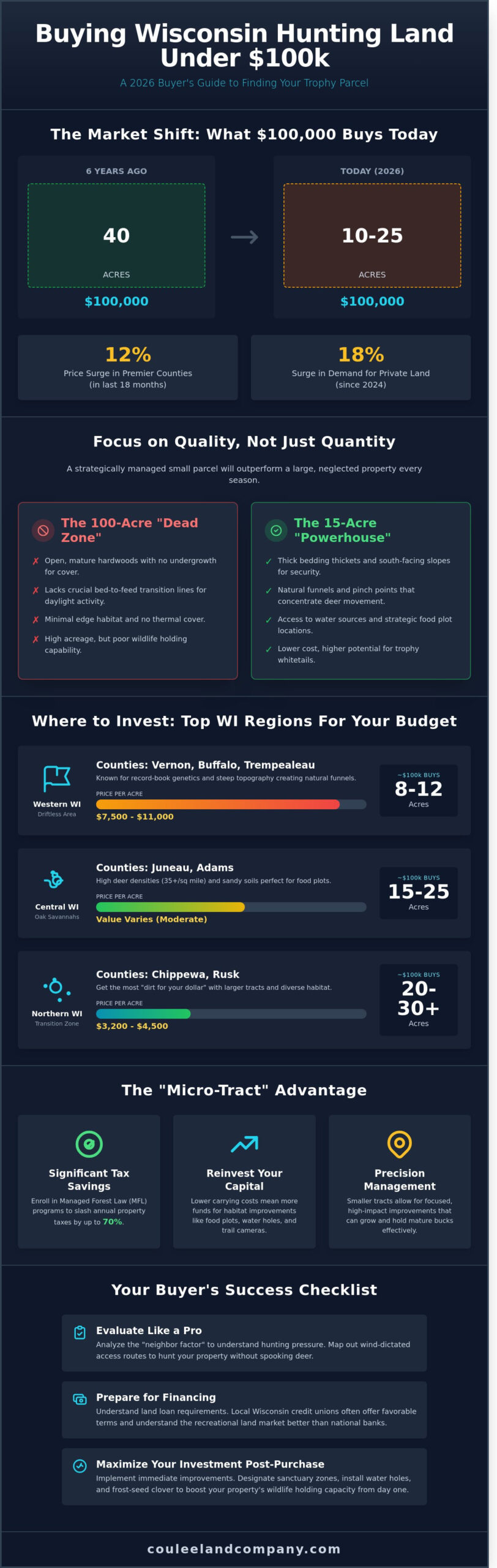
Finding hunting land for sale under $100k wisconsin in 2026 requires a sharp eye and a realistic strategy. Six years ago, $100,000 might have secured a 40-acre tract in the central sands; today’s buyers typically look at 10 to 25 acres for that same investment. Demand for private recreational retreats has surged 18% since 2024 as more hunters prioritize secure access over crowded public ground. You aren’t just buying dirt; you’re buying a controlled environment for your herd and a legacy for your family.
Don’t make the mistake of chasing high acreage at the expense of habitat quality. A 15-acre pinch point between two large cedar swamps will outproduce a 40-acre “dead zone” of open, mature hardwoods every single season. A dead zone lacks the necessary bed-to-feed transition lines that keep deer on your property during daylight hours. Conversely, a small tract with a south-facing slope and a thick bedding thicket can be a literal gold mine during the November rut. In the famed Bluff Country of Buffalo and Trempealeau counties, that $100,000 budget often buys closer to 8 or 12 acres because these ridges dominate the record books. You’re paying for the genetics and the steep topography that funnels mature bucks right past your stand.
To better understand how a smaller footprint can still offer incredible value for your investment, watch this look at a compact recreational property:
Understanding Price-Per-Acre Trends in WI
In 2026, Northern Wisconsin averages $3,200 to $4,500 per acre for raw hunting land. Western Wisconsin, particularly the driftless region, commands $7,500 to $11,000 per acre due to its world-class reputation. If a parcel has existing road access and power at the line, expect to pay a 15% premium or more. While the Wisconsin Department_of_Natural_Resources (DNR) manages over 1.5 million acres of public land, the privacy of a deeded 20-acre lot remains the gold standard for serious hunters. Recreational value in 2026 is defined as the appraised worth of a property’s specific capacity to sustain and harvest mature wildlife through strategic habitat and thermal cover.
Why Small Parcels are the New ‘Trophy’ Investment
Micro-land management has changed the game for whitetail fanatics. You don’t need 100 acres to kill a 160-inch buck if you manage your 15 acres with precision. Smaller parcels under the $100k mark also offer significant tax advantages. Many properties in this price bracket qualify for Managed Forest Law (MFL) programs, which can slash annual property taxes by 70% in some townships. Lower carrying costs mean you can reinvest your capital into high-end food plots and cellular trail cameras. It’s about being a “hunter’s realtor” and understanding that a small, well-positioned tract is a better investment than a large, poor-quality one. If you’re ready to start your search for hunting land for sale under $100k wisconsin, learn more about our exclusive hunting properties and see why we’re Wisconsin’s land specialists.
Where to Find Value: Top WI Counties for Under $100k
Finding quality hunting land for sale under $100k wisconsin requires a tactical approach to geography. In Vernon County, the gateway to the Driftless Area, buyers often find 10 to 15-acre parcels tucked into hidden valleys. These smaller tracts punch above their weight class because the steep topography creates natural funnels and thermal hubs that concentrate deer movement. While larger contiguous tracts in this region command premium prices, these smaller “pocket” properties allow you to own a piece of the bluff country without exceeding a five-figure budget.
Juneau and Adams counties offer a different kind of value. This central corridor is characterized by oak savannahs and high deer densities, with some townships reporting over 35 deer per square mile. The sandy soils and flatter terrain make these properties easier to manage for food plots. In Chippewa and Rusk counties, you move into the northern transition zone. Here, your investment buys more "dirt for the dollar." It’s common to find 30 to 40-acre tracts in this region for the same price as a 10-acre lot in the southern counties.
Jackson County remains a favorite for savvy land buyers due to its vast public land adjacencies. Purchasing a 20-acre parcel that shares a border with the 120,000-acre Black River State Forest effectively turns your small holding into a massive hunting camp. You own the private "sanctuary" where you can control the pressure, while using the public land as a massive buffer. When securing these smaller tracts, many buyers utilize USDA Farm Service Agency (FSA) loans to help bridge the gap between their down payment and the total purchase price.
The ‘Sleeper’ Counties of Western Wisconsin
Richland and Crawford counties are often overlooked by hunters rushing toward Buffalo County, but they offer nearly identical genetics and terrain. These “sleeper” areas are characterized by rugged ridges and deep coulees that require a physical hike to hunt effectively. This physical barrier often keeps prices lower than the state average. If you are willing to sweat for your trophy, these counties provide incredible big buck potential. While you explore the community and land in Buffalo County for inspiration, look to Richland and Crawford for the actual 2024 bargains. These areas are perfect for the hunter who prioritizes habitat quality over easy access.
Northern WI: The Land of the ‘Big Woods’ Bargain
In Price, Iron, and Sawyer counties, the “Big Woods” experience is still affordable. In 2023, several 40-acre parcels in these counties sold for less than $85,000. The trade-off is clear: you get more acreage, but deer densities are lower than in the central farmland. Success here depends on scouting “island” timber and cedar swamps within vast public expanses. You aren’t just buying land; you are buying a basecamp for a lifetime of wilderness adventure. Before you pull the trigger on a northern tract, view our current land listings to see how these prices compare to the southern markets. Focus on properties with diverse age classes of timber to ensure long-term holding power for local herds.
Evaluating Small Parcels: Quality Over Quantity
Finding hunting land for sale under $100k wisconsin requires a shift in perspective. You’re no longer looking for vast acreage; you’re hunting for a high-performance micro-tract. A 20-acre parcel isn’t an island. It’s a single piece of a 500-acre puzzle. Before you sign a deed, scout the neighbors within a one-mile radius. If the surrounding properties lack cover or are over-hunted, your small parcel becomes a sanctuary. Conversely, if you’re bordered by 1,000 acres of standing corn, your land needs to provide the thickest bedding in the township to hold deer during daylight hours.
Access dictates the real-world value of a small tract. If the only entrance forces you to walk with a west wind at your back into a valley, you’ll clear the woods before you reach your stand. Professional land managers prioritize “clean” ingress where the prevailing winds carry scent away from core holding areas. A property you can’t hunt on a north wind is a property where you’ve lost 25% of your seasonal opportunities.
Hold power depends on the “Big Three”: bedding, water, and food. A property without a year-round water source loses 30% of its utility during a dry October. Soil quality is the final hurdle. Don’t assume you can just “plant a plot.” Wisconsin’s glaciated soils vary wildly; a $95,000 tract might consist of Class IV soils with a pH of 4.5, requiring 4 tons of lime per acre just to grow basic clover. Always pull a soil sample before closing to ensure your food plot dreams are actually attainable.
Topography and Deer Movement
LIDAR technology has revolutionized how we evaluate small acreage. These high-resolution maps reveal hidden benches and subtle terrain breaks that traditional maps miss. In the Coulee Region, “vertical” land is an asset because it creates multiple thermal layers and travel corridors in a small footprint. A well-defined pinch point can concentrate 90% of local deer movement into a 30-yard wide corridor, turning a 15-acre ridge into a world-class ambush site. When you’re looking at hunting land for sale under $100k wisconsin, look for these natural funnels that force movement into predictable patterns.
The Checklist for Sub-100k Land Scrutiny
Due diligence is non-negotiable on budget-friendly parcels. Start with a legal easement check. A “landlocked” bargain is only a deal if you have a recorded, transferable right-of-way. Check the MFL (Managed Forest Law) status immediately. While MFL-Closed status can drop your property taxes to roughly $2.10 per acre in 2024, MFL-Open status requires you to allow public access for hunting and fishing. You can verify borders and nearby state-managed tracts through the Wisconsin Public Access Lands database to ensure your private retreat isn’t an extension of a busy public parking lot. Consider these factors before making an offer:
- Timber Value: A selective harvest of mature oak or walnut can return $5,000 to $15,000 to your pocket, effectively lowering your purchase price.
- Utility Access: If you plan to build a cabin, a $20,000 quote to bring in power can ruin your $100,000 budget.
- Zoning Restrictions: Ensure the township allows the specific land improvements you have planned.
Small tracts require precision. When you own 20 acres, every square foot must serve a purpose. By focusing on the surrounding landscape and the internal “hold power” of the dirt, you can out-hunt neighbors who own four times the ground but half the strategy.
Financing and Closing on Your Wisconsin Dirt
Securing a loan for raw land requires a different strategy than a standard residential mortgage. Traditional banks often view vacant acreage as a speculative investment, which is why most lenders require a down payment between 20% and 35%. If you are hunting for hunting land for sale under $100k wisconsin, you need your capital ready. Local Wisconsin credit unions and specialized agricultural lenders like Compeer Financial are often more aggressive than national banks. These local institutions understand the intrinsic value of Western Wisconsin’s topography; they recognize that a 30-acre ridge in Buffalo County is a tangible asset with consistent demand.
Your due diligence timeline typically spans 30 to 45 days from the moment an offer is signed. This period is your window to verify legal access and ensure the property matches the seller’s claims. Property taxes in Wisconsin for recreational land are generally manageable, but you must understand the classifications. Land zoned as “Undeveloped” (Class 5) or “Productive Forest Land” (Class 6) is assessed at 50% of its full value, significantly lowering your annual carry costs. In many rural townships, you can expect to pay between $18 and $35 per acre annually, depending on whether the land is enrolled in programs like the Managed Forest Law (MFL).
The Buyer’s Roadmap to a Smooth Closing
Closing on a rural parcel involves specific hurdles that “city” transactions skip. You must insist on a title insurance policy to ensure there are no hidden easements or old logging liens clouding the deed. A professional survey is equally vital; boundary disputes with neighbors can ruin a hunt faster than a shifting wind. Even if you only plan to park a camper, order a “percolation test” during your inspection period. A property that cannot support a septic system can see a 25% drop in future resale value. For a deeper dive into these requirements, view our comprehensive guide for land buyers.
Working with a Land Specialist
General realtors often struggle with the nuances of rural land, such as identifying deer bedding areas or understanding soil productivity indexes. Our specialists, including Mike Law and Bryan Lemke, spend their days walking these ridges and valleys. They evaluate the “wildlife capabilities” of a property, looking at thermal cover and natural funnels that a standard agent would miss. In the competitive bracket of hunting land for sale under $100k wisconsin, having an expert with “off-market” knowledge is your biggest advantage. Approximately 15% of our successful deals happen before the property ever reaches a public listing site.
Ready to secure your piece of the Wisconsin woods? Contact our team of land specialists today to start your search.
Maximizing Your Investment: Post-Purchase Management
Securing a deed for hunting land for sale under $100k wisconsin is a significant milestone, but the true value of your property is realized through sweat equity and tactical management. You don’t need a massive budget to transform a small parcel into a premier hunting destination. Success in the Bluff Country depends on how well you manage the four pillars of land improvement: security, water, cover, and food.
Your first priority is establishing secure boundaries and designated sanctuary zones. You should designate at least 25% of your interior acreage as a strict “no-human” zone. This area remains untouched 365 days a year, providing a safe haven that holds mature bucks on your property rather than your neighbor’s. Mark your boundaries clearly with purple paint or signage to deter trespassers; a secure perimeter is the foundation of a controlled hunting environment.
Water hole installation is the most cost-effective way to add immediate value to a 10 or 20-acre tract. In the rugged terrain of Western Wisconsin, deer often travel long distances to find water. By burying a 110-gallon stock tank in a high-traffic transition zone, you create a daily destination for local wildlife. This $150 investment, plus a few hours of digging, can increase your property’s attractiveness by 50% during the early season and the rut when bucks are moving frequently.
Timber Stand Improvement (TSI) is another essential step for creating better bedding cover. Use a chainsaw to selectively harvest low-value trees, allowing 40% more sunlight to reach the forest floor. This promotes the growth of native forbs and briars, providing the thick, horizontal cover that trophy whitetails require for security. Finally, implement strategic food plotting. Focus on late-season draws like brassicas and winter peas. These high-protein sources hold deer on your land when temperatures drop below 15 degrees, ensuring your hunting land for sale under $100k wisconsin remains productive through the final day of the season.
Low-Cost Habitat Improvements
Hinge cutting provides immediate screening and browse without a high price tag. By cutting trees halfway through at waist height and folding them over, you create living brush piles that offer both food and thermal cover. Combine this with mock scrapes. A $20 bottle of high-quality scent and a sturdy overhanging licking branch allow you to inventory 90% of the local buck population. Investing $500 in premium clover seed and 30 hours of labor can realistically add $5,000 in perceived land value for future buyers who want a turn-key property.
Long-Term Value: Selling Your Improved Land
Detailed management records are your best asset when you decide to trade up. Maintain a digital log of every habitat project, soil test, and harvest record. A three-year history of trail camera photos acts as a “resume” for your land, proving its ability to produce mature whitetails. If you are thinking of selling? Maximize your land’s return by documenting the transformation you’ve led. Buyers pay a premium for proven results and a well-managed ecosystem. Join the Coulee Land Company family and start your legacy today. We don’t just sell dirt; we help you build a lifestyle rooted in the Wisconsin outdoors.
Secure Your Wisconsin Hunting Legacy in 2026
Owning a legacy property in the 2026 market requires a strategic shift from quantity to quality. Finding hunting land for sale under $100k wisconsin remains achievable for the diligent buyer who focuses on high impact small parcels. You’ve seen that smart financing and a focus on wildlife capabilities can turn a 20 acre tract into a consistent trophy producer. Coulee Land Company stands as Wisconsin’s Land and Property Sales Specialists, bringing a hunter’s realtor perspective to every transaction. We specialize in the bluff country of Buffalo County, a region that continues to lead the Boone and Crockett Record Book for whitetail entries. Our team is endorsed by premier outdoor TV professionals who trust our deep expertise in land management and wildlife potential. Don’t let another season pass without a piece of dirt to call your own. Whether you’re looking for a secluded ridge or a tactical funnel, we’ll help you navigate the 2026 market with confidence and precision.
View Our Current Wisconsin Hunting Land Listings
The Wisconsin woods are calling, and your perfect 20 acre sanctuary is waiting for you to claim it.
Frequently Asked Questions
Can I build a cabin on hunting land under $100k in Wisconsin?
You can build a cabin on most affordable parcels, provided the land passes a soil percolation test and meets local zoning ordinances. Most Wisconsin townships require a minimum of 5 to 10 acres for a residential building permit. You’ll likely spend between $3,000 and $7,000 on a septic system and another $5,000 for a basic driveway. Always verify the buildable status with the county zoning office before closing your deal.
How many acres of land do I really need to hunt deer effectively?
You can effectively hunt deer on as little as 10 to 20 acres if the property features 75% or more thick bedding cover and connects to larger timber tracts. While a 40 acre parcel is the traditional standard for land management, smaller tracts in the Driftless Area often yield trophy bucks because of the rugged topography. Focus on how the land funnels deer movement rather than just the total acreage on the deed.
What is the Managed Forest Law (MFL) and how does it affect my taxes?
The Managed Forest Law is a landowner incentive program that can reduce your property taxes by 80% in exchange for following a sustainable forestry plan. Enrollment requires a minimum of 20 contiguous acres that are at least 80% productive forest land. You’ll choose between Open or Closed status, with closed acreage allowing you to restrict public access for a slightly higher tax rate than open land.
Is it better to buy land adjacent to public hunting grounds?
Buying hunting land for sale under $100k wisconsin next to public ground is a smart move because it effectively expands your hunting range by thousands of acres. Wisconsin has over 6.6 million acres of public hunting land, and owning the private gateway allows you to hunt the edges where big bucks retreat when pressure rises. You’ll need to manage your borders carefully to ensure public hunters don’t wander onto your 20 or 30 acre honey hole.
What are the hidden costs of buying vacant land in Wisconsin?
Hidden costs include the Wisconsin real estate transfer fee of $3.00 per $1,000 of the sale price and potential survey costs ranging from $1,500 to $3,500. You’ll also pay for title insurance and potentially a $500 to $1,000 fee for a formal wetland determination if the terrain looks low. These expenses can add $4,000 to your total acquisition cost, so budget accordingly when looking at lower priced parcels.
How do I check if a property has legal road access?
You must verify legal access by reviewing the recorded deed or a current survey for a 66 foot wide easement or direct frontage on a public road. Wisconsin Statute 82.27 addresses landlocked parcels, but gaining access through a Cartway is a long, expensive legal process. Don’t rely on a handshake or a mowed path; if the access isn’t written in the county records, the property is legally landlocked.
Can I get a loan for land with no house on it?
You can secure a land loan for vacant property, but most traditional banks require a 20% to 35% down payment for unimproved acreage. Specialized lenders like Compeer Financial or local community banks often offer 15 year or 20 year terms specifically for hunting land for sale under $100k wisconsin. These lenders understand the intrinsic value of the timber and wildlife capabilities, making them more flexible than national mortgage corporations.
Does Buffalo County ever have listings under $100k?
Buffalo County listings under $100,000 are rare and typically consist of small 5 to 12 acre parcels or steep bluff side tracts with limited buildable space. With average prices in the region hitting $5,500 to $8,000 per acre, these affordable options usually sell within 7 to 10 days. You’ll need to have your financing ready and be prepared to move immediately when a small piece of this trophy whitetail mecca appears.