
You aren’t just hunting whitetails in the Coulee region; you’re hunting verticality that can break a man’s spirit and his gear before the sun even clears the ridge. Most hunters in Buffalo County know the exact moment their hunt goes sideways. It’s that transition from a sweat-soaked climb up a 45-degree slope to a bone-chilling four-hour sit as the wind whips across the ridge. This specialized environment demands more than just standard camo. Our guide to Hunting Gear for Coulee Terrain: Essentials and Property Pairings provides the blueprint for mastering Wisconsin’s Bluff Country and pairing your equipment with the specific topography of your land.
We understand the frustration of technical gear that fails when the terrain gets tough. You’ll learn how to build a technical layering system that handles the “climb high, sit long” reality and discover how property access dictates your kit choice. We will examine the latest 2026 essentials, including the $1,599 Leupold BX-4 rangefinding binoculars and $429 Crispi Nevada boots, to ensure you’re prepared for the 2026-2027 season. This article covers everything from ridge-to-ridge glassing optics to footwear designed for the steepest bluffs in the Midwest.
Key Takeaways
- Learn how to defeat the “sweat-chill” cycle by utilizing technical layering systems designed to handle the steep vertical climbs and stationary stands of Wisconsin’s Bluff Country.
- Discover why 10×42 binoculars and lateral-support boots are the essential hardware required for effective ridge-to-ridge scouting and side-hill navigation.
- Master the strategic nuances of Hunting Gear for Coulee Terrain: Essentials and Property Pairings. to ensure your equipment matches your land’s specific topography and access points.
- Identify the critical differences between ridge-top scent control needs and the heavy insulation required for damp, cold valley-bottom hunting strategies.
- Gain the confidence to hunt your property more effectively by understanding how microclimates and verticality impact every piece of gear in your pack.
Mastering the Coulee Microclimate: Layering for Bluff Country Ridges
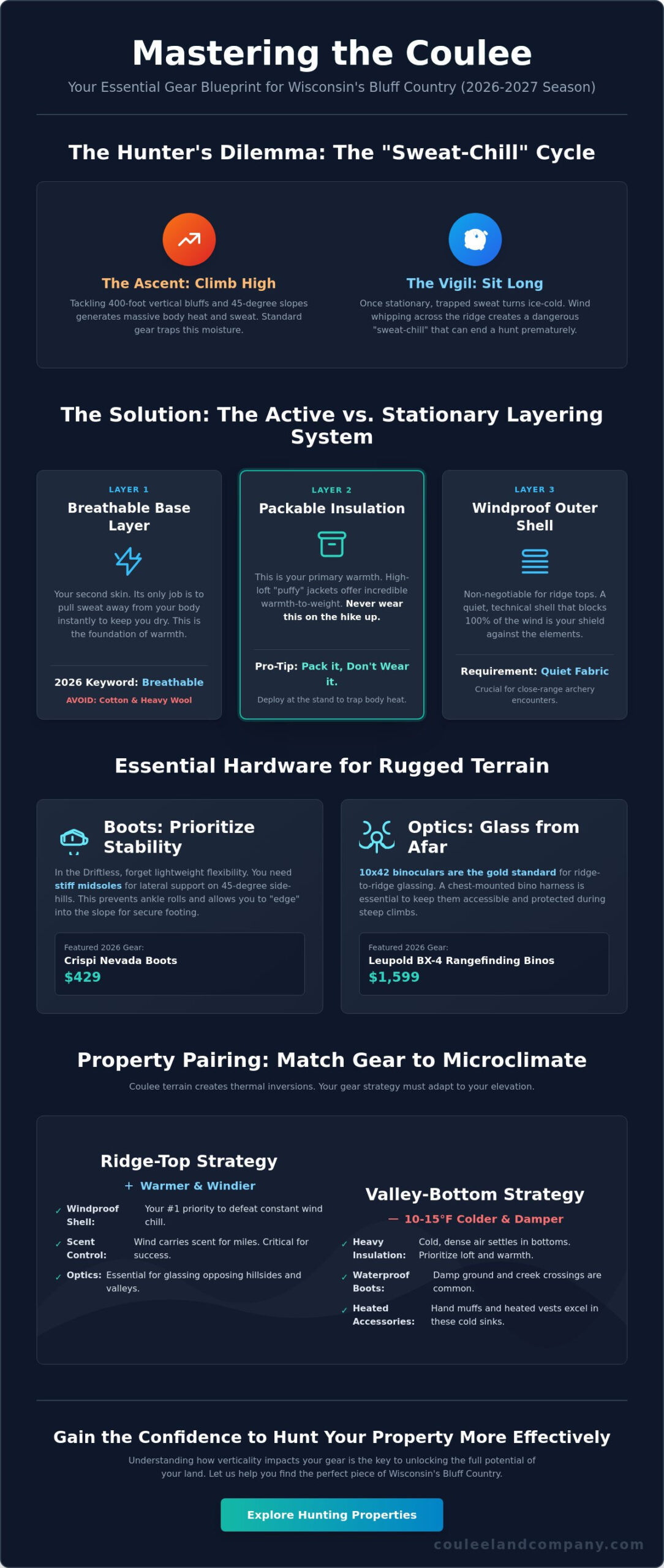
Wisconsin’s Driftless Area presents a physical challenge that renders standard Midwest hunting apparel obsolete. When you’re tackling a 400-foot vertical ascent on Buffalo County bluffs, your body generates massive amounts of heat; however, once you reach that ridge-top stand, the wind-chill can turn that perspiration into a dangerous deep-freeze. Mastering Hunting Gear for Coulee Terrain: Essentials and Property Pairings. starts with understanding that you aren’t just dressing for the weather. You’re dressing for a high-exertion hike followed by hours of complete stillness.
The unique geological formation of Coulee terrain creates microclimates that don’t exist on flatter ground. You’ll often experience thermal inversions where the valley bottoms are 10 to 15 degrees colder than the ridges during the golden hour. This verticality means your base layer must move moisture away from your skin instantly. Standard cotton or heavy wool will trap sweat, leading to a “sweat-chill” that ends your hunt early. To better understand how to build a versatile system for these conditions, watch this helpful video:
Windproofing is the final piece of the ridge-top puzzle. While a heavy parka might seem warm, it’s useless if the biting Western Wisconsin winds can penetrate the fabric. A dedicated wind-stop layer is non-negotiable for exposed bluff tops. This is a core component of effective Hunting Gear for Coulee Terrain: Essentials and Property Pairings. because it protects your core temperature from the constant airflow found on high ridges. We recommend a technical shell that blocks 100% of the wind while remaining quiet enough for a close-range archery encounter.
The Active vs. Stationary Layering System
The secret to staying warm is never wearing your heavy insulation during the hike. Successful hunters on our hunting properties often pack in their primary warmth layers; they strap their heavy bibs and parkas to their packs to keep their core temperature regulated during the climb. Once at the stand, they deploy a high-loft “puffy” jacket. These jackets offer an incredible warmth-to-weight ratio, providing essential insulation without the bulk of traditional heavy wool.
Essential Accessories for 2026
Don’t overlook the small items that protect your extremities from the elements. A fleece-lined neck gaiter and a heavy-duty hand muff are vital for enduring a late-season sit when the mercury drops. In 2026, “breathable” is the most important keyword for a Coulee base layer because it ensures that internal moisture escapes before it can freeze against your skin during a long stationary sit.
Essential Hardware for Rugged Terrain: Optics, Boots, and Stability
Mobility in the Driftless Area requires more than just grit; it demands specialized hardware built for 45-degree side-hills. While many general backcountry guides suggest lightweight, flexible boots, they often overlook the brutal lateral strain of Western Wisconsin’s verticality. Selecting Hunting Gear for Coulee Terrain: Essentials and Property Pairings. means prioritizing boots with stiff midsoles. This lateral support is vital to prevent foot fatigue and painful ankle rolls when you’re traversing a steep ridge to reach a hidden bedding area. Stiff-soled boots act as a platform, allowing you to “edge” into the slope rather than sliding down it.
Optics are your primary tool for scouting trophy whitetails without blowing out a sanctuary. A pair of 10×42 binoculars is the gold standard for ridge-to-ridge glassing in Buffalo County. To keep these optics protected and accessible during a hands-free climb, a chest-mounted bino harness is essential. Just as layering clothing for hunting protects your core temperature, these hardware systems protect your efficiency and focus. If you are searching for the perfect ridge-top vantage point, our hunting properties provide the ideal terrain to put this high-end glass to work.
Optics Strategies for Big Woods and Bluffs
Scouting distant food plots requires more than just handheld glass. We recommend using a tripod-mounted spotting scope for detailed observation of bachelor groups across a coulee. This stability allows you to judge antler mass and age classes at ranges exceeding 400 yards. You can review our Buffalo County community guide to identify the high-vantage scouting locations that make this specialized gear effective.
Stand Placement and Safety Hardware
The 2026 season sees a massive shift toward lightweight saddle hunting for mobile “hang-and-hunt” strategies on steep terrain. Saddles allow you to hunt bluffs where traditional stands might be impossible to level. However, vertical safety remains paramount. Always use lifeline systems and high-quality safety harnesses in the tall timber of Western Wisconsin. For the pack out, trekking poles are a secret weapon. They provide two extra points of contact on slippery, leaf-covered slopes, making it much safer to carry a trophy buck out of a deep valley. This combination of safety and stability is the cornerstone of effective Hunting Gear for Coulee Terrain: Essentials and Property Pairings.
Property Pairings: Matching Gear to Your Land Strategy
Your gear list should be as unique as your property’s legal description. In the Driftless Area, the way you access your land dictates the equipment you carry. A ridge-top specialist who enters from the plateau faces different tactical hurdles than a hunter navigating the damp thermal sinks of a valley floor. True mastery of Hunting Gear for Coulee Terrain: Essentials and Property Pairings. involves auditing your kit based on the specific verticality and access points of your parcel. If you’re still deciding on the right layout for your goals, you can connect with Mike Law or Bryan Lemke to discuss property access layouts and how they impact hunting pressure.
For properties with valley-bottom access, heavy insulation is your best friend. Cold air is denser than warm air; it flows down the bluffs like water and settles in the creek bottoms. You’ll often find that valley stands are 10 degrees colder than the ridges above. Conversely, ridge-top specialists must focus on scent control and wind-blocking outerwear. When you’re hunting above the deer, your scent plume is more susceptible to swirling winds. High-quality wind-stop layers prevent the biting ridge-top gusts from saping your core heat, allowing you to stay motionless during the critical final hour of daylight.
On larger tracts exceeding 80 acres, mobile hunting gear becomes a necessity rather than a luxury. Lightweight, modular systems allow you to adjust your strategy as the rut progresses without being anchored to a single permanent stand. This agility lets you pair your land management efforts, such as food plot placement, with your technical glassing equipment. By positioning high-end spotting scopes on distant ridges, you can monitor bachelor groups without ever stepping foot in their sanctuary. This approach preserves the “unhunted” feel of your property, which is essential for growing and holding trophy whitetail bucks.
Top-Access vs. Bottom-Access Gear Needs
Footwear choice is the most immediate strategic difference. Valley hunters should prioritize tall rubber boots to navigate damp creek crossings and manage scent in low-lying areas where moisture traps odors. Ridge hunters, however, need the support of mountain-style leather boots to handle the constant incline. Matching your footwear to your access prevents foot fatigue and ensures you can reach your stand silently and safely.
Maximizing Your Land Investment
The right gear allows you to hunt the “unreachable” corners of a property, effectively increasing the usable hunting size of your acreage. Technical saddles and lightweight climbing sticks open up steep side-hills that most hunters ignore. You can explore our hunting properties for sale to find your next ridge-top sanctuary where these specialized tactics will give you a distinct advantage over the local deer herd.
Elevate Your Hunt in Wisconsin’s Bluff Country
Success in the Driftless Area requires more than just a trail camera photo of a trophy buck. It demands the technical execution of a hunt where your gear and your land work in perfect harmony. You now understand how a precise layering system manages the intense exertion of a bluff climb and how lateral-support boots provide the stability needed for steep side-hills. Mastering Hunting Gear for Coulee Terrain: Essentials and Property Pairings. ensures you spend your energy on the hunt rather than fighting the topography.
Coulee Land Company operates as the undisputed authority in Wisconsin’s most famous hunting grounds. We specialize in Boone and Crockett record-holding counties, and our deep knowledge of Western Wisconsin bluff topography is backed by testimonials from outdoor TV industry leaders. We don’t just sell land; we help you find a property with the wildlife capabilities to produce world-class whitetails. The right acreage is the most important investment an outdoorsman can make.
View Our Exclusive Buffalo County Hunting Land Listings to find your next ridge-top sanctuary. Your dream of owning a piece of Bluff Country is within reach.
Frequently Asked Questions
What is the best boot for hunting Western Wisconsin bluffs?
A boot with a stiff midsole and high lateral support is the superior choice for navigating the 45-degree slopes of the Driftless Area. You need footwear that allows you to “edge” into the terrain rather than sliding down the leaf-covered inclines. Models like the Crispi Nevada GTX provide the necessary rigidity to prevent foot fatigue during a full day of side-hilling. Avoid flexible hiking boots that offer no ankle protection against the unique vertical strain of this region.
Do I need a spotting scope for hunting in Buffalo County?
A tripod-mounted spotting scope is essential for judging antler mass and age classes across wide coulees at distances exceeding 400 yards. While 10×42 binoculars are great for general scanning, they lack the magnification needed to confirm if a buck meets your harvest criteria. Using high-end glass from a ridge-top vantage point allows you to scout effectively without pressuring the bedding areas located in the deep timber below. This stability is key for long-distance observation.
How does thermal inversion affect my hunting clothing choice?
Thermal inversions cause cold air to settle in valley bottoms, often resulting in a 10 to 15-degree temperature drop compared to the ridges above. You must pack extra insulation if your stand is located near a creek or river front. This phenomenon is a core reason why Hunting Gear for Coulee Terrain: Essentials and Property Pairings. emphasizes modular layering. You might be comfortable on the ridge but freezing in the valley during the final hour of daylight.
What is the most important piece of gear for hunting steep coulees?
The most critical gear is a technical moisture-wicking layering system that prevents the dangerous “sweat-chill” after a steep climb. Standard Midwest apparel often fails because it traps perspiration against your skin during exertion. By using breathable merino wool or high-wicking synthetics, you ensure that moisture evaporates before you reach your stand. This allows you to remain motionless and warm for the duration of a four-hour sit in the biting wind despite the high exertion of the approach.
Should I buy a ridge-top or valley-bottom hunting property?
Your decision should depend on your preferred access strategy and how much verticality you want to manage. Ridge-top properties often offer easier “top-down” access, which keeps your scent above the deer, whereas valley-bottom parcels provide rich soil for food plots but are subject to intense cold sinks. Our team at Coulee Land Company specializes in analyzing these topographic features to help you find a parcel that matches your physical capabilities and hunting style in the Driftless Area.
How do I manage scent when climbing steep bluffs?
Managing scent on steep bluffs is achieved by controlling your internal body temperature to prevent sweating during the ascent. You should pack your heavy outer layers on your backpack and climb in your base layers only. This “climb cold” strategy is a fundamental part of Hunting Gear for Coulee Terrain: Essentials and Property Pairings. It ensures you arrive at your stand dry and scent-free, rather than soaked in perspiration that will alert every deer in the coulee as your scent disperses.