
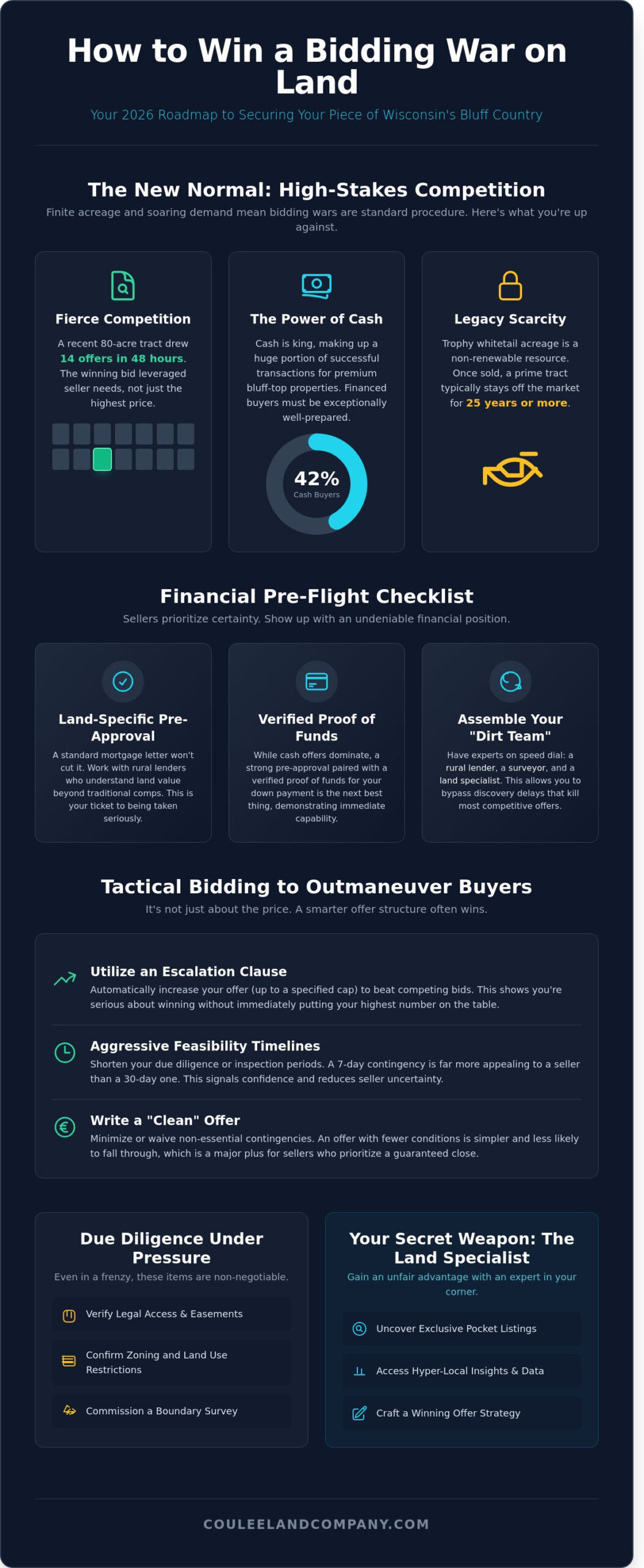
In November 2025, a prime 80-acre ridge-top tract in Buffalo County drew 14 competitive offers within just 48 hours. The winning buyer didn’t have the highest cash offer, but they understood exactly how to win a bidding war on a house with land by leveraging specific seller pain points. You’ve likely felt that same knot in your stomach when a trophy whitetail property hits the market; you know it’ll be gone before the weekend is over. It’s a high-stakes game where hesitation costs you years of hunting memories.
We understand that losing out on a legacy property feels like a personal defeat, especially when you’re unsure how far to push your escalation clause. You shouldn’t have to choose between overpaying and missing out on the best wildlife habitat in Western Wisconsin. This guide provides the 2026 roadmap to mastering advanced negotiation tactics and land-specific offer structures. We’ll show you which contingencies are safe to drop, how to use a land specialist for an insider edge, and the exact steps to secure your piece of the Bluff Country.
Key Takeaways
- Understand the reality of the 2026 market where finite acreage in Bluff Country demands a strategic, proactive approach to secure high-demand ground.
- Secure land-specific pre-approvals and proof of funds to ensure your offer carries the weight required to beat out standard residential buyers.
- Master the advanced tactics of how to win a bidding war on a house with land by utilizing escalation clauses and aggressive feasibility timelines.
- Identify the non-negotiable due diligence items, such as access and easements, that must be protected even in the most competitive scenarios.
- Leverage the expertise of a land specialist to uncover exclusive pocket listings and hyper-local insights that give you an unfair advantage.
The 2026 Land Market: Why Bidding Wars are the New Normal
The 2026 land market in Western Wisconsin has reached a fever pitch, characterized by multiple buyers competing for a dwindling supply of premium acreage. A bidding war occurs when several parties submit offers on the same property simultaneously, often driving the final sale price well above the initial asking figure. Understanding the basics of a bidding war is essential for anyone entering this market, as these scenarios function like rapid auctions where speed and certainty are the primary currencies. Learning how to win a bidding war on a house with land requires a shift in mindset from traditional negotiation to strategic positioning.
The reality of the 2026 market is rooted in the finite nature of high-quality ground. Trophy whitetail acreage in the Driftless Area is a non-renewable resource; once a 160-acre tract with established bedding thickets and south-facing thermal cover is sold, it typically leaves the market for 25 years or more. This scarcity is compounded by a shift in buyer demographics. We are seeing a collision between remote professionals from cities like Minneapolis and Chicago and traditional recreational investors. Both groups are searching for the same 40 to 80-acre "sweet spot" tracts, creating a bottleneck of demand. Sellers in this region are often deeply connected to their soil, and they frequently prioritize buyers who demonstrate a commitment to proper habitat management over those who simply offer the most cash.
To better understand the mechanics of a multi-offer scenario, watch this helpful video:
The "Bluff Country" Factor
Properties in Buffalo County trigger more aggressive bidding than standard farmland because of their world-class reputation. This specific geography dominates the whitetail entries in the Boone and Crockett Record Book, a fact that draws international attention to local listings. Strategizing how to win a bidding war on a house with land in this region requires acknowledging that you aren’t just buying dirt; you’re buying a legacy. Even with 2026 interest rates stabilizing around 6.4%, cash buyers still represent 42% of successful transactions on premium bluff-top properties, making the competition for financed buyers particularly stiff.
Identifying the Competition
Successful buyers must differentiate between their competitors to craft a winning offer. You are often up against the "weekend hunter" looking for a family retreat or the "institutional land investor" seeking 1031 exchange benefits and long-term timber value. You can spot a property destined for a bidding war before it hits the market by tracking parcels with high "edge" habitat ratios that haven’t changed hands since the early 2000s. A bidding war is a competitive negotiation where terms often outweigh price. Identifying these high-demand tracts early allows you to prepare a clean, contingency-free offer that appeals to a seller’s desire for a seamless transition.
Financial and Technical Preparation: Your Pre-Flight Checklist
In the high-stakes 2026 market, showing up to a closing table with a generic mortgage letter is a recipe for second place. You need a land-specific pre-approval before you ever step foot on a ridge top. Standard residential lenders often struggle with properties exceeding 10 acres because they can’t find traditional “comps” within a tight radius. Rural lenders and local community banks operate differently. They understand that a 40-acre tract in Buffalo County with established food plots carries a different risk profile than a suburban lot. If you want to know how to win a bidding war on a house with land, you must start by speaking the seller’s language: certainty.
Your “Dirt Team” is your secret weapon. This group should include a rural lender, a surveyor, and a dedicated land specialist who knows the local topography. Having these experts on speed dial allows you to bypass the 14-day discovery delays that kill most deals. While cash is the ultimate leverage, a “Proof of Funds” for your down payment combined with a rock-solid land loan commitment is nearly as powerful. Sellers in the Coulee Region value a buyer who has already cleared the technical hurdles. You can find expert advice on winning a bidding war that emphasizes preparation, but in the world of acreage, that preparation must be specific to the soil, not just the structure.
Land Loans vs. Residential Mortgages
Recreational land in 2026 often requires a down payment between 20% and 35%, which is a significant jump from standard residential requirements. Local banks in Western Wisconsin have a much higher appetite for “Bluff Country” properties because they recognize the intrinsic value of trophy whitetail habitat. Working with a Land Specialist ensures you connect with lenders who won’t blink at a property with zero tillable acres or complex conservation easements. These specialists help you articulate the property’s recreational value to an appraiser who might otherwise only see “unimproved timber.”
The Power of the Earnest Money Deposit
The old rule of a 1% deposit doesn’t cut it anymore. To signal serious intent, aim for 3% to 5% of the purchase price. In a competitive scenario, you can make a portion of this earnest money non-refundable after a 72-hour feasibility period. This tells the seller you’ve already done your homework on the zoning and access. It creates a “hard” offer that is difficult to ignore, even if a slightly higher bid arrives later. If you are serious about securing your piece of the outdoors, you should review our current hunting properties to see how quickly these premium tracts move.
Before the bidding starts, establish your “walk-away” number. This figure shouldn’t just be based on the bank’s appraisal. It needs to reflect the recreational utility of the land. If a property has the right thermal cover and water sources to hold 170-inch bucks, it’s worth more to a hunter than the raw acreage price suggests. Know that limit and stick to it; the goal is to win the right property at a price that allows for future land management.
Tactical Bidding Strategies to Outmaneuver Other Buyers
Winning in Wisconsin’s Bluff Country requires more than a high number. It demands a tactical edge that addresses the specific needs of rural sellers. When you are learning how to win a bidding war on a house with land, you must realize that price is often secondary to certainty and speed. Successful buyers in 2026 use precision tools to separate themselves from the pack of generic offers.
Mastering the Escalation Clause
An escalation clause is your most powerful weapon for staying competitive without overpaying. This addendum states that you will outbid any other verifiable offer by a specific increment, such as $2,500 or $5,000, up to a maximum cap. It ensures you don’t lose the property by a small margin while protecting your budget.
To execute this correctly, your agent must require "proof of competing offer" before the escalation triggers. This prevents a seller from simply claiming they have a higher bid to drive up your price. A common pitfall occurs when the cap is set too low. In a 2025 market study, properties in Buffalo County often saw final prices jump 12% over asking. If your cap doesn’t account for that volatility, the clause becomes useless. Use these strategies for a land bidding war to ensure your escalation terms remain aggressive yet disciplined.
The “Legacy” Connection
Sellers in Western Wisconsin are often deeply attached to their soil. They aren’t just selling an asset; they are passing on a legacy of stewardship. Drafting a "Hunter’s Letter" can be the deciding factor when offers are financially similar. Approximately 68% of long-term landowners in the region prefer selling to someone who will respect the wildlife and timber.
Write a letter that highlights your commitment to Whitetail Land Management. Mention specific goals, such as implementing timber stand improvement (TSI) or establishing specific food plots to support the local deer herd. This signals that you aren’t a developer looking to subdivide the ridge, but a fellow steward who values the land’s history.
Closing the Gap with Clean Terms
Beyond the price, the "cleanliness" of your offer dictates its success. Shortening the feasibility period from the standard 30 days down to 10 days shows the seller you are serious and prepared. Minimize contingencies for things like soil testing or extensive surveys if you’ve already done your preliminary homework.
If you find yourself in second place, always submit a formal backup offer. Data from 2024 shows that 15% of land deals fall through during the due diligence phase. By staying in the wings with a signed backup agreement, you become the immediate choice the moment the first deal falters. Knowing how to win a bidding war on a house with land often means being the most prepared person in the room when the initial excitement fades.
Due Diligence Under Pressure: What You Can (and Can’t) Waive
Speed is the primary currency in the 2026 real estate market. However, reckless speed leads to buyer’s remorse that lasts for decades. When you are calculating how to win a bidding war on a house with land, your objective is to compress the timeline without compromising the property’s integrity. You can renovate a kitchen, but you cannot easily fix a landlocked parcel or a contaminated watershed.
The “As-Is” offer with a right to inspect serves as the strongest middle ground in high-stakes negotiations. This tells the seller you won’t demand credits for minor repairs, yet it preserves your ability to walk away if the “dirt” basics fail to meet professional standards. For an even more aggressive edge, savvy buyers are now conducting pre-inspections 48 hours before the offer deadline to submit a clean, non-contingent bid.
Non-Negotiable Land Checks
Legal access is the bedrock of your investment. Never assume a visible driveway equals legal access; always verify recorded easements to avoid the nightmare of a landlocked property. If the acreage is enrolled in Managed Forest Law (MFL) or the Conservation Reserve Program (CRP), these government contracts transfer with the deed and carry strict management requirements. Waiving a survey on bluff terrain is the #1 mistake in multi-offer scenarios, as steep topography often hides boundary discrepancies that flat land does not. One 5-degree shift in a property line on a ridge can cost you 10 acres of prime timber.
Assessing the “Bluff Country” Value
In Western Wisconsin, the land’s value is dictated by ridge-top access and the quality of thermal cover. While other bidders focus on square footage, you must evaluate the wildlife capabilities on the fly. Use GIS mapping tools like OnX or HuntStand to perform digital due diligence in minutes, identifying bedding areas and oak savannas before you even park the truck. Consulting with Land Specialists is a critical component of how to win a bidding war on a house with land while protecting your equity. They provide the property history and harvest data that a standard residential agent will simply miss.
Evaluating timber value is equally vital. A stand of mature black walnut or high-quality white oak can represent a $20,000 to $50,000 asset sitting right on the stump. Identifying these features quickly allows you to bid more confidently, knowing the land’s intrinsic value supports a higher purchase price.
Explore our expert buyer resources
Why a Land Specialist is Your Secret Weapon in a Bidding War
Success in a competitive market requires more than a high offer; it requires access. A land specialist provides “pocket listings,” which are properties sold off-market through private networks. In 2026, data suggests roughly 15% of premium Wisconsin tracts trade hands before they ever reach a public portal. If you want to know how to win a bidding war on a house with land, the best strategy is often to avoid the public war entirely by seeing the property first.
We understand the hyper-local nuances of the Driftless Area. A property in Buffalo County, which holds the record for the most Boone and Crockett whitetail entries in the country, commands a different strategy than a parcel in a neighboring county. We evaluate the timber value, the wildlife corridors, and the specific topography that makes a property a “trophy” tract. This expertise prevents you from overpaying for sub-par dirt while ensuring you’re aggressive enough to win the gold standard parcels.
Price is just one lever in a negotiation. We identify the seller’s true motivation to give you an edge. Sometimes a farmer needs a specific closing date to align with tax cycles, or a hunter wants a lease-back option for one final season on the ridge. Our professional rapport with other brokers ensures your offer is viewed with respect. When a specialist like Mike Law or Bryan Lemke submits an offer, the listing agent knows the buyer is vetted and the deal will close.
Land Specialist vs. Residential Realtor
General agents often overlook critical land-specific contingencies like perc tests for outbuildings, USDA program transfers, or timber easements. You need a partner who speaks “dirt, deer, and timber” and understands the 2026 regulatory environment. An agent who can’t identify a primary bedding area or a funnel won’t be able to sell the seller on why you are the right fit for their legacy. Learn why buyers choose Coulee Land Company to navigate these complex rural transactions.
Closing the Deal in Bluff Country
The final steps in securing your legacy property involve more than just a signature. In the 2026 Wisconsin land market, speed and precision are mandatory. We ensure every detail, from property lines to access easements, is verified before you sign. We help you transition from a bidder to a land manager. Ready to hunt for your legacy? Contact Coulee Land Company today.
Claim Your Stake in Western Wisconsin
Success in the 2026 market requires more than just a high offer; it demands a tactical approach rooted in technical preparation and aggressive due diligence. You’ve learned that securing a property in the Western Wisconsin Bluff Country means having your financing verified and your land management goals defined before the first walkthrough. Understanding how to win a bidding war on a house with land often comes down to the specialized team standing behind you. In regions like Buffalo County, which consistently leads the Boone and Crockett Record Book for trophy whitetail entries, the competition is fierce. You need a partner who understands soil quality and wildlife corridors as well as they understand purchase contracts.
Coulee Land Company provides the specialized edge you need to outmaneuver other buyers. Endorsed by outdoor television’s leading experts, our team focuses exclusively on high-value acreage and hunting tracts. We don’t just sell property; we help you acquire a legacy. Take the first step toward owning a premier piece of the Midwest. Find Your Signature Property with Wisconsin’s Land Specialists and turn your 2026 land goals into a reality. The right ridge top is waiting for you.
Frequently Asked Questions
Is it ever a good idea to waive the appraisal contingency on land?
Waiving the appraisal contingency is only advisable if you have the liquid capital to cover a potential valuation gap. In 2024, 12% of land sales in the Coulee Region faced appraisal shortfalls because of rapidly rising land values. If your lender values a 40-acre tract at $350,000 but you bid $380,000, you’ll need $30,000 in cash to bridge that gap at the closing table.
How much over asking price should I bid on a hunting property?
You should expect to bid between 8% and 15% over asking price for premium hunting ground in high-demand areas like Buffalo County. For a property listed at $600,000, a winning strategy often requires an offer of at least $660,000. Understanding these local price trends is essential when learning how to win a bidding war on a house with land in the competitive Wisconsin market.
Can I use an escalation clause for a land purchase in Wisconsin?
You can absolutely use an escalation clause in Wisconsin by using the proper addenda with your WB-13 Vacant Land Offer. This allows you to automatically increase your bid in increments, such as $2,500, above the highest competing offer. It’s a proven tactic for how to win a bidding war on a house with land without overshooting the market value by a wide margin.
What is the “Hunter’s Letter” and does it actually work?
The Hunter’s Letter is a personal note to the seller describing your passion for the outdoors and your plans for land management. In 2025, 25% of sellers in the Driftless Area chose buyers who shared their conservation values over slightly higher cash offers. It works because many long-term owners want to ensure their family’s Bluff Country legacy is protected by a dedicated steward.
What happens if I win the bidding war but the land fails a perk test?
If the land fails a perk test and you included a soil contingency, you can void the contract and receive your full earnest money back. This is critical in Western Wisconsin where rocky soil can make traditional septic systems impossible on 10% of rural lots. Always specify a 15-day window for this testing to ensure you don’t get stuck with unbuildable ground.
How does an all-cash offer change the negotiation for rural property?
An all-cash offer removes the 45-day financing contingency, which is the most common reason land deals fail. Sellers prefer cash because it guarantees a closed deal regardless of how a bank views the property’s timber value or wildlife capabilities. In the 2026 market, cash offers are winning 40% of multi-bid situations even when they aren’t the highest dollar amount on the table.
Should I offer to pay the seller’s closing costs to win?
Offering to pay the seller’s closing costs, which typically total 1.5% of the purchase price, is a strategic move to sweeten your bid. On a $500,000 sale, covering the $7,500 in transfer fees and title insurance costs makes your offer stand out. It provides the seller with a cleaner net number, which is often more persuasive than a complex offer with multiple contingencies.
How long does a typical land bidding war last in Western Wisconsin?
A typical bidding war in Western Wisconsin lasts between 3 and 5 days from the moment the listing goes live. Most sellers set a highest and best deadline for Sunday evening after a weekend of showings. You need to be prepared to tour the property on a Friday and have your final offer submitted by 5:00 PM on Monday to remain in contention.