
Owning a piece of Wisconsin’s legendary “Bluff Country” isn’t just about property lines; it’s about securing a legacy on some of the most fertile, sought-after ground in the Midwest. While many see a simple field, you see the potential for a self-sustaining retreat. Learning how to start a hobby farm in wisconsin requires more than just a dream; it demands a tactical approach to land management and a deep understanding of local zoning. You already know that the difference between a thriving homestead and a costly mistake often comes down to the quality of the soil and the sturdiness of your winter infrastructure.
We promise to provide the exact roadmap needed to turn that vision into reality. This 2026 guide delivers the essential steps to launching a successful operation, from identifying high-yield acreage in Buffalo County to understanding the 2025 tax code updates regarding “hobby” versus “commercial” status. We will cover property acquisition strategies, specific livestock winterization requirements for sub-zero temperatures, and the agricultural incentives that make the Badger State a premier destination. You’ll finish this guide with the confidence to break ground on your first food plot or small livestock operation today.
Key Takeaways
- Identify the specific soil profiles and topographical features that define high-value acreage in Wisconsin’s rugged Bluff Country.
- Gain clarity on how to start a hobby farm in wisconsin by decoding complex A-1 and A-2 zoning regulations and county-specific livestock restrictions.
- Prepare your property for the elements with expert insights on sub-zero winter infrastructure and specialized fencing for steep terrain.
- Learn to evaluate land through the lens of a specialist, balancing agricultural output with the superior wildlife capabilities that define the region.
Defining the Wisconsin Hobby Farm in 2026
The dream of owning land reaches its peak in the rolling hills of the Driftless Area. As we move into 2026, the motivations for seeking out acreage have shifted from simple weekend escapes to a deep desire for tangible security and self-reliance. Learning how to start a hobby farm in wisconsin requires more than just a green thumb; it demands a strategic understanding of land use and local geography. Western Wisconsin, specifically the “Bluff Country” of Buffalo County, remains the premier destination for these ventures. The region’s unique topography offers a blend of fertile valley bottoms for crops and steep timbered ridges that harbor world-class wildlife.
This isn’t just about gardening. It’s about a lifestyle balance where you manage a small orchard in the morning and glass for trophy whitetails in the evening. The financial “why” behind the 2026 land rush is clear: land is a finite asset that provides both recreational joy and a hedge against economic volatility. Whether you’re looking for country homes with acreage or raw land to build upon, the goal is to create a property that serves your family and the local ecosystem simultaneously.
Hobby vs. Commercial: The Key Distinctions
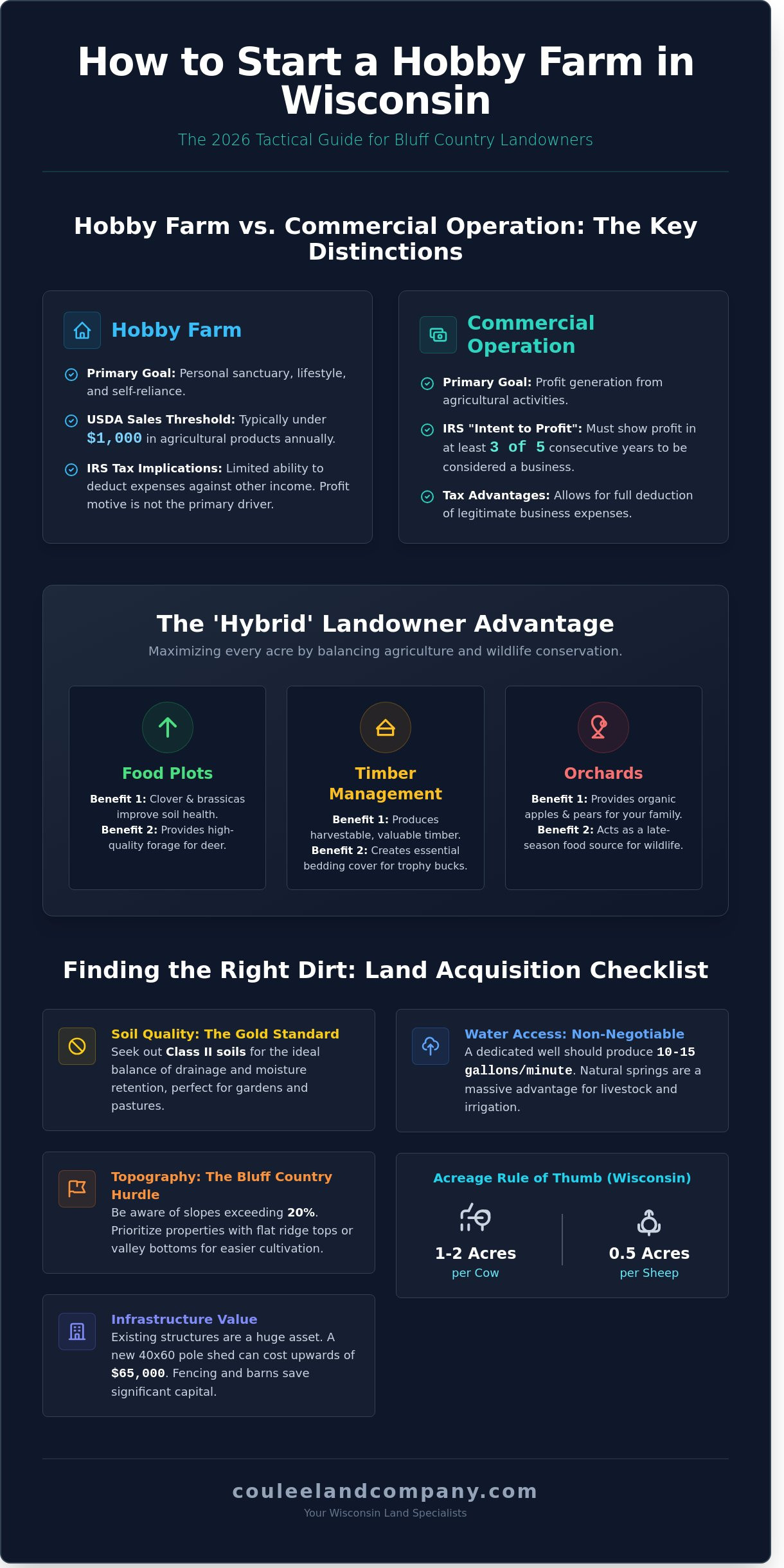
The USDA defines a farm as any place that produced and sold, or normally would have produced and sold, $1,000 or more of agricultural products during the census year. If your sales fall below this mark, you’re firmly in the hobby category. From a tax perspective, the IRS looks at your “intent to profit” under Section 183 rules. If you don’t show a profit in at least three out of five consecutive years, the IRS may classify your operation as a hobby, which limits your ability to deduct expenses against other income. Prospective buyers must decide early if they’re building a business or a personal sanctuary, as this choice shapes your entire property search strategy.
The Rise of the ‘Hybrid’ Landowner
Modern landowners in 2026 are increasingly “hybrid” managers. They don’t see a conflict between agricultural production and wildlife conservation. This approach allows you to master how to start a hobby farm in wisconsin while maintaining a premier hunting environment. Consider these common overlaps:
- Food Plots: Utilizing clover and brassica plots that serve as high-quality forage for deer while improving soil health.
- Timber Management: Thinning woods for harvestable timber while creating essential bedding cover for trophy bucks.
- Orchards: Planting apple and pear trees that provide organic fruit for your table and a late-season draw for wildlife.
Owning hunting properties that also function as working farms creates a multi-generational legacy. This dual-purpose approach maximizes every acre of the rugged Wisconsin landscape, ensuring your investment is as productive as it is beautiful.
Finding the Right Dirt: Buying Land for a Hobby Farm
Success begins with the soil. Class II soils represent the gold standard for Wisconsin growers because they offer the ideal balance of drainage and moisture retention. If you’re looking at land in the Driftless Area, topography is your biggest hurdle. Bluff Country slopes often exceed 20 percent; this makes traditional tilling difficult and increases erosion risks. You’ll need a property with flat ridge tops or valley bottoms to sustain healthy gardens or pastures.
Water access is non-negotiable. Most hobby farms require a dedicated well capable of producing 10 to 15 gallons per minute. Properties with active natural springs provide a massive advantage for livestock hydration and irrigation. Our team functions as the “Hunter’s Realtor” because we understand how to spot agricultural potential in what others see as just recreational woods. Understanding how to start a hobby farm in wisconsin starts with identifying these natural resources before you sign a contract.
Evaluating Acreage and Infrastructure
You need enough space to rotate your stock and prevent overgrazing. A general rule for Wisconsin land is 1 to 2 acres per cow or 0.5 acres per sheep. Don’t overlook the value of existing structures. Building a new 40×60 pole shed in 2024 costs upwards of $65,000. Finding a property with a standing barn or perimeter fencing saves you significant capital. Explore our country homes for sale in Wisconsin to find established farmsteads that already have these essential improvements in place.
The Buffalo County Factor
Land in Buffalo County commands a premium for a reason. It isn’t just about the trophy bucks; it’s about the unique geography. The Mississippi River valley creates distinct micro-climates that can extend your growing season by 10 to 14 days compared to inland counties. When evaluating these properties, check the access points. Modern farm equipment requires at least a 16-foot wide gate and a reinforced driveway to handle the weight of a loaded tractor. Our buyer specialists can help you identify tracts with the right infrastructure for both hunting and homesteading.
Navigating Wisconsin Hobby Farm Regulations
Understanding the legal landscape is the first step when you’re figuring out how to start a hobby farm in wisconsin. You can’t just drop a herd of cattle on any parcel without checking the local ordinances first. Zoning designations like A-1 and A-2 dictate your daily operations and long-term land use. A-1 Exclusive Agricultural zoning often requires a minimum of 35 acres to build a residence; this protects large-scale farming but can be a hurdle for small-scale hobbyists. A-2 Agricultural-Residential is typically the sweet spot for newcomers. Most Wisconsin counties follow a standard rule of one animal unit per acre. For context, one 1,000-pound steer equals one unit. If you’re looking at five acres in Buffalo County, you’ll need to plan your grazing rotation carefully to stay within these legal limits.
The Use-Value Assessment, established by the 1995 Wisconsin Act 27, is a massive advantage for your bottom line. Instead of paying property taxes based on the market value for development, you pay based on the land’s agricultural productivity. This often results in a 90% reduction in property taxes for eligible acreage. If neighbors complain about the rooster at dawn or the scent of fresh manure, Wisconsin Statute 823.08 protects you. This Right to Farm law ensures that as long as you follow standard agricultural practices, you’re legally shielded from nuisance lawsuits. It’s a critical protection that keeps the “Bluff Country” lifestyle viable for everyone.
Legal Structures and Tax IDs
You don’t necessarily need a Federal Tax ID (EIN) if you’re operating as a sole proprietorship, but it’s smart for keeping personal and farm expenses separate on your Schedule F. You can register your farm name with the Wisconsin Department of Financial Institutions (WDFI) for a $15 fee to protect your brand. This professional setup is essential if you plan to sell goods at local markets. Our team of land specialists can help you identify parcels where these legal structures are easiest to implement.
Environmental and Conservation Compliance
Wisconsin DNR regulation NR 151 sets the standard for manure management and runoff. You must ensure waste doesn’t enter navigable waters or groundwater. Participating in the Farmland Preservation Program can net you tax credits ranging from $5 to $10 per acre depending on your local participation. We recommend visiting your local NRCS office early. They offer cost-sharing through programs like EQIP, which can cover over 50% of the costs for projects like fencing or well stabilization. Learning how to start a hobby farm in wisconsin means becoming a steward of the land, and these agencies provide the roadmap for conservation.
Implementation: Infrastructure and Livestock Selection
Turning the dream of a rural lifestyle into reality requires more than just a deed. Learning how to start a hobby farm in Wisconsin demands a pragmatic approach to the Driftless Area’s unique topography and the harsh reality of a Zone 4 winter. You aren’t just building a farm; you’re engineering a system that survives 40-inch snowfalls and 50-degree temperature swings.
Essential Farm Infrastructure
The “Big Three” of infrastructure are water, shelter, and hay storage. In the Bluff Country, water is your most critical winter challenge. You must install frost-free hydrants buried at least 5 to 6 feet deep to stay below the frost line. Without these, you’ll spend every morning in January hauling 5-gallon buckets through knee-deep snow. For shelter, a three-sided pole barn facing south provides the necessary windbreak while allowing ventilation to prevent respiratory issues in livestock.
- Fencing the Bluffs: Traditional perimeter fencing often fails on steep 30-degree inclines. Use high-tensile wire with 6-inch diameter corner posts set in concrete to handle the tension and terrain shifts.
- Equipment: A 40-horsepower compact tractor with a front-end loader is the baseline for a 20-acre hobby farm. You’ll need it for clearing snow, moving round bales, and maintaining access trails.
- Hay Storage: Plan for 3.5 tons of hay per cow for the winter season. Keep storage elevated on pallets to prevent moisture wicking from the ground.
Livestock for Beginners
Success starts with choosing animals that match the Wisconsin climate. Beef cows like Black Angus or hardy heritage breeds such as Belted Galloways thrive here because they grow thick winter coats. If you’re managing steeper, brush-heavy acreage, Kiko or Boer goats are superior choices. These breeds are renowned for their parasite resistance and ability to clear invasive buckthorn, which improves your land’s overall health.
Effective pasture management is the difference between a lush field and an eroded hillside. Implement a four-paddock rotation system. By moving animals every 7 to 10 days, you prevent overgrazing and allow the root systems to stay strong. This practice is vital in Western Wisconsin to mitigate soil erosion on sloped terrain.
Your master plan should also integrate wildlife capabilities. Dedicated food plots of clover or brassicas serve a dual purpose: they provide high-protein forage for your livestock and act as a magnet for the trophy whitetail bucks that make Buffalo County famous. This synergy between traditional farming and land management maximizes the value of your investment.
Ready to find the perfect acreage for your Driftless Area homestead? View our current listings for buyers and start your journey today.
The Coulee Land Advantage: Your Wisconsin Land Specialists
A standard residential agent understands square footage; they rarely understand the difference between Class II silt loam and sandy wash. When you’re learning how to start a hobby farm in wisconsin, choosing the wrong broker can lead to expensive drainage issues or restrictive zoning headaches. Our team evaluates a property’s wildlife capabilities with the same rigor we apply to its agricultural productivity. We focus on Western Wisconsin, specifically the Driftless Area where the topography creates unique microclimates and nutrient-rich valleys. This specialized knowledge ensures your acreage isn’t just a plot of dirt, but a functional ecosystem designed for your specific goals.
Expert Guidance for Land Buyers
Mike Law and Bryan Lemke don’t just walk the perimeter. They analyze NRCS soil maps and 2-foot contour intervals to identify high-potential hobby farm tracts. This technical approach ensures your land supports livestock and crops without erosion risks. Learning how to start a hobby farm in wisconsin requires a partner who knows that the best soil often hides in the lower benches of a bluff. Ready to find your piece of Bluff Country? Contact our buyers’ agents today.
Maximizing Your Land Investment
Improving a property through hobby farming increases its long-term resale value significantly. Strategic land management, such as establishing perennial food plots or restoring oak savannas, creates a legacy property that serves your family for generations. We’ve seen well-managed recreational tracts in Buffalo County outperform standard investment portfolios over 10-year periods. You’ll build equity while enjoying the land as a private retreat. View our exclusive Wisconsin land listings to see the potential for yourself.
- Soil Analysis: We identify tillable acreage vs. pasture potential.
- Topography Experts: Understanding how water moves across your bluff-side property.
- Wildlife Integration: Balancing hobby crops with trophy whitetail habitat.
- Local Network: Connecting you with regional contractors and conservation programs.
Secure Your Legacy in Wisconsin’s Bluff Country
Building a successful homestead in the Driftless Area requires a tactical approach to land management and local regulations. By 2026, the most successful landowners are those who prioritize soil health and infrastructure before the first fence post is driven. You’ve discovered that understanding how to start a hobby farm in wisconsin involves balancing agricultural production with the unique wildlife capabilities of the region. Whether you’re targeting the 170 inch whitetails of Buffalo County or establishing sustainable organic pastures, the right dirt makes the difference between a struggle and a success.
Coulee Land Company specializes in Western Wisconsin’s premier acreage, offering deep expertise in both agricultural tracts and trophy hunting land. Our team is endorsed by leading outdoor television personalities because we understand the nuances of the Coulee Region better than any general realtor. We’ve spent decades identifying the superior properties that define this landscape, ensuring our clients find land that performs. Don’t settle for a generic plot when you can own a piece of the famed Bluff Country. Download our Wisconsin Land Buyer’s Guide to begin your journey with confidence. Your future in the Wisconsin outdoors is waiting for you to claim it.
Frequently Asked Questions
How many acres do I need to be considered a farm in Wisconsin?
Wisconsin typically requires a minimum of 35 acres to qualify for Farmland Preservation tax credits under Chapter 91 of the state statutes. While the USDA defines a farm as any operation producing 1,000 dollars in annual sales, local zoning in counties like Buffalo or Trempealeau often dictates different minimums for livestock. Small hobbyists can operate on as little as 5 acres depending on local municipal ordinances and specific land use classifications.
Can I get a property tax break on my hobby farm?
You can qualify for a property tax reduction through Wisconsin’s Use-Value Assessment program if your land is devoted primarily to agricultural use. This program, established in 1995, assesses land based on its income-producing capacity rather than its market value. For a typical landowner in the Driftless Area, this can reduce the assessed value of tillable acreage by over 50 percent compared to standard residential rates.
What are the best animals to start with on a Wisconsin hobby farm?
Chickens and hair sheep are the most practical choices for beginners learning how to start a hobby farm in Wisconsin due to their hardiness. A flock of 12 Rhode Island Red hens provides roughly 3,000 eggs per year with minimal infrastructure. Hair sheep like Katahdins don’t require shearing and thrive on the steep, brushy terrain found throughout the Coulee Region’s famed bluff country.
Do I need a special license to sell eggs or produce from my hobby farm?
You don’t need a license to sell up to 150 dozen eggs per month directly to consumers from your farm under Wisconsin’s egg exemption laws. For processed goods, the 2010 Pickle Bill allows sales of certain acidified canned foods like jams and pickles without a license, provided annual sales stay below 5,000 dollars. Always label your products with your farm’s name and address to remain compliant with state health codes.
How do I check if my land has good soil for farming?
Use the NRCS Web Soil Survey tool to access digital maps that detail the specific soil types and productivity ratings of your parcel. For 15 dollars per sample, the UW-Madison Soil and Forage Lab provides a comprehensive analysis of pH levels and nutrient content. This data is vital for managing the silt loam soils common in Western Wisconsin’s ridges and valleys where drainage varies significantly.
Is it possible to start a hobby farm on land primarily used for hunting?
Integrating a hobby farm with hunting land is a superior way to manage your property for trophy whitetails while producing food. Converting 3 to 5 acres of a 40 acre hunting tract into clover or brassica pastures serves as both livestock forage and high-quality wildlife food plots. This dual-use strategy enhances the land’s value and helps you learn how to start a hobby farm in Wisconsin while improving deer habitat.
What are the zoning requirements for building a barn in Western Wisconsin?
Zoning requirements vary by county, but most Western Wisconsin districts require a minimum setback of 50 feet from property lines for agricultural structures. In Buffalo County, you’ll likely need a Land Use Permit from the Department of Administration, which costs approximately 100 dollars for small outbuildings. Always verify your specific township’s A-1 or A-2 zoning status to ensure your barn meets local height and footprint restrictions.
How do I manage livestock during a Wisconsin winter?
Provide windbreaks and heated water tanks to ensure livestock survive temperatures that often dip to minus 20 degrees Fahrenheit. Cattle and sheep require 25 percent more caloric intake during extreme cold to maintain body heat and condition. Proper ventilation in your barn is critical; it prevents moisture buildup that leads to pneumonia in animals during the long January freeze that defines our northern climate.