
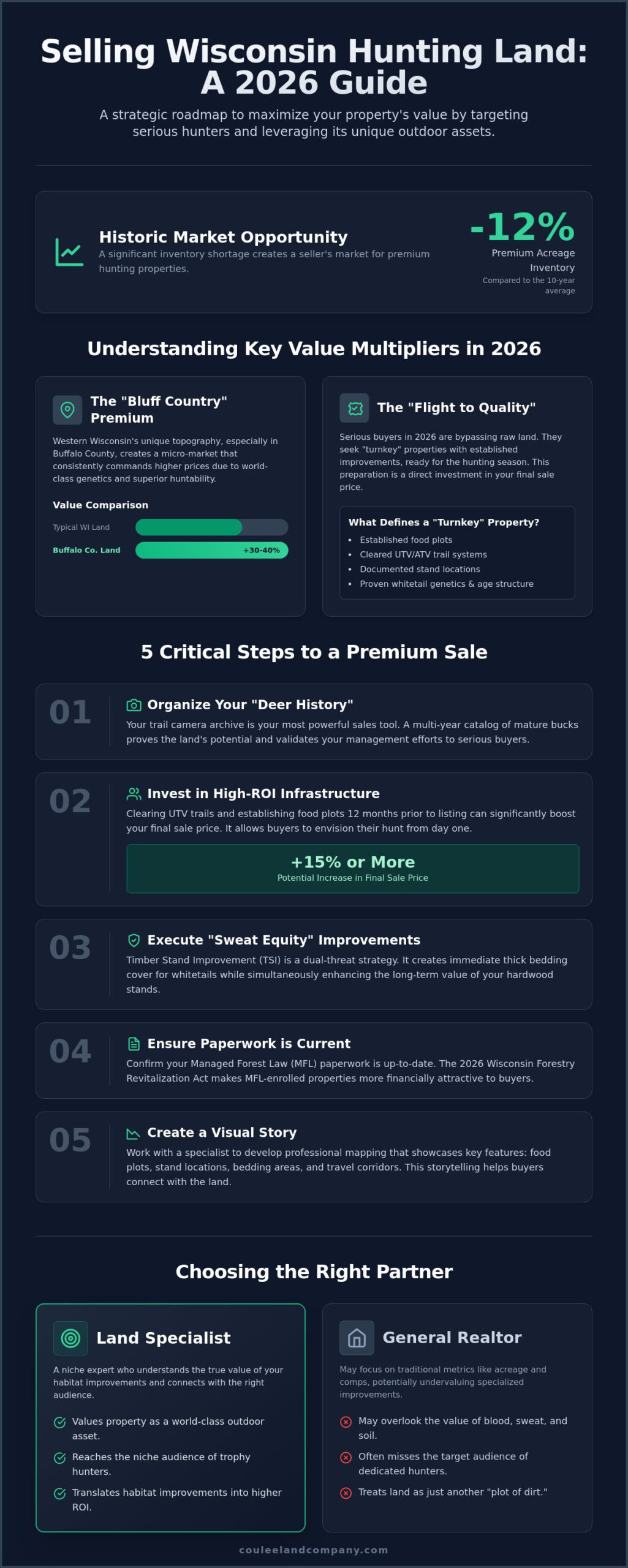
Did you know that premium acreage inventory across Western Wisconsin is currently 12% below the 10-year average? This historic scarcity creates a massive opportunity for owners who understand how to sell hunting land in Wisconsin to capture record-breaking prices in 2026. You’ve spent years managing your timber, planting food plots, and watching trophy whitetails mature; it’s only natural to worry that a general residential realtor might overlook the blood and sweat you’ve poured into the soil. You need a strategy that treats your property as a world-class outdoor asset rather than just another plot of dirt.
We understand that your land is a legacy, and we’re here to help you maximize its value. This guide will show you how to translate your habitat improvements into a high-ROI exit strategy that targets serious hunters willing to pay for turnkey trophy potential. We’ll break down current 2026 valuations, the impact of the Wisconsin Forestry Revitalization Act on your MFL land, and the specific property preparations that can boost your final sale price by 15% or more. From Buffalo County premiums to the effective capital gains rates for 2026, you’ll gain the roadmap needed to find a buyer who truly appreciates the hunt.
Key Takeaways
- Understand why Western Wisconsin’s unique topography acts as a value multiplier and how to leverage the “Bluff Country” premium to secure a higher price.
- Identify the high-ROI habitat improvements, such as established food plots and bedding areas, that transform raw land into a turnkey trophy property.
- Discover how to sell hunting land in Wisconsin by using trail camera archives and documented “Deer History” to prove your property’s trophy potential to serious buyers.
- Learn why partnering with a land specialist ensures your whitetail habitat is valued correctly, reaching the niche audience of trophy hunters that general realtors often miss.
Understanding the 2026 Market for Wisconsin Hunting Land
In 2026, the definition of “prime” has shifted from simple acreage to strategic habitat. Serious buyers are hunting for properties that offer more than just a place to sit in a stand; they’re looking for biological diversity, secure bedding, and established travel corridors. Understanding how to sell hunting land in Wisconsin requires recognizing that your property is an investment in whitetail genetics and age structure. This is especially true as the Wisconsin Department of Natural Resources (DNR) continues to focus on management strategies that favor long-term herd health.
To better understand how specific features and market conditions influence your property’s value, watch this expert breakdown on land pricing:
The “Bluff Country” of Western Wisconsin remains the undisputed crown jewel of the Midwest. This unique topography acts as a natural value multiplier because verticality creates more huntable “edge” and superior wind management opportunities compared to flat terrain. When you combine this rugged landscape with the region’s legendary Boone and Crockett record-book statistics, you have a recipe for high demand. Buyers aren’t just purchasing dirt; they’re buying a proven zip code for trophy whitetails.
The Buffalo County Factor: Why Location Still Rules
Buffalo County is a micro-market that consistently defies broader real estate trends. Properties within Buffalo County corridors often command a 30-40% premium over neighboring areas due to strict local management cultures and world-class genetics. Proximity to core Mississippi River bluffs ensures a steady flow of mature deer. This makes these parcels the most sought-after assets in the 2026 market.
Current Trends in Wisconsin Land Valuations
The most significant trend in 2026 is the flight to quality. Buyers are increasingly passing on raw, unmanaged land in favor of “turnkey” properties that are ready for the upcoming season. This includes established food plots, cleared UTV trails, and documented stand locations. Additionally, rising agricultural rents are bolstering land values for parcels that include tillable acreage. This provides sellers with a dual-income value proposition that appeals to both hunters and investors.
5 Critical Steps to Prepare Your Property for a Premium Sale
Maximizing your return requires more than just a sign at the gate. If you want to know how to sell hunting land in Wisconsin for top dollar, you must treat your property like a high-performance athlete. Buyers in 2026 aren’t just looking for woods; they’re looking for a proven producer. Preparation begins long before the first showing.
Start by organizing your “Deer History.” Your trail camera archives are the most powerful sales tool in your arsenal. A multi-year catalog of mature bucks proves the land’s potential and validates your management efforts. When combined with a property’s proximity to the Wisconsin Public Access Lands Atlas, these records show exactly how your parcel acts as a sanctuary in the local landscape.
Infrastructure is equally vital. Data indicates that investing in food plots or clearing UTV trails 12 months before listing can increase the final sale price by 15% or more. A clean, logical trail system allows a prospective buyer to envision their hunt without fighting brush. Additionally, ensure your Managed Forest Law (MFL) paperwork is current. The 2026 Wisconsin Forestry Revitalization Act has created new markets for low-value wood, making MFL-enrolled properties even more financially viable for the next owner.
Sweat Equity: Habitat Improvements that Pay Off
Timber Stand Improvement (TSI) is a dual-threat strategy. It creates immediate thick bedding cover for whitetails while enhancing the long-term value of your hardwood stands. Check out our Wisconsin Land Management for Wildlife guide for technical details on implementing these practices. Strategically placed food plots should act as “kill zones” that showcase the property’s huntability during a tour.
Mapping and Visual Storytelling
In 2026, your digital footprint is your first showing. High-quality drone footage that captures rolling bluffs and thermal cover is non-negotiable. Use interactive mapping tools to show stand locations and property flow. This level of detail builds immediate trust with serious buyers. If you’re ready to move forward, our team can help you prepare your land for market with professional-grade media.
Choosing the Right Partner: Land Specialist vs. General Realtor
A residential agent understands kitchens and curb appeal. They don’t understand how a north-facing slope provides essential thermal bedding or why a specific soil type is perfect for a late-season clover plot. If you want to know how to sell hunting land in Wisconsin at its true market potential, you can’t rely on generic comps. You need a partner who can calculate the financial value of a 160-inch buck history and the strategic placement of a sanctuary area.
Selling a trophy property requires speaking the specialized language of Quality Deer Management (QDM). A land specialist understands how to pitch your property’s biodiversity to the 1% of serious hunters who are looking for elite investment opportunities. We navigate the complexities of rural land inspections and specialized land financing that often stall traditional residential deals. Our goal is to ensure the buyer sees the years of stewardship you’ve invested in the soil.
The Coulee Land Company Advantage in Bluff Country
Our team lives and breathes the Mississippi River corridor. From the rolling hills near New Richmond to the steep ridges of the Driftless Area, we offer a level of regional expertise that national brands often lack. Experts like Mike Law and Bryan Lemke are more than just brokers; they’re property stewards who understand the dirt. Visit our Sellers page to receive a professional valuation that accounts for your land’s unique hunting merit.
Maximizing Profit Through Targeted Exposure
Generic MLS listings often bury recreational properties under a mountain of suburban homes. We utilize specialized land platforms and a deep private network of active buyers to ensure your acreage is seen by the right eyes. Coulee Land Company acts as the essential bridge between your years of hard work and a successful closing. We turn the dream of land ownership into a pragmatic, high-ROI reality for our clients.
Secure Your Legacy in the Wisconsin Land Market
The 2026 market offers a unique window for landowners who have invested years into habitat stewardship. By leveraging the Bluff Country premium and showcasing documented whitetail history through trail camera archives, you position your property as an elite asset rather than just a boundary on a map. You’ve seen how the right infrastructure and specialized marketing can significantly boost your ROI. Understanding how to sell hunting land in Wisconsin requires more than a simple listing; it demands a partner who understands the nuances of the Driftless Area and the specific demands of trophy hunters.
Coulee Land Company specializes in the rugged terrain of Buffalo County and the surrounding Western Wisconsin ridges. Our team brings deep expertise in trophy whitetail habitat and land management, ensuring your property’s biological value is fully realized at the closing table. Endorsed by high-profile industry figures and media personalities, we act as your expert guide in this competitive landscape. Don’t leave your property’s value to chance with a general realtor.
Get Your Professional Property Valuation from Coulee Land Company
Your land represents years of hard work and a deep connection to the outdoors. We’re ready to help you find a buyer who respects that legacy and pays a premium for the quality you’ve cultivated. Let’s make your next chapter as successful as your best season in the stand.
Frequently Asked Questions
How do I determine the value of my hunting land in Wisconsin?
Value is determined by a combination of soil quality, topography, and documented hunting success. While neighboring agricultural sales provide a baseline, true “trophy” value is added through established food plots and multi-year age-class management. A professional land specialist uses these specific hunting metrics to accurately assess how to sell hunting land in Wisconsin for a premium price that exceeds generic market averages.
Is it better to sell hunting land in the spring or fall?
Late winter and early spring are the most strategic times to list your property. This window allows potential buyers to walk the land when the “skeleton” of the terrain is visible, showcasing bedding areas and travel corridors without heavy leaf cover. Selling during this period ensures a buyer can close the deal and prepare their own food plots before the fall deer season begins.
Does Managed Forest Law (MFL) status affect my property value?
MFL status significantly impacts value by offering a substantial reduction in annual property taxes. While it requires adherence to a forest management plan, the long-term carrying cost savings are a major draw for serious land investors. The 2026 Wisconsin Forestry Revitalization Act has further enhanced this value by improving markets for low-value wood, making MFL-enrolled land more financially viable than ever before.
Should I harvest timber before selling my hunting land?
You should generally avoid a heavy timber harvest immediately before listing. While a harvest provides immediate cash, a clear-cut can damage the aesthetic and immediate hunting quality that premium buyers expect. Focus instead on selective Timber Stand Improvement (TSI). This practice enhances whitetail habitat and long-term timber value without compromising the “turnkey” appeal that drives high-ROI sales in the current market.