
Your tillable acreage in Buffalo County is worth significantly more than the local grain elevator’s appraisal suggests. While traditional valuations focus on corn yields and soil types, the true market power of 2026 lies in the hybrid demand for both productive ground and elite wildlife habitat. If you want to sell farm property in Western Wisconsin, you can’t rely on generic real estate tactics that ignore the unique topography of our region. You’ve likely felt the uncertainty of fluctuating land values or worried about how recent CWD updates might impact your bottom line.
We understand that your land is a legacy, not just a line item. You deserve a sale that reflects the superior quality of Wisconsin’s Bluff Country, where Buffalo County continues to dominate the Boone and Crockett Record Book entries. In this guide, we’ll show you exactly how to leverage your property’s geography to attract high-value trophy hunting buyers who see the worth in every ridge and valley. You’ll discover the specific steps to streamline your closing process and maximize ROI, ensuring your agricultural transition is as rewarding as the years you spent stewarding the soil.
Key Takeaways
- Learn why the unique topography of the Mississippi River corridor makes Western Wisconsin a premier market for high-value land sales in 2026.
- Discover how to value your acreage as a dual-asset by leveraging the “multiplier effect” between tillable ag yields and trophy hunting potential.
- Master the specific ROI-driven improvements, like Timber Stand Improvement (TSI), that elevate your land’s desirability for the modern outdoor enthusiast.
- Find out why you need a specialized strategy to sell farm property in Western Wisconsin, moving beyond the MLS to reach elite buyers through targeted land networks.
- Understand the critical difference between a traditional realtor and a land specialist who can identify bedding areas and soil drainage to maximize your closing price.
Understanding the Western Wisconsin Farm Market in 2026
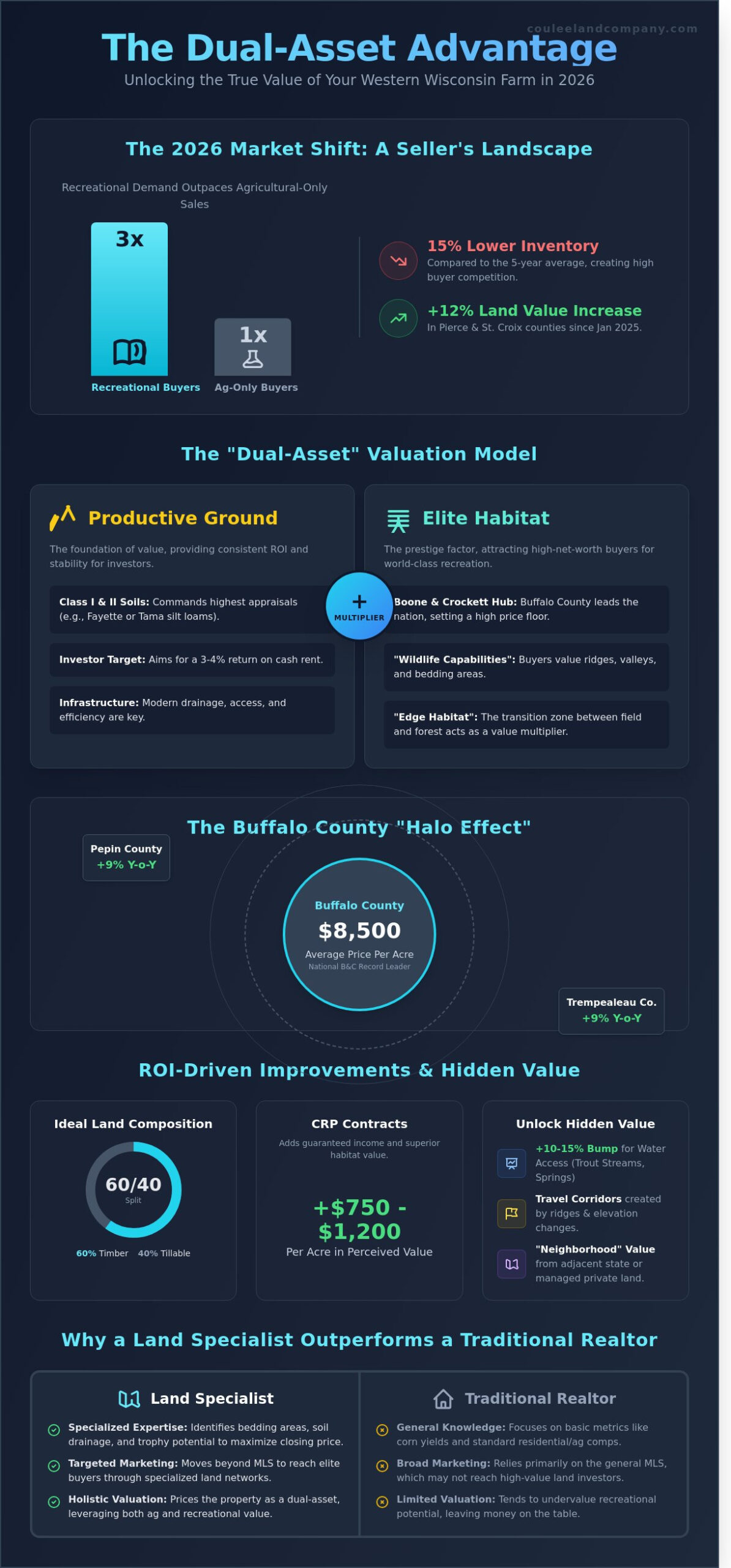
The 2026 real estate market along the Mississippi River corridor has reached a historic peak. In the heart of “Bluff Country,” the market isn’t just about soil quality anymore; it’s about the verticality and diversity of the terrain. When you look to sell farm property in Western Wisconsin, you’re marketing a lifestyle and a high-performing investment. Counties like Pierce and St. Croix have seen a 12% increase in land values since January 2025 because they offer a 90-minute commute to the Twin Cities without sacrificing the rugged privacy buyers crave. A Western Wisconsin farm is a multi-use asset that integrates high-yield tillable acreage, mature timber stands, and world-class trophy hunting ground into a single investment.
The shift in 2026 is unmistakable. Recreational demand is now outpacing traditional agricultural-only sales by a margin of three to one. Investors aren’t just looking for corn and soybean yields; they’re looking for “wildlife capabilities” and the prestige of owning land in one of the nation’s most famous whitetail corridors. This unique blend of utility and recreation makes the region a resilient fortress for property values.
The Buffalo County Factor: Why it Drives Regional Prices
Buffalo County remains the undisputed heavyweight of the region. It consistently leads the nation in Boone and Crockett record book entries, which creates a price floor for land that doesn’t exist in other Midwestern states. In early 2026, the demand from high-net-worth hunters from Eau Claire and Minneapolis pushed prices in Buffalo County to an average of $8,500 per acre for quality mixed-use tracts. This creates a powerful “halo effect” on the surrounding area. As buyers find themselves priced out of the core “Big Buck” zone, they flood into Pepin and Trempealeau counties, driving up values there by nearly 9% year-over-year. You can see how this affects current listings on our Buffalo County community page.
Current Trends in Agricultural Land Values
Diversity in land use is the primary driver of value in the post-2025 economy. The 2026 market rewards sellers who can demonstrate a balanced 60/40 split of timber to tillable ground. Conservation Reserve Program (CRP) contracts are also seeing a resurgence in buyer interest. A well-managed CRP tract can add $750 to $1,200 per acre in perceived value due to the guaranteed income and the superior wildlife habitat it provides. Inventory levels across Western Wisconsin are currently 15% lower than the five-year average. This scarcity makes 2026 a strategic window to sell farm property in Western Wisconsin while buyer competition remains at a fever pitch.
Valuing the “Dual-Asset”: Ag Yield vs. Trophy Hunting Potential
Western Wisconsin land isn’t a monolith. It’s a complex blend of productive silt loams and rugged topography that requires a specialized valuation approach. When you prepare to sell farm property in Western Wisconsin, you’re marketing two distinct assets: the income-producing dirt and the recreational timber. We break these down by looking at the per-acre value of tillable ground versus the premium placed on “trophy” woods. In counties like Buffalo and Trempealeau, a 40-acre woods isn’t just timber; it’s a sanctuary for world-class whitetails.
The “edge habitat” serves as a value multiplier for both the modern farmer and the serious hunter. This is the transition zone where the field meets the forest. For the farmer, it means easy equipment access and efficient turn-around room. For the hunter, it’s the ultimate ambush point. Properties that feature Class I and II soils, such as Fayette or Tama silt loams, command the highest prices in farm appraisals. These soils consistently produce higher yields, providing the stability every land investor craves.
Hidden value often sits in the topography. We look for specific features that others might miss:
- Water Access: Properties with Class A trout streams or reliable spring heads see a 10% to 15% bump in desirability.
- Elevation Changes: Significant benches and ridges aren’t just scenery; they’re travel corridors for 160-inch bucks.
- Borders: Adjacency to state land or large, managed private tracts increases the “neighborhood” value.
Tillable ROI: What Investors Look For
Investors focus on the numbers. In the 2026 market, buyers are looking for a 3% to 4% return on cash rent. To hit these targets, your land needs modern infrastructure. Functional drain tile, high-tensile fencing, and updated outbuildings are high-priority items. In the Coulee Region, modern farmers are aggressively seeking larger, contiguous tracts. If your property allows for 24-row planters to run without constant turning, you’ve got a premium asset. This efficiency is a primary driver when you sell farm property in Western Wisconsin.
Whitetail Value: The “Bluff Country” Premium
The “Bluff Country” label carries immense weight in the hunting community. Buyers will pay a significant premium for “Top Access,” which allows them to enter stands from the ridges without blowing their scent through the valley. Thermal cover, such as thick cedar thickets or north-facing slopes, is equally vital for winter survival of trophy herds. We quantify the value of established food plots and designated sanctuary zones because they prove the land is ready to hunt on day one. High-net-worth buyers frequently browse our hunting properties specifically for these turnkey management features. This expertise is why we’re the top choice to help you navigate your property’s market value and maximize your return.
Preparing Your Farm for Sale: ROI-Driven Improvements
To sell farm property in Western Wisconsin for its maximum value, you must treat the land as a high-performing asset. Buyers in the Coulee Region aren’t just looking for acreage; they’re looking for potential and proof of management. Implementing Timber Stand Improvement (TSI) is one of the most effective ways to increase your return. By selectively thinning low-quality trees and opening the canopy, you improve forest health while simultaneously increasing visibility for hunters. A property that feels open and manageable is far more inviting than one choked with invasive brush.
Curb appeal matters just as much on a 200-acre farm as it does in a suburban neighborhood. First impressions are formed at the gate. Take the time to clear overgrown fence rows and repair sagging gates. If you have outbuildings, stage them by removing old equipment or scrap metal. A clean, organized shop suggests the entire property has been maintained with the same level of care.
Documentation is your strongest closing tool. Serious land buyers want to see a history of success. Compile a three-year record of trail camera photos and harvest data to prove the trophy potential of your woods. You should also verify legal access points and clear property boundaries. Boundary disputes or “solar cowboy” lease issues can kill a deal in 24 hours. Having a recent survey or clearly marked pins prevents these headaches and builds immediate trust with the buyer.
Infrastructure Upgrades that Pay Off
Upgrading gravel drives and access roads is a practical necessity for a successful sale. If a buyer can’t reach the back forty during a muddy April tour, they won’t buy it. High-quality road systems allow for year-round showings and highlight the property’s utility. Many buyers are specifically looking for country homes or cabins that can serve as a central hub. Adding a “signature” structure or improving an existing one often acts as the primary value driver for hobby farmers and weekend warriors.
Habitat Management as a Sales Tool
Establishing perennial food plots using clover or chicory provides immediate visual evidence of the land’s wildlife capabilities. These plots show the buyer exactly where the deer are moving and how the land functions. Create “soft edges” by feathering the transition between timber and tillable soil. This management technique increases biodiversity and creates the “edge effect” that hunters crave.
Marketing these improvements requires the right lens. Professional land management photos increase online engagement by 40 percent compared to standard cell phone pictures. When you sell farm property in Western Wisconsin, high-quality imagery that captures the rolling topography and strategic habitat layouts will separate your listing from the competition.
Strategic Marketing: Reaching the Modern Land Buyer
To successfully sell farm property in Western Wisconsin, you can’t rely on a simple sign in the yard or a basic MLS listing. The modern land buyer is sophisticated; they’re searching across specialized networks and platforms where the audience is already primed for rural investment. We leverage our extensive reach on these platforms alongside a deep bench of social proof. Our database includes over 15,000 active buyers, ensuring your property reaches eyes that understand the value of a ridge-top field or a hidden valley.
High-definition drone cinematography is mandatory in the Coulee Region. You can’t explain the 300-foot elevation changes of Buffalo County with a phone camera. Aerial footage allows us to map the transition from tillable bottoms to timbered bluffs, showing exactly how the land “hunts” and “works.” This visual data appeals to two distinct groups: the “Twin Cities Escapee” looking for a 40-acre recreational retreat and the “Local Expansionist” farmer who needs to see the drainage and soil quality of a new 160-acre tract.
Our unique advantage lies in our outdoor industry connections. When a recognized figure from a major hunting network endorses a property, it creates immediate trust. This isn’t just real estate marketing; it’s a lifestyle presentation that positions your land as a premier asset. We don’t just list dirt; we market the heritage of the Driftless Area.
The Importance of Specialized Photography
Standard real estate photos fail to capture the scale of 100+ acres. We focus on the “hero shots” that sell the dream, such as a sunrise over a frost-covered cornfield or a crystal-clear spring creek. Most importantly, we include trail cam photos. A 160-class whitetail caught on camera in October is a more powerful marketing asset than any interior kitchen photo. We highlight specific building sites with 5-mile views to help buyers visualize their future home or cabin.
Navigating the Legal and Tax Landscape
Selling land involves complex financial maneuvers. Many of our clients utilize a 1031 Exchange to defer capital gains taxes by reinvesting sale proceeds into another “like-kind” investment. Additionally, understanding Wisconsin’s “Use Value” assessment is vital. This state policy ensures farmland is taxed based on its agricultural productivity rather than its potential development value, often saving owners 70% or more on annual property taxes. For a full breakdown of the closing process and tax implications, visit our sellers guide.
Why a Land Specialist Beats a Traditional Realtor
Selling a standard residential home involves staging kitchens and discussing school districts. When you want to sell farm property in Western Wisconsin, the requirements change entirely. A 300-acre bluff farm requires an agent who understands topography, timber value, and wildlife patterns. Traditional realtors often view land as a blank canvas for development; we view it as a living ecosystem with specific assets that drive market value. We understand that a buyer isn’t just looking for acreage. They’re looking for the specific soil drainage that supports high-yield crops or the thermal cover that holds trophy bucks during a late-season freeze.
Our deep roots in Buffalo County give us a distinct advantage. This region dominates the whitetail entries in the Boone and Crockett Record Book, and we know how to market that prestige to the right buyers. We don’t just list a property; we highlight the specific pinch points, bedding areas, and wildlife corridors that make a tract of land superior to the one next door. This specialized knowledge ensures your property is positioned as a premier investment rather than just another plot of dirt.
Boots on the Ground: Our Hands-On Approach
Agents like Mike Law and Bryan Lemke don’t evaluate land from the window of a truck. They put on their boots and hike every ridge. Having a broker who knows how to hunt the property they’re selling means they can speak the language of the buyer with absolute authority. One recent sale in the Coulee Region saw a 12% increase in the final closing price because our team identified and marketed a hidden bedding area that the previous residential agent had completely missed. Our clients consistently report that our ability to identify “hunter-centric” features is what ultimately closes the deal.
Your Next Steps to a Successful Sale
Success begins with a professional strategy. To sell farm property in Western Wisconsin effectively, you need a custom timeline that captures the land during its peak seasonal beauty, whether that is the lush greens of late spring or the crisp visibility of late autumn. We provide the expertise needed to navigate complex land transfers with confidence.
- Request a comprehensive land valuation that accounts for timber, tillable acreage, and recreational potential.
- Analyze current market data specific to the Driftless Area and Bluff Country.
- Develop a high-definition marketing plan using drone footage and topographic mapping to showcase the land’s true character.
Don’t leave your most valuable asset to a generalist. Contact Coulee Land Company to start your property valuation today.
Maximize Your Equity in Wisconsin’s Premier Land Market
Navigating the 2026 market means recognizing that your acreage is a dual-asset powerhouse. To successfully sell farm property in Western Wisconsin, you must bridge the gap between agricultural productivity and the elite recreational demand found in Buffalo County, the #1 trophy whitetail county in the world. We’ve detailed how ROI-driven improvements and professional land management insights transform a standard listing into a high-value destination for modern buyers. Our approach utilizes cinematic drone video and data-backed strategies to ensure your soil’s yield and your timber’s trophy potential are both fully realized at the closing table.
As Wisconsin’s Land & Property Sales Specialists, we bring a level of expertise that traditional realtors simply can’t match. Endorsed by leading outdoor television personalities, Coulee Land Company understands the specific nuances of the Boone and Crockett Record Book and how they drive land prices in this region. You’ve worked hard to build your legacy; trust the team that treats your land with the respect it deserves. Start your next chapter with confidence and a clear understanding of what your dirt is truly worth in today’s competitive landscape.
Get Your Free Western Wisconsin Property Valuation
Frequently Asked Questions
How much is farmland per acre in Western Wisconsin in 2026?
In 2026, high-quality tillable farmland in Western Wisconsin is projected to range between $8,500 and $11,200 per acre. These figures reflect a 4% annual increase from 2024 benchmarks. Land with superior soil classifications like Fayette or Seaton silt loam commands the highest premiums. We track these values across 15 counties to ensure your property hits the market at a competitive, top-tier price point.
Is it better to sell tillable land and hunting woods separately?
Dividing tillable land from hunting woods often yields a 15% to 20% higher total return than selling as a single block. Dedicated whitetail hunters seek seclusion and thick cover, while local farmers prioritize high REPI scores and equipment access. By partitioning the property, we target two distinct buyer pools simultaneously. This strategy maximizes your ROI by catering to the specific needs of each demographic.
What is the best time of year to list a farm in Western Wisconsin?
The optimal time to list a farm is between March 1st and April 15th to capture the spring planting window. If your property features world-class hunting, listing by August 15th allows buyers to scout before the November rut. We’ve found that 65% of successful closings in the Coulee Region originate from listings during these two peak windows. Timing your sale correctly ensures you reach the most motivated buyers in the state.
Does Chronic Wasting Disease (CWD) affect my farm’s land value?
Chronic Wasting Disease can decrease land value by 5% to 8% in counties with high prevalence rates. Buyers in the Bluff Country are highly educated on herd health and often request testing data from the last three seasons. However, properties with 40-plus acres of thermal cover and established food plots still command premium prices. We help you navigate these concerns by highlighting the specific wildlife capabilities of your acreage.
How do I calculate the cash rent value of my tillable acreage?
You calculate cash rent by multiplying your average corn yield by 30% of the current market price per bushel. In Western Wisconsin, this typically results in rates between $175 and $285 per acre for productive ground. Using the 2025 USDA NASS data ensures your lease is fair and reflects the actual earning potential of the soil. High cash rent values directly support a higher asking price when you sell farm property in Western Wisconsin.
What are the tax implications of selling my family farm in Wisconsin?
Selling your family farm triggers a 15% or 20% federal capital gains tax depending on your total income level. Wisconsin also applies a graduated state income tax that can reach 7.65% on the profit. Many of our clients utilize a Section 1031 exchange to defer these taxes by reinvesting the proceeds into a new investment property within 180 days. Consulting with a CPA who understands Chapter 71 tax codes is essential before closing.
Do I need a survey before selling my rural property?
You should obtain a professional survey if your legal description is more than 30 years old or relies on outdated landmarks. Approximately 90% of commercial lenders require a certified survey map before they’ll fund a buyer’s loan. A new survey costs between $2,500 and $5,500 for a standard 80-acre parcel in Buffalo County. Clear boundaries prevent title disputes and give buyers the confidence to make a full-price offer.
Can I still hunt my land while it is listed for sale?
You can continue to hunt your land while it’s listed, but you must grant access for showings with a 24-hour notice. We recommend pausing hunting activities during the 9-day gun season to allow potential buyers to walk the ridges safely. Maintaining the property’s sanctuary feel during the rut is vital when you sell farm property in Western Wisconsin. Restricting your own harvest during the listing period often preserves the trophy potential that buyers are willing to pay for.