
What if the difference between a trophy hunting property in Buffalo County and a landlocked headache is hidden in a single set of coordinates you’re currently misreading? You’ve likely stared at those grid lines and cryptic numbers, feeling the frustration of trying to translate a legal description into actual dirt and timber before the September 12, 2026 archery opener. It’s common to feel overwhelmed by the technical jargon of the Public Land Survey System, especially when you’re trying to secure your piece of the famed Bluff Country.
Mastering how to read a plat map wisconsin style ensures you’ll identify exact boundaries, calculate acreage with precision, and spot hidden land potential that others miss. Whether you’re looking at the 2026 Jefferson County Plat Book, which costs $35 this year, or studying the latest 2025 Wisconsin Act 103 updates, this guide provides the clarity you need. We’ll break down the Township and Range grid, explain how to decipher legal descriptions, and show you how these maps directly impact your land’s market value and wildlife capabilities.
Key Takeaways
- Understand the Public Land Survey System (PLSS) grid to unlock the legal foundation of every parcel in the Badger State.
- Learn how to read a plat map wisconsin landowners rely on to decode Township and Range numbers for precise property identification.
- Identify critical markers like section lines and easements to ensure your property access and boundaries are legally secure.
- Gain a strategic advantage by visualizing land corridors and hunter pressure on adjacent properties before you commit to a purchase.
- Transform raw legal descriptions into clear mental images of a property’s layout and its potential for trophy whitetail management.
What is a Wisconsin Plat Map and the PLSS Grid?
A Wisconsin plat map isn’t just a simple drawing; it’s a legal blueprint certified by your County Register of Deeds. While satellite apps are excellent for scouting trophy whitetails, they lack the legal authority found in a recorded plat. Understanding how to read a plat map wisconsin landowners rely on begins with the Public Land Survey System (PLSS). This foundational grid, established in the 19th century, serves as the rectangular survey system that organizes land into six-mile-square townships across the state.
To better understand this concept, watch this helpful video:
Learning how to read a plat map wisconsin officials use is the only way to avoid costly boundary disputes. Digital boundaries on a GPS app can be off by 20 feet or more, which is a massive margin when you’re hanging a stand near a property line. Your local County Register of Deeds maintains the official plat records that override any mobile app. These documents are the final word in boundary accuracy, especially after the 2025 Wisconsin Act 103 updates which were certified on April 3, 2026. If you want to know exactly where your dirt ends and the neighbor’s begins, the plat map is your only source of truth for hunting properties.
Decoding Townships, Ranges, and Sections
Every township in Wisconsin is a grid of 36 sections, each containing approximately 640 acres. Township numbers run North or South of the Illinois-Wisconsin border baseline, while Range numbers track East or West of the Fourth Principal Meridian. When you look at a legal description, you’re reading a map from the smallest unit to the largest. For example, Section 16 is always located near the center of the township. This specific section was historically reserved for the support of public schools, a detail that explains why you’ll often see large, unbroken blocks of public or municipal land in these areas. Understanding this structure is essential for anyone looking at Buffalo County land, where terrain and property lines dictate hunting success.
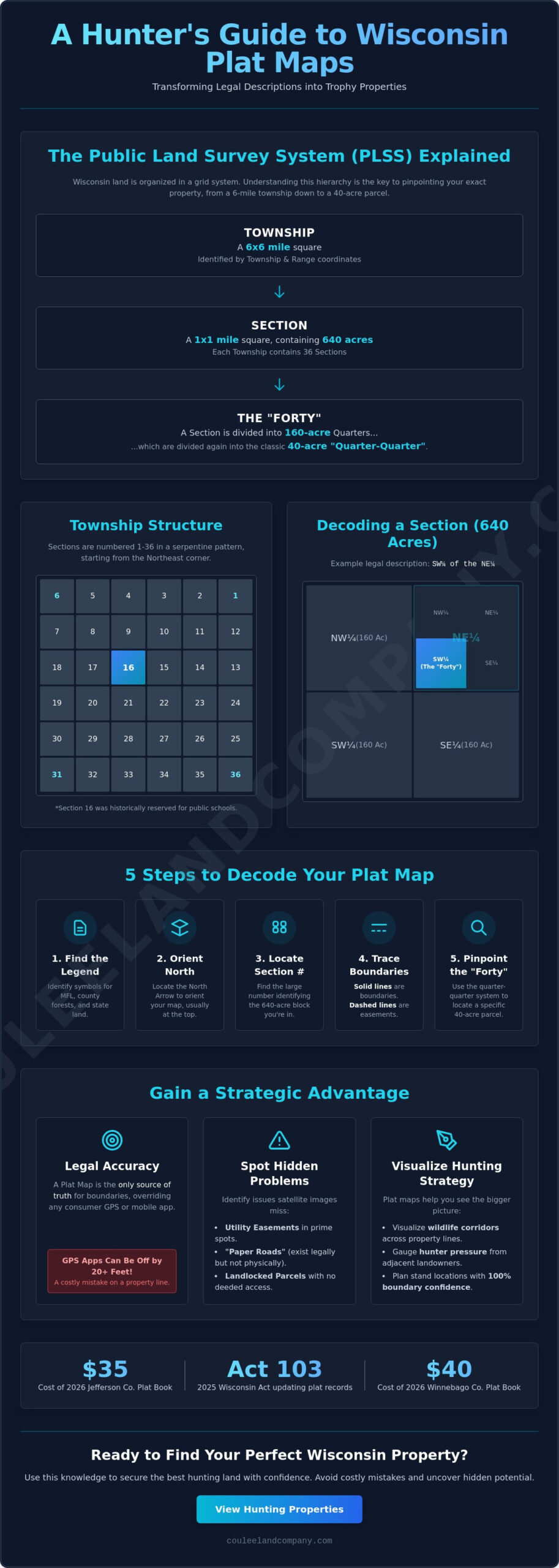
5 Steps to Read and Decode Your Wisconsin Plat Map
Learning how to read a plat map wisconsin residents use to manage their property begins with the legend. Every county surveyor uses specific symbols to denote state-owned land, county forests, or managed forest law (MFL) acreage. You must first locate the North Arrow to orient your perspective. Most Wisconsin plat books and land ownership maps place North at the top, but local topography can occasionally dictate otherwise. Once oriented, look for the Section number. This is the large number centered in the grid square that identifies which 640-acre block you’re examining.
Next, trace the solid lines to define the parcel’s legal footprint. Solid lines represent property boundaries, while dashed lines usually indicate easements or rights-of-way. Mastering how to read a plat map wisconsin style means knowing the difference between a fence line and a legal boundary. These dashed lines are critical because they reveal where you can’t build a cabin or plant a permanent food plot. If you’re looking at a parcel in Winnebago County, the 2026 plat book edition (priced at $40) will show these encumbrances clearly. Always verify if a dashed line represents a utility easement or a shared access road before you commit to a purchase.
Mastering the ‘Quarter-Quarter’ System (The Forty)
Wisconsin’s rural landscape is built on the 40-acre unit. A full Section is 640 acres. When you divide that into four 160-acre quarters, and then divide those quarters again, you get the 40-acre ‘quarter-quarter.’ This is the standard building block for agriculture and timber tracts in the Badger State. Identifying the ‘SW 1/4 of the NE 1/4’ allows you to pinpoint a specific 40-acre parcel with surgical precision. If you are preparing for a purchase, check our buyer’s resources to see how these blocks influence property layout and wind direction strategy.
Spotting Easements and Public Access
Don’t assume a road on a map exists in reality. Many Wisconsin plat maps show ‘paper roads,’ which are legally dedicated but never physically constructed. You might also see utility easements for power lines that could bisect a prime bedding area. These map features can significantly impact your land’s wildlife capabilities. If you’re unsure about a specific boundary, our team of specialized land agents can help you verify the physical reality of the map’s lines.
Why Plat Maps Matter for Wisconsin Hunting Land Buyers
Plat maps are the ultimate scouting tool for the serious whitetail hunter. While most hunters rely on digital aerials, the savvy landowner uses a plat map to identify neighboring landowners and assess potential hunting pressure. If a neighboring 40-acre tract is owned by a large family trust, you might face more pressure during the November 21 to 29, 2026 gun season than if it were owned by a distant timber company. Understanding how to read a plat map wisconsin style allows you to cross-reference ownership blocks with topographic maps to find natural funnels and hidden access points. You can’t truly master the “Bluff Country” without knowing who shares your borders. For complex interpretations in Buffalo County, contact land specialists like Mike Law or Bryan Lemke to ensure you’re seeing the full picture.
Identifying Property Potential in Western Wisconsin
Spotting landlocked parcels is a critical skill. In Wisconsin, “landlocked” doesn’t always mean inaccessible, but the legalities of access are complex. A plat map reveals historical boundaries and old fence lines that often signify mature timber stands or ancient travel corridors. These historical markers help you visualize the property’s potential long before you step foot on it. Review our Buffalo County community guide to understand how ownership patterns in this trophy buck territory impact your success. Knowing how to read a plat map wisconsin experts use ensures you don’t overlook a parcel with superior wildlife capabilities just because the access looks difficult on a standard GPS app.
The Role of a Land Specialist in Map Interpretation
A standard residential realtor often lacks the specialized knowledge to interpret rural land documents. They might miss a subtle easement or fail to recognize the significance of a “paper road” that could impact your building plans. At Coulee Land Company, we use these maps as the foundation for a comprehensive land management plan. We identify hidden value and help you maximize your property’s profit potential. Learn more about our specialized approach to selling hunting land in Wisconsin to see how we turn map data into a superior sales strategy. Our team lives and breathes this land, ensuring your investment is backed by diligent research and authentic expertise.
Secure Your Legacy in Wisconsin’s Bluff Country
You’ve now mastered the technical grid of the PLSS and the strategic importance of the “forty.” You know that a recorded plat map is the final word on legal boundaries, far outweighing the estimated lines on a mobile app. Understanding how to read a plat map wisconsin gives you a decisive edge in identifying superior deer corridors and avoiding landlocked parcels before the September 12, 2026 archery opener. This knowledge transforms a confusing grid into a clear roadmap for your future property.
Coulee Land Company specializes in the rugged terrain of Western Wisconsin, particularly Buffalo County, where our team brings decades of experience to every transaction. Our deep expertise in trophy whitetail brokerage is why leading outdoor television hosts trust us to manage their land searches. We don’t just sell property; we help you build a land management plan that maximizes every acre of your investment. You deserve a partner who understands the dirt as well as the data.
Your dream property is out there, and now you have the tools to find it with total confidence. Let’s get to work on making that ownership dream a reality.
Frequently Asked Questions
Where can I find a plat map for a specific Wisconsin county?
You can purchase official plat maps directly from the County Register of Deeds or the County Clerk’s office. For example, the 2026 Winnebago County Plat Book is currently available for $40 plus tax, while the 2026 Dane County edition is sold for $42 at the counter. Many landowners also use how to read a plat map wisconsin resources provided by the State Cartographer’s Office to locate digital versions or historical records.
What is the difference between a plat map and a survey map in Wisconsin?
A plat map is a broad organizational tool used for tax and ownership identification across a township or county. It shows general parcel shapes and neighboring owners but isn’t intended for precision construction. A Certified Survey Map (CSM) is a detailed, legally binding document that shows exact property pins and specific boundary measurements. While a plat map helps you scout a section, a survey map is what you need to settle a precise boundary dispute.
How do I calculate the acreage of a parcel labeled as ‘NW 1/4 of the SE 1/4’?
This specific description represents exactly 40 acres of land. In the Public Land Survey System, a standard section contains 640 acres. You calculate the size by dividing 640 by four to find the 160-acre quarter section, then dividing by four again to find the 40-acre quarter-quarter. This “forty” is the classic unit of measurement for Wisconsin agriculture and timber tracts.
Are Wisconsin plat maps available for free online?
Many Wisconsin counties offer free access to land ownership data through their interactive GIS (Geographic Information Systems) websites. These digital tools are excellent for identifying how to read a plat map wisconsin boundaries during a land search. However, official printed plat books usually carry a fee to cover production, such as the 2026 Jefferson County Plat Book which is available for $35. Always verify the publication date, as new books are typically released every 4 to 6 years.