
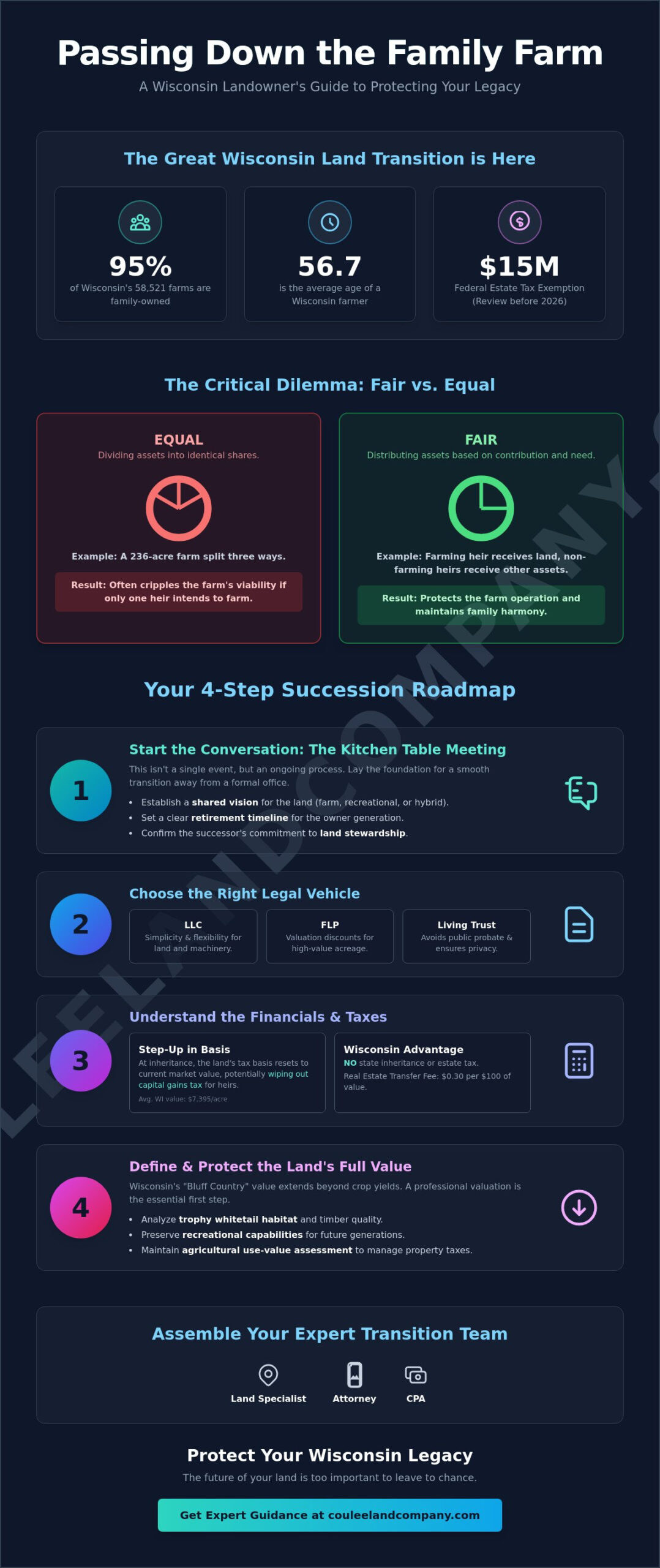
Did you know that 95% of Wisconsin’s 58,521 farms are family-owned, yet the average farmer is now 56.7 years old? This statistic highlights a looming reality for our state’s landowners: a historic amount of “Bluff Country” soil is about to change hands. You’ve likely spent your life cultivating a legacy, so it’s natural to feel anxious about how to pass down the family farm without sparking a sibling feud or losing the business to a developer’s bulldozer. You want to ensure the land stays whole while securing your own financial freedom for retirement.
We understand that your property is more than just a legal description; it’s your life’s work and a piece of Wisconsin’s heritage. This guide provides a clear roadmap to navigate the emotional and legal complexities of succession. We’ll examine the 2026 federal estate tax exemption of $15 million, explain why Wisconsin’s lack of an inheritance tax matters for your heirs, and share strategies to maintain family harmony during the transition. By the end, you’ll have the expert insights needed to protect your legacy and keep your family’s farming tradition alive for the next generation.
Key Takeaways
- Master the critical distinction between “fair” and “equal” to maintain family harmony among farming and non-farming heirs.
- Evaluate the best legal structures, such as LLCs or Revocable Living Trusts, to shield your land from the public probate process.
- Discover the essential steps for how to pass down the family farm while protecting the land’s unique recreational and agricultural value.
- Learn why a professional land valuation is the necessary first step to ensure your legacy is both financially secure and legally sound.
- Gain a clear roadmap for 2026 that balances your retirement needs with the long-term health of your Wisconsin acreage.
Starting the Conversation: Bridging the Gap Between Generations
2026 marks a pivotal moment for Wisconsin landowners. As the “Great Wealth Exchange” accelerates, trillions of dollars in assets are shifting between generations. For the 58,521 farm families in our state, this isn’t just about bank accounts; it’s about the future of the ridges and valleys we call home. Learning how to pass down the family farm requires more than a handshake. It demands a proactive strategy that addresses the $15 million federal estate tax exemption before potential legislative shifts occur. You need a transition team that includes a land specialist, an attorney, and a CPA to ensure your legacy remains intact.
To better understand the foundational steps of this process, watch this helpful video:
Succession planning often stalls because of the “fair vs. equal” trap. Dividing a 236-acre farm equally among three siblings might seem just, but if only one child intends to farm, that split can cripple the operation’s viability. We advocate for a shared vision. Is the property a working dairy, a premier hunting retreat, or a hybrid of both? Establishing these goals early prevents the land from being subdivided and sold off in pieces. Professionals call this succession planning, but for us, it’s about protecting the heritage of the Coulee Region.
The Kitchen Table Meeting: Setting Ground Rules
The first meeting should happen at the farm, not in a sterile office. Start by setting a clear timeline for the “owner generation” to transition into retirement. This isn’t an overnight handoff. It’s a multi-year process. You must identify the successor’s commitment to land stewardship. If the next generation lacks the passion to manage the soil and timber, it’s better to know now than after the deeds are signed. Clear communication prevents the emotional blowouts that destroy family harmony.
Defining the Legacy of the Land
Wisconsin land is unique because its value isn’t tied solely to crop yields. In areas like the Coulee Region, the “Bluff Country” features are high-value assets. We look at trophy whitetail habitat and timber quality as part of the total package. For those in the heart of the big buck country, understanding Buffalo County Wisconsin Deer Hunting potential is vital. Preserving these recreational capabilities ensures the land remains a prized family asset for decades, whether it’s used for the harvest or for the hunt.
The Mechanics of Transfer: Choosing the Right Legal Vehicle
Choosing the correct legal structure is the most critical technical hurdle when figuring out how to pass down the family farm. In 2026, many Wisconsin owners prefer Limited Liability Companies (LLCs) for their simplicity and flexibility in managing land and machinery. Family Limited Partnerships (FLPs) remain a powerhouse for those with high-value acreage; they allow for valuation discounts that can significantly lower the taxable value of the gift. A Revocable Living Trust is often the best way to keep your business private. It allows your heirs to avoid the public, costly probate process that can drag on for months in Wisconsin courts.
The “Step-up in Basis” is perhaps the most valuable tax tool available to your heirs in 2026. When land passes at death, the tax basis resets to the current market value, which currently averages $7,395 per acre across Wisconsin. This effectively wipes out decades of capital gains taxes for the next generation. For additional guidance on structuring these complex transitions, the University of Wisconsin offers a specialized program called Cultivating Your Farm’s Future. This resource helps families align their legal choices with their long-term agricultural goals.
Wisconsin Property Tax and Estate Considerations
Wisconsin does not have a state inheritance or estate tax, but you cannot ignore the real estate transfer fee of $0.30 for every $100 of value. This rate remains in effect after the failure of SB 218 in March 2026. To keep property taxes manageable, you should maintain your agricultural use-value assessment. Integrating Wisconsin land management for wildlife can often coexist with these assessments while enhancing the property’s recreational appeal. If you are unsure of your land’s current market standing, reaching out to Mike Law can provide a clear picture of your property’s specialized value.
Buy-Sell Agreements and Life Insurance
Life insurance provides the liquidity needed to satisfy heirs who do not want to farm. Instead of subdividing the land to pay off a sibling, the insurance payout provides their “fair” share of the estate. Pair this with a robust buy-sell agreement. This legal contract ensures that if a family member wants to sell their interest, the land must first be offered to the remaining farming heirs at a pre-determined price. It acts as a shield against outside developers and ensures the farm stays in the family name for another generation.
Protecting Your Legacy: Valuing and Managing the Land for the Future
Most succession plans focus heavily on machinery and livestock, but they often overlook the land’s greatest asset: its recreational potential. In the Coulee Region, a farm is rarely just a collection of tillable acres. It’s a complex ecosystem of timber, bedding areas, and water sources. Understanding how to pass down the family farm means recognizing that the market value for a property with trophy whitetail habitat is significantly different than a flat section of corn ground. A professional land valuation is essential before any deeds are signed. This ensures the “owner generation” receives a fair retirement base while the successors understand the true worth of the heritage they are inheriting.
Effective management requires a transition of knowledge, not just a transition of title. The next generation needs to understand more than just crop rotations; they must be proficient in timber stand improvement and the strategic placement of food plots. For a broader look at the legal and financial frameworks involved in this process, A Complete Guide to Farm Succession Planning offers excellent foundational advice. Combining these financial strategies with a deep commitment to land stewardship ensures the farm remains a productive, private sanctuary rather than a subdivided development.
Maximizing Value Through Specialized Brokerage
A general realtor often misses the nuances that drive value in Western Wisconsin. They might see an overgrown hillside where a land specialist sees a primary bedding area for Boone and Crockett bucks. When you visit our Coulee Land Company Sellers page, you’ll see how we quantify these specific wildlife capabilities. We track current market trends across our Hunting Properties to ensure your family’s land is positioned correctly. This specialized insight is the difference between a generic appraisal and a valuation that respects the land’s true legacy.
The Final Handshake: Implementing the Plan
Execution is the final hurdle. We recommend a “trial period” where the successor manages daily operations and land management decisions under the current owner’s guidance. This hands-on phase reveals any gaps in the plan before the legal documents are finalized. Once the transition team has reviewed the tax implications and family goals, you can move forward with confidence. This deliberate approach keeps the farm in the family, the relationships intact, and the land’s wild character protected for decades to come.
Securing Your Legacy in Wisconsin’s Bluff Country
Passing a farm to the next generation is one of the most significant decisions a landowner will ever make. You’ve learned that a successful transition requires balancing technical legal vehicles like LLCs with the deep, emotional connection your family has to the soil. By establishing a clear timeline and addressing the “fair versus equal” challenge early, you protect both your financial security and your family relationships. Knowing how to pass down the family farm is ultimately about stewardship; it’s about ensuring the timber, ridges, and fields you’ve managed stay intact for decades to come.
Coulee Land Company has specialized in the unique landscape of Wisconsin’s Bluff Country since our inception. Our team, led by recognized land specialists like Mike Law and Bryan Lemke, understands that your property’s value isn’t just in the tillable acres. We provide expert analysis that accounts for both agricultural production and the superior trophy hunting potential that defines this region. Don’t leave your life’s work to chance or a generic appraisal. Get a Professional Property Valuation to Start Your Succession Plan today. You’ve worked hard to build this legacy; let’s work together to make sure it lasts.
Frequently Asked Questions
What is the most tax-efficient way to pass down a farm?
Utilizing the “step-up in basis” at death is the most efficient method for heirs. In 2026, this resets the land’s value to the current market average of $7,395 per acre, which effectively wipes out capital gains taxes on decades of appreciation. For lifetime transfers, you can use the 2026 annual gift tax exclusion of $19,000 per recipient. Combining these with the $15 million federal estate tax exemption ensures your family keeps the maximum value of the acreage.
How do I handle heirs who do not want to work on the farm?
You should use life insurance policies or non-farm assets to provide liquidity for heirs who have no interest in land management. This allows you to be “fair” without being “equal” by giving the farming successor the land and the non-farming heirs a cash equivalent. Structuring a buy-sell agreement is also vital. This legal tool ensures that if a non-farming sibling wants to sell their interest later, the farming heir has the first right to buy it.
Do I need a trust to pass down my land in Wisconsin?
A Revocable Living Trust is the best tool to avoid the public probate process, which can be both slow and expensive in Wisconsin. While it’s not a legal requirement, it keeps your land holdings and transition details private from the public record. This is a key step in how to pass down the family farm because it allows for an immediate transfer of management. It ensures that the daily operations and land stewardship don’t stall during a legal transition.
What happens if I die without a succession plan?
Your property will be distributed according to Wisconsin’s intestacy laws, which often results in the land being split equally and sold to satisfy different heirs. This fragmentation is a primary reason why Wisconsin saw a 10% decrease in total farms between 2017 and 2022. Without a clear plan, the land you’ve managed for trophy whitetails or crops could be subdivided by developers. You also lose the ability to dictate who manages the “Bluff Country” features you’ve spent years improving.