
Why do some 80 acre parcels in the Driftless Region command a staggering $14,000 per acre while neighboring tracts struggle to find a buyer? The difference isn’t just luck or location; it’s the presence of a turnkey trophy legacy. Understanding how to increase hunting land value in Wisconsin requires moving beyond basic ownership and into active stewardship. You likely already realize that a property is more than just dirt and trees, yet it’s frustrating when your timber grows thick and unmanaged while mature buck sightings dwindle. You deserve a property that performs as both a sanctuary and a high yield investment.
This 2026 strategic guide promises to show you exactly which habitat projects and management decisions command the highest premiums in today’s stabilizing market. We will explore the financial impact of professional forestry mulching, the tax advantages of the Managed Forest Law, and the specific timber stand improvements that turn a standard woods into a world class hunting destination. From food plot architecture to water access, you’ll learn how to build a property that justifies a top tier price tag and attracts the most serious buyers in the state.
Key Takeaways
- Learn how to define recreational ROI by balancing timber health, wildlife density, and property accessibility in the Coulee Region.
- Discover how to increase hunting land value in Wisconsin through forestry mulching that clears invasives while boosting immediate curb appeal.
- Identify the Timber Stand Improvement (TSI) techniques that create thick bedding cover and promote high-value hardwood growth.
- Understand the ‘turnkey’ premium and why low-impact trail systems are essential for command-and-control hunting strategies.
- Master the art of documenting success with harvest records and trail camera history to provide undeniable proof of concept to buyers.
Strategic Habitat Management as a Value Driver in Wisconsin’s Bluff Country
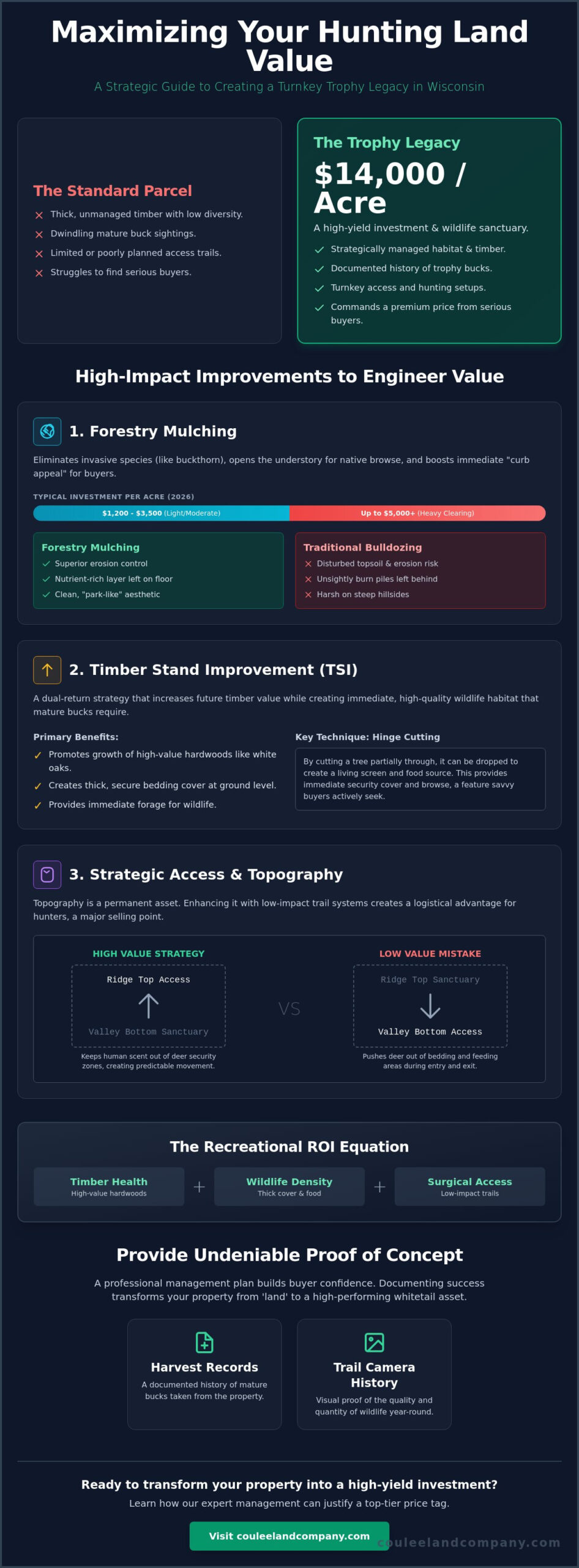
In the rugged terrain of Western Wisconsin, land value is no longer a simple calculation of acreage and road frontage. To truly understand how to increase hunting land value in Wisconsin, you must view your property through the lens of recreational ROI. This is the precise intersection where timber quality, wildlife density, and surgical accessibility meet. In the Coulee Region, where steep bluffs and deep valleys dictate deer movement, a specialized approach to thermal cover and habitat diversity is required. Owners who implement rigorous wildlife management principles see a direct correlation between their stewardship and the market premium their land commands. This is especially evident in Buffalo County, where a documented history of mature buck sightings transforms a parcel from mere dirt into a high performing whitetail asset.
To better understand how these habitat choices translate into real world value, watch this helpful video:
The Psychology of the Modern Hunting Land Buyer
Today’s buyers in 2026 aren’t just looking for a place to sit in a tree; they’re looking for a legacy that’s ready to hunt from day one. There’s a significant price gap between raw, unmanaged acreage and a turnkey property with established food sources and bedding. A professional management plan builds immediate buyer confidence. It signals that the property has been curated by an expert, often leading to faster offers and higher closing prices for premium hunting properties.
Leveraging Topography for Maximum Value
Topography is a permanent asset. It can be enhanced but never manufactured. In our bluff country, identifying and sharpening natural funnels within steep terrain creates predictable deer movement that hunters crave. High value properties prioritize ridge top access to keep human scent out of valley bottom security zones. By reinforcing these natural features with strategic plantings, you ensure the land works with the hunter, not against them. This logistical advantage is a major selling point for serious outdoorsmen. If you are also exploring investment properties in other rugged landscapes, you can discover NC High Country Real Estate to see how topography and terrain influence luxury mountain listings in the Blue Ridge region.
High-Impact Improvements: From Forestry Mulching to Trophy Food Plots
Passive land ownership is a relic of the past for those seeking maximum returns. To truly master how to increase hunting land value in Wisconsin, you must transition from a spectator to an engineer of the landscape. High impact improvements like forestry mulching and strategic timber thinning don’t just improve the habitat; they fundamentally alter the property’s marketability. In 2026, light to moderate vegetation mulching typically costs between $1,200 and $3,500 per acre, while heavy clearing can reach $5,000 per acre. This investment pays dividends by eliminating invasive buckthorn and opening up the understory for native browse and better visibility.
Forestry Mulching vs. Traditional Clearing
Traditional bulldozing often leaves behind unsightly burn piles and disturbed topsoil, which is a recipe for disaster on steep Wisconsin hillsides. Forestry mulching provides superior erosion control by leaving a nutrient rich layer of organic material on the forest floor. This method creates a park like aesthetic that appeals to every family member, not just the hunters. It transforms an overgrown thicket into an inviting landscape, significantly increasing the perceived value during a walkthrough with a specialized land broker.
Timber Stand Improvement (TSI) for ROI
Strategic thinning is the fastest way to promote the growth of high value hardwoods like white oaks while simultaneously creating the thick bedding cover mature bucks require. By using techniques like hinge cutting, you can provide immediate ground level security and forage. For a deeper dive into these methods, see our guide on Wisconsin land management for wildlife. This balance of future timber value—the same quality required for premium custom dining tables Galena Ohio—and immediate habitat quality is exactly what savvy buyers look for in a premium listing.
Food plot architecture is about more than just throwing seed. Placement and security are far more valuable than total acreage. A small, hidden “kill plot” nestled near a bedding area is often worth more to a buyer than a massive, exposed field. Additionally, installing strategic water tanks or ponds in dry ridge top areas can hold deer on your property that would otherwise wander to a neighbor’s creek. Participating in the Wisconsin Deer Management Assistance Program (DMAP) can provide the professional guidance needed to ensure these improvements align with state conservation goals and maximize your property’s potential.
The ‘Turnkey’ Premium: Positioning Your Land for a Record-Breaking Sale
Turnkey properties sell for a premium because they eliminate the “work” phase for the new owner. A professional trail system is a cornerstone of this status. It allows for low-impact scouting and hunting, ensuring that even a small parcel feels larger and hunts better. When considering how to increase hunting land value in Wisconsin, don’t overlook the psychological impact of a clean, accessible property. Research-based resources like UW-Madison Extension Forestry & Wildlife provide excellent frameworks for maintaining these systems sustainably while protecting the integrity of your timber.
Documentation is your proof of concept. A buyer isn’t just buying land; they’re buying the potential for a world class trophy. Showing years of trail camera history and organized harvest records validates your management efforts. To see how professional visual documentation can set a listing apart, check out Houzpics | Real Estate Photographers in Hilton Head, SC. Before listing, dressing up the property by mowing trail edges, clearing debris from gates, and ensuring food plots are lush ensures the first impression matches your premium asking price. This attention to detail transforms a standard listing into a must have legacy property.
Preparing for a Professional Valuation
Management history justifies why your land is worth more than the county average. While Buffalo County land can reach $14,000 per acre in 2026, your specific improvements might push your valuation even higher. We encourage owners to get a free property valuation that specifically accounts for habitat enhancements, thermal cover, and timber quality rather than just looking at generic soil maps. This specialized approach ensures no dollar of your hard work is left on the table during negotiations.
The Coulee Land Company Advantage
Marketing managed land requires an agent who speaks the language of the outdoors. Working with a land specialist broker in Wisconsin ensures your property’s unique features aren’t missed by potential buyers. Experts like Mike Law and Bryan Lemke understand how to market the nuances of Bluff Country, from thermal hubs to ridge top access. Their regional authority and industry endorsements provide the social proof necessary to move buyers from interest to a record breaking close.
Command a Premium for Your Wisconsin Legacy
Owning a piece of the Coulee Region is a significant privilege, but maximizing its worth requires a transition from a passive owner to an active land manager. We’ve explored how strategic habitat engineering and high-impact improvements like forestry mulching create a property that hunts as well as it looks. Mastering how to increase hunting land value in Wisconsin ultimately comes down to creating a turnkey experience where the next owner sees immediate potential rather than a project list. Whether you’re hinge cutting for bedding or establishing a low-impact trail system, every decision should build toward a record-breaking sale. Much like how residential specialists at Robert Caicedo Real Estate guide sellers through a curated exit strategy, your land management efforts ensure your asset is positioned to command a premium.
As record-holding whitetail experts specializing in Buffalo County and Western Wisconsin’s Bluff Country, we bring a stewardship-focused approach to every transaction. We understand the vision required to curate a trophy property because we’ve done it ourselves. Maximize your return-get a professional valuation for your Wisconsin land today. Your land is a high-performing asset; let’s ensure the market recognizes its true value and rewards your hard work.
Frequently Asked Questions
What is the single best improvement for increasing hunting land value?
The single best improvement is the establishment of a comprehensive, low-impact access system paired with high-quality, secure food plots. Buyers prioritize properties where the heavy lifting of land engineering is already finished. A well-designed trail system allows for stealthy entry and exit, which is vital for maintaining a sanctuary environment. When you combine this with strategically placed food sources, you demonstrate the property’s immediate potential to hold and grow mature bucks.
Does clearing brush for food plots decrease my timber value?
Clearing invasive brush and low-quality understory actually increases your property’s overall health and aesthetic appeal without compromising high-value timber. Most food plots are established in existing openings or areas with “trash” trees that hold little commercial value. By removing these competitors, you allow your prize hardwoods like white oaks to thrive. This strategic thinning is a core component of how to increase hunting land value in Wisconsin because it balances future logging revenue with immediate wildlife benefits.
How much does a professional land management plan cost in Wisconsin?
The cost of a professional land management plan depends entirely on the total acreage and the complexity of the terrain. Factors such as the density of invasive species and your specific goals for timber production versus wildlife habitat will influence the required investment. While state programs like the Managed Forest Law offer tax incentives for following a plan, private consultations are tailored to maximize your specific recreational ROI. It’s best to consult with a specialist who understands the unique topography of the Coulee Region.
Will hunters pay more for land that is already managed and ‘ready to hunt’?
Serious hunters consistently pay a premium for turnkey properties that offer immediate gratification and a documented history of success. In the competitive Wisconsin market, a managed property often commands a significantly higher price per acre than unmanaged neighboring tracts. Buyers value the years of stewardship, trail camera history, and established habitat that you’ve already invested in. Learning how to increase hunting land value in Wisconsin through these turnkey features ensures your property stands out as a premier trophy destination.