
The dream of owning your own slice of hunting paradise-the kind of ground that holds trophy whitetails and promises seasons of memories-is a powerful one. Yet, turning that dream into a deed often hinges on a daunting challenge: financing. Securing a loan for raw land is a different beast than a standard home mortgage, and many passionate outdoorsmen find themselves searching for a clear answer on how to get a loan for hunting land. Questions about specialized lenders, steep down payments, and appraisals that don’t account for a property’s true wildlife capabilities can quickly make the process feel overwhelming.
This is where your hunt for answers ends. As land and property sales specialists, we’ve created the definitive guide to navigate this complex process with confidence. This article breaks down every step, from preparing your finances and understanding key requirements to identifying lenders who recognize the unique value of recreational property. Our goal is to provide you with a clear, actionable plan to successfully secure the financing you need and finally purchase your own piece of prime hunting real estate.
Key Takeaways
#1. Work with a lender who understands your goals like ERGO Bank. They specialize in rural – hunting land loans and will give you the small town customer service you deserve. Contact Kevin: [email protected] https://www.ergobank.com/loans-leasing/hunting-recreational-land-loans
#2. Understand why financing raw land is a different game; lenders have specific concerns about unimproved properties that you must be prepared to address.
#3. The first step in learning how to get a loan for hunting land is preparing a rock-solid financial profile to prove you are a low-risk, reliable borrower.
#4. Discover which types of lenders, from agricultural credit unions to specialized land banks, are the best partners for financing your dream hunting property.
#5. Go beyond a strong credit score by implementing specific strategies to make your application stand out and give the lender ultimate confidence in your purchase.
Table of Contents
Why Financing Hunting Land is Different Than a Home Loan
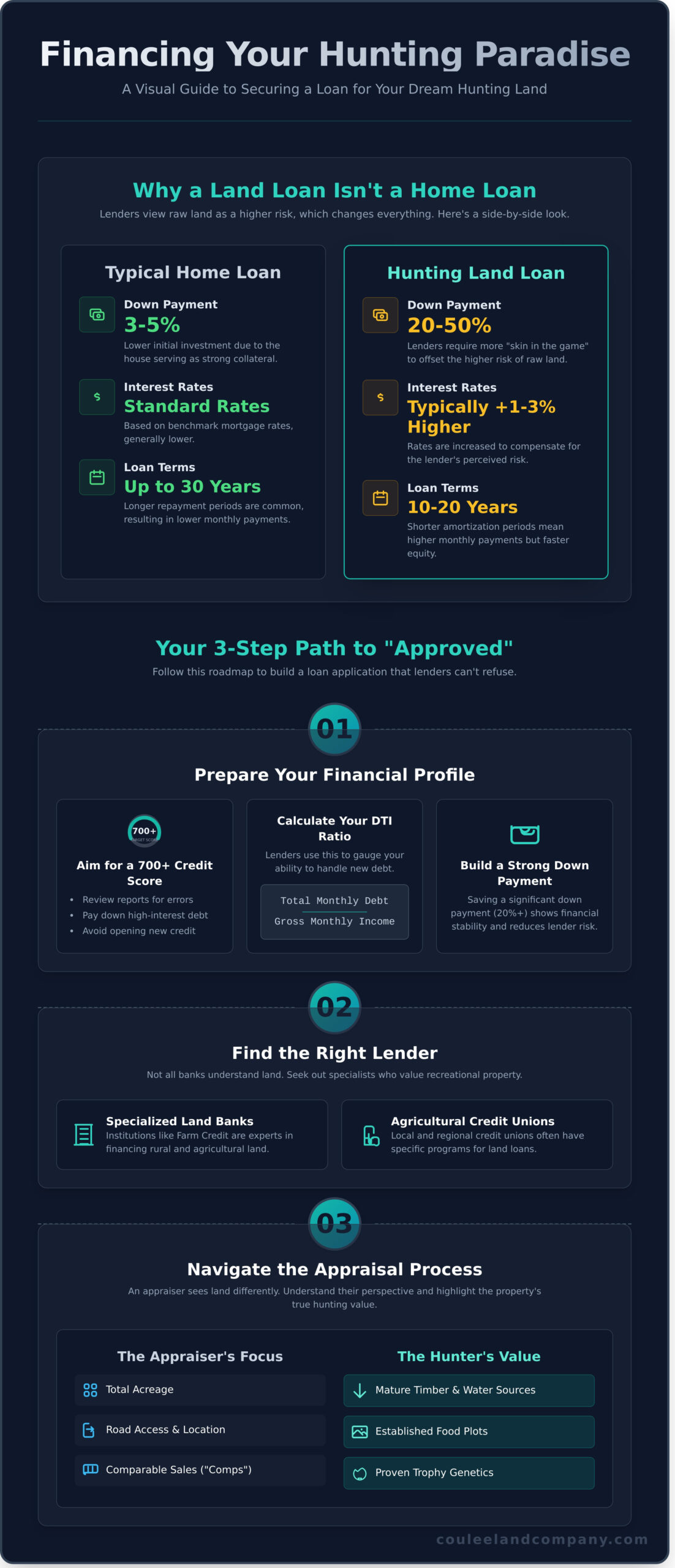
Securing financing for your dream hunting property is a fundamentally different process than buying a house. Lenders view raw, undeveloped land as a riskier investment. Why? Because unlike a home, there is no structure to act as primary collateral. If a borrower defaults, a vacant parcel of land is often harder for a bank to liquidate than a residential property. This perceived risk changes the entire lending equation, resulting in different qualification standards than a typical residential mortgage loan. Understanding these key differences is the first critical step in learning how to get a loan for hunting land.
To see these concepts explained in more detail, watch this excellent overview from a land and wildlife specialist:
The Down Payment: Expect to Invest More Upfront
The most significant difference you’ll face is the down payment. While home loans can sometimes require as little as 3-5% down, typical down payments for land range from 20% to as high as 50%. Lenders require you to have more "skin in the game" to offset their risk. The exact amount will be influenced by factors like your credit score and whether the land is completely raw or has improvements like road access, a well, or septic. Start saving early for this significant initial investment.
Interest Rates & Loan Terms
Because of the higher risk, you should anticipate both higher interest rates and shorter loan terms. Rates for land loans are often 1-3% higher than conventional mortgage rates. Furthermore, instead of a 30-year amortization, land loans are commonly structured with shorter terms, such as 10, 15, or 20 years. This combination means your monthly payment will likely be higher than a home loan of a similar amount, making it crucial to shop different lenders to find the best rate.
The Appraisal Process for Hunting Properties
Appraising a hunting property is more of an art than a science. An appraiser’s valuation will be based primarily on "comps"-recent sales of comparable parcels in the area. They focus on objective factors like total acreage, road access, and location. However, the specific features that make a property a premium hunting tract-like mature timber, water sources, established food plots, and proven trophy genetics-can be subjective. An out-of-area appraiser may not grasp their true value. This is where working with an experienced land specialist is invaluable, as they can often provide the appraiser with relevant comps that accurately reflect the property’s unique wildlife capabilities.
Step 1: Preparing Your Financials to Secure a Loan
Before you ever step foot on a potential property, the most critical groundwork happens at your desk. Securing financing for hunting land is less about the dirt and more about the details of your financial history. Lenders are in the business of managing risk, and they want to see a stable, reliable borrower who has a proven track record of financial responsibility. Understanding how to get a loan for hunting land begins with presenting yourself as the best possible candidate. This process goes far beyond a single credit score; it’s about building a comprehensive financial profile that inspires confidence.
Check Your Credit Score and History
Your credit score is the first number a lender will scrutinize. It’s a direct reflection of your creditworthiness. For the most competitive interest rates and terms, you should aim for a score of 700 or higher. To ensure you’re putting your best foot forward, take these essential actions:
-
Review your credit report from all three major bureaus (Equifax, Experian, and TransUnion) for any errors and dispute them immediately.
-
Pay down high-interest debt, like credit card balances, to lower your credit utilization ratio and improve your score.
-
Avoid opening new credit lines or making large purchases on credit in the months leading up to and during your loan application.
Calculate Your Debt-to-Income (DTI) Ratio
Your Debt-to-Income (DTI) ratio is a powerful metric that tells lenders what percentage of your gross monthly income goes toward paying your existing debts. To calculate it, simply divide your total monthly debt payments (mortgage, car loans, credit cards) by your gross monthly income. Lenders generally prefer a DTI below 43%, as this demonstrates you have sufficient income to comfortably handle an additional land loan payment without financial strain. This single number is a key indicator of your ability to manage your financial obligations.
Gather Key Financial Documents
When you apply for a loan, you must provide concrete proof of your financial stability. Being organized is a non-negotiable part of learning how to get a loan for hunting land. Lenders will require a standard set of documents, and having them ready will significantly streamline the process. While specific requirements can vary between a traditional agricultural lender and government-backed programs like USDA farm loans, your core file should include:
-
W-2s and federal tax returns for the last two years.
-
Recent pay stubs covering at least 30 days.
-
Bank statements for the last two to three months for all checking and savings accounts.
-
A detailed list of all assets (investments, retirement accounts, other properties) and liabilities (all outstanding debts).
Organize these documents in a dedicated physical or digital folder so you can provide them to your lender without delay.
Step 2: Finding the Right Lender for Your Hunting Property
Securing financing is a critical step, but not all lenders understand the unique value of a prime piece of whitetail habitat. Many traditional banks are hesitant to finance raw or unimproved land, viewing it as a higher-risk investment compared to a residential home. This is a common hurdle when learning how to get a loan for hunting land. Success depends on finding a lending partner who sees the property for what it is: a valuable asset with immense recreational and long-term potential. At Coulee Land Company, we guide our clients to lenders who specialize in rural real estate and share our passion for the outdoors.
Local Banks and Credit Unions
Your local bank or credit union can be a solid option, especially if you have a strong, established relationship with them. They possess intimate knowledge of the local market and can accurately assess land values in the area. However, be prepared for potentially stricter down payment and credit score requirements for unimproved parcels. When you approach them, be direct and ask specifically about their "recreational land loan" or "raw land loan" programs to gauge their experience and willingness to finance your dream property.
The Farm Credit System & Agricultural Lenders
For most aspiring landowners, this is the best place to start. Lenders within the Farm Credit System, such as AgCountry Farm Credit Services or Compeer Financial, live and breathe rural America. Their entire business model is built around financing agricultural and recreational land. They understand the nuances of timber value, wildlife capabilities, and long-term land management goals. Because of this specialization, they often offer more flexible terms, competitive rates, and a deeper understanding of the appraisal process for hunting tracts.
Seller Financing: An Alternative Option
In some cases, the property owner may be willing to act as the bank. With seller financing, you make payments directly to the seller based on an agreed-upon promissory note. This arrangement can offer significant advantages, including more flexible terms, a lower down payment, and reduced closing costs. While more common in private sales, it’s always an option worth exploring. It is absolutely critical, however, to have a real estate attorney draft and review any seller-financing agreement to ensure it is legally sound and complies with all state and federal title and land use regulations, protecting both you and the seller.
Step 3: The Application, Appraisal, and Closing Process
Once you have selected a lender who understands the unique value of recreational and hunting properties, the formal process begins. This is where your vision of owning a piece of prime whitetail habitat starts to take shape. A clear understanding of this timeline is a critical part of knowing how to get a loan for hunting land and ensuring a smooth journey from offer to ownership.
Getting Pre-Approved: Your First Strategic Move
It’s essential to distinguish between pre-qualification and pre-approval. A pre-qualification is a quick, informal estimate of your borrowing power based on self-reported information. A pre-approval, however, is a conditional commitment from a lender following a thorough review of your credit, income, and assets. Armed with a pre-approval letter, you are no longer just a window shopper; you are a serious, verified buyer. This gives you immense negotiating power and should be your first objective before you start seriously evaluating specific hunting properties.
Navigating the Appraisal and Underwriting
After your offer is accepted, your lender will order an appraisal. An appraiser specializing in rural land will assess the property’s fair market value, considering factors like acreage, road access, timber quality, water sources, and wildlife capabilities. Simultaneously, your file moves to underwriting. The underwriter is the final decision-maker, meticulously reviewing every detail to ensure the loan meets all guidelines. This is the most intensive phase and can take several weeks, so patience is key. Be prepared to respond promptly to any requests for additional documentation.
What Happens at Closing?
Closing day is the culmination of all your hard work and planning. This is the final meeting where ownership is officially transferred. Be prepared for the following:
-
Signing Documents: You will sign a significant number of legal documents, including the promissory note (your promise to repay the loan) and the mortgage or deed of trust (which secures the property as collateral).
-
Providing Funds: You will need to bring a certified or cashier’s check for your down payment and all associated closing costs.
Once the last document is signed and the funds are transferred, the dream property is officially yours. The land, the legacy, and the future hunting seasons belong to you. The expert team at Coulee Land Company can guide you through every step of this rewarding process.
Pro Tips for Strengthening Your Loan Application
Securing financing for your dream property involves more than just a good credit score and a down payment. Lenders who specialize in rural land want to see that you are a well-prepared, low-risk borrower with a clear vision for the future. By presenting a comprehensive application that demonstrates the property’s long-term value, you significantly increase your chances of approval. This strategic approach is a critical part of knowing how to get a loan for hunting land.
Present a Clear Plan for the Property
Don’t just state that you want the land for hunting. Provide the lender with a detailed management plan that showcases your vision. Are you planning to install food plots to enhance the wildlife capabilities? Do you have a strategy for timber stand improvement that could generate future income? Outlining specific goals-from establishing a cabin site to improving water sources-shows you’ve done your homework and view the property as a serious, long-term investment, which reduces the lender’s perceived risk.
Work With a True Land Specialist
Navigating the nuances of land financing is not a job for a typical residential realtor. A true land specialist lives and breathes rural real estate and understands its unique value. They have an established network of proven, land-friendly lenders who specialize in these loans. An expert like Mike Law can not only find the right property but also help justify its value to the lender and appraiser, ensuring the deal is built on a solid foundation.
Highlight the Property’s Unique Value
A lender needs to see the property’s worth beyond just raw acreage. Your application should build a compelling case for its unique attributes that contribute to its current and future value. We help our clients create a portfolio that highlights these key features, including:
-
Established road access and proximity to utilities.
-
Current and future marketable timber value.
-
Prime location in a renowned region like Wisconsin’s famed Buffalo County.
-
Evidence of trophy whitetail genetics and existing habitat work.
By presenting these facts, you help the lender see the property not as a liability, but as a secure asset.
Ultimately, the key to how to get a loan for hunting land is preparation. By presenting a thoughtful plan, working with an expert, and clearly articulating the property’s tangible value, you position yourself as the ideal candidate. You’re not just buying land; you’re making a sound investment in a legacy property. For expert guidance through every step of this process, trust the specialists at Coulee Land Company.
Your Legacy in Bluff Country Awaits
Securing financing for your dream hunting property is a significant step, but it’s an achievable one. The journey begins with preparing your financials to present a strong case and, crucially, partnering with a lender who understands the unique value of rural land. Mastering how to get a loan for hunting land is about more than just credit scores; it’s about aligning with experts who share your passion and vision for the outdoors.
You don’t have to navigate this complex process alone. At Coulee Land Company, we leverage our deep expertise in Western Wisconsin’s famed ‘Bluff Country’ and our trusted network of rural and agricultural lenders to guide you. As specialists in valuing and financing trophy whitetail properties, we connect you with the right people to turn your dream into a deed. Start your search with Wisconsin’s Land & Property Sales Specialists. The perfect tract of land is out there, and with the right team, you can make it yours.
Frequently Asked Questions
How much money do I need for a down payment on hunting land?
Lenders view raw land as a higher-risk investment than a residential property, so you should expect a larger down payment. Most financial institutions specializing in rural real estate will require between 20% and 35% down. A strong financial profile, a well-defined land management plan, or a property with existing utilities can sometimes help you secure more favorable terms with a lower down payment. Plan for at least 20% to be a competitive buyer.
Can I get a loan for land that is ‘landlocked’ with no road access?
Securing a loan for a landlocked parcel is a significant challenge, as legal access is critical to a property’s value and a lender’s collateral. Most lenders will not finance a property without a legally recorded, deeded easement ensuring permanent access. If you are considering a landlocked tract, the first step is to negotiate and secure this legal access from a neighboring landowner, as it will almost certainly be a prerequisite for financing approval.
Is it possible to roll the cost of improvements, like a well or cabin, into the land loan?
Yes, it is often possible to finance improvements through a construction-to-permanent loan. This type of financing combines the land purchase with the costs of building a cabin, digging a well, or running electricity. Lenders will require detailed construction plans, contractor bids, and an appraisal based on the property’s future, improved value. This is an excellent strategy for building your dream hunting camp from the ground up on your new property.
Can I use a VA loan or other government-backed loan to buy hunting land?
Typically, government-backed loans like VA, FHA, or USDA loans cannot be used to purchase raw land for purely recreational purposes. These programs are designed to finance a primary residence. An exception may apply if you intend to immediately build your primary home on the property. For a dedicated hunting tract, you will need to pursue a conventional land loan from a lender that specializes in financing rural and recreational properties.
What are the typical closing costs associated with a land loan?
You should budget for closing costs to be between 2% and 5% of the total loan amount. These fees cover essential third-party services required to finalize the transaction. Common costs include the property appraisal, a new survey if needed, title search and insurance, loan origination fees, and county recording fees. Your lender is required to provide you with a Loan Estimate that clearly details all of these anticipated costs well before your closing day.
How long does the entire process take from loan application to closing on a property?
The timeline for the process of how to get a loan for hunting land typically ranges from 30 to 60 days. After your initial application, the key stages include the lender’s underwriting review, ordering and receiving the property appraisal, and completing the title search. Factors such as a complex property boundary requiring a new survey or a high volume of applications at the bank can sometimes extend this timeframe, but 45 days is a solid average.