
Buying a piece of Wisconsin dirt based on a standard residential agent’s advice is the fastest way to lose $50,000 in potential timber value before you even close. If you’re eyeing a prime parcel in the Coulee Region, you can’t afford to miss a hidden easement or overlook poor soil quality that ruins your food plot strategy. You likely already know that the right acreage is a legacy asset; however, finding it requires a partner who speaks the language of the land. Learning how to find a reputable land broker in wisconsin is the only way to protect your capital and your hunting season.
This guide provides the exact criteria and vetting questions used to identify top-tier specialists who actually understand wildlife capabilities. We’ll show you how to avoid the 22% of rural land transfers that hit legal snags due to improper access documentation. You’ll learn how to spot a broker who functions as a land management partner to secure a property with high ROI and trophy potential. We’re diving into the specific technical skills and local knowledge required to dominate the 2026 land market.
Key Takeaways
- Understand why standard residential agents often overlook critical details like Managed Forest Law (MFL) status and the unique topographic value of Wisconsin coulees.
- Discover how to find a reputable land broker in wisconsin by vetting their specific knowledge of soil types, food plot suitability, and local trophy whitetail history.
- Learn to spot “Solar Cowboy” red flags and avoid agents who over-promise on property potential without providing hard trail camera or harvest data.
- Gain the “Bluff Country Advantage” by identifying the five non-negotiable traits of a specialist who truly understands deer biology and land management.
- Master the criteria for selecting a partner with a proven track record in high-value regions like Buffalo and Trempealeau Counties to ensure your investment holds its value.
Why a Standard Realtor Isn’t Enough for Wisconsin Land
Selling a suburban kitchen is a matter of square footage, granite finishes, and school district ratings. Selling a Wisconsin coulee requires an understanding of biology, geology, and state tax law. A standard Real estate agent focuses on 3-bedroom, 2-bath layouts and curb appeal. They aren’t equipped to analyze the 25-year commitment of a Managed Forest Law (MFL) contract or the subtle shifts in topography that create a natural funnel for trophy whitetails. If you’re researching how to find a reputable land broker in wisconsin, you have to look for someone who spends more time in rugged boots than in a dress shirt.
A “city agent” often views hunting properties as simple vacant acreage. They miss the “hidden” value that drives a premium price in the current market. A specialized land broker identifies the specific value of a 15-year-old white oak stand or the thermal cover provided by a north-facing slope. These details aren’t found on a standard MLS sheet; they’re discovered through a deep analysis of the land’s physical characteristics. In Buffalo County, where the record books are filled with 170-inch bucks, missing these details can cost a seller $500 to $1,200 per acre in unrealized value.
The Complexity of Wisconsin Land Transfers
Land deals in the Driftless Area aren’t as simple as checking a box on a title report. You’re dealing with complex easements, historic access rights, and the potential nightmare of landlocked parcels. A reputable broker analyzes 1930s-era soil maps (SCS) to determine if a field will actually support a modern septic system or if it’s strictly for tillable use. They navigate DNR regulations and local zoning ordinances that might restrict building on a ridge top. These factors determine if a 40-acre tract is a dream homestead or a liability that can’t be developed for another 50 years.
The Cost of Inexperience in Rural Deals
Inexperience is expensive. When an agent writes a property description without mentioning the specific wildlife capabilities or the neighbor’s 200-acre sanctuary, they waste months of your time. They attract the wrong buyers and leave money on the table. Identifying “comparable sales” for land is a specialized skill that requires more than a basic search. You can’t just look at what the 40 acres next door sold for in 2023. You have to account for the percentage of tillable ground, the quality of the timber, and the presence of year-round water sources. A broker who knows the local neighbors and the 30-year history of a property provides a level of security that a residential agent simply can’t match. This expertise is the foundation of how to find a reputable land broker in wisconsin who can protect your equity and your legacy.
The 5 Non-Negotiable Traits of a Reputable Wisconsin Land Broker
Buying a piece of the Driftless Area is a high-stakes investment that requires more than a standard real estate license. When you’re researching how to find a reputable land broker in wisconsin, you aren’t just looking for a salesman; you’re looking for a land steward who understands the unique heartbeat of the Badger State. The right broker understands that a 100-acre tract in Buffalo County is an complex ecosystem with specific wildlife capabilities, not just a line item on a spreadsheet.
A true professional brings five non-negotiable traits to the table. First, they possess a deep-seated knowledge of Wisconsin whitetail deer biology and habitat. They don’t just see woods; they see bedding cover, travel corridors, and nutritional gaps. Second, they have a proven track record in high-value regions like Buffalo and Trempealeau Counties, where they’ve successfully closed 20 or more specialized land deals in the last 24 months. Third, they’re active in conservation groups like the National Deer Association, proving they’re invested in the long-term health of the land. Fourth, they provide access to off-market “pocket listings” through a network built over decades of local handshakes. Finally, they offer total transparency regarding property flaws, such as poor access points or unrealistic management potential, ensuring you don’t buy a “lemon” property.
Dirt Knowledge: More Than Just a Camo Hat
Expertise starts under your boots. A reputable broker can identify tree species on sight, knowing exactly which white oaks will produce the most mast for the 2026 hunting season. They must also understand the evolving landscape of Chronic Wasting Disease (CWD). By 2026, CWD management zones and local herd health will significantly influence land values and hunter recruitment. Your broker should be able to explain how these biological factors impact your specific parcel. They must also be masters of topography. If they can’t look at a topo map and immediately point out the natural funnels and pinch points that steer a 170-inch buck past a stand site, they aren’t the specialist you need. This level of expert land analysis is what separates a hunter’s realtor from a residential agent.
Professional Credentials and Local Reputation
Credentials provide the framework for trust. You should prioritize brokers who hold the Accredited Land Consultant (ALC) designation. This isn’t a participation trophy; it requires rigorous education and a proven volume of high-level land sales. Reputable brokers also hold themselves to the highest ethical standards, often citing the REALTORS® Land Institute Code of Conduct as their operational benchmark. This commitment ensures they’re working in your best interest, not just chasing a commission check.
Local reputation is the final litmus test. In rural Wisconsin, a broker’s standing with local farmers and long-term hunters carries more weight than any billboard. Ask for testimonials from neighbors who share a fence line with their previous listings. You want a full-time land specialist who spends 50 hours a week in the field, not a part-time hobbyist who sells suburban ranch homes on weekdays and looks at “hunting land” on Saturdays. This focus ensures they have the pulse of the market and the respect of the community, which is vital when you’re trying to how to find a reputable land broker in wisconsin who can actually deliver the “Bluff Country” dream.
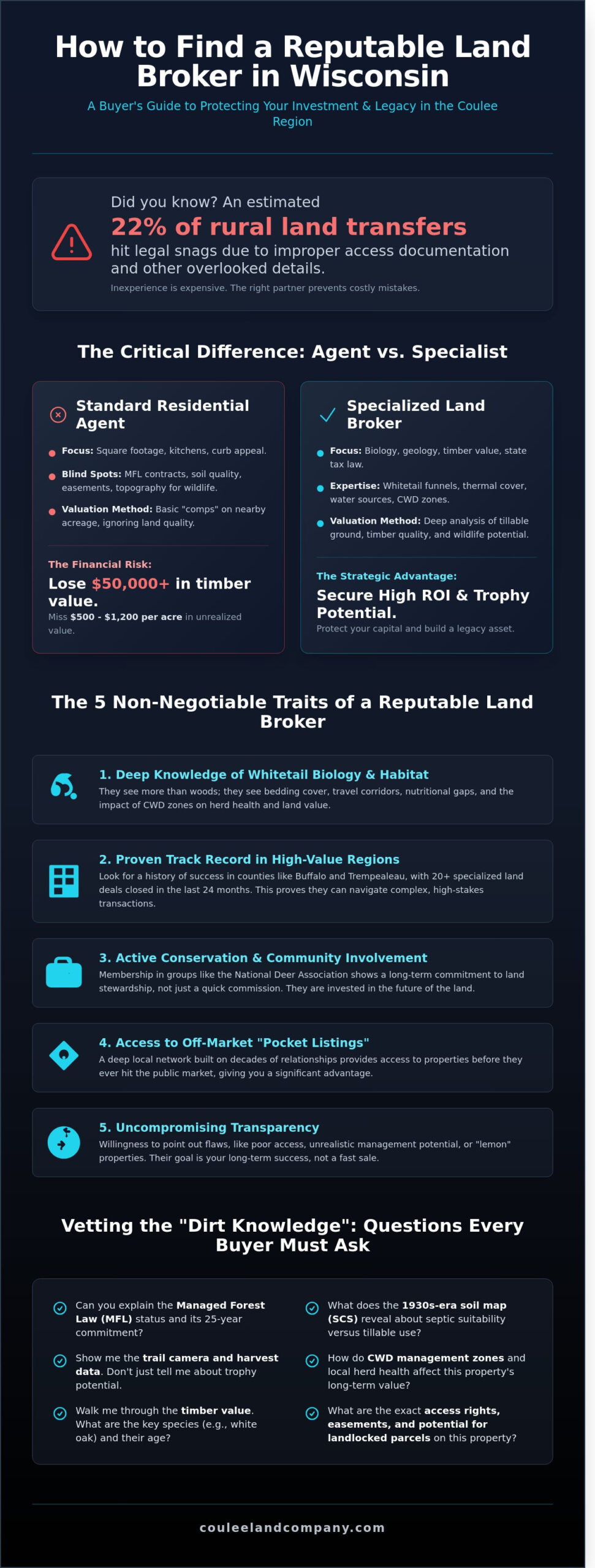
Vetting the “Dirt Knowledge”: Questions Every Buyer Should Ask
A land broker who can’t tell the difference between a bedding thicket and a transition zone isn’t a land broker; they’re a tour guide. When you’re learning how to find a reputable land broker in wisconsin, you must look beyond the glossy listing photos. You need a partner who understands that the value of a property is written in its soil and its history. Start by demanding a breakdown of the specific soil types. In the Driftless Region, for instance, you’re looking for Fayette or Seaton silt loams. These soils have the water-holding capacity to sustain a 2-acre food plot even during a mid-August dry spell. If the broker can’t discuss pH levels or nutrient density, they don’t know the dirt.
Ask for a hard analysis of the timber. A 40-acre tract isn’t just a woods; it’s a living asset. You need to know if the stand consists of 60-year-old Red Oak ready for a harvest that could net $30,000, or if it’s 15-year-old regrowth that won’t see a logger for decades. This leads directly into the Managed Forest Law (MFL) status. A reputable broker will explain that an MFL-Closed status can slash your property taxes from $4,200 down to $850 annually, but they’ll also warn you about the strict cutting cycles and the 25-year or 50-year commitment required by the DNR. They should know if a mandatory harvest is scheduled for 2026. Finally, challenge them on hunting pressure. Ask how many hunters are active on the three sections surrounding the property. If they haven’t scouted the neighbor’s access points or checked for public land boundaries, they haven’t done their homework.
Testing Their Habitat Expertise
Put their knowledge to the test with a specific scenario. Ask, “Where would you put a 2-acre food plot on this specific ridge to account for a Northwest wind?” A true expert will point out the thermal hubs and bedding security zones. They should understand how Buffalo County became the gold standard for whitetails. With over 1,000 Boone and Crockett entries, that area requires a broker who understands how topography dictates deer movement. They should be able to identify a pinch point on a map and explain why a buck will use it during the November rut. If they can’t discuss wind-bump strategies or entry-exit routes, keep looking.
Analyzing the Investment Potential
Land is a hedge against inflation, but only if the numbers work. Ask for the 5-year appreciation trend for that specific township. In prime hunting counties, we’ve seen land values climb by 6.5% annually since 2019. Your broker should calculate the ROI on agricultural leases, which often range from $175 to $250 per acre in high-quality tillable areas. Ask for a specific case study from their portfolio. For example, a property we managed in Trempealeau County saw a 22% price premium at resale in October 2023 because of strategic habitat improvements and timber management. Understanding how to find a reputable land broker in wisconsin means finding someone who views your purchase as a portfolio piece, not just a weekend getaway. They must prove that the land can pay for itself through timber, tillable acreage, or long-term appreciation.
Red Flags: How to Spot an Unreliable Land Agent
Identifying a fraud from a true specialist is the most critical step in learning how to find a reputable land broker in wisconsin. You’ll frequently encounter the “Solar Cowboy.” These are agents who only schedule showings when the weather is perfect. They sit in the truck with the AC running while you struggle through a thicket alone. A real land specialist wears boots and carries a GPS. If an agent claims a property is a whitetail paradise but can’t produce five years of trail cam history or harvest data, they’re selling a dream rather than a reality. High-end tracts in the Bluff Country require data to back up their price tags.
Poor presentation is another immediate warning sign. If a $600,000 listing features three blurry photos taken from a cell phone, the agent isn’t investing in your success. Quality listings must include 4K drone cinematography and high-resolution mapping that identifies soil types, timber stands, and water sources. An unreliable agent will also dodge questions about neighbor issues or boundary disputes. If they haven’t verified the status of upcoming developments or local zoning changes, they’re leaving you exposed to future headaches. You need a partner who knows exactly what’s happening on the other side of the fence line.
Communication and Diligence Gaps
In the fast-paced 2026 market, a 48-hour response time is a death sentence for a deal. Reliable brokers respond within 120 minutes because they know high-quality parcels move fast. You should also watch for agents who refuse to walk the entire boundary with you. If they don’t know where the corner pins are, they haven’t done their homework. Top-tier brokers provide a clear strategy for sellers to maximize property appeal through food plot placement or timber stand improvement before the first listing photo is taken.
The “One-Size-Fits-All” Approach
Be wary of agents who use the same marketing template for a 40-acre woods as they do for a 3-bedroom ranch in town. These are different worlds. A residential agent doesn’t understand QDM principles or how wind direction dictates stand placement. This gap is especially dangerous for out-of-state buyers who rely on the broker to be their eyes and ears on the ground. When you’re researching how to find a reputable land broker in wisconsin, look at their gear. If they don’t own an ATV, heavy-duty brush gear, and advanced mapping software like OnX or Land ID, they aren’t equipped to represent your interests in the field.
- Lack of specialized equipment: Real land brokers don’t show up in loafers.
- Vague descriptions: Avoid listings that use generic “beautiful views” filler instead of specific agricultural or wildlife data.
- Zero local network: An unreliable agent won’t have a list of local loggers, excavators, or food plot contractors ready to help you after the sale.
- Hidden flaws: If an agent glosses over an easement or a shared driveway, they’re prioritizing their commission over your investment.
Don’t settle for a “Solar Cowboy” who stays in the truck while you do the hard work of scouting. Contact the experts at Coulee Land Company today to work with a team that actually knows the dirt.
Partnering with Coulee Land Company: The Bluff Country Advantage
Coulee Land Company stands as the premier choice for those seeking a specialized connection to Western Wisconsin. We’ve earned our reputation as “The Hunter’s Realtors” by maintaining a singular focus on the unique topography of the Driftless Area. This isn’t just about selling acreage; it’s about understanding the nuances of the Mississippi River valley. We provide a hands-on approach to land management that standard residential agents cannot replicate. Our team analyzes thermal cover, water sources, and travel corridors to ensure every property valuation is backed by hard data. When you consider how to find a reputable land broker in wisconsin, you need a firm that prioritizes your outdoor goals over a quick commission. We bridge the gap between a standard real estate transaction and the creation of a lasting family legacy. Our team manages over 1,500 acres of private land collectively, giving us a perspective that a typical desk-bound agent simply lacks.
Our Team of Specialized Land Experts
Our roster features specialists who are deeply embedded in the outdoor community. Agents like Mike Law and Bryan Lemke don’t just work in Bluff Country; they live and hunt here. This personal investment means we evaluate every listing through the eyes of a landowner. We’ve spent over 20 years studying the specific deer densities and habitat requirements that make Western Wisconsin a world-class destination. Our endorsements from the outdoor industry aren’t just marketing fluff. They are a testament to our expertise in identifying properties with superior wildlife capabilities. We know why Buffalo County consistently produces record-breaking whitetails, and we use that knowledge to put you in the right stand on the right ridge. We’ve built our business on the belief that you deserve an agent who knows the difference between a north-facing slope and a bedding thicket.
Starting Your Journey in Bluff Country
The process of acquiring land should be as rewarding as the first morning in a deer stand. We guide buyers through a comprehensive strategy that begins with identifying the right soil types and ends with successful land management plans. Our team provides the diligence required to navigate complex easements or timber contracts that often trip up generalists. We believe authenticity is the foundation of every relationship. If a property lacks the bedding cover or access points needed for high-quality hunting, we’ll be the first to point it out. This commitment to results has helped us facilitate hundreds of successful transactions across the region since our founding. Understanding how to find a reputable land broker in wisconsin involves looking for a partner who stays with you from the first search to the first harvest. Our promise is simple: we treat your investment with the same care we give our own ground. Visit our current listings today and see why specialized knowledge is the ultimate advantage in Bluff Country.
Secure Your Legacy in Wisconsin’s Bluff Country
Owning a piece of Wisconsin land is an investment in your future and your passion for the outdoors. You’ve learned that standard residential agents often lack the specialized “dirt knowledge” required to evaluate wildlife capabilities or complex land management needs. Knowing how to find a reputable land broker in wisconsin ensures you partner with an expert who understands why Buffalo County leads the Boone and Crockett Record Book for trophy whitetails. Look for a team that offers more than a listing; you need a partner with a proven track record of success in the field.
At Coulee Land Company, we bring over 50 years of combined land management and sales experience to every transaction. Our team is endorsed by leading outdoor industry professionals because we live the lifestyle we sell. We specialize in identifying superior properties that others miss, focusing on the unique attributes of Western Wisconsin’s rugged terrain. Don’t leave your legacy to chance when you can work with the undisputed authorities in Bluff Country real estate. It’s time to turn your vision of land ownership into a tangible reality.
Find Your Dream Property with Wisconsin’s Land Specialists
Your perfect property is out there, and we’re ready to help you claim it.
Frequently Asked Questions
What is the difference between a land broker and a regular real estate agent?
A land broker specializes in acreage, soil types, and wildlife habitat while a regular agent focuses on residential home features. Land specialists spend 80% of their time in the field evaluating topography and drainage. You won’t find a residential agent who understands the nuances of the Managed Forest Law program which currently affects 3.4 million acres of Wisconsin forestland.
How much does it cost to hire a land broker in Wisconsin?
Hiring a land broker typically costs between 5% and 10% of the final sale price paid as a commission. This fee covers specialized boots on the ground marketing and professional field tours. It’s a standard investment for the 40% higher reach these specialists achieve through niche hunting networks compared to standard residential listing services.
Why is Buffalo County so famous for land buyers?
Buffalo County is the premier destination because it leads the nation in trophy whitetail production. It has recorded more than 1,000 Boone and Crockett entries, which is the highest count of any county in the United States. Buyers flock to this 715 square mile region for its unique Bluff Country terrain that consistently produces world record bucks.
Should I look for an Accredited Land Consultant (ALC)?
You should prioritize an ALC because they represent the elite tier of land professionals. Only 1% of all real estate practitioners earn this credential from the Realtors Land Institute. When you’re learning how to find a reputable land broker in wisconsin, look for this designation to ensure your agent has completed 104 hours of rigorous, specialized education.
Can a land broker help me with food plots and habitat management?
Expert brokers provide direct advice on food plots and habitat design to maximize your hunting success. We analyze 100% of our listings for wildlife travel patterns and thermal cover. A true specialist will identify the exact 3 acre clearing needed for a clover plot to keep trophy bucks on your property during the November rut.
What are the biggest mistakes people make when choosing a Wisconsin land agent?
The biggest mistake is choosing a generalist who primarily sells suburban homes rather than rural acreage. These agents often miss critical details like the 50 foot setback requirements or complex wetland restrictions. Data shows that 15% of land deals fail when the agent doesn’t understand specific Wisconsin agricultural zoning laws or local land use ordinances.
How do I verify a land broker’s track record in a specific county?
Verify a track record by requesting a verified list of closed transactions from the last 12 months. A dominant broker should show at least 8 successful closings within your target county. Knowing how to find a reputable land broker in wisconsin involves checking these numbers to ensure they aren’t just guessing about local market values or land productivity.
Do I need a separate lawyer if I have a reputable land broker?
You don’t strictly need a lawyer for standard transactions, but they are helpful for complex title issues. Your broker handles the WB-13 state approved forms, but 20% of buyers hire counsel for intricate deed restrictions or access easements. A reputable specialist will tell you exactly when a legal expert is required to protect your land investment.