
What if the standing timber on that Wisconsin 40-acre tract isn’t just a backdrop for your deer stand, but a liquid asset capable of funding the entire land purchase? For many buyers, the biggest fear is overpaying for “scrub” timber while missing out on high-value species hidden in the canopy. You want a property that pays for itself without sacrificing the thick bedding cover your trophy whitetails need. Learning how to evaluate timber value when buying land in wisconsin is the difference between a savvy investment and a costly mistake.
Our regional land specialists know the dirt and the canopy of this state better than anyone else. This 2026 guide teaches you how to identify premium species like Black Walnut, which currently fetches up to $880 per thousand board feet, and White Oak, which sits near $500. We’ll show you how to navigate the June 1, 2026, MFL enrollment deadline and use the Wisconsin Forestry Revitalization Act to your advantage. You’ll discover how to calculate potential harvest revenue while engineering a whitetail sanctuary that balances profit with world-class hunting cover.
Key Takeaways
- Learn how a professional timber cruise identifies high-value species like Black Walnut and White Oak to establish a realistic baseline for your property investment.
- Discover how to evaluate timber value when buying land in wisconsin while protecting the “hunting premium” that standing timber adds to a property’s long-term resale value.
- Master the art of strategic harvesting to transform a standard timber stand into a trophy whitetail sanctuary by creating thick bedding cover and improved travel corridors.
- Understand the importance of hiring an independent consulting forester to obtain an unbiased appraisal and avoid the conflicts of interest common with logging company foresters.
- Find out how to safeguard your capital by incorporating specific timber contingencies into your purchase offer for heavily wooded Wisconsin acreage.
Species, Grade, and Volume: The Core Pillars of Wisconsin Timber Value
Timber isn’t a generic asset that grows uniformly across the landscape. A professional Forest inventory, often called a timber cruise, is your first line of defense against overpaying for a property. This process identifies the specific species, health, and merchantable volume of every harvestable tree on the acreage. Without this data, you’re essentially guessing at the value of a crop that takes decades to mature.
Understanding how to evaluate timber value when buying land in wisconsin requires a grasp of log scaling. Most Midwest mills use the Doyle or Scribner scales to calculate board feet. While the Doyle scale is the regional standard, it often under-represents the volume in smaller diameter trees. This technicality can lead to a hidden surplus of value for a patient landowner who understands how these scales impact the bottom line during a future harvest.
To better understand this concept, watch this helpful video:
High-Value Species in the Wisconsin Bluff Country
In the Driftless Area and Coulee Region, Black Walnut and White Oak are the undisputed heavyweights. As of May 2026, Black Walnut sawlogs are commanding between $490 and $880 per thousand board feet (MBF), while White Oak ranges from $320 to $500 per MBF. The real profit lies in veneer quality logs. These are perfectly straight, large-diameter trees without knots or bird peck. A single veneer-grade walnut can be worth ten times more than a standard sawlog of the same size, making species identification a critical skill for any buyer.
Determining Stand Density and Basal Area
Commercial viability depends on density and accessibility. Professional foresters measure basal area to determine if a stand is overcrowded or ready for a thinning harvest. In the steep terrain of the Wisconsin bluffs, logging costs can fluctuate based on slope and soil stability. If a logger can’t reach a ridge top safely, the “stumpage value” of those trees drops. This is why we prioritize hunting properties that offer a balance of high-quality timber and manageable logging access points.
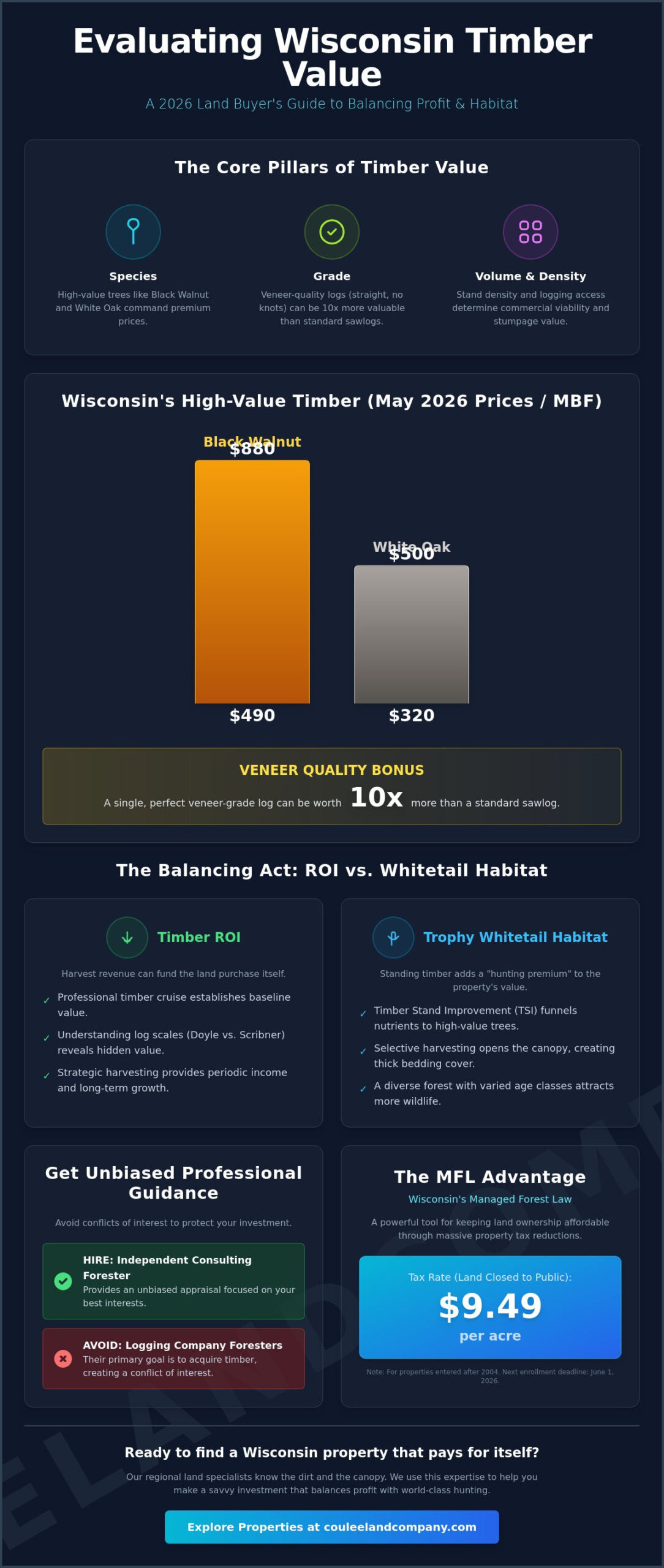
Beyond the Board Foot: Balancing Timber ROI with Trophy Whitetail Habitat
A standing forest often carries a “hunting premium” that far exceeds its raw lumber value at the sawmill. You aren’t just buying board feet; you’re investing in the security and holding power of a mature whitetail sanctuary. When you consider how to evaluate timber value when buying land in wisconsin, it’s vital to analyze how those trees function as habitat. A total clear-cut might provide a one-time windfall, but a strategically managed forest provides a lifetime of trophy opportunities and higher resale appeal.
Timber Stand Improvement (TSI) acts as the bridge between forestry ROI and elite hunting. By selectively removing low-value trees, you redirect the soil’s nutrients into your high-value oaks while creating immediate ground-level forage. This proactive management builds a diversified timber portfolio that grows in value every year. If you’re currently browsing hunting properties, prioritize those with a documented history of thoughtful stewardship.
Creating Bedding Cover Through Selective Harvest
Opening the canopy through selective harvesting is the fastest way to engineer thick bedding cover. When sunlight reaches the forest floor, it triggers a flush of early successional growth like saplings and woody briars. This creates the “edge effect” that big bucks crave. A diverse timber stand with varying age classes will always attract more wildlife than a stagnant, old-growth monoculture that lacks horizontal cover at the deer’s eye level.
The Managed Forest Law (MFL) Advantage
Wisconsin’s Managed Forest Law (MFL) program is a powerful financial tool for keeping land ownership affordable. For properties entered after 2004, the current tax rate for land closed to public access is $9.49 per acre. This represents a massive reduction compared to standard ad valorem property taxes. Over 50,000 Wisconsin landowners use MFL to maintain their woods while keeping annual carrying costs low. If you’re looking at land in a legendary region like Buffalo County, always verify the status of the existing MFL plan. The deadline to submit applications for new 2027 enrollment is June 1, 2026. Always review the mandatory harvest schedule before you close on a deal. You need to know if a required cut will impact your favorite hunting sanctuary in the coming seasons.
Navigating the Timber Appraisal Process During Your Land Purchase
The appraisal process is a race against the clock during your due diligence period. To truly understand how to evaluate timber value when buying land in wisconsin, you must distinguish between a logging company forester and an independent consulting forester. A logger’s forester represents the mill’s interest in securing raw material; an independent consultant represents your financial interest. This distinction is vital for an unbiased inventory. You also need to calculate the “stumpage value,” which is the net profit you receive after logging and hauling costs are subtracted from the delivered mill price. Our expert guide for land buyers provides deeper insights into these financial layers before you sign a purchase agreement.
When the wooded acreage is significant, always incorporate a timber contingency into your offer. This allows you to walk away or renegotiate if the professional cruise reveals the timber isn’t as valuable as the listing suggested. For example, the official DNR stumpage rates for the period ending October 31, 2026, place White Oak logs at $499.62 per thousand board feet (MBF). If a stand is dominated by lower-value species or has poor access, you need that data in hand to justify your offer price.
The 5-Step Timber Due Diligence Checklist
- Initial Walkthrough: Identify “wolf trees” with large, spreading crowns that shade out valuable saplings and spot high-value veneer candidates.
- Forester Consultation: Schedule a professional cruise to get an accurate inventory of species and merchantable volume.
- Market Analysis: Compare the cruise results against 2026 Wisconsin stumpage price reports to ensure regional accuracy.
- Access Evaluation: Determine if logging equipment can reach the timber without destroying critical hunting funnels or creek crossings.
- Final Valuation: Integrate the timber’s liquid value into your overall land offer to ensure you aren’t overpaying for the dirt.
Avoiding Common ‘Timber Cowboy’ Pitfalls
Never sign a timber harvest contract before the deed is officially in your name. Unscrupulous buyers might try to fund their down payment by selling the timber before they even own it, which can lead to legal nightmares. Another danger is “high-grading,” the practice of cutting only the best trees and leaving a mess of genetic “junk” behind. This ruins the long-term property value and destroys whitetail habitat. Connect with a specialist like Mike Law to ensure your timber strategy aligns with your long-term land ownership goals.
Turn Your Timber Into a Strategic Advantage
Owning a piece of the Midwest is about more than just the acreage. It’s about the potential growing within the canopy. By identifying high-value species like Black Walnut and leveraging the MFL program, you transform raw land into a high-performing asset. Mastering how to evaluate timber value when buying land in wisconsin ensures your investment is rooted in hard data rather than guesswork. You don’t have to choose between a profitable harvest and a premier hunting sanctuary when you apply these strategic principles.
Our team specializes in the high-value timber and legendary hunting tracts of Buffalo County. We employ expert agents who possess a deep understanding of both commercial forestry and whitetail biology. This unique expertise is endorsed by top industry figures in land management. We see value where others see only trees. Whether you’re looking to buy or sell, we provide the authoritative guidance needed to navigate the complexities of the 2026 market.
Get a Professional Land Valuation from Coulee Land Company and take the first step toward owning a property that pays for itself. Your dream of owning a world-class outdoor retreat is within reach.
Frequently Asked Questions
How much does a timber appraisal cost in Wisconsin in 2026?
Landowners can expect to pay approximately $500 plus $7 per acre for a new MFL management plan prepared by a Certified Plan Writer. While independent appraisal fees for a private timber cruise vary based on acreage and terrain, this investment is essential for an accurate inventory. Knowing the exact volume of your standing timber before closing protects you from overpaying for the dirt while ignoring the liquid assets above it.
Can the timber value pay for my entire land purchase?
It’s rare for timber to cover the full purchase price, but a high-quality stand can significantly offset your acquisition costs. With Wisconsin forest land averaging $3,668 per acre in 2024, a dense tract of veneer-grade hardwoods represents a massive percentage of the total value. Learning how to evaluate timber value when buying land in wisconsin helps you identify properties where the harvestable logs act as a substantial down payment on the acreage.
What is the difference between saw-timber and pulpwood?
Saw-timber refers to large, straight trees suitable for lumber or veneer, while pulpwood is smaller, low-grade wood used for paper and composite products. The price gap between the two is significant. For instance, White Oak sawlogs currently command up to $500 per thousand board feet, whereas Aspen cord products for pulp are valued at approximately $43.16 per cord. Maximizing your ROI requires a forest dominated by saw-timber sized trees.
Does harvesting timber hurt the deer hunting on my property?
A strategic harvest actually improves whitetail habitat by creating the thick bedding cover and browse that trophy bucks require. Removing selected trees allows sunlight to reach the forest floor, stimulating the growth of early successional plants and woody briars. This “edge effect” provides much-needed security and nutrition. A stagnant, closed-canopy forest often lacks the horizontal cover necessary to hold mature deer on your property throughout the year.
How does the Wisconsin Managed Forest Law (MFL) affect my timber value?
The MFL program increases your net profit by drastically reducing annual property tax carrying costs. For land entered after 2004, the current tax rate for closed acreage is just $9.49 per acre through 2027. This program requires a commitment to a sustainable harvest schedule, ensuring your timber stays healthy and valuable. If you’re looking to enroll for 2027, the deadline to submit your application and management plan is June 1, 2026.
What are the most valuable trees in Western Wisconsin right now?
Black Walnut and White Oak are the undisputed kings of the Western Wisconsin timber market in 2026. Black Walnut is currently fetching between $490 and $880 per thousand board feet, while White Oak ranges from $320 to $500. These species thrive in the Coulee Region’s unique soil, producing the high-grade veneer logs that international buyers crave. Understanding species composition is a fundamental part of how to evaluate timber value when buying land in wisconsin.