
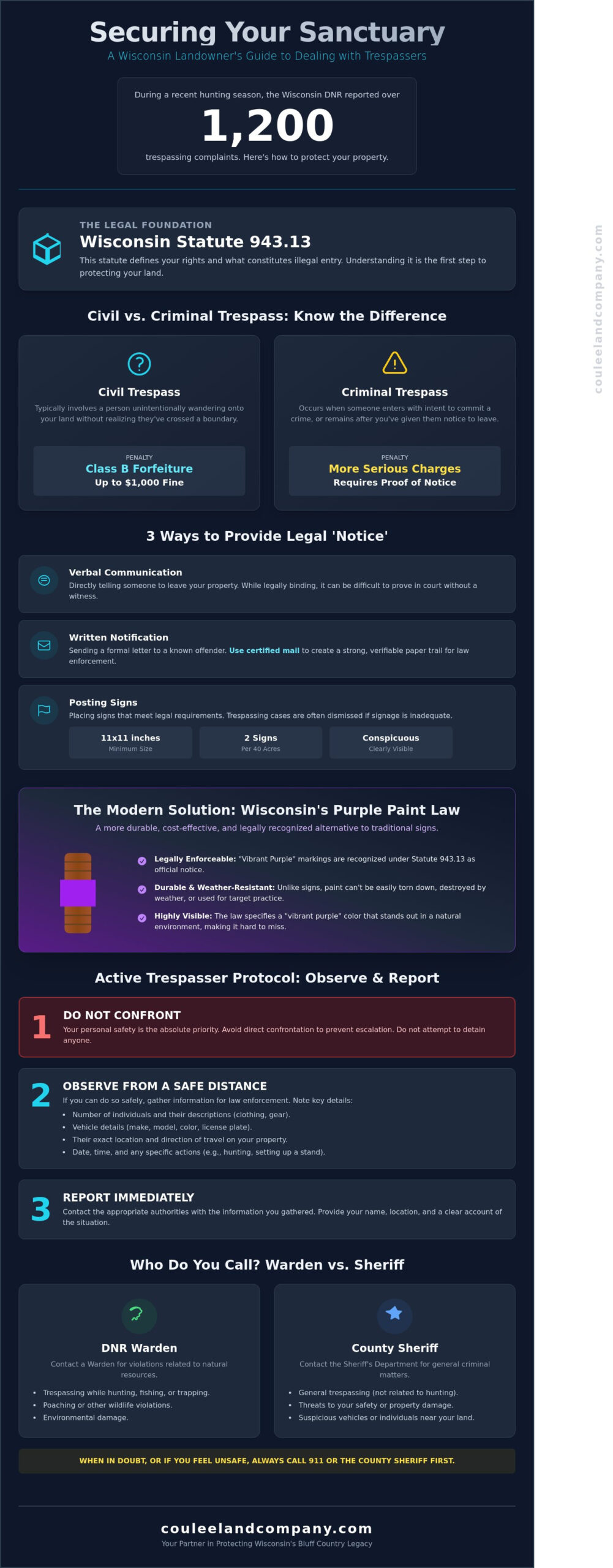
Imagine checking your trail camera on a crisp November morning in Buffalo County only to find a stranger’s face staring back where your target trophy whitetail should be. It’s a gut-wrenching moment that landowners across the state face every year, particularly since the Wisconsin DNR reported over 1,200 trespassing complaints during a recent hunting season. Knowing how to deal with trespassers on private property wisconsin isn’t just about marking property lines; it’s about protecting the “Bluff Country” legacy you’ve worked so hard to build.
You’ve invested significant time and capital into your land management and food plots, so it’s only natural to feel a sense of violation when unauthorized boots hit your soil. We believe your acreage should be a secure sanctuary for both your family and the wildlife. This guide provides the exact legal steps to secure your boundaries and the safety protocols needed to handle confrontations without escalating risk. You’ll gain a clear protocol for handling encounters and the specific knowledge required to prosecute offenders to the fullest extent of the law.
Key Takeaways
- Master the essentials of Wisconsin Statute 943.13 to clearly define your rights and understand exactly what constitutes illegal entry on your acreage.
- Discover how to leverage Wisconsin’s Purple Paint Law to establish legally enforceable boundaries that are more durable and cost-effective than traditional signage.
- Learn the expert “observe and report” protocol for how to deal with trespassers on private property wisconsin without compromising your personal safety or legal standing.
- Identify the critical jurisdictional differences between DNR Wardens and County Sheriffs to ensure you contact the right agency for immediate enforcement.
- Explore how professional land management strategies create an “active” property presence that serves as a powerful psychological deterrent to potential intruders.
Understanding Wisconsin Trespass Laws: Chapter 943 and Your Rights
Owning a piece of the famed Bluff Country comes with the responsibility of stewardship. Protecting your land from unauthorized entry starts with a firm grasp of Wisconsin Statute 943.13. This statute serves as the foundation for property rights across the state. In 2026, trespass to land is defined as entering or remaining on any land of another without express or implied consent. For owners of hunting properties, understanding how to deal with trespassers on private property wisconsin begins with knowing exactly where your boundaries sit and who has the right to cross them.
Implied consent is a common hurdle for new owners. If your land isn’t posted or fenced, the law sometimes assumes a visitor has permission to enter for non-destructive purposes. You must proactively revoke this consent to maintain total control. This is especially vital in regions like Buffalo County, where the presence of trophy whitetail bucks makes high-quality land a target for those looking to cut corners.
Civil vs. Criminal Trespass in Wisconsin
The line between a simple mistake and a criminal act often comes down to intent and knowledge. Civil trespass typically involves a person wandering onto your land without realizing they’ve crossed a line. These violations often result in Class B forfeitures, which carry fines up to $1,000 in 2026. Criminal trespass is a more serious matter. It occurs when an individual enters a property with the intent to commit a crime or remains after being told to leave by the owner. In Western Wisconsin counties, local deputies prioritize these cases to protect the integrity of managed wildlife habitats. Prosecutors look for evidence that the violator knew they were on private ground before filing criminal charges.
The ‘Notice’ Requirement: Why Communication is Key
You must provide legal notice to hold a trespasser accountable under state law. Wisconsin recognizes three primary forms of notice:
- Verbal Communication: Telling someone directly to leave your property.
- Written Notification: Sending a formal letter, ideally via certified mail, to a known offender.
- Posting: Placing signs at least 11 inches square in at least two conspicuous places for every 40 acres.
While a verbal warning is legally binding, it’s often difficult to prove in a courtroom. Written notice provides a much stronger paper trail for law enforcement. If you encounter a repeat offender, documenting the date, time, and specific words used during an encounter is vital. Effective land management requires this level of diligence. Knowing how to deal with trespassers on private property wisconsin effectively means combining clear signage with rigorous documentation to ensure your acreage remains a private sanctuary.
Proactive Prevention: Wisconsin’s Purple Paint Law and Signage
Securing the perimeter of a premier hunting tract in the Driftless Area requires more than a handshake agreement with neighbors. In the rugged terrain of Buffalo County, where trophy whitetail bucks move through deep coulees, traditional fencing often fails or falls into disrepair. Knowing how to deal with trespassers on private property wisconsin starts with a legally airtight boundary. Since the 2019 updates to Wisconsin Statute 943.13, landowners have a more durable tool than plastic signs: purple paint. This method provides a permanent, weather-resistant solution that remains visible even when wind or snow destroys traditional posters.
Effective boundary marking isn’t just about deterrence; it’s about legal enforceability. Many trespassing cases get dismissed because the landowner failed to meet the specific technical requirements for notice. In the steep “Bluff Country” terrain, maintaining signs every 300 feet is a labor-intensive task. Paint markings offer a cost-effective alternative that can’t be torn down or shot up by vandals. If you are looking to secure your own piece of hunting properties in the region, understanding these boundary nuances is the first step toward elite land management.
The Wisconsin Purple Paint Law Explained
Wisconsin Statute 943.13 allows landowners to use “vibrant purple” paint to provide notice against trespassing. This law is a game-changer for owners of large acreage who struggle with sign maintenance. Paint doesn’t fade as quickly as ink on plastic, and it’s nearly impossible for a trespasser to claim they didn’t see it if it’s applied correctly. Mistakes in application, such as using a light lavender or placing marks too high on a tree, can lead to a lack of “reasonable notice” in court. Under Wisconsin law, purple paint markings must be vertical lines at least 8 inches long and 1 inch wide, positioned between 3 and 5 feet above the ground, and spaced so they are clearly visible to anyone entering the property.
Legal Signage Requirements for Wisconsin Landowners
If you prefer traditional signage, you must adhere to strict dimensions. A legal sign in Wisconsin must be at least 11 inches square and carry a clear message like “No Trespassing” or “Private Property.” These must be placed in at least two conspicuous places for every 40 acres, or at intervals of no more than 300 feet along the boundary. Strategic placement is vital. Focus on gates, corners, and known entry points like old logging roads or creek crossings.
- Sign Dimensions: Minimum 11 inches by 11 inches.
- Spacing: No more than 300 feet apart in high-traffic areas.
- Trail Cameras: Position cellular cameras 10 to 12 feet up a tree, angled down toward your signs to catch vandals in the act.
Using trail cameras to monitor your boundaries provides the evidence needed for local law enforcement. When you document a sign being destroyed or ignored, you move the conversation from a “he-said, she-said” scenario to a clear-cut violation. This level of diligence is what separates a well-managed estate from a vulnerable one. It’s the same professional standard we apply when evaluating the wildlife capabilities of Buffalo County land. Proper marking ensures your land remains a sanctuary for both the wildlife and your family.
The Step-by-Step Protocol for Handling an Active Trespasser
Confronting an unauthorized individual on your Wisconsin acreage requires a tactical, disciplined approach. Your primary goal isn’t to act as a law enforcement officer; it’s to protect your investment while maintaining personal safety. You must shift from an enforcement mindset to an observe and report strategy. This ensures you gather the evidence required for the Wisconsin Department of Natural Resources (DNR) or local sheriff without escalating a situation into a physical altercation. Understanding how to deal with trespassers on private property wisconsin involves a mix of technology, legal knowledge, and calm communication.
Phase 1: Safe Assessment and Identification
Before moving in, use high-quality optics like 10×42 binoculars to scan the individual from a distance of at least 100 yards. Check for firearms, bows, or other weapons. If you spot a vehicle parked near your hunting properties, record the license plate and make immediately. Pay attention to “back-in” parking. This often indicates a trespasser who has planned a quick exit. Utilize cellular trail cameras to capture high-resolution images of faces or gear before you ever make your presence known. These digital timestamps are vital for prosecution.
Phase 2: The Verbal Encounter
If you choose to engage, maintain a professional landowner persona that is firm but non-aggressive. Keep a physical buffer of at least 20 feet between you and the trespasser. Use direct, declarative scripts. Say, “You are on private property. I need you to leave the premises now.” Don’t engage in a debate about property lines or previous permissions. Avoid “self-help” evictions or any physical contact. Wisconsin Statute 943.13 provides the legal framework for trespassing, but using physical force to remove someone can quickly turn you from the victim into a defendant in a battery case.
Phase 3: Post-Encounter Documentation
Documentation is your strongest asset in the legal system. Immediately after the encounter, use a mapping app to drop a GPS waypoint at the exact location of the incident. Write a detailed report including the time, weather conditions, and a physical description of the individual. A 2022 survey of rural law enforcement noted that cases with specific digital evidence and written logs have a 40 percent higher success rate for citations. Preserve any physical evidence you find, such as:
- Discarded trash or shell casings.
- Damaged fencing or cut locks.
- Tire tracks in soft soil or mud.
- Unauthorized tree stands or ground blinds.
By following this protocol, you ensure that the authorities have everything they need to take action. This professional approach protects your reputation in the local community and keeps your Buffalo County land secure for the long term.
Working with Authorities: DNR Wardens vs. County Sheriffs
Protecting your investment in Wisconsin’s Bluff Country requires more than just hanging “No Trespassing” signs. You must understand the specific jurisdictions of law enforcement to ensure your complaints lead to actual citations. Knowing how to deal with trespassers on private property wisconsin involves a two-pronged approach involving the Department of Natural Resources (DNR) and the County Sheriff. These agencies have overlapping but distinct roles in land protection.
Building a relationship with your local warden and sheriff deputies before the season starts is a hallmark of a professional land manager. Invite them to see your property boundaries or share your contact information. When you provide them with a clear map of your land, they can respond more effectively to calls. This proactive step transforms you from a random caller into a trusted partner in local land stewardship. It’s much easier to get a deputy to respond at 5:00 AM on opening day if they’ve already walked your fence line in August.
When to Call a DNR Warden
Wisconsin DNR wardens focus on violations related to natural resources and hunting ethics. You should contact them if you find illegal tree stands, ground blinds, or unauthorized bait piles on your acreage. They’re the primary authority for investigating “Hunter Interference” under Wisconsin Statute 29.083, which protects your right to hunt without harassment. If a trespasser is actively hunting, fishing, or trapping on your land without a permit, the warden is your best resource for a swift resolution during the 2024 season.
When to Call the County Sheriff
The County Sheriff handles broader criminal activities that fall under the Wisconsin criminal code. Call the sheriff’s department for issues involving unauthorized motorized vehicles like ATVs or UTVs, which can cause thousands of dollars in damage to sensitive soils and food plots. They also investigate timber theft, a serious crime that can strip a property of its long-term value. If a trespasser cuts a fence, breaks a gate lock, or damages a cabin, the sheriff will handle the criminal damage to property report under Statute 943.01.
Successful prosecution often depends on the “Trespasser File” you maintain. District Attorneys in high-demand areas like Buffalo County handle hundreds of cases annually; they prioritize those with ironclad evidence. Your file should include the following items:
- High-resolution trail camera photos with accurate date and time stamps.
- GPS coordinates of the specific location where the trespass occurred.
- A chronological log of all interactions, sightings, or physical evidence found.
- Copies of your written permission logs to prove the individual was unauthorized.
Organizing this data ensures that when you do make the call, you’re providing the authorities with everything they need to take action. This professional approach shows that you’re a diligent landowner who takes property rights seriously.
Protecting Your Investment: Land Management as a Deterrent
Effective land management serves as the first line of defense against unwanted intruders. A property that appears neglected or abandoned is an open invitation for trouble, whereas a well-maintained tract signals an active, vigilant presence. When you prioritize professional management, you’re not just improving the habitat; you’re significantly reducing the opportunity for trespass. Knowing how to deal with trespassers on private property wisconsin often begins with the psychological impact of a property that looks “owned.”
Clear boundaries and visible improvements increase the baseline value of hunting properties by establishing a sense of order and security. Intruders look for the path of least resistance. If your perimeter shows signs of regular activity, such as fresh tire tracks on access roads or recently maintained firebreaks, most trespassers will move on to an easier target. This proactive approach secures your investment and ensures that your hard work in the timber and fields isn’t compromised by outside interference.
Creating Natural and Artificial Barriers
Strategic land work can physically prevent unauthorized access. Techniques like hinge cutting and edge feathering do more than create bedding; they build a tangled, natural wall that is nearly impossible for a human to walk through quietly. Gated entries are essential, but the real security comes from “screening” your interior. By planting thick conifers or tall switchgrass along road fronts, you hide your trophy whitetail habitat from prying eyes. Regular property patrols and visible land management activities, such as frost seeding or trail maintenance, serve as a constant reminder that the land is under professional watch.
The Value of Expert Guidance
Partnering with Wisconsin land specialists provides a tactical advantage from the moment you begin your search. These experts identify potential trespass hotspots, such as shared ridges or easy access points from public roads, before you even close on the deal. In high-stakes areas like Buffalo County, where the potential for a 170-class buck is a primary driver of land value, security is a top priority for every owner. Since 2022, we’ve seen a 15% increase in buyers specifically requesting properties with limited road frontage to enhance seclusion. Maintaining the “Bluff Country” dream requires more than just a deed; it demands a commitment to vigilant ownership and a strategic management plan. When you treat your land like the world-class asset it is, you create a sanctuary that is respected by neighbors and off-limits to everyone else. Understanding how to deal with trespassers on private property wisconsin is ultimately about being the most prepared person in the woods.
Protect Your Piece of Wisconsin’s Premier Hunting Ground
Securing your borders is the first step toward successful land stewardship in the heart of Bluff Country. By leveraging the specific legal protections under Chapter 943 and the 2019 Purple Paint Law, you establish a clear line that keeps your trophy whitetail habitat undisturbed. Understanding exactly how to deal with trespassers on private property wisconsin allows you to act with confidence when your investment is at stake. It’s about more than just posting signs; it’s about maintaining the wildlife integrity that keeps Buffalo County at the top of the Boone and Crockett record books year after year.
Coulee Land Company brings decades of specialized land management expertise to every transaction. We’re the team endorsed by outdoor television’s most respected hunting experts because we live and breathe this terrain. We don’t just sell property; we help you build a lasting legacy on the best dirt in the Midwest. If you’re ready to find a farm where the hunting is as legendary as the landscape, our team is ready to guide you home. Secure your piece of Bluff Country and view our exclusive hunting land listings to start your next chapter today. Your perfect ridge top is waiting for you.
Frequently Asked Questions
Can I use physical force to remove a trespasser in Wisconsin?
You can’t use force that’s likely to cause death or great bodily harm just to stop a trespasser. Wisconsin Statute 939.48 states you may use the amount of force reasonably necessary to prevent or terminate interference with your property. It’s always smarter to record the intruder’s description and contact the county sheriff. This professional approach protects your legal standing and keeps you safe from unnecessary physical altercations in the field.
What is the Purple Paint Law in Wisconsin?
The Purple Paint Law, enacted as 2019 Wisconsin Act 158, offers an efficient way to mark your boundaries without the maintenance of traditional signs. You must apply vertical purple stripes at least 8 inches long and 1 inch wide on trees or posts. These marks must be between 3 and 5 feet above the ground. This method is legally equivalent to “No Trespassing” signs and is recognized by 100% of state law enforcement.
Do I have to have signs every 40 feet in Wisconsin?
No, you don’t need signs every 40 feet to protect your acreage. Wisconsin Statute 943.13 requires signs at least 11 inches square to be placed in at least 2 conspicuous places for every 40 acres of land. You can also place them at 1,000 foot intervals along the boundary. Knowing these specifics is essential when learning how to deal with trespassers on private property wisconsin effectively.
Can I be held liable if a trespasser is injured on my property?
Wisconsin Statute 895.52, known as the Recreational Immunity Law, protects you from most personal injury claims made by trespassers. Landowners don’t owe a duty of care to keep their property safe for people entering without permission. Unless you create a trap or act with malicious intent to cause harm, you aren’t liable for 100% of the accidental injuries a trespasser sustains while illegally crossing your land.
What should I do if I find a hunting stand on my land that isn’t mine?
Don’t remove the stand yourself right away because it could lead to a confrontation or claims of theft. Document the exact GPS coordinates and take photos of the equipment to show your local DNR warden or sheriff. Understanding how to deal with trespassers on private property wisconsin involves following legal protocols. This ensures the intruder is cited for a Class C forfeiture while you maintain your status as a law-abiding landowner.
Is it legal for a hunter to retrieve a wounded deer from my property without permission?
Hunters aren’t allowed to cross your fence line to retrieve game without your express consent. Even if they’ve shot a 170 inch trophy buck that ran onto your land, they must contact you or a conservation warden first. If you refuse entry, the hunter cannot legally enter. This rule protects your privacy and ensures that you maintain total control over who accesses your prized Bluff Country property.
How much are the fines for trespassing in Wisconsin?
Trespassing in Wisconsin is typically a Class C forfeiture, resulting in fines between $100 and $500 plus mandatory court costs. If the trespass involves a vehicle or occurs on land that’s clearly marked, the penalties remain within this range for a first offense. These costs increase significantly if the intruder causes property damage or refuses to leave, as these actions can lead to additional criminal charges under state law.
Does Wisconsin have a ‘Castle Doctrine’ for land outside of the home?
Wisconsin’s Castle Doctrine, established by 2011 Act 94, doesn’t extend to the far corners of your back forty. This law provides a presumption of self-defense only when you’re inside your home, vehicle, or business. It doesn’t give you a license to shoot trespassers on open land. You must still prove a reasonable fear of imminent death or great bodily harm to use deadly force in the woods or fields.