
Your land is more than just acres on a map; it’s a legacy built on crisp fall mornings, successful hunts, and a deep connection to the outdoors. But when the time comes to consider its future, translating that legacy into a dollar figure is a daunting task. Answering the critical question, how much is my hunting land worth, is the first and most important step, yet the uncertainty of where to even begin can leave you feeling overwhelmed and afraid of undervaluing your investment.
Valuing premier hunting property is a different game than standard real estate. A simple per-acre calculation fails to capture the true essence of its worth, which is forged in the quality of its habitat, the maturity of its timber, and its proven ability to produce and hold trophy-class wildlife. These are the features that serious hunters and land investors are willing to pay a premium for, and understanding them is the key to a successful sale.
As Wisconsin’s Land & Property Sales Specialists, we’ve built our reputation on this exact expertise. This guide will equip you with our insider knowledge, breaking down the key factors-from access and location to specific land improvements and trophy potential-that determine your property’s true market value. You’ll gain a realistic perspective on your land’s worth and the confidence to take the next step toward maximizing your return.
Key Takeaways
- Understand that hunting land is valued as a specialized asset, where simple price-per-acre averages can be highly misleading.
- A property’s true hunting potential is determined by its habitat quality-the critical blend of food, water, and cover-and its location in a proven trophy-producing region.
- Discover how “turnkey” improvements like established trail systems, food plots, and accessible utilities can significantly multiply your property’s market value.
- Answering “how much is my hunting land worth” requires a specialist’s eye, as online estimators cannot accurately assess the unique factors that drive recreational property value.
Beyond ‘Price Per Acre’: The Core Factors of Hunting Land Value
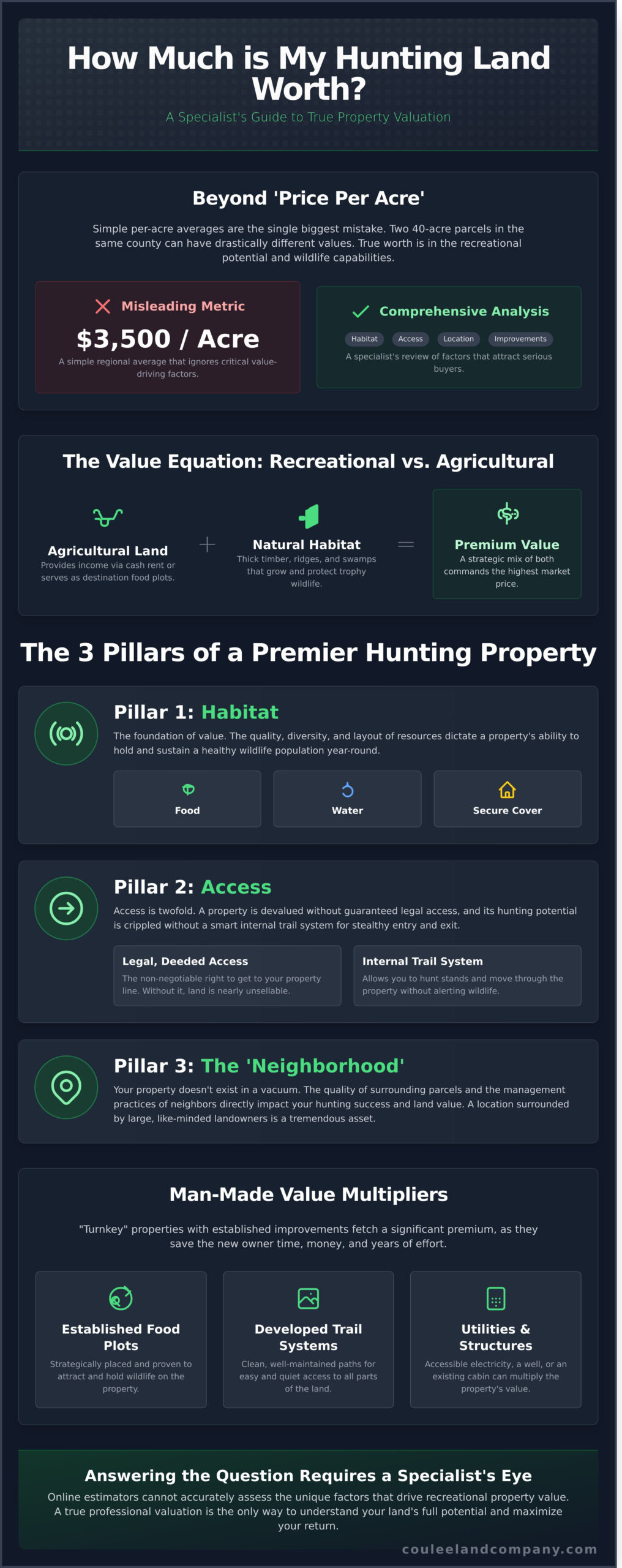
When landowners ask, “how much is my hunting land worth?” the first instinct is often to search for a regional price-per-acre average. This is the single biggest mistake you can make. In reality, a simple average is a deeply misleading metric. Two 40-acre parcels in the same county can have drastically different values because hunting land is a specialized asset, valued far more for its recreational potential and wildlife capabilities than for its soil class alone.
Understanding these critical nuances is the first step in determining your property’s true market value. To explore this concept further, the experts at RecLand Talks offer some excellent insights:
A true valuation requires a comprehensive analysis that looks beyond the surface. This complexity is why a genuine understanding of your land’s worth involves a detailed review similar to a professional valuation process, one that weighs the four foundational pillars of value: Location, Land Quality, Improvements, and the current Market. Each of these pillars is composed of multiple factors that collectively determine a property’s appeal to a serious hunter or land investor.
Recreational vs. Agricultural Value: A Key Distinction
Unlike a straightforward farm tract, premier hunting land value is a delicate balance. Tillable acres are certainly valuable; they can provide annual income through cash rent or serve as destination food plots to hold and pattern mature bucks. However, the true heart of a hunting property lies in what a farmer might deem “unproductive”-the thick timber, steep ridges, and swampy bottoms. This is the cover, the sanctuary, that grows and protects trophy-class animals. A property with a strategic mix of both agricultural and natural habitat often commands a significant premium.
The Three Pillars of a Premier Hunting Property
When we drill down into land quality, three elements stand above all else for creating a superior hunting experience. These are the non-negotiable pillars that every seasoned hunter and land specialist looks for:
- Pillar 1: Habitat. This is the foundation. A property must provide the essential trifecta of food, water, and secure cover. The quality, diversity, and layout of these resources dictate the property’s ability to hold and sustain a healthy wildlife population year-round.
- Pillar 2: Access. Access is twofold. First is legal, deeded access to get to your property line. Second, and equally critical, is the internal access-the trail systems that allow you to enter, exit, and hunt your stands without alerting every deer in the county.
- Pillar 3: The ‘Neighborhood’. Your property doesn’t exist in a vacuum. The quality of the surrounding properties and the management practices of your neighbors have a direct impact on your hunting success and, consequently, your land’s value. A location surrounded by large, like-minded landowners is a tremendous asset.
Location & Neighborhood: The Unchangeable Value Drivers
Of all the factors influencing your land’s value, none is more fundamental than its location. This is the one thing you can never change. The value of a 40-acre parcel can vary by hundreds of thousands of dollars simply by crossing a state or even a county line. While national trends in U.S. farmland values provide a baseline, the true worth of premier hunting ground is dictated by a much more specific set of geographic criteria.
The Power of Reputation: Why a ‘Good Area’ Matters
Hunters are willing to pay a significant premium to own property in an area legendary for producing trophy-class animals. A region’s reputation, built over decades and backed by record-book entries, creates intense buyer demand. Nowhere is this more evident than in Wisconsin’s Bluff Country, where counties like Buffalo County dominate the whitetail entries in the Boone and Crockett records. This prestige is a primary driver when answering the question, “how much is my hunting land worth?” As specialists in the famed Buffalo County, we see firsthand how this world-class reputation translates directly to higher per-acre values.
Proximity to Population Centers and Amenities
While the dream of a remote wilderness tract is appealing, the practical reality for most buyers is convenience. Properties located within a one-to-three-hour drive of a major metropolitan area are highly sought after by “weekend warrior” hunters. This accessibility commands a premium, as buyers are paying to spend more time hunting and less time driving. Furthermore, easy access to a nearby town for fuel, groceries, and supplies adds another layer of practical value that enhances the ownership experience.
The ‘Neighborhood Effect’: Assessing Surrounding Properties
Your property doesn’t exist in a vacuum; its value is heavily influenced by what surrounds it. Consider the following factors:
- Positive Influences: Large, neighboring parcels with limited hunting pressure are a major asset. The ultimate value-add is an area with an active Quality Deer Management Association (QDMA) cooperative, where like-minded landowners work together to grow mature bucks. This creates a wildlife sanctuary that savvy buyers will pay a premium to be part of.
- Negative Influences: Conversely, land adjacent to high-traffic roads, industrial sites, new subdivisions, or properties with heavy, unmanaged hunting pressure can see its value significantly diminished.
The Land Itself: Analyzing Habitat, Topography, and Resources
When you’re trying to determine how much is my hunting land worth, the analysis must begin with the land itself. While location and access are important, the quality of the habitat is the true engine driving a property’s value. An elite hunting parcel is a complete ecosystem, offering wildlife everything they need to not just survive, but thrive. This boils down to three core components: food, water, and cover. A diversity of these resources is far more valuable than a monoculture of mature timber or a single vast field.
Water Sources: The Lifeblood of Your Property
A year-round water source-a flowing creek, river, or spring-fed pond-is a massive value-add. It acts as a magnet for wildlife, especially during dry periods. Secluded ponds or hidden waterholes within timber create natural ambush points for deer and turkeys. Furthermore, properties with significant river or lake frontage often command a premium due to their dual recreational value for fishing and boating, expanding their appeal beyond just the hunting season.
Food: Natural Browse, Mast Crops, and Tillable Land
A superior hunting property offers a diverse menu for wildlife. This includes valuable timber like acorn-producing white and red oaks, hickory, and other mast-producing trees. Crucially, it also includes areas of thick browse found in early successional growth. Any tillable acreage significantly boosts value, providing opportunities for destination food plots or income through cash rent. The type of tillable land matters; as shown in a recent University Extension land value survey, irrigated cropland can be valued significantly higher than non-irrigated pastureland, directly impacting your property’s bottom line.
Cover: Where Wildlife Feels Safe
Cover is the element that makes wildlife feel secure and encourages them to stay on your property. A parcel is far more valuable if it holds animals year-round, and that requires diverse security cover. This includes dense bedding thickets, stands of native warm-season grasses, and sections of thick woods. In northern climates like Wisconsin’s Bluff Country, south-facing slopes are a critical feature, providing essential thermal cover that allows deer to conserve energy during harsh winters.
Topography and ‘Huntability’
Finally, the land’s layout dictates its ‘huntability.’ This is a critical, often overlooked, factor when asking how much is my hunting land worth. Rolling hills, ridges, saddles, and creek bottoms create natural funnels that concentrate wildlife movement. These pinch points make it significantly easier to pattern and effectively hunt mature bucks. A well-laid-out property allows for multiple stand locations to accommodate various wind directions, ensuring you can hunt your best spots under ideal conditions.
Improvements & Access: The Man-Made Value Multipliers
When determining how much is my hunting land worth, the raw acreage and habitat are only the starting point. The man-made improvements and established infrastructure represent a massive investment of time, labor, and capital. These are the elements that transform a good piece of ground into a superior, turnkey hunting property that commands a premium price.
Structures and Utilities: Cabins, Barns, and Power
A property with a livable cabin or house immediately appeals to a much broader audience, including families and recreational buyers. It offers instant usability and comfort. Functional outbuildings like barns and pole sheds for storing tractors, UTVs, and equipment are a significant utility. Furthermore, the presence of established electricity and a drilled well can save a new owner tens of thousands of dollars and months of logistical headaches. These features transform a parcel from simple hunting land into a true country home retreat.
Internal Trail Systems and Entry/Exit Routes
A well-maintained internal trail network is one of the most valuable assets for a serious hunter. A thoughtfully designed system allows for easy travel by truck or UTV, but more importantly, it provides stealthy, low-impact access to treestand and blind locations. Properties with multiple, distinct access points from different roads are especially coveted, as they give a hunter the strategic advantage of being able to hunt any wind direction without disturbing the property.
Guaranteed Legal Access: The Non-Negotiable Factor
This is the single most critical factor in this category. A property without clear, deeded, year-round legal access is severely handicapped in the market. Here’s the bottom line:
- Deeded Access: A legally recorded, permanent right-of-way is required for a property to be financeable by a bank and marketable to serious buyers. It is not optional.
- Informal Easements: A “handshake deal” or a verbal agreement with a neighbor is worthless in a real estate transaction. Landlocked parcels, or those relying on informal access, are worth a fraction of their potential value and are incredibly difficult to sell.
Ultimately, these improvements are a testament to years of thoughtful land management. They represent solved problems and immediate enjoyment for the next owner, which is a powerful driver of value when you ask, “how much is my hunting land worth?” An expert land specialist can help you quantify the value of these crucial assets.
The Final Step: How to Get a True Professional Valuation
You’ve walked the property lines, considered the timber value, and analyzed the habitat. You understand that the true worth of your land is a complex blend of location, access, wildlife potential, and market demand. But turning those factors into a precise dollar figure is the most critical step. A professional valuation isn’t just a suggestion; it’s an essential final action before you list your property, ensuring you don’t leave money on the table.
Why Generic Online Estimators Fall Short for Hunting Land
Automated online estimators are fundamentally flawed for valuing recreational properties. Their algorithms can’t see the difference between a fallow field and a strategically placed food plot, nor can they identify a natural deer funnel or a south-facing slope that provides crucial winter bedding. These tools rely on generic, often outdated sales data from residential or agricultural transactions, completely missing the premium that passionate hunters will pay for superior habitat and trophy potential.
The Land Specialist Advantage: Boots-on-the-Ground Expertise
A true land specialist understands what makes a property exceptional because they are hunters themselves. Unlike a generic realtor, a specialist walks the land with a trained eye, identifying the subtle features that create immense value for a buyer: pinch points, travel corridors, water sources, and stand locations. They don’t rely on public data; they maintain an active database of comparable hunting property sales (“comps”) and understand the specific desires of the recreational land buyer. This deep, boots-on-the-ground knowledge is the only way to get a definitive answer to the question, “how much is my hunting land worth?” This unmatched expertise is central to our process; you can read about our approach for sellers to learn how we translate these unique features into maximum value for you.
What to Expect from a Professional Property Assessment
Getting a professional valuation is a straightforward, transparent process designed to give you clarity and confidence. It is the only reliable way to determine your hunting land’s worth in today’s market. The process typically includes:
- An Initial Conversation: We start by listening to you. We’ll discuss your property’s history, your management efforts, and your financial goals for the sale.
- A Thorough Property Walk-Through: Our specialists will personally tour your land to assess its habitat, timber, access points, and overall hunting quality firsthand.
- A Detailed Market Analysis: You will receive a comprehensive report and a suggested listing price backed by relevant, recent sales of comparable hunting properties in your area.
When you’re ready to take the final step, trust the specialists at Coulee Land Company to reveal the true market value of your property.
Unlock Your Property’s Full Potential: The Final Word on Value
Determining the true value of your hunting land is far more than a simple price-per-acre calculation. As we’ve explored, its worth is a complex tapestry woven from its specific location, the quality of its wildlife habitat, and the strategic value of its access and improvements. Answering the critical question, how much is my hunting land worth, requires a specialist’s eye-one that sees beyond the survey lines to the potential for trophy whitetails and family legacy.
While this guide provides a solid foundation, nothing replaces on-the-ground expertise from a team that lives and breathes this land. With decades of experience in hunting and recreational properties, Coulee Land Company has a proven track record of maximizing value for landowners. As the premier specialists in Wisconsin’s famed ‘Bluff Country,’ we understand what makes a property truly exceptional. Request a Free, No-Obligation Property Valuation from Our Land Specialists today to gain clarity and confidence in your asset.
Let us help you understand the complete picture of your investment and achieve its maximum potential.
Frequently Asked Questions About Hunting Land Valuation
Does having a lot of road frontage increase my land’s value?
Absolutely. Extensive road frontage is a significant value driver for hunting land. It provides superior, year-round access for hunting, bringing in equipment, and future land management projects. For a potential buyer, this ease of access is a major selling point. Furthermore, significant frontage can offer future subdivision potential, adding a layer of investment value beyond its immediate recreational use, which can substantially increase the property’s overall market price and appeal.
How much value do established food plots really add to a property?
Established food plots add immense value by creating a “turnkey” hunting property that attracts serious buyers. These individuals are looking for land with proven wildlife capabilities and are willing to pay a premium to avoid years of foundational work. A well-designed food plot system demonstrates thoughtful land stewardship and directly contributes to holding and growing trophy whitetail bucks, a primary objective for buyers in Wisconsin’s famed Bluff Country and beyond.
Will a recent timber harvest on my property hurt its value?
A recent timber harvest can impact value, but it isn’t always negative. A poorly executed, high-grade harvest can temporarily decrease aesthetic and timber value. However, a professionally managed harvest designed to improve forest health and create elite wildlife habitat-like thick bedding cover and new browse-can actually enhance the property’s long-term hunting appeal. The key is how the harvest was conducted and its role in the land’s overall management plan.
Is my land worth more if it’s enrolled in a government program like CRP or MFL?
Enrollment in programs like the Conservation Reserve Program (CRP) or Managed Forest Law (MFL) almost always increases your land’s value. These programs provide guaranteed annual income and often include significant property tax reductions, which are powerful selling points. This reliable revenue stream and lower holding cost make the property a more attractive and affordable investment, directly contributing to a higher valuation when you’re determining how much is my hunting land worth.
How do current market conditions and interest rates affect my land’s value?
Current market conditions are a critical factor in your land’s valuation. High demand for premier recreational properties, like we often see in Western Wisconsin, can drive prices up. Conversely, rising interest rates can temper the market by increasing the cost of financing for potential buyers. This can reduce the pool of qualified buyers and put downward pressure on prices, making timing the sale a key strategic consideration for maximizing your property’s return.
What documents should I have ready for a property valuation?
To get an accurate answer to how much is my hunting land worth, it’s best to have key documents ready. This includes your most recent property tax bill, a survey or plat map, and the property deed. You should also gather any documentation related to timber cruises, government program contracts (CRP, MFL), and records of land improvements like new trails, ponds, or established food plots. This information provides a complete picture of the property’s assets.