
What if the thickest cover on your back forty is actually the primary reason your trail cameras have gone quiet? You’ve likely noticed those impenetrable green walls of common buckthorn choking out your woodlots, making it nearly impossible to walk to your stand or see more than twenty yards. Understanding how buckthorn affects wisconsin deer hunting is the first step toward restoring a property that actually holds big woods whitetails.
It’s frustrating to watch your native oak regeneration vanish as this restricted invasive species creates a biological desert where acorns and nutritious browse used to thrive. You want a legacy property that produces results, not a tangled thicket that drives deer to the neighbor’s corn. This guide provides the professional strategies you need to reclaim your habitat, from mechanical forestry mulching to targeted chemical control. We will show you how to transform a tangled mess back into a high-value landscape with clear shooting lanes and the mast-producing trees that define Wisconsin’s legendary Bluff Country.
Key Takeaways
- Identify how common and glossy buckthorn outcompete native flora to destroy the mast-producing habitat required for high-quality deer woods.
- Gain insights into how buckthorn affects wisconsin deer hunting by creating walls of green that compromise shooting lanes and disrupt natural deer movement.
- Master professional treatment techniques like the basal bark method to effectively kill root systems and prevent the spread of this restricted invasive species.
- Learn why a multi-year management plan is essential for restoring native browse and increasing the long-term trophy potential of your Wisconsin acreage.
The Silent Habitat Killer: Why Buckthorn Degrades Wisconsin Deer Woods
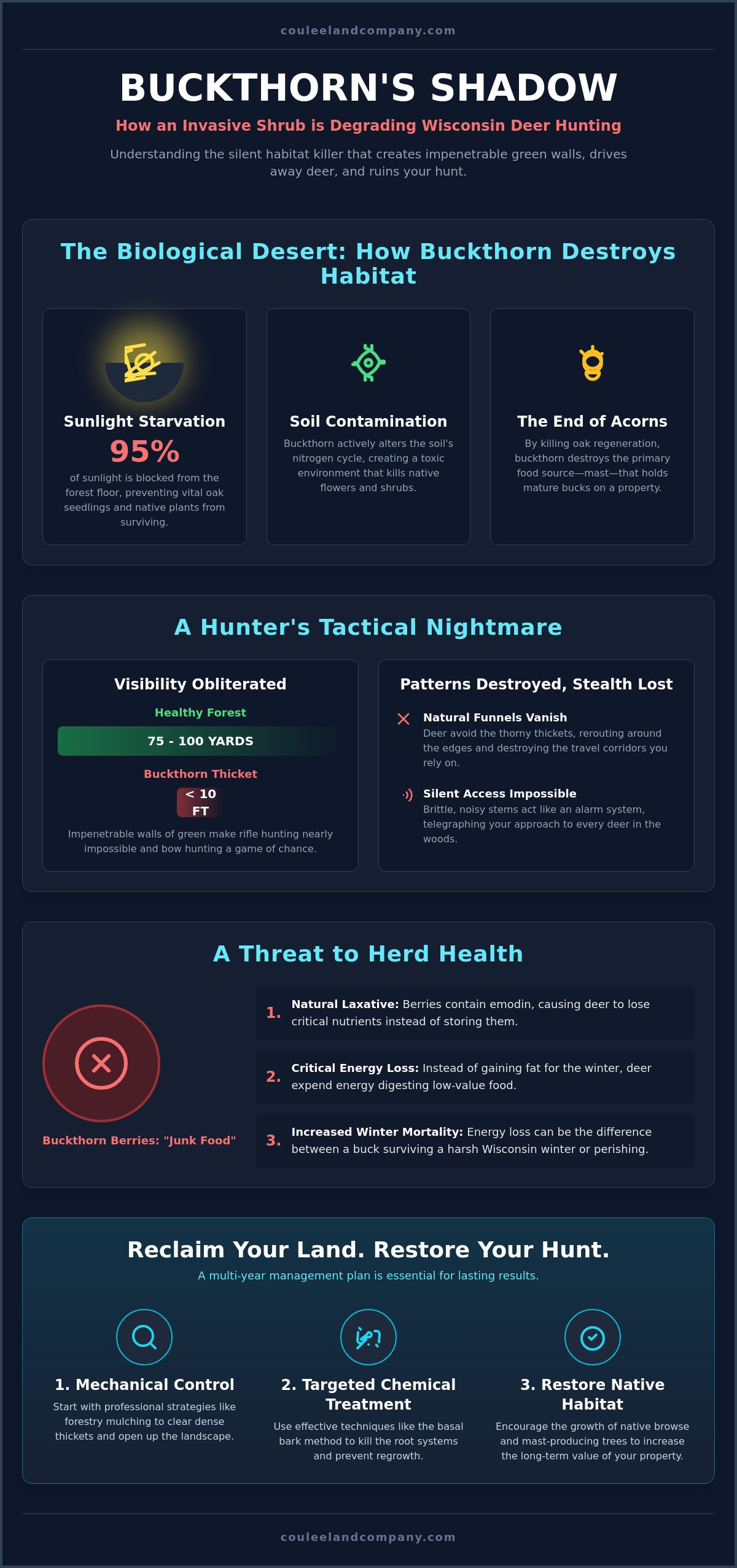
Most landowners see a wall of green in the spring and assume it’s a sign of a healthy forest. That is a dangerous misconception. Common buckthorn (Rhamnus cathartica) and its cousin, glossy buckthorn, are aggressive invaders that leaf out weeks before our native hardwoods and hold their foliage well into November. This extended growing season gives them an unfair advantage, allowing them to monopolize sunlight and moisture before a single white oak bud has even opened. Understanding how buckthorn affects wisconsin deer hunting requires looking past the thick foliage to see the biological desert forming underneath.
These plants don’t just shade out the competition; they actively poison the ground. Buckthorn alters the nitrogen cycle in the soil, creating a high-nitrogen environment that native woodland flowers and shrubs can’t handle. This shift favors even more invasive species, effectively erasing the diverse browse that mature bucks need to thrive. When the native forage disappears, the deer follow, moving to neighboring properties that offer better nutrition.
To better understand how these invasive thickets impact your property’s potential, watch this helpful video:
The impact on herd health is equally devastating. While deer will eat buckthorn berries when other food is scarce, they’re essentially junk food with a nasty side effect. The berries contain emodin, a natural laxative. Instead of gaining fat for the winter, deer lose critical energy and nutrients through increased digestion rates. This energy loss is often the difference between a buck surviving a harsh Wisconsin winter or succumbing to the elements.
The Death of the Oak Savanna
In the world of Wisconsin land management for wildlife, oak regeneration is the gold standard for trophy potential. A single mature white oak can drop enough mast to anchor a buck’s home range for the entire month of October. However, buckthorn thickets are so dense they can block up to 95% of the sunlight from reaching the forest floor. Without that light, oak seedlings simply cannot survive. When your old-growth oaks eventually die off, there’s nothing but a wall of buckthorn waiting to take their place, permanently destroying the property’s ability to produce the acorns that drive whitetail movement.
Hunting the Thicket: How Buckthorn Ruins Visibility and Deer Patterns
A woodlot choked with buckthorn is a tactical nightmare for any serious whitetail hunter. In a healthy Wisconsin forest, a hunter can often see 75 to 100 yards through the understory, allowing for early detection and clean shot opportunities. Buckthorn changes the math entirely. It creates a literal wall of green that reduces visibility to 10 feet or less. This dense growth makes rifle hunting nearly impossible and turns bow hunting into a game of luck rather than skill. You can’t hunt what you can’t see, and buckthorn ensures you won’t see much at all.
Mature bucks are creatures of efficiency and edge. They rarely choose to fight through the center of a thorny, impenetrable buckthorn thicket if they don’t have to. Instead, they tend to skirt the edges of these monocultures, moving toward more navigable native cover. This shift in behavior ruins the natural funnels and pinch points you’ve spent years scouting. When buckthorn fills every gap in the woods, the distinct travel corridors that hunters rely on to pattern deer simply vanish into a featureless blob of invasive brush.
Accessing your stand silently becomes another casualty of this invasion. Buckthorn stems are notoriously brittle and noisy. Trying to sneak through a thicket in the pre-dawn hours is like walking on a bed of dry potato chips. Observing the signs of deer’s impacts on a forest often reveals that whitetails avoid browsing buckthorn, which allows the shrub to grow into a dense, noisy barrier that telegraphs a hunter’s approach. If you can’t reach your stand without snapping branches, the hunt is over before it begins.
Visibility vs. Security Cover
There is a massive difference between high-quality security cover and an invasive mess. Native species like grey dogwood or young cedar provide thermal protection and legitimate browse. Buckthorn provides neither. While buckthorn looks like bedding, its lack of thermal value and digestible browse creates a false security that eventually displaces deer to neighboring hunting properties with superior native cover. Understanding how buckthorn affects wisconsin deer hunting is vital for anyone looking to maintain a high-value, huntable landscape in the Bluff Country.
Reclaiming Your Land: Management Strategies for Better Hunting
Removing invasive species is not a one-time event; it is a strategic mission to restore the legacy of your woods. Many landowners make the mistake of simply cutting stems, only to find that the root systems respond with vigorous, multi-stemmed regrowth that is even harder to manage. To truly address how buckthorn affects wisconsin deer hunting, you must implement a professional-grade eradication plan that kills the plant at its source. This involves a combination of mechanical removal and targeted chemical application to ensure the “wall of green” doesn’t return next season.
The most effective methods for Wisconsin woodlots are the basal bark and cut-stump treatments. Basal bark treatment involves applying an oil-based herbicide, such as triclopyr, directly to the lower 12 to 15 inches of the standing stem. This is particularly effective during the late fall and winter months when native plants are dormant but buckthorn is still active. If you choose to cut the brush to clear space immediately, you must apply herbicide to the stump within minutes to prevent resprouting. Left unchecked, these infestations will continue to destroy wildlife habitat by choking out the thermal cover and native browse that trophy bucks require.
The 3-Step Eradication Framework
- Step 1: Identify Mother Trees. Locate the largest, berry-producing female trees. Eliminating these first cuts off the seed supply and slows the spread across your acreage.
- Step 2: Apply Professional Herbicide. Use a specialized product like Garlon 4 Ultra to treat stems or stumps. This ensures a total kill of the root system, which is the only way to stop the cycle of infestation.
- Step 3: Fill the Void. Once the canopy opens up, you must re-seed with native grasses or establish strategic food plots. If you leave the ground bare, the buckthorn seed bank will simply sprout again.
Long-Term Property Value
Landowners who take a proactive stance against invasive species often see a significant return on investment. Because of how buckthorn affects wisconsin deer hunting by degrading the natural environment, properties that have been professionally managed command a higher price in the Buffalo County market. Buyers look for turnkey hunting tracts where the hard work of habitat restoration and Timber Stand Improvement (TSI) is already underway. Before you list, it’s wise to consult with Wisconsin land specialists to assess your habitat health and ensure your property reflects its true trophy potential.
Reclaiming the Legacy of Your Wisconsin Woodlot
Restoring your land from an invasive thicket to a thriving ecosystem is the most impactful investment you can make as a sportsman. By removing the impenetrable understory, you aren’t just clearing a path to your stand; you’re allowing the next generation of mast-producing oaks to flourish. This restoration directly counters how buckthorn affects wisconsin deer hunting by bringing back the natural funnels and high-quality browse that hold mature bucks on your side of the fence.
Success in the field begins with superior stewardship. We specialize in the legendary Bluff Country of Buffalo County, and our team of expert brokers understands that a property’s true value lies in its habitat health. We combine professional real estate expertise with a deep knowledge of land management to help you find or create a world-class hunting tract. Looking for land with trophy potential? View our exclusive Wisconsin hunting listings today.
Your woods have the potential to be a whitetail sanctuary once again. Take the first step toward reclamation and enjoy the rewards of a healthy, productive forest for seasons to come.
Frequently Asked Questions
Does buckthorn provide any benefit to deer at all?
Buckthorn offers almost zero nutritional benefit and actually harms deer health through the laxative properties found in its berries. While the dense growth might seem like security cover, it’s a poor trade-off for the loss of native dogwood, cedar, and oak seedlings. Mature bucks prefer the high-quality thermal protection and diverse browse provided by native habitats over the biological monocultures that invasive species create.
When is the best time of year to kill buckthorn in Wisconsin?
Late fall and early winter are the most effective times to target this invasive because it remains green and active long after native plants have gone dormant. This timing allows you to easily identify the stems while minimizing the risk of herbicide overspray hitting your desirable hardwoods. Treating the wood during the cold months ensures the chemical is pulled deep into the root system as the plant prepares for winter dormancy.
Can I just use a brush hog to clear out buckthorn thickets?
Using a brush hog without immediate follow-up chemical treatment usually makes the infestation much worse. Cutting triggers a vigorous sprouting response from the root collar, often resulting in half a dozen new stems for every one you cut. If you use mechanical clearing, you must apply a professional-grade herbicide to the stumps within minutes to ensure the plant is fully eradicated and won’t return even thicker.
Will killing buckthorn improve my property’s resale value?
Eliminating invasive species significantly increases the marketability and value of your land in regions like Buffalo County. Savvy buyers and hunting land investors look for properties with healthy oak regeneration and clear visibility rather than overgrown, impenetrable thickets. Understanding how buckthorn affects wisconsin deer hunting allows you to present a property that is hunt-ready and biologically productive, which commands a premium price in the legendary Bluff Country market.