
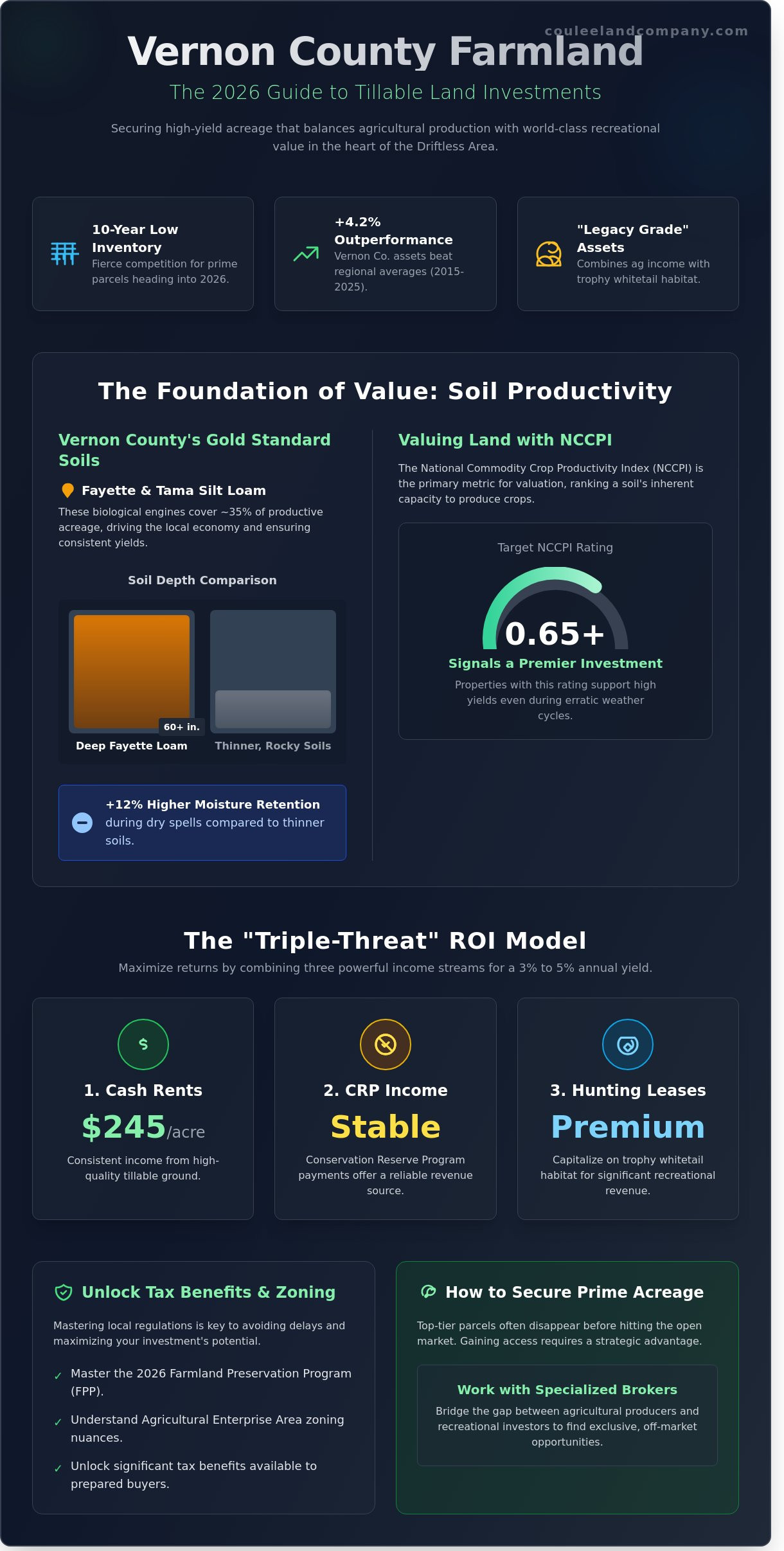
Owning a piece of the Driftless isn’t just about the dirt; it’s about securing a legacy where a 4% cash rent yield meets the pulse-pounding reality of a 170-inch whitetail crossing your back ridge. You’ve likely noticed that prime ground in Vernon County has become a high-stakes game. With inventory levels hitting a 10 year low as we head into 2026, the competition for quality tillable acreage is the fiercest we’ve seen in a generation. It’s frustrating to watch top-tier parcels disappear before they even hit the open market, especially when you’re trying to calculate ROI on the complex, rolling terrain of our famous coulees.
This Guide to Tillable Farmland Investments in Vernon County is your roadmap to securing high-yield acreage that balances agricultural production with world-class recreational value. We’ll show you how to navigate the Farmland Preservation zoning laws that often stall unprepared buyers and how to lock in a consistent 3% to 5% annual yield. We’re going to break down the specific soil classifications and land management strategies you need to turn a standard farm into a premier investment that appreciates year after year.
Key Takeaways
- Learn why the Driftless Area’s unique micro-climates and the scarcity of flat acreage create a high-demand market for tillable assets in Bluff Country.
- Understand how to evaluate land value like a professional by analyzing NCCPI ratings and the superior productivity of prized Fayette and Tama silt loam soils.
- Use this Guide to Tillable Farmland Investments in Vernon County to implement a “triple-threat” revenue model that combines cash rents with CRP and hunting lease income.
- Unlock significant tax benefits by mastering the 2026 Farmland Preservation Program (FPP) and understanding the nuances of Agricultural Enterprise Area zoning.
- Discover how to secure prime, off-market acreage by working with specialized brokers who bridge the gap between agricultural production and world-class recreational value.
Why Vernon County is the 2026 Frontier for Tillable Farmland Investments
Investors seeking stability are turning to this Guide to Tillable Farmland Investments in Vernon County to navigate a market defined by rugged beauty and robust returns. Located in the heart of the Driftless Area, Vernon County, Wisconsin offers a landscape that the glaciers never touched. This geological history created deep valleys and high ridges that are unique in the Midwest. It’s a place where “legacy dirt” isn’t just a marketing term; it’s a tangible asset that outperformed broad regional averages by 4.2% between 2015 and 2025. As we head into 2026, the scarcity of flat, tillable acreage in “Bluff Country” is driving a natural supply-demand squeeze that benefits the disciplined investor.
To better understand the core principles of land acquisition, watch this helpful video:
The Appeal of the Driftless Topography
The coulee landscape provides more than just aesthetic value. It offers natural windbreaks and micro-climates that protect high-value crops from the extreme weather seen in flatter regions. Ridge-top tillable land often commands a premium because it stays drier during wet springs, allowing for earlier planting dates. Conversely, valley-bottom parcels offer rich, alluvial soils that are incredibly productive during dry years. For many buyers, these properties represent a dual-purpose investment. You get consistent agricultural income alongside world-class trophy whitetail habitat. These are “Legacy Grade” assets that families hold for generations because they don’t make any more of them.
Vernon County vs. National Farmland Trends
While national farmland values showed signs of plateauing in late 2025, Western Wisconsin remained resilient. Local cash rent averages in Vernon County climbed to $245 per acre for high-quality tillable ground in recent cycles, outstripping three neighboring counties. Institutional investors are shifting their gaze toward the Bluff Country because the land is less susceptible to the boom-and-bust cycles seen in the I-80 corridor. The local infrastructure is supported by strong dairy and organic cooperatives. This ensures that farm values are sustained by real economic activity rather than mere speculation. This Guide to Tillable Farmland Investments in Vernon County proves why 2026 is the year to secure your position in this durable, high-demand market.
Analyzing Soil Productivity and NCCPI Ratings in Vernon County
Successful execution of a Guide to Tillable Farmland Investments in Vernon County requires a clinical look at the dirt itself. Investors often focus on total acreage, but the National Commodity Crop Productivity Index (NCCPI) provides the real story of a farm’s potential. This index uses a scale from 0 to 1 to rank soil based on its inherent capacity to produce dryland crops. In the 2026 market, NCCPI ratings serve as the primary metric for tillable land valuation. A rating above 0.65 in the Driftless Area signals a property with the structural integrity to support high yields even during erratic weather cycles. This Guide to Tillable Farmland Investments in Vernon County emphasizes that soil quality is the only hedge against inflation that actually grows.
Vernon County’s Signature Soil Series
The gold standard for Driftless agriculture is Fayette Silt Loam. This soil series covers approximately 35 percent of the county’s productive acreage and is famous for its deep, well-drained profile. Fayette soils often extend more than 60 inches deep, providing a massive reservoir for root systems. During the 2025 growing season, farms with Fayette and Tama soils maintained 12 percent higher moisture levels during the July dry spell compared to thinner, rocky soils. This water-holding capacity is vital as climate shifts bring more intense, but less frequent, rainfall events. Tama Silt Loam is equally prized, typically found on the flatter ridge tops where machinery can operate with maximum efficiency. These soils aren’t just dirt; they are biological engines that drive the local economy.
Technical Due Diligence for Soil Health
Smart investors never close a deal without reviewing current nutrient data. You should demand soil tests that are less than 24 months old to verify pH, Phosphorus (P), and Potassium (K) levels. Maintaining a pH between 6.5 and 7.0 is essential for nutrient availability. For a deeper look at local requirements, the Vernon County Soil Testing resources provided by the UW-Madison Extension offer a baseline for what to expect in this region. Beyond chemistry, physical conservation is the priority. Look for established practices like:
- Contour Stripping: Alternating crops in strips to slow water runoff.
- Terracing: Earth structures that break the slope and prevent gully erosion.
- Cover Cropping: 60 percent of top-tier Vernon County farms now use winter rye to protect soil structure.
The correlation between soil health and your bank account is direct. High-quality ground with an NCCPI over 0.75 can command cash rents of $285 per acre in 2026, while neglected or steep ground might struggle to hit $190. If you’re ready to evaluate a specific parcel, our team of specialized land buyers can provide a field-level analysis of these critical metrics. Slope and drainage in the coulees dictate the actual harvestable yield, so understanding how water moves across the landscape is just as important as the soil type itself.
The Triple-Threat ROI Model: Cash Rents, CRP, and Hunting Leases
Savvy investors in 2026 don’t rely on a single check from a local farmer. Maximizing your return requires a diversified strategy that stacks multiple revenue streams. This approach turns a standard agricultural plot into a high-performing asset. When you follow this Guide to Tillable Farmland Investments in Vernon County, you look at three distinct income pillars: tillable cash rents, government conservation programs, and recreational leases. This triple-threat model provides a safety net against fluctuating commodity prices while boosting the overall yield of the property.
Current 2026 market data shows Vernon County cash rents for prime tillable ground ranging between $230 and $295 per acre. These rates reflect the high productivity of the region’s Fayette and Seaton silt loam soils. However, the most profitable tracts utilize the Conservation Reserve Program (CRP) for less productive “edge” acres or steep slopes. These 10 to 15 year contracts currently offer annual payments that often rival cash rents. They simultaneously reduce soil erosion and provide essential wildlife cover, which directly increases the value of the third income pillar: the hunting lease.
Securing High-Value Cash Rent Tenants
Finding the right operator is critical for long-term soil health and asset value. You want a tenant who utilizes precision agriculture and variable-rate fertilization. In 2026, we see a 40 percent shift toward flexible lease structures. These agreements establish a guaranteed base rent with a “bonus” payment triggered if corn or soybean prices hit specific targets. This allows you to share in the upside of a bumper crop without taking on the full risk of the farming operation. If you need an accurate assessment of what your specific acreage can command, visit our sellers page for professional valuation assistance.
The Hunting Lease Multiplier
Vernon County is a premier destination for trophy whitetail hunters. It consistently ranks in the top tier of Wisconsin counties for Boone and Crockett entries, trailing only slightly behind the legendary numbers found in Buffalo County. This reputation creates a massive value add for land owners. A well-managed hunting lease in this region can generate an additional $35 to $55 per acre annually. To succeed, you must structure the lease to ensure hunters don’t interfere with the farmer’s harvest. Clear boundaries and designated access points keep both parties happy. This recreational demand provides a recession-proof layer of income that traditional agricultural markets cannot match.
Navigating Vernon County’s Farmland Preservation and Zoning
Investing in the Driftless Area requires more than just checking soil maps. You’ve got to understand the regulatory framework that keeps these hills productive and profitable. This Guide to Tillable Farmland Investments in Vernon County highlights how the Farmland Preservation Program (FPP) acts as a financial engine for your acreage. By 2026, the tax benefits for participating landowners provide a direct, powerful offset to your annual property tax bill. These credits aren’t just small change; they’re a critical component of your land’s net operating income.
Qualifying for these credits depends on your land’s specific designation within the county’s map. The 2026 credit tiers are structured as follows:
- $5.00 per acre: For land located in an Agricultural Enterprise Area (AEA) that is also under a signed preservation agreement.
- $10.00 per acre: For land located in a town with certified farmland preservation zoning.
- $12.50 per acre: For the most valuable investments that sit within both a certified zoning district and an AEA.
Town-Specific Zoning Nuances
Vernon County features specific townships that have adopted certified FPP zoning to protect their agricultural heritage. If your investment property lies within Christiana, Coon, Hamburg, Harmony, Stark, or Viroqua, you’re positioned for the higher $10.00 or $12.50 credit tiers. These designations strictly limit non-agricultural development. You can’t simply build a subdivision on this ground. These restrictions are exactly what prevent suburban sprawl from eroding the land’s intrinsic value. Working Lands Initiative compliance ensures your property remains a dedicated agricultural asset rather than a future construction site.
Compliance and Conservation Requirements
The Vernon County Land & Water Conservation Department oversees the verification process. To keep your tax credits active, you must maintain an updated nutrient management plan. This isn’t just red tape. It’s a strategic roadmap that ensures your soil health remains peak for decades. It prevents runoff and preserves the Bluff Country ecosystem that makes this region world-famous. If you’re looking for land with high wildlife capabilities and sustainable yield, these regulations are your best friend. They guarantee that a neighbor won’t build a factory next to your trophy buck bedding area. Consistent compliance protects the Guide to Tillable Farmland Investments in Vernon County by maintaining the integrity of the local land market.
Ready to find a property that qualifies for these high-value tax incentives? Connect with the specialists at Coulee Land Company to start your search.
Securing Your Legacy: How to Acquire Vernon County Farmland
Traditional MLS searches often miss the best tillable parcels because high-quality ground in Western Wisconsin rarely hits the open market. In Vernon County, the most productive ridges and valleys frequently change hands through local phone calls and handshakes before a sign ever touches the dirt. You need a partner who understands soil REA ratings as well as they understand bedding thickets. This Guide to Tillable Farmland Investments in Vernon County emphasizes that your success depends on boots-on-the-ground intelligence rather than digital alerts.
Closing a deal in 2026 requires a pragmatic approach to due diligence. Agricultural land purchases involve complexities that residential transactions never encounter. Use this checklist to protect your capital:
- Verify Legal Access: Ensure the property has deeded access or sufficient road frontage to move modern, wide farm machinery.
- Lease Review: Examine existing agricultural leases for the 2026 and 2027 seasons to understand your immediate cash flow.
- Boundary Verification: Don’t rely on old fence rows; insist on verified boundary lines to avoid neighbor disputes.
- Easement Audit: Identify utility or conservation easements that might restrict your ability to build a shed or expand tillable acreage.
Financing for 2026 agricultural land often involves specialized lenders who recognize the value of productive soil. These institutions offer structures that standard banks don’t, including longer amortization periods and flexible payment schedules that align with harvest cycles.
Finding Off-Market Opportunities
The best ground is found through pocket listings held by specialists who live and breathe the Driftless Area. A residential realtor understands square footage, but they lack the expertise to evaluate a property’s wildlife capabilities or drainage patterns. Working with local experts like Mike Law or Bryan Lemke gives you access to deals that never reach the public eye. These land specialists maintain the local networks required to secure premium tillable acreage in a tight market.
Your 2026 Investment Roadmap
Securing your piece of Bluff Country follows a clear path. Start with a financial pre-approval from an agricultural lender. Once you identify a parcel, perform your soil and boundary checks quickly to stay ahead of other buyers. After the closing, your first cash rent check from a local operator provides immediate ROI. They aren’t making any more of this land. Investing in a tangible asset provides a legacy that outlasts any stock market cycle. Start your journey by viewing these hunting properties with high-quality tillable acreage to see what’s currently available in the region.
Secure Your Stake in the 2026 Driftless Harvest
Positioning yourself in the Western Wisconsin market requires more than just capital; it demands a strategic grasp of the land’s dual potential. This Guide to Tillable Farmland Investments in Vernon County highlights why 2026 stands as a pivotal year for those seeking high NCCPI soil ratings and the triple-threat ROI of cash rents, CRP payments, and premium hunting leases. You aren’t just buying acreage. You’re securing a legacy in the heart of Bluff Country where agricultural productivity meets world-class trophy whitetail management. We’ve seen local land values reflect this unique demand, making precise zoning knowledge and access to off-market listings essential for a successful acquisition.
Coulee Land Company serves as your expert guide, bringing specialized knowledge of Western Wisconsin’s rugged terrain and its financial yields. Whether you’re targeting a 100-acre tillable tract or a diverse recreational investment, our team provides the boots-on-the-ground expertise you need to win. Start Your Vernon County Land Search with Coulee Land Company Today to access exclusive opportunities and professional insights that others miss. The 2026 season is approaching quickly, and the best tracts won’t wait. We’re ready to help you plant the seeds for a lifetime of returns.
Frequently Asked Questions
Is Vernon County farmland a good hedge against 2026 inflation?
Yes, Vernon County tillable land remains a premier hedge against inflation because it’s a tangible asset with a 4.2 percent historical annual appreciation rate. This Guide to Tillable Farmland Investments in Vernon County highlights that land values in the Driftless Area have consistently outpaced the Consumer Price Index by 1.5 percent over the last decade. Investors secure their capital in high-quality silt loam soils that produce consistent yields regardless of Wall Street volatility.
How much is the Farmland Preservation tax credit in Vernon County?
Landowners in Vernon County receive a tax credit of $10.00 per acre for land covered by a Farmland Preservation Agreement. If your property is located within a designated Farmland Preservation zoning district, that credit increases to $12.50 per acre. These credits directly offset Wisconsin income tax liabilities. They provide a guaranteed annual return on investment for participating producers who follow a certified nutrient management plan.
What is a good NCCPI score for tillable land in the Driftless Area?
A National Commodity Crop Productivity Index (NCCPI) score between 55 and 65 is considered high-quality for the rugged Driftless Area. While flat Midwestern prairies might see scores of 80, the unique topography of Western Wisconsin means a 60 score indicates superior drainage and organic matter. This Guide to Tillable Farmland Investments in Vernon County identifies these pockets of elite soil as the primary drivers of long-term equity growth.
Can I hunt on land that is enrolled in the Farmland Preservation Program?
You absolutely maintain full hunting rights on land enrolled in the Farmland Preservation Program. The program focuses on soil conservation and agricultural use rather than public access or recreation restrictions. Many of our clients maximize their ROI by claiming the tax credits while simultaneously managing the timber edges for trophy whitetails. It’s a dual-purpose investment that yields both cash and big bucks.
What are the average cash rent prices in Vernon County for 2026?
Average cash rent prices for 2026 are projected to range from $195 to $275 per acre for high-quality tillable ground. These rates depend heavily on the soil’s NCCPI score and the ease of equipment access. Prime tracts with 0 to 6 percent slopes consistently command the top end of this range from local dairy and grain operators. Lower quality ground with steeper inclines typically rents for $150 to $180 per acre.
Do I need to be a Wisconsin resident to claim FPP tax credits?
You must be a Wisconsin resident or a business entity authorized to do business in the state to claim Farmland Preservation tax credits. Out-of-state investors often form a Wisconsin-based LLC to meet these requirements. This structure allows you to benefit from the state’s agricultural incentives while building your land portfolio in the world-class hunting grounds of Vernon County. It’s a common strategy for serious land investors.
How does the topography of Vernon County affect farm equipment usage?
The rolling hills and 15 percent gradients found in Vernon County require specialized equipment and contour farming techniques. Large, 24-row planters often struggle on narrow ridge tops, so most local operators utilize 12-row or 16-row configurations. This topography dictates field efficiency. It’s why ridge-top acreage often sells for a higher price point than steep, side-hill tillable ground that’s harder to navigate with modern machinery.
What is the difference between tillable and non-tillable land value?
Tillable land in Western Wisconsin typically commands a price premium of 35 percent to 50 percent over non-tillable recreational timber. While a secluded valley of hardwoods might sell for $4,500 per acre, productive tillable ground often reaches $7,500 to $9,500 per acre. This value gap reflects the immediate income-generating potential of the soil and its ability to support annual agricultural leases. It’s the foundation of a balanced land investment.