
What if the real value of a Minnesota field isn’t measured by this year’s bushel count, but by the total absence of synthetic chemicals over the last 1,095 days? You’ve likely realized that finding land that’s truly ready for sustainable production is harder than just checking a map. The 36 month USDA transition period represents a massive financial hurdle, and the constant threat of pesticide drift from a neighbor’s conventional corn can ruin a certification in a single afternoon. This Guide to Organic Farming Land in Minnesota: Sustainable Options and Agent Insights provides the professional clarity you need to secure a property that actually meets your standards.
We understand that soil health history is your most vital asset, not just a line item on a ledger. We’ll show you how to identify properties with established buffer zones and how to leverage Minnesota Department of Agriculture incentives like the Organic Certification Cost Share Program. You’ll learn the exact steps to evaluate soil quality and navigate the brokerage process with the confidence of an expert land manager. We’re going to break down the transition requirements and show you how to protect your investment from day one.
Key Takeaways
- Learn how to identify “organic-ready” properties that meet the three-year substance-free standard, positioning your operation in one of the nation’s premier agricultural hubs.
- Discover how to move beyond basic soil testing to evaluate the microbial life and organic matter essential for long-term sustainable success.
- This Guide to Organic Farming Land in Minnesota: Sustainable Options and Agent Insights details why physical buffer zones are the ultimate defense for your certified acreage.
- Uncover specialized financial tools like the AgBMP Loan Program designed to offset the costs of transitioning to organic systems and water quality equipment.
- Understand the value of partnering with a land specialist who can identify “highest and best use” to ensure your sustainable investment yields superior long-term results.
Understanding the Minnesota Organic Land Market in 2026
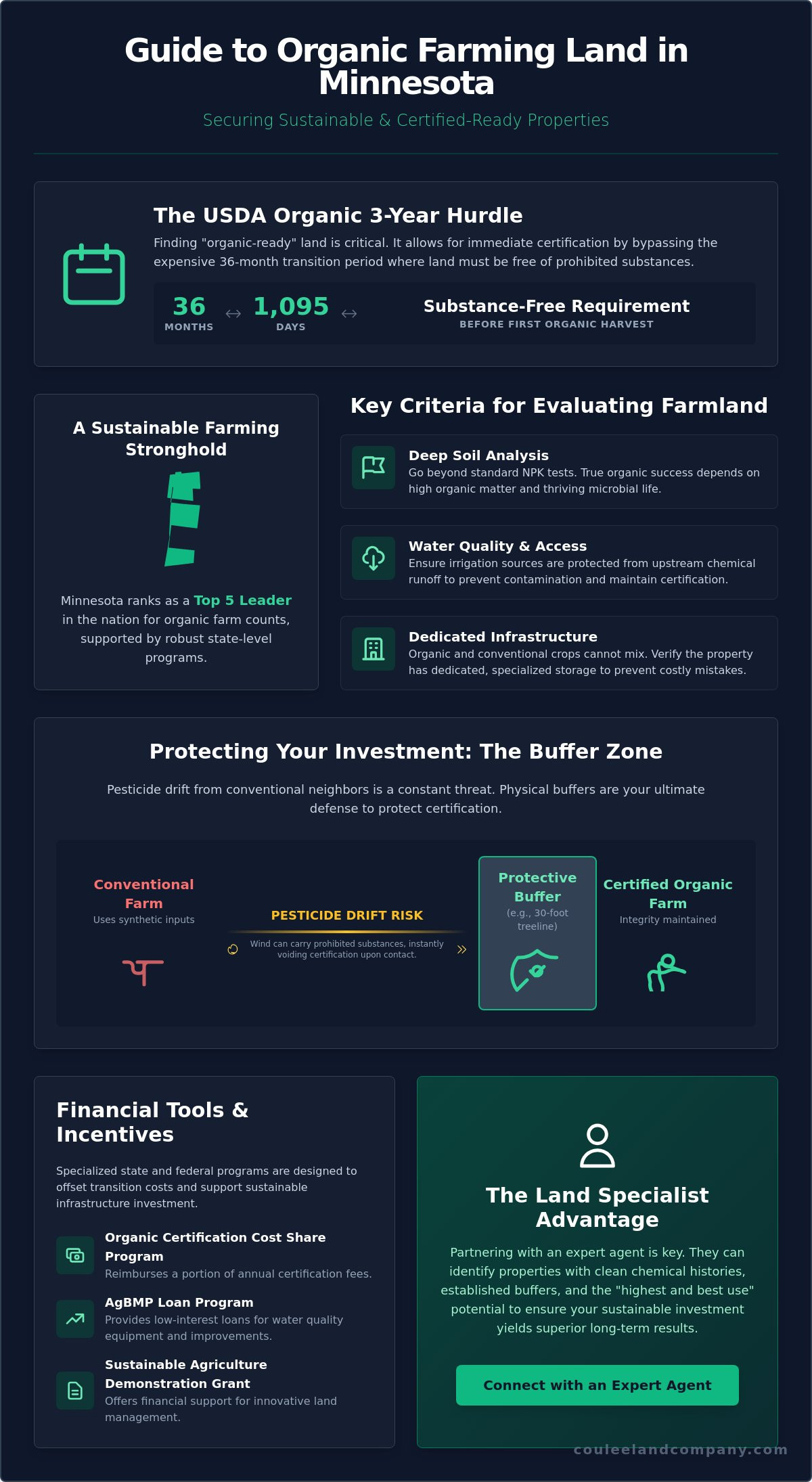
Minnesota’s agricultural landscape is shifting toward high-value sustainability. As of 2026, the state holds its position as a top-five leader in organic farm counts, a ranking established by the 2022 USDA Census of Agriculture. Buyers searching for organic-ready land prioritize properties that haven’t seen prohibited substances for at least 36 months. This status is a gold standard in rural real estate because it allows for immediate certification. This Guide to Organic Farming Land in Minnesota: Sustainable Options and Agent Insights helps you identify tracts that bypass the expensive three-year transition period.
Land already certified or nearing the end of its transition often commands a premium in the 2026 market. This price difference reflects the immediate earning potential and the avoidance of the transition period hurdle. During those three years, farmers often face higher labor costs and lower yields without the benefit of organic price premiums. Savvy investors look for land with documented chemical histories to secure these high-value assets early.
To better understand the fundamentals of this market, watch this helpful video:
The USDA National Organic Program (NOP) Basics
Certification hinges on a mandatory 36-month window between the last application of prohibited substances and the first organic harvest. Common inputs like synthetic fertilizers, most pesticides, and sewage sludge reset this clock instantly. Successful buyers study the principles of organic farming to ensure their land management strategy aligns with federal law. Understanding these regulations is vital for maintaining the integrity of your investment from day one.
Why Minnesota is a Sustainable Farming Stronghold
The Minnesota Department of Agriculture (MDA) provides robust support through cost-share programs that reimburse a portion of annual certification fees. This state-level infrastructure supports a diverse range of production, from organic corn and soybeans to specialty cold-hardy fruits. Our team at Coulee Land Company understands how these factors impact land value and long-term viability. If you’re ready to explore these opportunities, our agents like Mike Law provide the expertise needed to evaluate soil health and historical land use records.
Key Criteria for Evaluating Sustainable Farmland in Minnesota
Identifying the right property for a sustainable operation requires a specialized eye for detail. This Guide to Organic Farming Land in Minnesota: Sustainable Options and Agent Insights focuses on long-term viability rather than just immediate acreage. Successful organic farming starts with the dirt, but it doesn’t end there. You must evaluate the entire ecosystem of the property to ensure it meets strict certification standards.
Standard NPK tests don’t provide the full picture for regenerative systems. You need to analyze microbial life and organic matter percentages to gauge true soil vitality. Healthy soil acts as a living engine that supports superior crop yields without synthetic inputs. Beyond the soil, water quality is a non-negotiable factor. You must ensure irrigation sources are shielded from upstream chemical runoff, as 2023 state water reports indicate increasing pressure on shared watersheds. Additionally, organic production requires dedicated, specialized storage. Mixing organic grains with conventional stock is a costly mistake that voids certification instantly. The Minnesota Department of Agriculture provides Minnesota sustainable agriculture grants to assist with these infrastructure needs, offering financial support for innovative land management.
Analyzing Neighboring Land Use and Drift Risks
Neighboring activities dictate your daily operations and certification safety. Use tools like Driftwatch to map conventional spraying schedules within a 1.5-mile radius of your borders. In the Coulee region, natural windbreaks and high ridges provide excellent topographical barriers against pesticide drift. Physical buffers, such as a 30-foot wide strip of non-crop vegetation, are often mandatory to separate your fields from conventional neighbors. If you’re looking for land with these natural protections, our buyers’ services can help identify high-ridge parcels that offer built-in security.
Soil Mapping and Historic Usage Records
Verifying at least 3 years of field history is the top priority during your due diligence process. You need documented proof that no prohibited substances were applied during this window to achieve full organic status. Transition-ready land is a property with 1-2 years of verified chemical-free history. This history ensures you aren’t fighting residual toxins from previous industrial farming practices. This Guide to Organic Farming Land in Minnesota: Sustainable Options and Agent Insights helps you spot these opportunities before they hit the open market, saving you years of waiting for certification.
Navigating the Purchase: MN Grants and Specialist Insights
Securing acreage for sustainable use requires a sharp eye for both soil quality and financial strategy. The Minnesota Agriculture Best Management Practices (AgBMP) Loan Program serves as a vital tool, offering low-interest loans to fund equipment that protects water quality or facilitates the organic transition. This Guide to Organic Farming Land in Minnesota: Sustainable Options and Agent Insights emphasizes that your success hinges on leveraging these state-level resources effectively from the start.
Minnesota-Specific Financial Incentives
The Minnesota Department of Agriculture (MDA) provides the Organic Transition Grant to help farmers manage the costs of certification. This program typically reimburses 75% of transition-related expenses, up to a maximum of $750 annually. For those just starting out, the Aggie Bond Loan program offers a path to lower interest rates on land purchases. These incentives reduce the financial burden during the mandatory three-year transition period when crops can’t yet be sold at organic premiums.
The Land Specialist Advantage
A standard residential agent often overlooks the complexities of rural land, such as soil drainage or chemical history. You need a partner who understands the highest and best use of a property. Our team, including specialists like Mike Law or Bryan Lemke, brings deep expertise in rural Minnesota territory. They help buyers identify parcels with diverse potential, ranging from agricultural property sales to world-class hunting grounds. If you’re looking to liquidate assets to fund your new venture, check out our resource on selling hunting land in Wisconsin to maximize your return.
When you structure an offer on land in transition, clarity is everything. Include specific contingencies for historical pesticide use records and current soil health benchmarks. You aren’t just buying dirt; you’re buying a biological timeline. Working with a dedicated land specialist ensures these details are baked into the contract, protecting your investment. This Guide to Organic Farming Land in Minnesota: Sustainable Options and Agent Insights serves as your roadmap for turning a vision of sustainable land ownership into a profitable reality.
Cultivate Your Future in Minnesota’s Organic Landscape
Securing high-quality acreage requires a deep understanding of the 2026 market shifts and the technical nuances of soil health. This Guide to Organic Farming Land in Minnesota: Sustainable Options and Agent Insights highlights how modern buyers prioritize properties with high NRCS soil productivity ratings and established conservation easements. You’ve learned how the Minnesota Department of Agriculture (MDA) provides essential grant funding to offset transition costs, making sustainable stewardship more accessible than ever. We bring specialized expertise in Upper Midwest land brokerage and a proven track record in rural residential and agricultural sales to every transaction. Our team understands soil capabilities and land management because we live and work in this terrain every day.
Success in rural real estate comes down to having a partner who knows the land’s wildlife capabilities and its true market value. We’re ready to help you find a property that meets your rigorous standards for sustainability and production. View our current Minnesota agricultural and hunting land listings to find your perfect plot. Your vision for a sustainable legacy starts with the right piece of Minnesota ground.
Frequently Asked Questions
What is the most important factor when buying land for organic farming in Minnesota?
The most critical factor is the land’s chemical history because the USDA requires a 36-month period free of prohibited substances before certification. You’ll want to verify the drainage patterns and soil health metrics; productive Minnesota soils often require specific management to maintain high yields. Our Guide to Organic Farming Land in Minnesota: Sustainable Options and Agent Insights emphasizes that securing land with a documented clean history saves you three years of waiting.
Can I get a grant to help with the organic transition in MN?
You can access financial assistance through the Minnesota Department of Agriculture’s Organic Transition Cost Share Program, which historically reimbursed 75 percent of transition costs. The USDA NRCS also offers the Environmental Quality Incentives Program (EQIP) Organic Initiative to provide technical and financial help. These programs are vital for managing the initial costs of cover cropping and soil amendments while your land matures into full organic status.
How do I protect my organic land from pesticide drift from neighbors?
Establishing a minimum 30-foot vegetative buffer zone is the primary defense against chemical drift from neighboring conventional farms. You should also register your property with the FieldCheck or DriftWatch registry, which alerts pesticide applicators to your organic status. This proactive land management strategy ensures your soil remains untainted and your certification stays intact during the critical growing seasons.
Is certified organic land a better investment than conventional farmland in 2026?
Certified organic land is projected to be a superior investment in 2026 as consumer demand for sustainable products continues to outpace conventional supply. Data from the USDA’s Economic Research Service shows that organic premiums often range from 50 to 100 percent above conventional prices for corn and soybeans. This Guide to Organic Farming Land in Minnesota: Sustainable Options and Agent Insights highlights how these higher margins create a resilient asset for any serious land investor.