
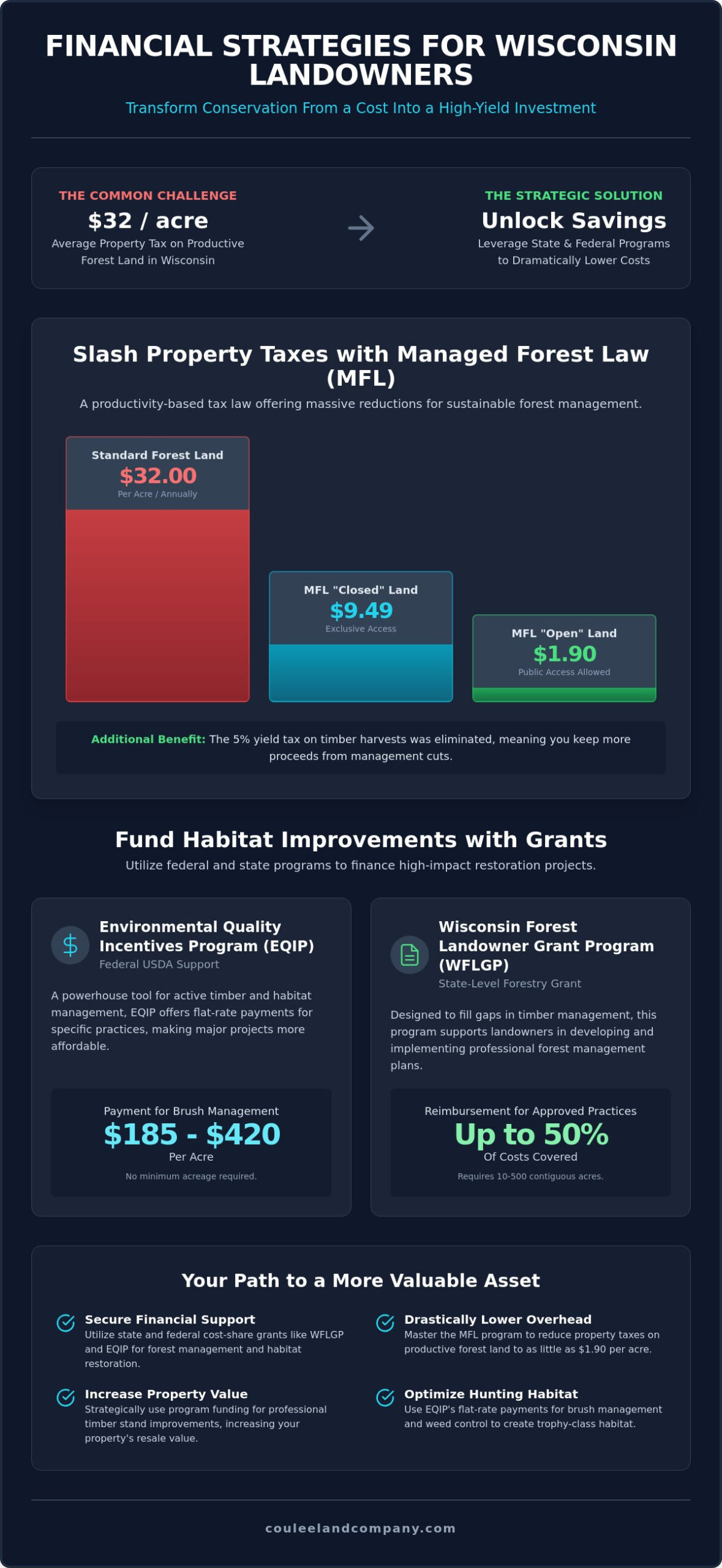
Most Wisconsin landowners are essentially leaving money on the table because they view conservation as a chore rather than a high-yield investment. While the average property tax for productive forest land in our state sits at $32 per acre, savvy hunters and stewards are using government programs for landowners in wisconsin to slash those costs and reinvest the savings into trophy-class habitat. You’ve likely felt the sting of rising taxes or the sticker shock of timber stand improvements; it’s a common frustration for those of us dedicated to the Northwoods and the Driftless Area.
It’s time to change that narrative and transform your property into a more valuable asset. This guide reveals how to leverage specific state and federal assistance to enhance your property value while ensuring your land pays for itself through strategic enrollment. We’ll break down the 2026 Managed Forest Law rates, explore EQIP flat-rate payments for brush management, and provide the latest updates on the Knowles-Nelson Stewardship Fund to help you maximize every acre you own.
Key Takeaways
- Secure significant financial support for forest management and habitat restoration by utilizing state-level cost-share grants like the WFLGP.
- Drastically lower your overhead by mastering the Managed Forest Law (MFL) program, which can reduce property taxes for productive forest land to as little as $9.49 per acre.
- Discover how to strategically use government programs for landowners in wisconsin to fund professional timber stand improvements and increase your property’s resale value.
- Ensure a seamless land transfer by learning the essential steps for due diligence and contract assignment during a real estate transaction.
- Optimize your hunting habitat with federal EQIP funding that offers flat-rate payments for brush management and weed control without a minimum acreage requirement.
Essential Financial Assistance Programs for Wisconsin Acreage
Owning a legacy property in the Driftless Area or the Northwoods is a pinnacle achievement for any sportsman, yet the overhead of proper stewardship can be a heavy lift. Strategic use of government programs for landowners in wisconsin transforms these costs into manageable investments. By leveraging federal and state dollars, you can implement high-impact habitat projects that would otherwise be cost-prohibitive. These initiatives don’t just subsidize your hobby; they build tangible equity in your dirt and ensure your acreage reaches its full potential.
Federal USDA Support: CRP and EQIP
Federal programs through the USDA provide the heavy lifting for major restoration projects. The Conservation Reserve Program (CRP) remains a cornerstone for soil health, offering annual rental payments in exchange for establishing long-term wildlife cover on sensitive lands. For those focused on active timber and habitat management, the Environmental Quality Incentives Program (EQIP) is a powerhouse tool. Unlike traditional cost-shares, EQIP uses flat-rate payments for specific practices. In 2026, Wisconsin landowners can see payments ranging from $185 to $420 per acre for brush management. This funding is essential for clearing invasive species or performing forest thinning to improve your hunting properties and foster healthy oak regeneration.
State-Level Forestry Grants: WFLGP
At the state level, the Wisconsin Forest Landowner Grant Program (WFLGP) fills the gaps in timber management. To qualify, you must own at least 10 contiguous acres of non-industrial forest but no more than 500 acres statewide. This program is designed to reimburse up to 50% of the costs for approved practices, including the development of a mandatory forest management plan. Having a certified plan is the first step toward professional timber stand improvement. It ensures your tree planting or thinning efforts follow sound silvicultural principles, ultimately maximizing the long-term health and timber value of your Wisconsin acreage. These government programs for landowners in wisconsin are the most effective way to offset the professional fees required for expert land stewardship.
Maximizing ROI Through Wisconsin Conservation Tax Incentives
Securing the right piece of dirt is only the first step. To truly maximize the return on your investment, you must address the recurring overhead that can erode the value of large recreational tracts. High property taxes often force landowners to make tough decisions about their acreage. Fortunately, government programs for landowners in wisconsin offer a strategic path to lower these annual costs while simultaneously improving timber health and wildlife habitat.
The Managed Forest Law (MFL) Advantage
The Managed Forest Law (MFL) stands as the premier tax-saving vehicle for anyone holding significant forest acreage in the Badger State. MFL is a productivity-based tax law for forest land that encourages sustainable timber harvesting in exchange for massive tax reductions. For land entered after 2004, the current rates through 2027 are remarkably low. Landowners can choose between “Open” and “Closed” designations. Open land, which allows public access for hunting and fishing, is taxed at just $1.90 per acre. However, most serious hunters opt for the “Closed” designation to maintain exclusive access. Even with the closed status, the tax rate is only $9.49 per acre. Compared to the statewide average of $32 per acre for productive forest land, the savings are substantial. These 25 or 50-year commitment periods provide the long-term financial predictability needed to manage a legacy property correctly.
It’s also vital to recognize that the 5% yield tax on timber harvests was eliminated in 2016. This means you keep more of the proceeds from your management cuts. If you’re looking to acquire a property already enrolled in these programs, you should consult with experts who understand how these contracts impact value. You can connect with our team of specialized land brokers to discuss how an existing MFL contract influences a property’s market position.
Conservation Easements and Property Value
Beyond annual tax breaks, permanent conservation easements offer another layer of financial strategy. These agreements can provide immediate tax relief and serve as a powerful tool for estate planning. While an easement limits certain types of development, it protects the wild character of the land that outdoor enthusiasts prize. The key is finding the balance between protecting the resource and maintaining future marketability. When managed correctly, these incentives ensure your land remains a high-value asset for generations.
Navigating Program Enrollment During Land Transactions
Real estate transactions in Wisconsin’s premier hunting counties often involve more than just a simple deed transfer. When land is enrolled in government programs for landowners in wisconsin, those contracts typically follow the property to the next owner. This continuity is a double-edged sword. It offers immediate tax benefits but requires the buyer to step into the shoes of the previous steward. Failing to understand the existing management plan can lead to unexpected expenses or legal headaches shortly after closing.
Due Diligence for Prospective Buyers
Buyers must verify the status of any MFL or CRP contracts before signing on the dotted line. It’s critical to check for non-compliance issues, such as missed timber harvests or neglected invasive species control. These lapses can result in hefty withdrawal penalties that the new owner might inherit. You should also confirm the “Closed” acreage limits. While you might want the entire tract for private use, existing contracts might dictate public access if the land isn’t properly designated. For those looking to navigate these complexities, our specialized buyers agents provide the expert due diligence needed to protect your investment.
Preparing Your Land for Sale with Active Contracts
If you’re a seller, an active and compliant management plan is one of your strongest marketing assets. Highlighting the massive tax savings provided by MFL can significantly increase the appeal of your acreage to serious investors. Ensure all required management practices, like timber stand improvements or food plot installations, are up to date before listing. A property that’s “turn-key” from a regulatory standpoint commands a premium price. You can find more strategies for market positioning in our guide on Selling Hunting Land in Wisconsin. The transfer process isn’t automatic; it requires specific paperwork filed with the DNR or USDA to ensure benefits continue. Ultimately, having a land specialist who understands the nuances of government programs for landowners in wisconsin ensures that the value of your stewardship is fully realized at the closing table.
Secure Your Legacy in the Wisconsin Outdoors
Owning a piece of the Badger State is a lifelong dream, but the true value of your acreage lies in how you manage it. By strategically leveraging government programs for landowners in wisconsin, you transform your property from a simple land holding into a high-performing investment. You’ve seen how the Managed Forest Law can slash your tax bill and how EQIP funding provides the capital needed for serious habitat restoration. These aren’t just administrative tools; they’re the foundation for a premier hunting legacy.
Navigating the complexities of state and federal enrollment requires a partner who knows the terrain. Our team of dedicated land brokers and outdoor enthusiasts specializes in the unique landscapes of the Western Wisconsin Bluff Country. We bring deep expertise in Buffalo County trophy whitetail properties to every transaction, ensuring your land reaches its peak potential for wildlife and resale value. Contact our Wisconsin Land Specialists to maximize your property potential. Your land deserves an expert guide who shares your passion for the outdoors. Let’s build something that lasts for generations.
Frequently Asked Questions
Can I still hunt on my land if it is enrolled in the Managed Forest Law program?
Yes, you can maintain exclusive hunting rights by enrolling your acreage as “Closed” land within the Managed Forest Law program. While “Open” land requires public access for a lower tax rate, the “Closed” designation allows you to keep the gate locked for a modest $9.49 per acre through 2027. This is the preferred choice for serious sportsmen who want to manage trophy whitetail habitat without any outside interference.
What happens to my CRP contract if I decide to sell my Wisconsin property?
When you sell your property, the Conservation Reserve Program (CRP) contract typically transfers to the new owner, who must agree to continue the conservation practices. If the buyer refuses to assume the contract, the seller may be liable for significant termination fees and the repayment of previous incentives. It’s vital to include specific language in the purchase agreement to ensure a smooth transition of these government programs for landowners in wisconsin at the closing table.
Are there grants available for planting food plots for whitetail deer?
Most government programs don’t offer direct grants for “food plots” intended solely for hunting, but they do provide substantial funding for native habitat restoration that serves a similar purpose. The Landowner Incentive Program (LIP) can reimburse up to 75% of the cost for habitat management in the Driftless Area. Additionally, EQIP flat-rate payments for herbaceous weed control and brush management can effectively clear the way for high-quality wildlife openings and native cover.
How do I find out if a property I want to buy has existing government liens or contracts?
You can identify existing contracts by reviewing the property deed at the County Register of Deeds, as Managed Forest Law (MFL) designations are legally recorded encumbrances. For federal programs like CRP or EQIP, you’ll need to contact the local USDA Service Center with the seller’s permission to verify any active contracts. Working with a specialized land broker is the most efficient way to uncover these government programs for landowners in wisconsin during your due diligence period.