
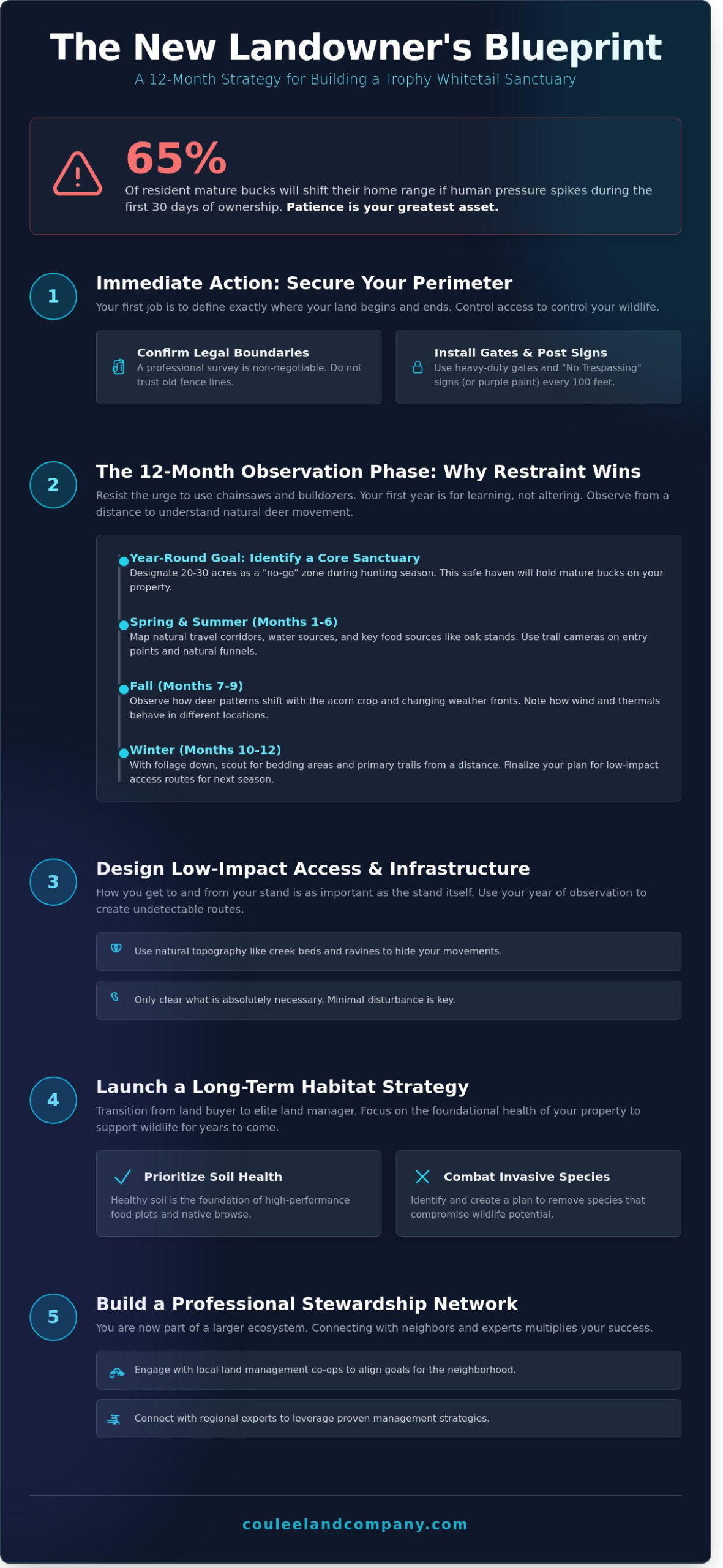
The moment you sign the closing papers on a prime piece of Buffalo County timber, your biggest threat to tagging a 170 inch buck isn’t the neighbors; it’s your own boots on the ground. Most new owners feel a frantic urge to start clearing trails and hanging stands immediately, yet research suggests nearly 65 percent of resident mature bucks will shift their home range if human pressure spikes during the first 30 days of ownership. Understanding the first things to do after buying hunting land is the difference between owning a true sanctuary and owning a vacant woodlot. You’ve invested heavily in your piece of the bluff country, and you deserve a strategy that protects that investment from day one.
We know the excitement of finally holding the deed to your own dirt, but we also understand the nagging worry that one wrong move could spook the very trophies you bought the land to hunt. This professional checklist will help you master the transition from land buyer to elite land manager by securing your borders and establishing a clear 12 month management plan. You’ll learn exactly how to mark your property lines, audit your habitat, and improve your wildlife capabilities without burning out your best bedding areas.
Key Takeaways
- Secure your investment immediately by confirming legal property corners and establishing clear boundaries to prevent neighbor disputes and protect your perimeter.
- Discover why a patient 12-month observation period is one of the most critical first things to do after buying hunting land to avoid disrupting natural deer travel patterns.
- Master the art of low-impact infrastructure by designing undetected entry and exit routes that allow you to reach your stands without alerting trophy whitetails.
- Launch a high-performance habitat strategy by prioritizing soil health and identifying invasive species that could compromise your property’s long-term wildlife potential.
- Build a professional stewardship network by engaging with local management co-ops and regional experts to align your goals with the proven success of Wisconsin’s premier hunting grounds.
Securing the Perimeter and Establishing Legal Boundaries
Landing a prime piece of Wisconsin’s Bluff Country is a milestone for any hunter. One of the absolute first things to do after buying hunting land is to define exactly where your dirt ends and the neighbor’s begins. You shouldn’t rely on a handshake or a rusted 40-year-old barbed wire fence. A professional survey is the only way to confirm property corners and avoid costly legal disputes. Once you’ve located the iron pins, mark your boundaries clearly. Wisconsin’s “Purple Paint Law” provides a legal alternative to traditional signage, but high-visibility “No Trespassing” signs still hold weight.
To better understand the initial steps of property ownership, watch this helpful video:
Walking the entire perimeter is a full-day job, especially in rugged terrain. Identifying these boundaries is among the most critical first things to do after buying hunting land because it prevents accidental encroachment. You’ll likely find old logging roads or breaches in existing fences that invite unauthorized access. Installing heavy-duty steel gates at primary access points is non-negotiable. These gates deter vehicle entry and signal that the property is under active management. While you’re out there, stop by the neighboring farm. Introducing yourself as the new owner of one of our hunting properties builds rapport. A 10-minute conversation can turn a stranger into an ally who helps watch your gate when you’re not around.
The Legalities of Posting and Trespass Prevention
Wisconsin law requires specific spacing for signs or paint marks to be legally enforceable. Place your markers no more than 100 feet apart in high-traffic areas. Use trail cameras strategically. Don’t just point them at scrape lines; point them at access points to catch license plates or faces. If you find trash or 10-year-old tree stands from previous trespassers, document the damage with photos before removing it. This creates a paper trail for local law enforcement. Effective wildlife management starts with controlling who has access to the habitat.
Survey Verification in Rugged Terrain
Finding survey pins in the steep topography of Buffalo County is a challenge. Pins often slide down hillsides or get buried under 6 inches of leaf litter over time. Use GPS apps like OnX or HuntStand to cross-reference your deed descriptions, but remember these are tools, not legal proof. If a boundary seems off by even 5 feet, hire a surveyor to reset the pins. Never trust an old fence line as a legal boundary. Many fences in Western Wisconsin were built for convenience rather than accuracy 75 years ago.
The 12-Month Observation Phase: Why Restraint Wins
One of the most critical first things to do after buying hunting land is to resist the urge to fire up the chainsaw immediately. New landowners often feel pressured to bulldoze paths or clear-cut timber within the first 90 days of ownership. This is a mistake that can ruin a property’s potential before you even spend a night in the stand. You need a full 12-month cycle to understand how deer utilize the specific terrain of the Coulee Region. Spend your first year mapping natural travel corridors from a distance and recording how deer move during different moon phases and weather fronts.
You must identify a core “inner sanctuary” of at least 20 to 30 acres where you’ll never step foot during the hunting season. This area becomes a safe haven that holds mature bucks on your property when hunting pressure increases on neighboring parcels. Monitoring water sources and natural mast-producing trees like white and red oaks is equally vital. A heavy acorn crop in a 5-acre stand can shift deer patterns for an entire month, and you won’t know which trees are the “hot” producers without watching them through the seasons. Understanding how wind currents and thermals pull down into valleys during the morning and rise up the ridges in the evening is essential before you hang a single permanent stand. Mastering these observations is among the first things to do after buying hunting land if you want to avoid spooking the very deer you bought the property to hunt.
Patterning Resident Whitetails with Low-Impact Scouting
Success in the bluff country requires intelligence rather than physical presence. Low-impact scouting is the intentional avoidance of core areas to preserve natural movement. Place cellular trail cameras in transition zones or along field edges where you can swap batteries or pull cards without entering the woods. This strategy lets you monitor 24-hour activity across 365 days without depositing human scent in sensitive bedding areas. By identifying bedding areas based on thermal cover and prevailing winds, you’ll see which trophy bucks are residents and which are just passing through during the rut.
Identifying “Low-Hanging Fruit” Improvements
Before you launch a massive construction project, look for existing natural funnels that only need a light touch. A 20-minute clearing of a downed log or a few strategically placed branches can open a perfect pinch point. Search for old fruit trees or overgrown clearings that are easily reclaimed with a brush hog. While you develop a wildlife habitat management plan to guide your long-term vision, these small wins provide immediate results. If you’re still looking for that perfect piece of Wisconsin dirt, browse our current hunting properties to find land with high natural potential.
Developing Low-Impact Access and Infrastructure
Establishing a strategic infrastructure is one of the first things to do after buying hunting land to ensure long-term success. Your goal is to move through the property like a ghost. This begins with designing entry and exit routes that allow you to reach stands undetected by mature bucks. You should clear “quiet paths” by removing every dry leaf and snapping branch down to the bare mineral soil. A path that is 2 feet wide and cleared of debris allows for a silent approach even in the dead of November when the woods are crisp. These paths should lead directly to your stands, stopping roughly 15 yards short to keep your final movements concealed.
A central staging area is another priority. Locate this zone at least 300 yards from high-density bedding areas to contain vehicle noise and human scent. This area serves as the hub for your equipment and UTVs. When building a permanent trail system for year-round maintenance, always follow the natural contour lines of the terrain. This design choice prevents the 12 percent soil erosion common on steep, vertical tracks that wash out after heavy spring rains. Proper trail grading keeps your property accessible for the next 20 years without constant repair costs.
- Utility Planning: Identify sites for future cabins or storage sheds near existing power lines to save thousands in trenching costs.
- Wind Awareness: Map your staging area so it sits downwind of your primary hunting corridors during the prevailing fall winds.
- Equipment Management: Store heavy implements on the property periphery to avoid driving through the heart of the sanctuary during the season.
Access Strategy for Bluff Country Ridges
In the steep terrain of Western Wisconsin, “side-hill” trails are your best friend. These paths allow you to walk ridges while staying 15 to 20 feet below the skyline, preventing you from being silhouetted against the horizon. For morning hunts, prioritize creek-bottom access. This keeps your scent in the lowlands while deer remain bedded on the points above you. Utilizing “hard” edges, such as a rock bluff or a dense fenceline, provides a physical barrier that helps mask your movement and noise during entry.
Staging and Storage for the Long Haul
Evaluate existing outbuildings for weatherproofing and security before moving expensive machinery on-site. When you determine the location for a country home, check that the site doesn’t conflict with your best hunting wind. If a Northwest wind carries your household scents directly into a 10-acre bedding thicket, you’ve compromised the property’s potential. Plan for storage that allows you to grab gear and go without crossing the interior of the land, keeping the core of your woods a true sanctuary.
Launching a Long-Term Habitat Management Strategy
Securing the deed to your property is a milestone, but the real work begins when you step into the role of a land steward. One of the first things to do after buying hunting land is to transition from a buyer to a manager. You aren’t just owning dirt; you’re cultivating a legacy. High-quality habitat doesn’t happen by accident, especially in the competitive landscape of Western Wisconsin. It requires a strategic approach that balances immediate improvements with long-term ecological health. By evaluating your soil and timber today, you set the stage for decades of successful hunts.
Soil Health and Food Plot Foundations
A $20 soil test is the most important investment you’ll make this year. It’s common for new owners to spend thousands on seed and equipment only to watch their plots fail because the pH was too acidic. Most brassicas and clovers thrive in a pH range of 6.5 to 7.0. Without this data, you’re guessing with your checkbook. When you begin mapping your layout, think about the difference between destination plots and kill plots. Destination plots are typically 2 to 5 acres and focus on high-tonnage late-season nutrition. Kill plots are smaller, often 0.25 acres, tucked into secluded corners to catch bucks during daylight hours. Always design these with irregular shapes to maximize “edge” and provide deer with a sense of security near the timber line.
Timber Management for Wildlife
Your woods shouldn’t be a stagnant collection of trees. Consulting with a professional forester is vital to understanding the wildlife capabilities of your timber. They can help you implement a Timber Stand Improvement (TSI) plan that removes low-value species to let sunlight reach the forest floor. Sunlight is the catalyst for natural browse and thick bedding cover. You can use hinge-cutting strategically to create immediate horizontal cover, which directs deer movement and provides thermal protection. While you work, identify and protect “legacy trees.” These are your high-producing white oaks or heritage mast trees that provide the caloric foundation for your herd. Protecting these giants ensures your property remains a preferred destination during the rut.
- Identify Invasive Species: Scout for buckthorn and garlic mustard immediately. These aggressive plants can dominate a woodlot within 3 growing seasons if left unchecked.
- Year-Round Nutrition: Select tree and shrub species like red osier dogwood or American plum for new plantings to bridge the “late-winter gap” when food is scarce.
- Audit Existing Cover: Walk the interior of your woodlots to see where visibility exceeds 40 yards; these areas need TSI to increase stem density.
Managing land is a journey that transforms a simple piece of real estate into a premier hunting destination. To see how these management principles look in practice, you can view hunting properties that have been developed for maximum wildlife potential. Taking these steps early ensures that your property’s value and hunting quality only increase over time.
Ready to find a property with the right bones for your management vision? Contact our land specialists today to start your search.
Building Community and Professional Stewardship
Successful land ownership doesn’t happen in a vacuum. One of the first things to do after buying hunting land is to immerse yourself in the local Buffalo County community. Understanding regional deer trends requires talking to neighbors who have hunted these bluffs for decades. They know how the thermals pull through specific coulees and which years the acorn crop fails. This local intelligence is the foundation of a successful management plan. You aren’t just buying acreage; you’re joining a culture of conservation that has made Western Wisconsin a premier destination for trophy whitetails.
The Power of the Neighborhood Co-op
High-fence results without the fence come from collaboration. Joining or starting a Deer Management Co-op ensures that the 3.5-year-old buck you pass survives to reach his 5.5-year-old potential. Share trail camera data and “hit list” photos with trusted neighbors to build a collective understanding of the local herd. When 75% of a section agrees on harvest criteria, trophy potential skyrockets. Managing for age structure across fences benefits everyone, turning a collection of individual parcels into a massive, managed sanctuary where bucks can reach their full genetic potential.
Reviewing local tax incentives is a critical financial move for any new owner. In Wisconsin, the Managed Forest Law (MFL) can reduce property taxes by up to 80% in exchange for following a professional forestry plan. These contracts, typically lasting 25 or 50 years, ensure your timber remains healthy and your tax burden remains manageable. Pair this professional oversight with a personal Land Journal. Track every sighting, wind direction, and food plot result. This data becomes your property’s “black box,” revealing patterns that years of casual observation might miss. It’s one of the most effective first things to do after buying hunting land to ensure you’re making data-driven decisions.
Leveraging Expert Land Specialists
Your relationship with your broker shouldn’t end at the closing table. Consulting with Mike Law or Bryan Lemke post-sale adds immense value because they see potential that average hunters miss. They help you refine your long-term vision, from timber stand improvements to strategic pond placement. These specialists understand the nuances of the “Bluff Country” terrain and can guide you on where to place stands for the best prevailing winds. Professional land specialists provide the bridge between a simple purchase and a legacy investment.
- Engage Neighbors: Build trust to prevent trespassing and coordinate deer management.
- MFL Enrollment: Consult a forester to see if your acreage qualifies for significant tax breaks.
- Document Everything: Use a journal to record soil test results, planting dates, and buck movement.
- Expert Consultation: Keep your land specialist’s number handy for advice on property improvements.
Mastering Your New Piece of Bluff Country
Owning a piece of Wisconsin’s premier terrain is a significant milestone, but the real work of stewardship begins the moment the deed is signed. By prioritizing legal boundaries and committing to a full 12 month observation phase, you ensure your long term habitat goals align with the land’s natural rhythm. These are the critical first things to do after buying hunting land to protect your investment and maximize wildlife potential. As Wisconsin’s premier land and property sales specialists, we’ve helped hundreds of hunters secure world class dirt in Buffalo County, a region that consistently leads the Boone and Crockett Record Book for trophy whitetail entries. Our team is endorsed by leading outdoor television personalities who trust our deep roots in the driftless region. Whether you’re launching a habitat strategy or building community ties, your journey as a landowner is about more than just the hunt; it’s about professional stewardship. Ready to find your own piece of Bluff Country? Browse our exclusive hunting land listings today. We’ll see you in the woods.
Frequently Asked Questions
How soon can I start hunting my new property after buying it?
You can hunt your land the moment the deed is recorded at the county register of deeds. While legal access is immediate, we recommend spending 14 days scouting the terrain before hanging stands to avoid spooking trophy whitetails. Wisconsin’s deer seasons follow strict dates, so ensure you have the correct tags for your specific zone before your first sit. This patience helps you understand the land’s natural flow.
Do I need to survey my land if there are already old fences in place?
Yes, you should always commission a professional survey because old fence lines are inaccurate in 35% of rural boundary disputes. Relying on a rusted wire fence from 1950 can lead to legal headaches or timber trespass issues. A modern survey using GPS coordinates ensures your food plots and stands remain 100% within your property lines. It’s the only way to protect your investment with absolute certainty.
What are the most important tools for a new hunting land owner?
A reliable 50cc chainsaw and a rugged UTV are the two most critical tools for managing your acreage. You’ll also need a premium mapping subscription like HuntStand or onX to track your boundaries and stand locations. These tools allow you to clear 100 yards of trail or move a 500-pound mineral block with efficiency during your first weekend of ownership. Don’t underestimate the power of a quality pole saw for clearing shooting lanes.
How do I stop neighbors from trespassing on my new hunting land?
Posting purple paint or “No Trespassing” signs every 50 feet along the perimeter is one of the first things to do after buying hunting land. You should also install cellular trail cameras at primary access points to monitor activity in real-time. Establishing a physical presence by walking the boundaries 2 times a month signals to the community that the property is actively managed. Clear communication usually resolves 90% of boundary issues before they escalate.
Should I clear food plots in the first year of ownership?
You should start with small, 0.5-acre “kill plots” in the first year to observe how deer naturally move through the terrain. Clearing 5% of your total acreage for forage is a standard goal for Western Wisconsin land management. Testing your soil pH before planting ensures your $150 investment in clover or brassicas doesn’t go to waste in acidic soil. Focus on high-quality forage that provides nutrition during the critical winter months.
What is the best way to meet neighbors without sounding overprotective?
Visit your neighbors in person with a handshake and a business card to establish a positive rapport from day one. Mention your passion for growing mature 4.5-year-old bucks to find common ground on quality deer management. This approach turns a potential trespasser into a 24-hour lookout who helps protect your investment while you’re away. Building these relationships is vital for successful long-term land ownership in Bluff Country.
How does the Wisconsin Managed Forest Law (MFL) affect my hunting land?
The MFL program can reduce your property taxes by 80% if you follow a certified forest management plan. You must decide between “Open” or “Closed” status, which determines if the public can access your land for hunting. Most of our clients choose the “Closed” designation for up to 160 acres to maintain total privacy for their trophy hunting. It’s a 25-year or 50-year commitment that requires strict adherence to timber harvest schedules.
What should I look for when walking my property for the first time as the owner?
Look for primary bedding thickets and 3-way trail intersections that indicate heavy deer traffic. Identify white oak clusters that will drop acorns in October and natural funnels created by the steep coulees of Western Wisconsin. Mapping these 5 key features helps you prioritize the first things to do after buying hunting land to maximize its wildlife potential. Understanding these topographical advantages is the hallmark of a successful Bluff Country hunter.