
The 2026 Wisconsin land market doesn’t care about your scouting skills if you can’t beat the cash buyers to the closing table. You’ve likely spent years dodging orange vests on overcrowded public tracts or watching prices in trophy counties like Buffalo and Trempealeau climb by an average of 14% annually. It’s frustrating to see prime parcels disappear before you can even walk the timber, leaving you with the fear of overpaying for “dead” land with poor wildlife travel patterns. We know the high stakes involved in finding private hunting land in wisconsin that actually produces results.
We believe every dedicated hunter deserves a legacy property where they can manage the habitat and control the hunt. This article provides the exact roadmap you need to secure high-quality acreage in the world-renowned Bluff Country. You’ll learn how to analyze property capabilities like a professional land specialist and move with confidence to bag a 160+ inch buck on your own soil.
Key Takeaways
- Understand the 2026 market shift toward fee-simple ownership and why securing your own acreage is the only way to guarantee long-term access.
- Evaluate the superior ROI of land ownership compared to annual leases, focusing on the total management control required for trophy buck production.
- Discover how the unique topography of the Bluff Country creates natural funnels and pinch points that dictate hunting success.
- Learn a professional strategy for finding private hunting land in wisconsin through targeted zone identification and off-market networking.
- Gain a competitive edge by partnering with a specialized land expert who understands the specific wildlife capabilities of the Coulee Region.
The Landscape of Private Hunting Land in Wisconsin (2026)
The 2026 hunting season marks a definitive shift in how serious outdoorsmen approach the woods. For decades, a simple knock on a farmhouse door might secure a season’s worth of access. That era has ended. Finding private hunting land in Wisconsin now requires a strategic, fee-simple ownership approach to guarantee high-quality results. Wisconsin’s reputation as the premier destination for trophy whitetails remains unchallenged. The state consistently produces more Boone and Crockett entries than any other region in North America. Buffalo County alone has recorded over 150 entries in the last decade, cementing its status as the global leader for giant bucks.
Much of this success stems from Wisconsin’s landscape, specifically the Western Upland. This rugged area features the steep ridges and deep coulees known as “Bluff Country.” With 46% of the state covered in forest, the habitat diversity provides the necessary thermal cover and mast crops to grow world-class deer. Owning a piece of this ground isn’t just a real estate transaction; it’s an investment in a legacy of land management and world-class wildlife capabilities.
Why Public Land Pressure is Driving Private Sales
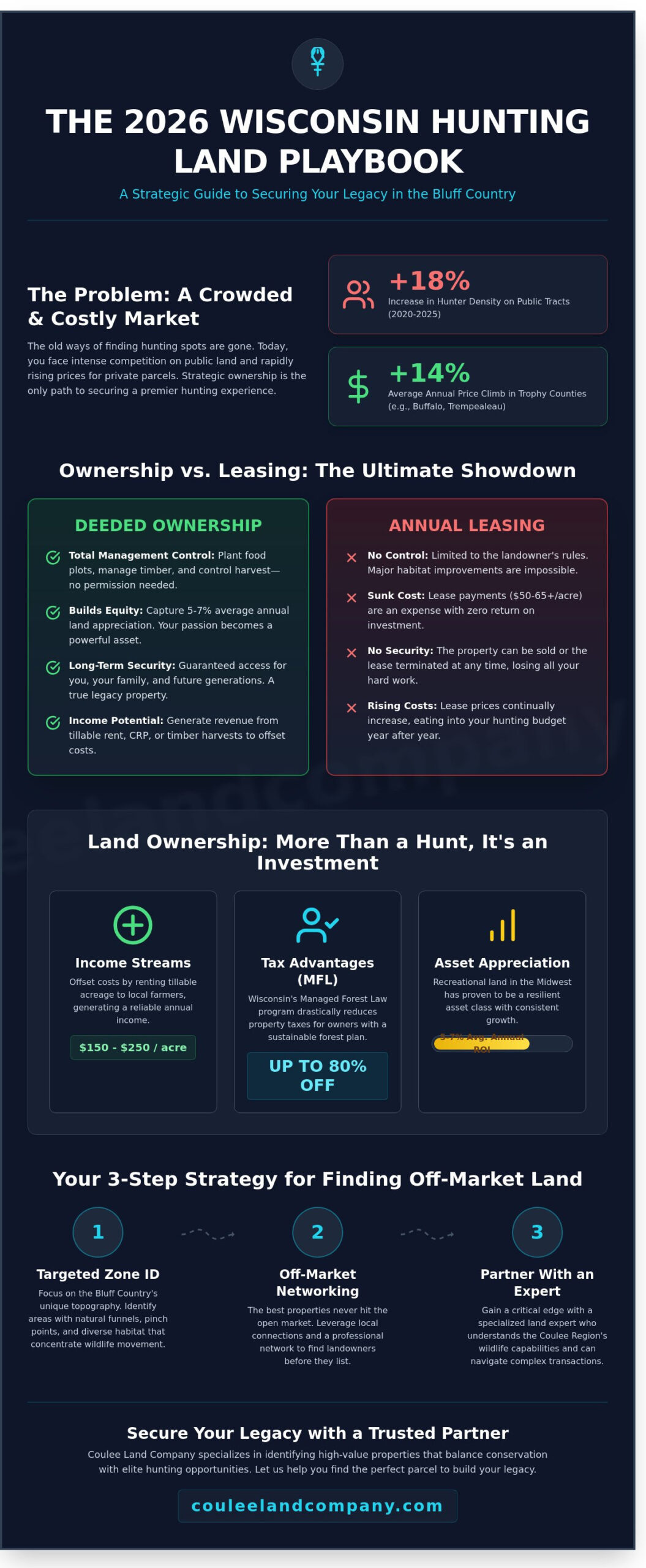
Hunter density on public tracts increased by 18% between 2020 and 2025. This surge makes finding secluded spots nearly impossible on state-owned ground. E-scouting tools have democratized topographical data. This means that “hidden” benches and remote hollows are now marked on every smartphone in the woods. Serious hunters are moving toward private ownership to escape this crowding. Buying land that borders public acreage offers a tactical advantage. You can use the public land as a massive buffer, while your private food plots act as the primary draw for pressured deer. However, fully private holdings remain the gold standard for those who want total control over deer age structure.
The Different Tiers of Private Access
Access isn’t a one-size-fits-all model. Hunting leases are a common entry point, but they lack the long-term security of a deed. Deeded ownership allows for permanent improvements like timber stand enhancement and strategic pond placement. The Managed Forest Law (MFL) is a critical tool for Wisconsin landowners. This program can reduce property taxes by up to 80% if the owner follows a sustainable forest management plan. It’s a pragmatic way to offset the costs of finding private hunting land in Wisconsin. Contrast this with the Voluntary Public Access (VPA-HIP) program, where the state pays owners to allow public hunting. While VPA-HIP provides more ground for the masses, it doesn’t offer the exclusivity required to manage for 170-inch class whitetails. Our team at Coulee Land Company specializes in identifying these high-value MFL-eligible properties that balance conservation with elite hunting opportunities.
Ownership vs. Access: Evaluating Your Wisconsin Land Options
Deciding between an annual lease and a permanent deed is the first major hurdle for hunters. While a lease provides temporary access, it lacks the equity and security required for true legacy building. In Western Wisconsin, where the terrain is rugged and the bucks are world-class, ownership represents more than just a place to park a truck. It’s a strategic investment. Leasing costs in prime counties like Buffalo or Trempealeau have climbed to $50 or $65 per acre annually. These costs are sunk. When you own the land, you capture the appreciation that has historically averaged 5% to 7% across the Midwest over the last decade.
Ownership grants you total management control. You aren’t asking permission to plant a food plot, clear a trail, or conduct a prescribed burn. You dictate the age class of the bucks harvested and the health of the timber. This level of influence is the only way to consistently produce trophy whitetails in the Bluff Country. If you are serious about finding private hunting land in wisconsin, you must consider the long-term ROI of a property that pays you back through both recreation and equity.
The Financial Case for Buying Hunting Land
Recreational land in the Midwest has proven to be a resilient asset class. Beyond simple appreciation, your property can generate annual revenue. Many tracts in Western Wisconsin include tillable acreage that can be rented to local farmers for $150 to $250 per acre. You might also enroll marginal land in the Conservation Reserve Program (CRP) or execute a selective timber harvest. These income streams help offset your carrying costs. Understanding how to finance hunting land is the first step toward turning a passion into a portfolio piece. To see how these income-producing features look on the ground, you can view our latest property walkthroughs and expert analysis.
Understanding the Managed Forest Law (MFL) Benefits
Wisconsin offers a unique tax incentive called the Managed Forest Law (MFL). This program can slash your property taxes by up to 80% in exchange for following a sustainable forestry plan. When finding private hunting land in wisconsin, you’ll encounter “Open” and “Closed” MFL statuses. “Open” land allows public access for hunting and fishing, which significantly lowers the tax rate. Most serious hunters prefer “Closed” status. This keeps the land private while still offering a substantial tax break. You should always verify the expiration date of an MFL contract during due diligence; withdrawing early can result in stiff penalties.
The 2026 market for Western Wisconsin land remains highly competitive. Inventory in the Driftless Area is finite. We are seeing a trend where buyers prioritize smaller, 40 to 80-acre parcels with high “huntability” rather than massive, lower-quality tracts. Before you schedule a walk-through, use this checklist to evaluate a property’s potential:
- Topographical Diversity: Look for pinch points and thermal hubs created by the coulees and ridges.
- Access Points: Ensure you can enter and exit stands without blowing your scent across the entire bedding area.
- Neighboring Pressure: Research if adjacent landowners are also practicing quality deer management.
- Water Sources: Identify year-round springs or creeks that hold wildlife during dry October months.
- Program Participation: Check if the land is enrolled in private land access programs or if it remains strictly exclusive.
The Bluff Country Factor: Why Geography Dictates Success
The Coulee Region of Western Wisconsin is a geographical masterpiece for whitetail hunters. This unglaciated landscape, often called the Driftless Area, features steep ridges and narrow valleys that create a complex ecosystem for trophy bucks. When you’re finding private hunting land in Wisconsin, you must understand how these vertical changes dictate deer movement. Buffalo County stands as the epicenter of this region, holding the record for the most Boone and Crockett entries in the United States. The bluffs aren’t just scenery; they are biological factories that produce some of the largest deer in the world.
These vertical limestone structures create natural funnels that concentrate deer movement into predictable patterns. A mature buck will often take the path of least resistance through a “saddle” in the ridge or along a “bench” halfway up a 300-foot incline. These pinch points allow hunters to set stands with high confidence. South-facing slopes provide a distinct thermal advantage during the harsh Wisconsin winters. These slopes receive direct sunlight throughout the day, offering critical warmth for wintering herds when temperatures drop below zero. A property with the right thermal cover will hold deer while neighboring tracts sit empty.
Topography as a Security Feature
Steep terrain acts as a physical wall that protects your investment. A 40-degree incline stops casual trespassers and limits neighbor intrusion more effectively than any fence. Access is the most critical tactical factor in Bluff Country. We prioritize top-access properties where hunters can enter ridge-point stands without blowing scent into the bedding areas in the hollows below. If you’re looking at the Buffalo County community page, you’ll see how this rugged landscape defines the local hunting culture. Effective woodland stewardship requires a deep understanding of these elevation changes to manage both the timber quality and the herd’s health. We look for properties that allow a hunter to move undetected, regardless of the wind direction.
Evaluating Soil Quality and Food Plot Potential
The secret to the region’s massive antler growth is the soil. Much of the Coulee Region is covered in loess, a wind-deposited silt that is exceptionally rich in minerals. This soil supports high-protein forage like alfalfa and clover far better than the sandy soils found in the central part of the state. Smart buyers look for hidden ridge-top flats. These are level areas of 2 to 5 acres that are invisible from the road and offer secluded locations for food plots. Because water drains quickly in this ridge-and-valley system, identifying a year-round spring or a site for a small pond is vital. Adding a reliable water source to a dry ridge can increase a property’s holding capacity by 30 percent or more. When finding private hunting land in Wisconsin, we analyze these micro-features to ensure the land can support a healthy, mature deer population year-round.
This region’s unique combination of mineral-rich soil, thermal cover, and natural security makes it the premier destination for serious land buyers. It’s not just about the acreage; it’s about how the dirt and the hills work together to create a sanctuary for world-class whitetails.
The 2026 Strategy for Finding Off-Market Hunting Land
Successful hunters don’t wait for a “For Sale” sign to appear on a fence post. Finding private hunting land in Wisconsin requires a tactical approach that mirrors a pre-season scouting mission. In a market where high-quality “deer dirt” moves in less than 72 hours, you need a system that places you ahead of the digital aggregators. This five-step strategy ensures you aren’t fighting for scraps on the open market.
- Step 1: Identify your core “target zone” based on trophy potential. Focus on counties with proven track records. Buffalo County, for example, holds the title for the most Boone and Crockett entries in the nation, totaling over 1,000 historical entries. Narrow your search to specific townships where the topography creates natural funnels and thermal hubs.
- Step 2: Partner with a land specialist who hunts the region. You need an advocate who understands the difference between a scenic view and a bedding thicket. A specialist lives in these communities and hears about upcoming sales at the local grain elevator or coffee shop weeks before a contract is signed.
- Step 3: Utilize GIS mapping tools to analyze neighbor management. Use tools like OnX or county GIS sites to see who owns the surrounding parcels. If you’re looking at 40 acres bordered by a 400-acre farm that practices Quality Deer Management (QDM), your land’s value effectively triples.
- Step 4: Secure pre-approval for recreational land loans. Land financing differs from residential mortgages. Most lenders require a 20% to 30% down payment for vacant land. Having a commitment letter from a lender who understands rural property ensures you can sign a contract the moment the right parcel appears.
- Step 5: Move quickly on “pocket listings” before they hit the MLS. These are properties held by brokers that haven’t been advertised yet. By the time a property hits a national search engine, it’s often already under a 48-hour inspection contingency.
Why General Online Real Estate Search Engines Fall Short for Hunting Land
Many general online real estate platforms are designed for residential properties, not the unique characteristics of rugged bluff country or prime hunting land. There’s a significant lag time, often 24 to 48 hours, between a listing going live and appearing on these broad platforms. In Western Wisconsin, the most coveted hunting properties sell via word-of-mouth networks before a single digital photo is uploaded. You need an agent who understands “deer dirt” value, focusing on soil quality, mast-producing timber, and water access rather than just square footage and school districts.
The Role of the Land Specialist Broker
A residential realtor looks at a woodlot and sees “undeveloped land,” but a land specialist sees a biological asset. Specialists like Mike Law or Bryan Lemke evaluate the specific wildlife capabilities of a property, from the age class of the timber to the potential for hidden food plots. They can identify if a property has been over-hunted or if the local deer herd has the genetics to produce 160-inch class bucks. Their “boots on the ground” experience beats a digital tour because they can smell the bedding areas and hear the wind patterns that dictate how a property actually hunts. Finding private hunting land in Wisconsin is about local intelligence, not just search filters.
Don’t wait for the best land to vanish. Contact our specialists today to access exclusive off-market listings in Wisconsin’s premier hunting counties.
Securing Your Legacy with Coulee Land Company
The Coulee region of Western Wisconsin remains the premier destination for hunters chasing world-class whitetail deer. This unique landscape, defined by its steep ridges and deep valleys, creates the perfect micro-climate for trophy bucks to reach maturity. Buffalo County alone consistently dominates the whitetail entries in the Boone and Crockett Record Book, a fact that draws serious outdoorsmen from across the country. As we move through 2026, the demand for these elite parcels has reached an all-time high. Competition is fierce, and the best properties often sell before they ever hit a public portal. Success in finding private hunting land in wisconsin now requires a strategic advantage that only a specialized firm can provide.
We pride ourselves on being “Wisconsin’s Land & Property Sales Specialists.” Our team doesn’t just look at property lines; we analyze bedding thickets, thermal cover, and natural funnel points. We operate as the “Hunter’s Realtor,” a persona built on the foundation of actually walking the timber and understanding how deer move through the Driftless Area. When you work with us, you aren’t just hiring an agent; you’re partnering with a peer who shares your obsession with the rut and land stewardship. We bring a pragmatic, results-oriented approach to every transaction, ensuring that the wildlife capabilities of the land match your specific goals for the future.
Our Approach to Bluff Country Real Estate
Our roots run deep in the soil of Buffalo, Trempealeau, and Jackson counties. We’ve spent decades building relationships with local landowners and conservationists, giving us an “insider” perspective on the market. This localized expertise allows us to help sellers find the right buyers who will respect and improve the land. Our reputation for excellence is reinforced by endorsements from major figures in the outdoor television industry. These professionals trust us because they know we understand the difference between a scenic view and a high-performance hunting tract. We evaluate every acre for its potential to produce 160-inch plus bucks, looking at everything from soil quality for food plots to the security of neighboring borders.
Start Your Search Today
The journey toward finding private hunting land in wisconsin starts with a clear vision of your ideal property. We invite you to explore our exclusive listings, which feature some of the most sought-after acreage in the Bluff Country. Beyond a simple tour, we offer detailed consultations to discuss your long-term land management goals. Whether you want to implement a timber stand improvement plan or design a complex sanctuary system, our team provides the technical knowledge to make it happen.
- Access exclusive off-market opportunities in high-demand counties.
- Receive expert analysis on deer density and age structure for specific parcels.
- Partner with agents who understand the nuances of Wisconsin land use programs.
Owning a piece of the Wisconsin wilderness is more than a financial investment; it’s a commitment to a lifestyle and a legacy for your family. There’s a profound emotional value in standing on your own ridge top as the sun rises over the fog-filled coulees. Don’t leave your dream to chance in a competitive market. Contact Coulee Land Company today to secure your place in the finest hunting grounds the Midwest has to offer. Your legacy in the big woods starts with a single, decisive conversation.
Secure Your Legacy in the Heart of Bluff Country
Success in the 2026 market demands a shift from passive searching to proactive land management and strategic acquisition. You’ve seen how the unique topography of the driftless region creates unmatched wildlife capabilities, particularly in Buffalo County, which remains the #1 Whitetail County in the US with the most Boone and Crockett record entries. Finding private hunting land in Wisconsin isn’t just about a real estate transaction; it’s about securing a legacy on ground that produces trophy whitetail bucks year after year. Our team at Coulee Land Company specializes in these elite properties, bringing expertise that’s earned the endorsement of top outdoor industry professionals.
We don’t just sell dirt. We understand the biology and the terrain that makes a property a world-class hunting destination. Whether you’re looking for a secluded 40-acre ridge or a massive 500-acre valley, the right tract won’t stay on the market for long in this competitive landscape. Take the next step toward owning the premier hunting ground you’ve always envisioned. Your future in the bluffs starts today.
Find Your Piece of Bluff Country: Browse Our Exclusive Hunting Listings
Frequently Asked Questions
How much does an acre of hunting land cost in Wisconsin in 2026?
Expect to pay between $4,500 and $8,500 per acre for quality hunting land in 2026. This price range depends on the property’s tillable percentage and standing timber value. In premium regions like Buffalo County, prices often exceed $9,000 per acre because the area consistently produces Boone and Crockett bucks. Market trends show a 4 percent annual appreciation for these high-demand parcels in the western bluff country.
Can I hunt on land enrolled in the Managed Forest Law (MFL) program?
You can hunt on land enrolled in the Managed Forest Law program, but your access depends on the specific designation of the acreage. Landowners with a “closed” designation retain exclusive hunting rights for their private use. Conversely, “open” MFL land requires the owner to allow public access for hunting, fishing, and hiking. Over 2.5 million acres are currently enrolled in this program to reduce property tax burdens by up to 80 percent.
What are the best counties for trophy whitetail hunting in Wisconsin?
Buffalo, Trempealeau, and Richland counties remain the premier destinations for trophy whitetail hunting in Wisconsin. Buffalo County alone has recorded over 100 Boone and Crockett entries in the last decade, securing its spot as the top producer in the nation. These driftless area counties offer the steep ridges and thermal cover necessary to grow mature bucks. Finding private hunting land in Wisconsin within these specific zip codes significantly increases your chances of a world-class harvest.
How do I find out who owns a specific piece of private land in WI?
Use the specific county’s GIS mapping website or a digital platform like OnX Hunt to identify private landowners. Every Wisconsin county maintains a digital tax parcel map that lists the owner’s name and mailing address for all 72 counties. You can also visit the Register of Deeds office at the local courthouse to view physical plat books. This data allows you to contact owners directly to inquire about potential off-market sales or lease opportunities.
Is it better to buy a small piece of prime land or a large piece of average land?
Buying a 40-acre piece of prime Bluff Country land is often superior to owning 120 acres of average habitat. High-quality acreage with established bedding thickets and 15 percent tillable soil for food plots holds more deer than large, open timber tracts. Managing a smaller, high-caliber property is more efficient for the serious hunter. It allows you to control the environment and hunting pressure more effectively to produce older age-class bucks.
What should I look for in a Wisconsin land contract?
Ensure your Wisconsin land contract clearly defines the interest rate, the balloon payment date, and default remedies. Most sellers require a 20 percent down payment and offer a 5-year term with a 7 percent interest rate. You must verify that the deed transfer occurs only after the final payment is satisfied. Work with a specialized realtor to include specific language regarding timber harvesting rights and existing MFL program obligations during the contract period.
Do I need a special loan to buy recreational hunting land?
You typically need a specialized land loan from a lender like Compeer Financial rather than a traditional residential mortgage. These lenders understand the value of timber and agricultural income, often requiring a 25 to 35 percent down payment for recreational tracts. Finding private hunting land in Wisconsin becomes easier when you have a pre-approval from a rural credit association. They offer flexible terms up to 20 years that standard banks won’t provide for vacant land.
What is the difference between a “closed” and “open” MFL property?
The primary difference is that “closed” MFL land is private while “open” MFL land is accessible to the public. Landowners pay a higher tax rate for “closed” status, currently around $10.68 per acre, to keep the land for their exclusive use. “Open” land owners pay a lower rate of approximately $2.14 per acre but must permit public foot access. You can designate up to 320 acres as “closed” per municipality to ensure your hunting grounds remain strictly private.