
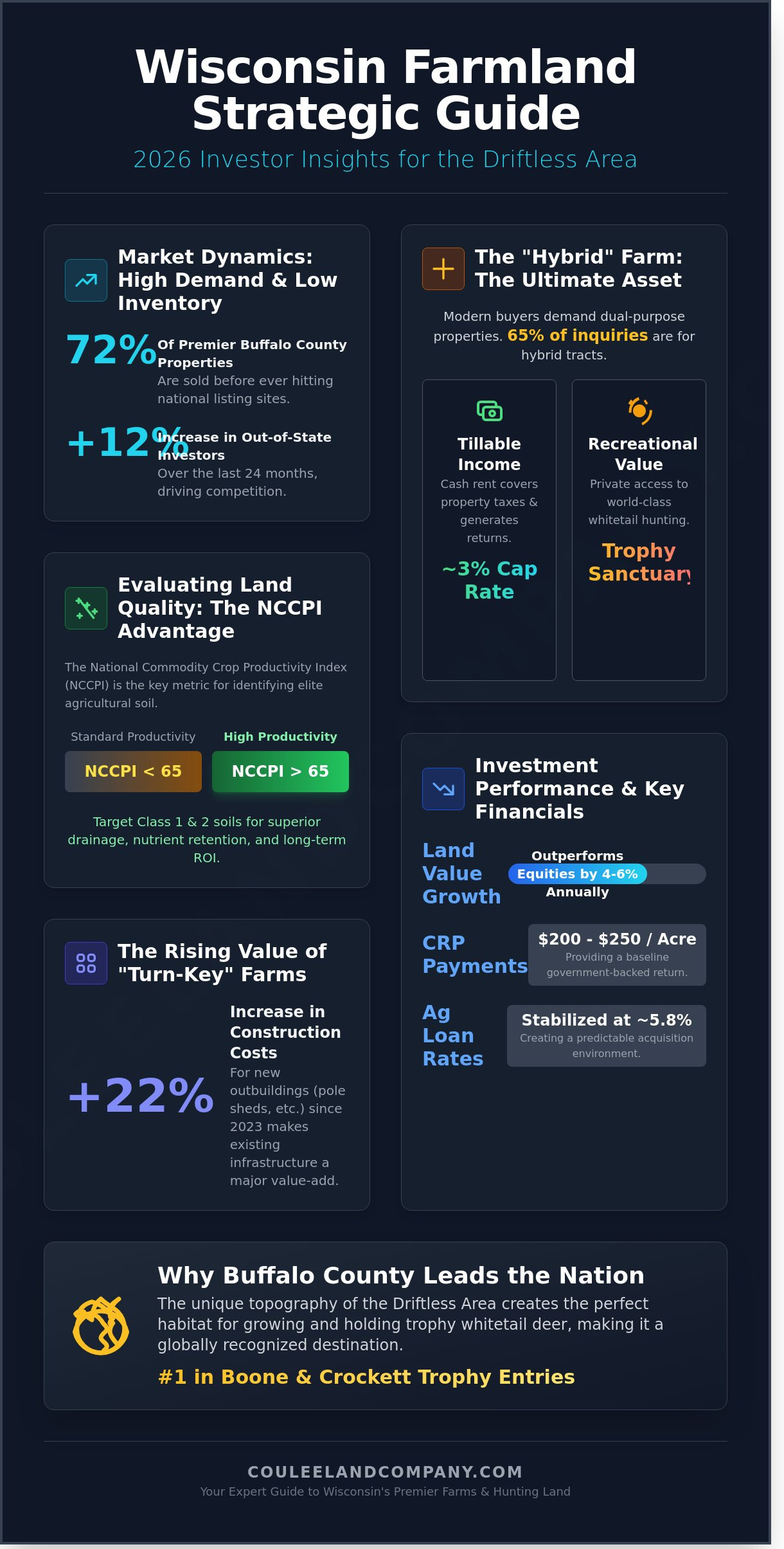
Owning a premium tract in Wisconsin’s Driftless Area isn’t just a real estate transaction; it’s a strategic acquisition of the most coveted whitetail habitat and agricultural soil on the planet. You’ve likely realized that finding high-quality farms for sale in Wisconsin is significantly harder than it was five years ago. In 2025, over 72% of top-tier properties in Buffalo County were snatched up before they ever reached national listing sites, often leaving uninformed buyers to settle for poor soil or restrictive zoning. You want a property that delivers a steady agricultural return while serving as a sanctuary for trophy whitetail bucks.
This 2026 guide will show you how to evaluate tillable acreage, analyze hunting potential, and secure a high-value investment ROI in a competitive market. We’ll provide the specific data you need to navigate local land use laws and soil productivity indexes with the expertise of a seasoned land manager. We’re moving beyond the basics to help you establish a legacy in the legendary Bluff Country, ensuring your next purchase is both a financial win and a premier outdoor retreat.
Key Takeaways
- Learn how to leverage the NCCPI to identify Class 1 and Class 2 soils, ensuring your investment is backed by superior land productivity.
- Master the formula for calculating both tillable cash rent and the “hidden” recreational ROI found in the premier farms for sale in Wisconsin.
- Discover why the unique topography of the Driftless Area and Buffalo County makes this region the ultimate destination for world-class trophy whitetail hunting.
- Navigate the 2026 buying process with confidence by mastering essential due diligence steps, from securing agricultural financing to expert-level ground evaluations.
Understanding the Wisconsin Farmland Market in 2026
Wisconsin’s land market entered 2026 with sustained momentum, driven by a 12% increase in out-of-state investor interest over the previous 24 months. Buyers searching for farms for sale in Wisconsin aren’t just looking for dirt; they’re looking for legacy assets that offer both fiscal stability and world-class recreation. The market breaks down into three distinct tiers: high-yield production ground, manageable hobby farms, and elite recreational tracts. For a detailed overview of agriculture in Wisconsin, one can see how the state’s diverse topography, from the driftless ridges to the central sands, dictates property value and long-term potential.
Take a look at this premier Crawford County listing to see how these market dynamics play out on the ground:
Our team approaches valuation from the “Hunter’s Realtor” perspective, which blends soil productivity with wildlife potential. This means we analyze a property’s value based on its ability to produce both a record-breaking harvest and a consistent ROI. In 2026, the average price per acre in prime counties like Buffalo and Trempealeau has remained resilient; these areas often outperform traditional equity markets by 4% to 6% annually. We don’t just see a fence line; we see a strategic funnel for movement. We don’t just see a cornfield; we see a primary food source that holds mature whitetails through the late season. Buffalo County continues to lead the nation in Boone and Crockett entries, a fact that keeps land values here insulated from broader economic shifts.
The Rise of the Hybrid Farm Property
Modern buyers are moving away from mono-use properties. The demand for “hybrid” tracts has surged, making up 65% of our recent inquiries from 2025 through early 2026. These properties combine high-quality tillable acreage with rugged, timbered draws. A hybrid farm is a property that balances USDA-prime soils with mature timber. Owning a hybrid property provides a diversified income stream, where cash rent from a local farmer covers the annual property taxes while the wooded acreage provides private hunting access. This dual-purpose utility makes these farms the most liquid assets in the current market. Investors appreciate that they can hunt the “Bluff Country” ridges while their bottom-land acres generate a 3% capitalization rate through corn or soybean production.
Key Market Drivers for 2026
Several factors dictate the current pricing for farms for sale in Wisconsin. Interest rates have stabilized at roughly 5.8% for long-term agricultural loans, providing a predictable environment for large-scale acquisitions. The Conservation Reserve Program (CRP) continues to play a massive role in land valuation, with 2026 rental rates in some Wisconsin counties reaching $200 to $250 per acre. These government-backed payments offer a “floor” for land value, ensuring a baseline return even during volatile commodity cycles. Additionally, the local food movement has created a 15% uptick in demand for 20-to-40-acre farmettes near urban hubs like Madison and Eau Claire. We also see buyers prioritizing properties with existing outbuildings, as construction costs for new pole sheds have risen 22% since 2023. This makes “turn-key” farms significantly more valuable than raw land in the current economic climate.
Evaluating Land Quality: Soil, Water, and Topography
Evaluating land quality is the first step in securing a legacy property. When you look at farms for sale in Wisconsin, you aren’t just buying acreage; you’re investing in the geological history of the Upper Midwest. Serious buyers prioritize the National Commodity Crop Productivity Index (NCCPI). This index provides a non-subjective rating of dryland crop production based on soil, slope, and climate. In Wisconsin, an NCCPI rating above 65 indicates high productivity, while elite Class 1 and Class 2 soils represent the top tier of the state’s agricultural land. These soils offer superior drainage and nutrient retention, which directly impact your annual yield and long term ROI.
According to recent Wisconsin agricultural statistics, the state manages 14.2 million acres of farmland across 64,100 farm operations. Securing the right farms for sale in Wisconsin requires an eye for both the dirt and the drainage. Water rights in this state follow the reasonable use doctrine. This means you have the right to manage water on your property, but you must ensure that your tiling or drainage systems don’t negatively impact the neighbors. Proper drainage is the difference between a field that’s ready for planting in April and one that stays “tacky” until June, costing you valuable growing days.
Deciphering Soil Productivity Maps
Reviewing a Web Soil Survey before you sign a contract is a non-negotiable step for any savvy investor. In Western Wisconsin, we specifically hunt for Fayette and Tama silt loams. These are wind-blown loess soils that often run several feet deep. They don’t just produce 200-bushel corn; they produce world-class rack growth. There’s a direct, measurable correlation between the mineral content in these silt loams and the skeletal development of whitetails. High calcium and phosphorus levels in these specific soil types are the reason why Buffalo County and the surrounding Bluff Country consistently produce trophy bucks that dominate the record books. When the soil is healthy, the local wildlife thrives, and your property value follows suit.
Topography and Land Use Efficiency
The ridge and valley system of the Driftless Area defines our region’s beauty and its unique utility. Unlike the flat plains of the central state, these properties require a precise calculation of percent tillable versus total acreage. A 160-acre parcel might only have 65 tillable acres on the ridges, but those acres are often high-yielding Class 2 soils. The remaining 95 acres of timber and steep coulees provide the thermal cover and bedding sites necessary for elite land management.
Topography also dictates your water access. We look for natural water sources like year-round springs and Class I trout streams to add drought-proof value to a property. These features are rare and highly sought after by both farmers and recreational hunters. If you want to see how these topographic features affect market value in real-time, you can view our latest land listings to compare site-specific data and see what makes a “superior” property stand out from the crowd. Understanding how the land flows allows you to maximize every square inch of your investment, from the bottom land fields to the highest ridge points.
Investment Analysis: Tillable Income vs. Recreational Value
Investing in farms for sale in Wisconsin requires a sharp eye for both the quality of the dirt and the caliber of the deer. You’re not just buying acreage; you’re acquiring a dual-purpose asset that generates annual revenue while providing a world-class recreational outlet. Professional investors look at the “cap rate” of the tillable land, but they also factor in the “recreational dividend,” which is the intrinsic value of owning a property in a premier hunting zip code. Wisconsin’s unique land market allows owners to offset their mortgage and taxes through crop leases while the underlying land value continues to appreciate at a steady clip.
Maximizing Agricultural ROI
Current cash rent prices in Western Wisconsin reflect the productivity of our silt loam soils. For 2024 and 2025, high-quality tillable acres in the Coulee Region are commanding between $215 and $285 per acre. When you analyze Wisconsin agricultural statistics, it’s clear that yield consistency keeps these rents stable even when commodity prices fluctuate. Beyond cash rent, owners can leverage USDA programs like the Conservation Reserve Program (CRP), which pays landowners to keep environmentally sensitive land out of production. We provide detailed asset valuations on our sellers page to help you understand how these income streams impact your total return on investment.
The Premium of Trophy Hunting Land
A farm in Buffalo County often commands a 25% to 40% price premium over similar acreage in other parts of the state. This isn’t an accident of geography. It’s the result of decades of “neighborhood management,” where large groups of landowners agree on minimum harvest ages for whitetail bucks. This collective effort creates a “sanctuary effect” that you won’t find on a map. When you browse our hunting properties, you’ll see that elite habitat features, such as south-facing bedding slopes and secluded valley floors, add quantifiable value to the land that goes far beyond a simple per-acre price tag.
Understanding the financial trajectory of your investment is vital for long-term planning. Our analysis of regional trends suggests the following for farms for sale in Wisconsin as we look toward the 2026 market:
- Appreciation Rates: Western Wisconsin is projected to see a 5.4% annual appreciation in 2026, outperforming the 3.9% growth expected in the more industrial agricultural zones of the central sands.
- Tax Advantages: Wisconsin’s “Use Value Assessment” is a massive benefit. It ensures that agricultural land is taxed based on its income-producing capacity rather than its fair market value for development. This often reduces property tax burdens by 70% or more compared to residential or commercial land.
- Hunting Rights: Lease rates for trophy hunting rights in the Driftless Area have climbed to $45-$60 per acre in 2024. Even if you don’t hunt the land yourself, this represents a secondary income stream that can cover your annual property tax bill.
The smartest move a buyer can make is to identify a property where the tillable income covers the carrying costs. This allows the owner to “hold” the property for long-term appreciation while enjoying the land for personal use. It’s a pragmatic approach that has made Wisconsin farmland one of the most stable and sought-after asset classes in the Midwest. Whether you’re looking for a 40-acre hobby farm or a 400-acre production powerhouse, the fundamentals of soil health and wildlife habitat remain the keys to a successful purchase.
Why Western Wisconsin and Buffalo County Lead the Way
The geological history of Western Wisconsin sets it apart from any other region in the Midwest. While massive glaciers flattened most of the surrounding states 10,000 years ago, the Driftless Area remained untouched. This lack of glacial activity left behind a rugged, vertical landscape defined by steep ridges and narrow valleys. If you’re searching for farms for sale in Wisconsin, you’ll quickly realize that this unique topography is the primary driver of property value and wildlife quality. The limestone-rich soils found here provide the necessary minerals for massive antler growth and high-yield crop production, making it a dual-threat location for investors and sportsmen.
Buffalo County stands as the crown jewel of this region. It’s widely recognized as the “King of Whitetails” because it consistently produces more record-breaking bucks than any other county in the United States. The Boone and Crockett Club has recorded over 150 entries from this single county, a statistic that dwarfs most entire states. This isn’t a fluke of nature; it’s the result of perfect habitat and a culture of disciplined land management. The deep coulees provide natural security for mature bucks, allowing them to reach ages of five or six years, which is rare in more accessible terrains. This reputation creates a robust real estate market where demand for quality acreage stays high regardless of broader economic shifts.
The Mississippi River valley adds another dimension to the region’s appeal. It serves as a vital corridor for waterfowl and provides a diverse ecosystem that supports everything from wild turkeys to bald eagles. Buying a farm here means you’re investing in a lifestyle that values the outdoors. The local culture is built around the harvest, the hunt, and a deep respect for the land. Buyers aren’t just purchasing dirt; they’re joining a community of like-minded stewards who understand the intrinsic value of a well-managed property.
The Allure of Bluff Country
The dramatic vistas of the Coulee Region offer more than just aesthetic beauty. These steep hillsides and “coulees” create natural funnels that dictate how wildlife moves across the landscape. A 40-acre parcel in this terrain can hunt like a 100-acre flatland property because the verticality creates distinct bedding and feeding zones. You can find more details on the local landscape and market trends by visiting our Buffalo County community page. This region provides a tactical advantage for hunters that flat ground simply can’t match.
Strategic Locations for Farm Buyers
Accessibility is a major factor for land buyers in Western Wisconsin. Many of the most productive farms for sale in Wisconsin are located within a 60-minute drive of the Minneapolis-St. Paul metro area or a 2-hour drive from Madison. Towns like New Richmond have become hotspots for those seeking tillable acreage with strong appreciation potential. Navigating these local markets requires boots-on-the-ground expertise. Specialists like Mike Law or Bryan Lemke provide the localized knowledge needed to evaluate soil maps and timber value accurately.
Ready to secure your own piece of the legendary Driftless Area? Connect with our team to view our latest listings and find your ideal property today.
The Due Diligence Process: Buying Your Farm in 2026
Purchasing farms for sale in Wisconsin requires more than a simple handshake and a credit check; it demands a rigorous 60 day due diligence period to protect your investment. In 2026, securing financing for mixed use acreage involves specialized lenders like Compeer Financial or the Farm Service Agency (FSA). Traditional banks frequently struggle to value the recreational premium of Bluff Country timber, often requiring a 20% to 35% down payment for raw land. Data from 2025 shows that properties with at least 40% established tillable income qualify for more favorable interest rates and longer amortization periods. You’ll need your tax returns and a detailed land management plan ready before approaching a loan officer.
When you’re on the ground for a site visit, look beyond the scenic vistas. Check the soil’s National Commodity Crop Productivity Index (NCCPI) scores through the USDA Web Soil Survey. A score above 65 indicates high quality tillable ground capable of sustaining profitable yields. Inspect the transition zones where timber meets field edges. This is where the 170 inch whitetails live. Look for historical signs like rubs and heavy trails from the previous November to confirm the property’s wildlife capabilities. You should also examine the health of the timber stand, looking for invasive species like buckthorn that might require immediate mitigation costs.
Wisconsin zoning laws are strict and vary significantly between counties like Buffalo, Trempealeau, and Vernon. Ensure the property isn’t landlocked and verify that existing easements don’t interfere with your building plans or food plot locations. Working with a land specialist is vital because they understand the nuances of rural transactions. A generic realtor might miss a 30 year old utility easement or a neighbor’s prescriptive right of way that could ruin your sanctuary’s privacy. Our team acts as an expert guide, ensuring every legal boundary and zoning restriction is accounted for before you sign.
Navigating Managed Forest Law (MFL)
The Wisconsin MFL program is a powerful tool to reduce property taxes by up to 80% on eligible timberland. You must choose between Open status, which allows public access for hunting and fishing, or Closed status, which keeps the land private for an additional fee per acre. MFL is a long term commitment that requires a written management plan. If you purchase farms for sale in Wisconsin already enrolled in MFL, you’ll have 30 days post closing to file a transfer form or face substantial withdrawal penalties that can reach thousands of dollars.
Steps to a Successful Closing
Your final steps involve verifying the property’s physical and legal boundaries through a modern GPS survey. Don’t rely on old fence lines; surveys frequently reveal discrepancies of 5 or 10 acres that impact your total valuation. If the property includes active tillable ground, review any existing farm leases. Wisconsin law requires notice by November 1st to terminate a lease for the following year, so check if a tenant already has legal rights to the 2027 crop season. Once the title insurance is cleared and the environmental contingencies are met, you’re ready to secure your legacy in the Driftless Area.
Claim Your Stake in America’s Premier Whitetail Territory
Securing high-value land in 2026 requires a blend of investment savvy and a deep appreciation for the dirt. You’ve learned that Buffalo County remains the undisputed leader, dominating the Boone and Crockett Record Book for trophy whitetail entries. Success in this market hinges on balancing tillable income with the unmatched recreational value found in Western Wisconsin’s unique topography. As you evaluate farms for sale in Wisconsin, remember that soil quality and water access are the foundation of long-term appreciation.
Don’t settle for a generalist when searching for “Bluff Country” acreage. Coulee Land Company stands as Wisconsin’s premier land and property specialists, offering a level of expertise endorsed by top outdoor television celebrities. We don’t just sell property; we understand the wildlife capabilities and land management strategies that turn a simple plot into a legacy. Our team is ready to guide you through every step of the 2026 due diligence process to ensure your investment is sound.
Take the first step toward owning the land you’ve always dreamed of. View Our Exclusive Wisconsin Farm & Hunting Land Listings and let’s find your perfect property today. The right piece of ground is waiting for you.
Frequently Asked Questions
What is the average cost per acre for a farm in Wisconsin in 2026?
In 2026, the projected average cost for high-quality tillable land in Wisconsin is $8,400 per acre based on 6% annual appreciation rates reported by the USDA. Prices vary by region, and prime agricultural tracts in southern counties often command $12,000 per acre. If you’re looking for recreational farms for sale in Wisconsin, prices typically range from $4,500 to $6,000 per acre depending on timber quality and water access.
Can I hunt on the land I buy if it is currently being farmed?
You can hunt on land you own even if it’s currently under a cash rent lease for farming. Most standard Wisconsin agricultural leases, such as those provided by UW-Extension, automatically reserve hunting rights for the landowner unless a written agreement states otherwise. We recommend including a specific clause in your 2025 lease agreement to ensure clear boundaries between crop harvesting schedules and the November firearm season.
What is the Managed Forest Law (MFL) in Wisconsin?
The Managed Forest Law is a 25 or 50 year landowner incentive program that reduces property taxes by 80% in exchange for following a sustainable forest management plan. To qualify, you must own at least 20 contiguous acres that are 80% covered by forest. As of 2024, the closed acreage fee is $2.14 per acre, which is a massive savings compared to standard undeveloped land rates for our clients.
How do I check the soil quality of a property before buying?
You should use the USDA Natural Resources Conservation Service Web Soil Survey to generate a custom soil report for any specific parcel. This digital tool provides a Productivity Index and identifies Class I or Class II soils that are essential for high crop yields. Our team also recommends a standard 6 inch core sample test through the UW Soil and Forage Lab to check pH levels and nutrient density before you close.
Is Buffalo County really the best place for trophy whitetail hunting?
Buffalo County is the top-ranked county in the United States for Boone and Crockett whitetail entries, totaling over 150 record book bucks. The unique topography of the Coulee Region creates natural funnels and thermal hubs that produce superior age structures in the deer herd. This 712 square mile area remains the gold standard for hunters seeking world class trophy potential. Our amazing track record in this region confirms that the bluff country habitat is unmatched.
What are the property tax implications for agricultural land in WI?
Wisconsin uses a use-value assessment system for agricultural land, which means taxes are based on the land’s income potential from farming rather than its market value. This law, established under Wisconsin Statute 70.32, can lower your tax bill from $30 per acre to $5 per acre for tillable ground. You’ll need to ensure the land meets the specific 2024 Department of Revenue criteria for agricultural use to maintain these savings for your property.
Do I need a special loan to buy a farm in Wisconsin?
Most buyers utilize specialized agricultural lenders like Compeer Financial or USDA Farm Service Agency loans because traditional residential mortgages don’t cover large acreage or outbuildings. The FSA Beginning Farmer Down Payment program offers 5% down payment options for those who’ve farmed for at least 3 years. These specialized products offer 20 or 30 year fixed rates tailored to the seasonal cash flow of a working farm and its unique wildlife capabilities.
How much tillable acreage do I need for a farm to be profitable?
You typically need at least 40 tillable acres to generate a profit through cash rent or small-scale specialty crops. For a full-time grain operation to be viable in 2026, data suggests a minimum of 500 to 800 acres is required to offset equipment overhead and input costs. When evaluating farms for sale in Wisconsin, look for parcels with a high percentage of tillable ground to maximize your annual return on investment and land management goals.