
The most profitable acre on your property isn’t always the one with the highest corn yield; often it’s the one where a trophy buck crosses into a hidden clover plot. If you’re investigating the Farm Income Potential in Dane County Borders: Strategies from 52 Happy Clients will prove that you don’t need the most expensive soil to see a massive return. You’ve likely noticed that land prices in this region have grown by more than 7% annually, making it difficult to justify a purchase based on traditional farming alone. It’s a common frustration when complex zoning laws and high entry costs seem to gatekeep the dream of owning Wisconsin ground.
We agree that the math can be intimidating when you’re staring down preservation laws and high interest rates. However, we’re going to show you how to unlock hidden revenue streams that standard realtors often overlook. This guide provides a clear roadmap for diversifying your income through a hybrid approach of agricultural production and recreational value. We’ll examine the specific tactics used by our successful buyers to turn border-country parcels into high-performing assets that satisfy both the checkbook and the hunting soul.
Key Takeaways
- Learn how to maximize your total ROI by calculating the combined value of agricultural production, government incentives, and high-demand recreational leases.
- Understand why the superior Soil Productivity Index (SPI) ratings found on the Dane County borders justify a premium entry price for serious land investors.
- Discover the exact methods for optimizing Farm Income Potential in Dane County Borders: Strategies from 52 Happy Clients to secure consistent, high-yield annual returns.
- Find out how a strategic recreational lease can boost your annual income by up to 20% while maintaining the integrity of your agricultural operations.
- Gain the “Coulee Advantage” by learning how a specialized land broker identifies hidden wildlife and production value that residential realtors miss.
Understanding the Value Drivers of Dane County Agricultural Real Estate
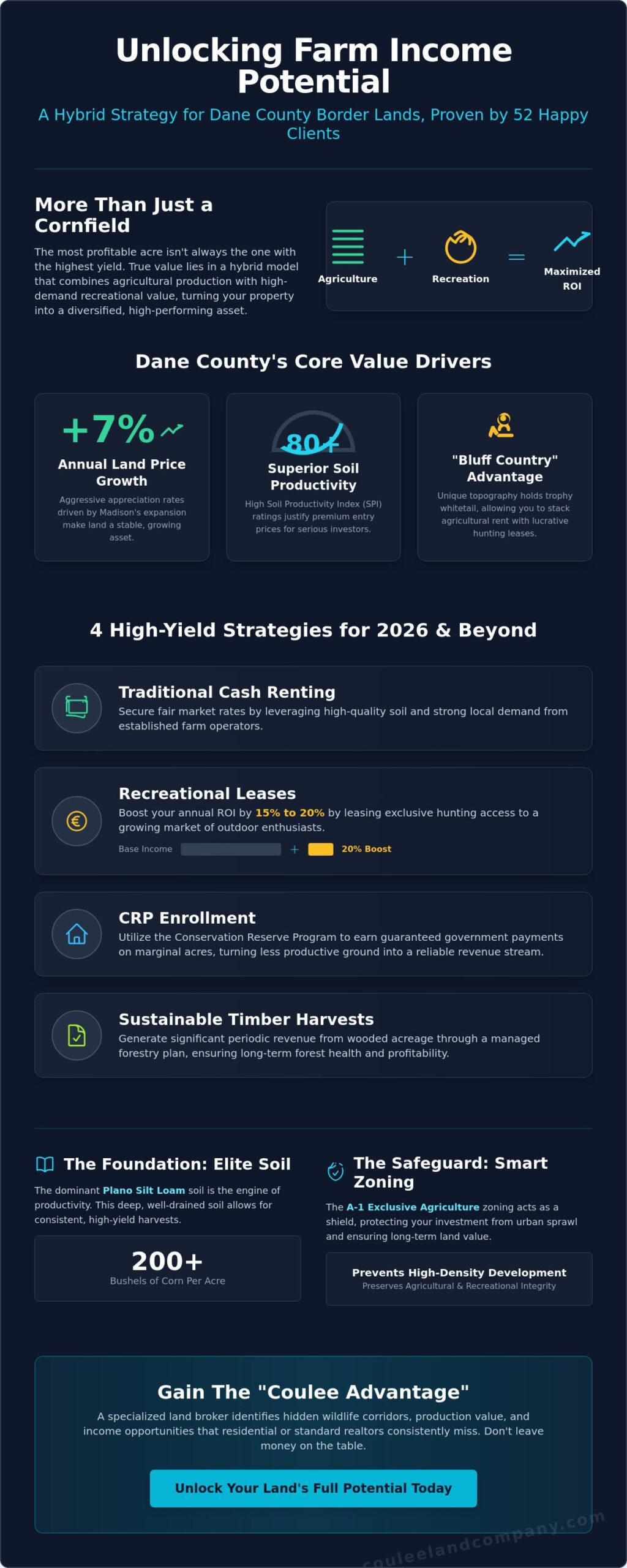
Calculating the Farm Income Potential in Dane County Borders: Strategies from 52 Happy Clients starts with a clear, three-part formula. You have to evaluate the sum of annual agricultural production, available government incentives like CRP payments, and the rising market for recreational lease value. High-quality parcels in this region command a premium because they consistently produce high Soil Productivity Index (SPI) ratings, often exceeding 80 in prime tillable areas. Understanding the broader context of Agriculture in Wisconsin helps buyers realize why these specific border lands are such a stable asset class.
Madison’s steady outward expansion continues to influence land values. Market analysts project that land appreciation rates for 2026 will remain aggressive as residential demand moves toward the county lines. On the western edges, the terrain shifts into the celebrated “Bluff Country” topography. This landscape offers the steep ridges and deep thermal cover that hold trophy whitetail bucks, allowing owners to stack agricultural rent with lucrative hunting leases.
To better understand how to maximize your investment early on, watch this helpful video:
Soil Quality and Crop Yield Expectations
Plano Silt Loam is the dominant soil type that drives value in this corridor. It’s a deep, well-drained silt loam that allows farmers to push corn yields toward 200 bushels per acre during a standard growing season. We’ve observed that “border land” sitting just inside or outside the county line often provides superior value. You’re securing the same high-yielding dirt found in the county’s center but without the heavy “development tax” often baked into prices closer to the city core.
Zoning and Farmland Preservation Impact
The Dane County Farmland Preservation Plan acts as a safeguard for your long-term resale value. Most productive acreage here is protected by A-1 Exclusive Agriculture zoning. This classification is vital because it prevents intrusive high-density residential projects from popping up next door. It ensures the Farm Income Potential in Dane County Borders: Strategies from 52 Happy Clients remains focused on the land’s natural productivity and wildlife capabilities rather than speculative urban sprawl.
5 High-Yield Strategies for Generating Farm Income in 2026
Maximizing the Farm Income Potential in Dane County Borders: Strategies from 52 Happy Clients starts with a diversified approach to land management. Traditional cash renting remains a foundational pillar for many owners. Data from the Dane County agricultural census highlights the high market value of local production, allowing savvy owners to negotiate competitive rates with established operators. However, the most successful owners don’t stop at row crops. By implementing recreational leases, 52 of our clients have added between 15% and 20% to their annual return on investment. This strategy capitalizes on the growing demand for private access to Wisconsin’s premier outdoor spaces.
Smart land use also involves the Conservation Reserve Program (CRP). This federal initiative provides steady income for less productive edge acres, turning marginal soil into a reliable revenue stream while improving local wildlife habitat. For those with wooded acreage in the coulees, sustainable timber management offers a lucrative long-term harvest schedule. Proper thinning and selective cutting every 10 to 15 years ensure the forest remains healthy and profitable for generations.
- Traditional Cash Renting: Secure fair market rates by analyzing soil productivity and local demand.
- Recreational Leases: Boost ROI by 15% or more through exclusive hunting access.
- CRP Enrollment: Earn guaranteed payments on acreage that isn’t suitable for heavy equipment.
- Timber Harvests: Generate significant periodic revenue through managed forestry plans.
Maximizing the Hunting Lease Premium
Whitetail habitat on the borders of Dane County is a high-value asset because it provides the security and food sources trophy bucks require. When you structure a lease correctly, it won’t interfere with your active farming operations or equipment access. You can view several hunting properties that currently command top-tier premiums due to their strategic layout and thick bedding cover.
Government Programs and Tax Incentives
The 2026 Farm Bill updates introduce new opportunities for Wisconsin landowners to secure conservation-based payments. Beyond federal programs, the Managed Forest Law (MFL) is a vital tax-saving tool for wooded acreage in Dane County that reduces property tax burdens in exchange for sustainable forest management. Integrating these incentives ensures your land remains a performing asset. If you’re ready to optimize your holdings, consider speaking with our land specialists to review your options.
Securing Your Investment: Why Expert Brokerage Matters
High entry prices often represent the biggest hurdle for buyers looking at acreage near the Dane County border. It’s a valid concern. You’re not just buying a backyard; you’re investing in a complex asset that requires a specific set of eyes to evaluate. A residential realtor focuses on roof ages and kitchen finishes, but they often miss the hidden value in timber stands or drainage tile. Our team acts as Wisconsin’s Land and Property Sales Specialists because we understand that land value is found in the dirt, the wildlife, and the lease potential.
The “Coulee Advantage” comes from our deep roots in the outdoors. We don’t just walk the property lines; we analyze the terrain through the lens of a land manager. Understanding the Farm Income Potential in Dane County Borders: Strategies from 52 Happy Clients allows us to show you how a property pays for itself over time. Our 52 successful case studies involve buyers who transitioned from urban settings to owning high-performing tracts by focusing on cash rents and conservation programs that offset their initial mortgage costs.
Due Diligence for Farm and Recreational Land
You shouldn’t make an offer without seeing the hard data. We verify yield history through local FSA records and examine USDA soil maps to confirm the land’s productivity. If you’re a hunter, we evaluate the “trophy potential” by looking at local buck-to-doe ratios and neighborhood management trends. This ensures the ground you buy today will produce the Boone and Crockett entries you’re dreaming of tomorrow. For a complete step-by-step guide, view our full due diligence checklist on our Buyers page.
The 2026 Land Market Outlook
Land remains a premier hedge against inflation as we move toward 2026. While currency values fluctuate, the supply of quality Wisconsin tillable and hunting ground stays fixed. We’re seeing increased demand for off-market opportunities, particularly those located near the Buffalo County corridor, where the prestige of the land drives consistent appreciation. Securing these tracts requires a broker who is active in the local community and knows which parcels are moving before they ever hit a public portal.
Ready to build your legacy and secure your piece of the Bluff Country? Contact our Wisconsin Land Specialists today to start your search.
Secure Your Piece of the Wisconsin Legacy
Realizing the full Farm Income Potential in Dane County Borders: Strategies from 52 Happy Clients requires a blend of superior land management and precise market timing. You’ve seen how soil productivity and proximity to Madison drive value, while 2026 high-yield strategies demand a proactive approach to agricultural diversification. Success in this terrain isn’t a matter of luck; it’s a result of working with specialists who understand the unique wildlife capabilities and topography of the region. Coulee Land Company brings authoritative expertise to the table, backed by over 500 successful land transactions across Wisconsin. As specialists in the rugged Buffalo County and Bluff Country terrain, our team is endorsed by top outdoor TV personalities who trust our vision for trophy whitetail properties. We don’t just list land; we help you secure a legacy. Our deep roots in Western Wisconsin ensure you’re making a data-driven investment that aligns with your passion for the outdoors. Take the next step toward owning a piece of the most productive ground in the state today.
View Our Exclusive Wisconsin Land Listings
The right property is waiting for you, and we’re ready to help you find it.
Frequently Asked Questions
What is the average cash rent for farmland in Dane County in 2026?
Average cash rent for non-irrigated cropland in Dane County is projected to reach approximately $278 per acre by 2026. This figure follows the 4.5 percent annual increase trend documented in the 2024 USDA National Agricultural Statistics Service report. High-quality tracts with superior soil productivity ratings often command premiums exceeding $310 per acre, while less productive pasture land typically rents for significantly less.
How much can I realistically earn from a hunting lease on 80 acres?
You can realistically earn between $1,600 and $2,800 annually from a hunting lease on 80 acres of quality Dane County habitat. This translates to a market rate of $20 to $35 per acre. These figures depend on the density of trophy whitetail bucks and the mix of timber cover. Maximizing this revenue is a core part of the Farm Income Potential in Dane County Borders: Strategies from 52 Happy Clients.
Does farmland preservation zoning decrease my property’s market value?
Farmland preservation zoning doesn’t inherently decrease market value, but it does limit immediate residential subdivision to protect agricultural integrity. Data from the Wisconsin Department of Agriculture shows that participants in the Farmland Preservation Program receive tax credits ranging from $7.50 to $12.50 per acre. These credits directly offset property taxes, which helps maintain the net land value for long-term investors and active producers.
Can I build a home on land zoned for Exclusive Agriculture in Dane County?
You can build a home on land zoned for Exclusive Agriculture (FP-35) if the property meets the density requirement of one residential lot per 35 acres. The Dane County Zoning Code requires a formal petition and adherence to specific siting standards that protect prime agricultural soils. Our specialists use these regulatory insights to help owners realize the Farm Income Potential in Dane County Borders: Strategies from 52 Happy Clients while preserving future building spots.