
The smartest land investment in Western Wisconsin right now isn’t found in the over-saturated markets of the south, but in the rugged, high-yielding terrain of the north. You’ve probably watched land prices in traditional trophy counties skyrocket over the last 24 months, making it harder to justify a purchase that doesn’t generate its own return. We know the frustration of scouting properties only to find depleted soil or signs of heavy public pressure. By Exploring Chippewa County Acreage: Hunting and Farming Opportunities Revealed, you’ll see why this region is the premier destination for dual-purpose ownership. It’s a place where high-yield agricultural potential meets the same world-class whitetail genetics that put Buffalo County on the map.
You deserve a property that pays for itself through strategic agricultural leases without sacrificing the thrill of a private bluff country hunt. We’ve analyzed the local land market trends for 2026 to help you navigate these shifting opportunities with confidence. This guide uncovers how to secure elite hunting ground while leveraging productive tillable acres to offset your mortgage. We’ll examine the specific soil profiles and wildlife corridors that make this county a hidden gem for the serious land manager.
Key Takeaways
- Discover why Chippewa County offers a superior “value gap” compared to saturated markets, providing the same rugged Bluff Country aesthetic at a more strategic price point for 2026.
- Learn how the terminal moraine’s glacial history created elite hunting grounds and why Antigo Silt Loam is the secret to high-yield food plots and agricultural productivity.
- By Exploring Chippewa County Acreage: Hunting and Farming Opportunities Revealed, you will learn how to maximize your ROI through a dual-income model that balances tillable land leases with trophy whitetail management.
- Master the essential buyer’s checklist to avoid common pitfalls like landlocked parcels and to ensure the surrounding acreage is under proper land management.
- Understand why partnering with a “Hunter’s Realtor” is the only way to uncover off-market opportunities and see the true potential in a property that standard agents often miss.
The Rise of Chippewa County: Why Acreage Here is a Tier-1 Investment in 2026
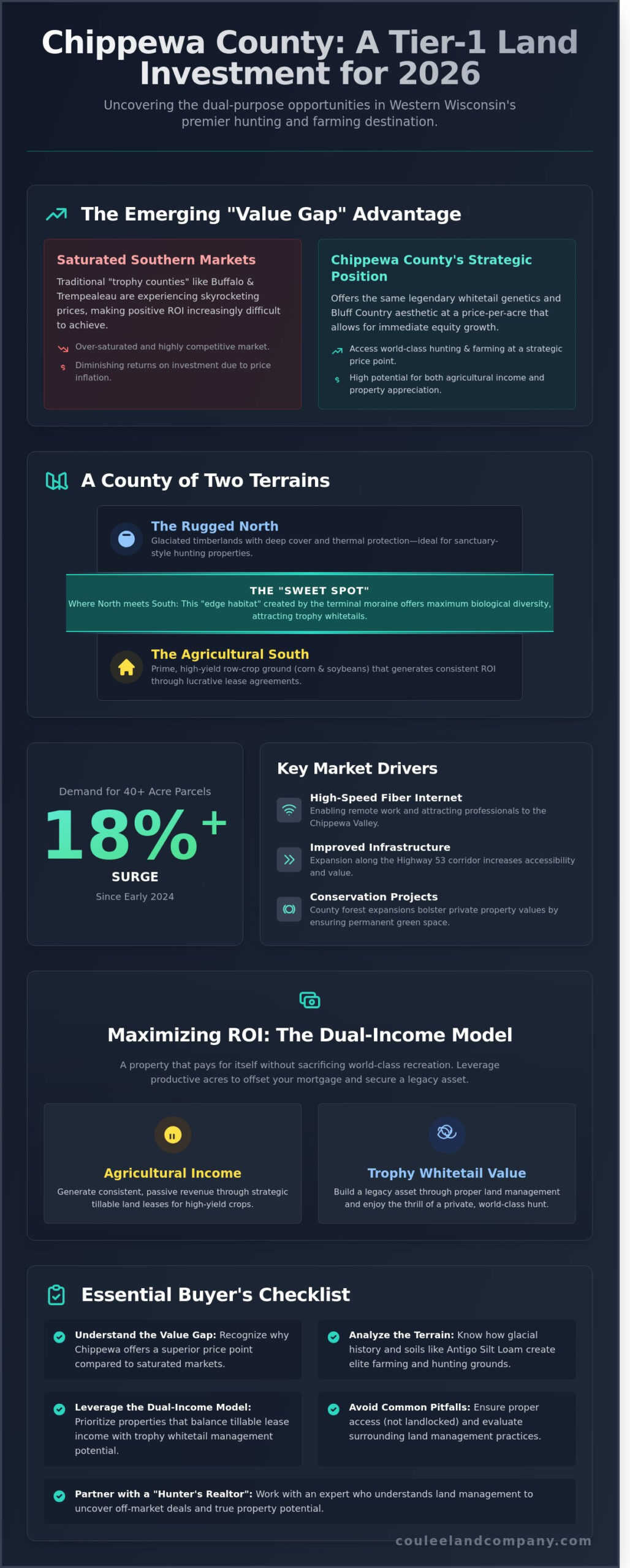
Chippewa County is no longer a hidden secret for those seeking elite Wisconsin soil. As we move into 2026, the region has solidified its status as a tier-1 investment destination. It offers a strategic blend of the “Bluff Country” aesthetic that defines Buffalo County and the high-yield agricultural productivity of the Central Plain. This unique intersection creates a land market that serves both the serious producer and the trophy hunter. When Chippewa County, Wisconsin is compared to saturated markets like Buffalo or Trempealeau, a clear “Value Gap” emerges. Buyers are securing high-quality acreage at a price-per-acre that allows for immediate equity growth while accessing the same legendary whitetail genetics found further south.
To visualize the potential of this landscape, watch this walkthrough of a premier local property:
The shift we’re seeing in 2026 is fundamental. Land isn’t just a place for a weekend cabin; it’s a vehicle for long-term wealth preservation. Investors are moving capital out of volatile markets and into tangible assets like hunting properties and tillable ground. Exploring Chippewa County Acreage: Hunting and Farming Opportunities Revealed shows that the Western Wisconsin corridor is the primary target for this migration. By acquiring land here, you’re not just buying dirt; you’re securing a legacy asset in a region with proven biological and economic resilience.
Geography of Opportunity: North vs. South County
The county is split by a distinct geological transition. The Southern agricultural flats consist of prime row-crop ground, often yielding high-bushel corn and soybeans that support lucrative lease agreements. These parcels are typically easier to farm and offer consistent ROI. The Northern timberlands offer rugged, glaciated terrain. This is where you find sanctuary-style properties with deep cover and heavy thermal protection. “The Line” where these two ecosystems meet creates maximum biological diversity. This edge habitat is exactly what trophy bucks crave, making it the “sweet spot” for land management specialists.
Market Trends: The 2026 Outlook for Western Wisconsin
Demand for parcels with 40+ acres has surged by 18% since early 2024. This growth is fueled by the expansion of high-speed fiber internet and improved infrastructure along the Highway 53 corridor. Remote work allows professionals to manage global operations from a farmhouse in the Chippewa Valley. Local conservation projects, such as the Chippewa County Forest expansions, also bolster private property values by ensuring permanent green space and managed wildlife corridors nearby. For buyers looking to enter the market, 2026 represents the final window before these price gaps close entirely. The combination of agricultural income and recreational value makes this county a powerhouse for any portfolio.
Decoding the Terrain: How Glacial History Created Elite Hunting & Farming Grounds
Chippewa County owes its world-class status to the Wisconsin Glaciation, which ended roughly 10,000 years ago. The terminal moraine created a rugged transition zone where the glaciated north meets the unglaciated style terrain. This geological clash produces the diversity needed for Exploring Chippewa County Acreage: Hunting and Farming Opportunities Revealed. You’ll find sharp glacial ridges that drop into fertile bottomlands, providing natural travel corridors for mature bucks. The Chippewa River and its many tributaries, like the Yellow River and Fisher River, act as the lifeblood of these properties. These waterways don’t just provide hydration; they dictate how deer move through the landscape, creating predictable patterns for hunters during the rut.
Timber composition in this region is equally diverse. It ranges from productive oak savannas to dense pine thickets. These pines offer essential thermal cover when winter temperatures drop below zero, keeping deer on your property year-round. This mix of food and cover is why the area remains a top destination for serious land buyers.
Antigo Silt Loam: The Farmer’s Secret Weapon
Antigo Silt Loam is Wisconsin’s official state soil for a reason. It offers superior drainage while maintaining the nutrient retention necessary for heavy-hitting crops. According to the 2022 Census of Agriculture for Chippewa County, the region supports 1,811 farms, proving the productivity of this ground. For the land manager, this soil quality translates directly into antler growth. High calcium and phosphorus levels in the soil mean your food plots aren’t just green; they’re nutrient-dense fuel for trophy whitetails. Antigo Silt Loam is the foundation for both high-yield corn and Boone and Crockett whitetails.
The ‘Edge Effect’ in Western Wisconsin
Wildlife thrives on the margins. In Chippewa County, the “edge effect” is maximized where hardwood timber meets active agriculture. This intersection provides the high-protein diet of a farm field alongside the security of thick bedding. Smart land buyers look for properties where glacial ridges create natural funnels, forcing deer into narrow gaps between steep terrain and water. You can use professional tactics for scouting for deer in hills to master how these elevation changes influence wind currents and stand placement. Understanding these nuances is what separates a casual hunter from a consistent producer. If you’re ready to find your own piece of this dirt, check out our current hunting properties to see what’s available.
Maximizing ROI: Combining Agricultural Income with Trophy Whitetail Management
Owning land in Western Wisconsin is a dream for many, but the smartest investors understand that the best properties pay for themselves. Exploring Chippewa County Acreage: Hunting and Farming Opportunities Revealed shows that successful land ownership balances passion with a pragmatic business model. By leasing tillable acreage to local farmers, you create a steady annual revenue stream while retaining exclusive hunting rights for yourself. This dual-income strategy offsets property taxes and management costs, making the pursuit of a trophy buck a sustainable financial endeavor. It’s about making the land work for you while you wait for the rut to kick in.
Revenue isn’t limited to active farming. Government programs like the Conservation Reserve Program (CRP) offer payments for taking sensitive environmental areas out of production. These areas often become the best bedding cover on the property, providing the security mature bucks crave. According to the latest Chippewa County agricultural statistics, the region maintains a diverse agricultural base with over 350,000 acres in farms. This robust market makes finding a reliable tenant farmer straightforward. Strategic food plotting using agricultural waste or dedicated stands of brassicas and corn helps hold deer on your land throughout the winter. Timber Stand Improvement (TSI) adds another layer of long-term value. Sustainable logging provides immediate cash flow and improves forest health, creating the thick undergrowth trophy whitetails need to reach maturity.
The Economics of Agricultural Leases
Most landowners in Chippewa County choose between cash rent and sharecropping. Cash rent is popular because it provides a guaranteed payment per acre, regardless of the harvest. Sharecropping allows you to take a percentage of the crop, which can be beneficial if commodity prices are high. When you draft a lease, specify that farming activities must conclude before the archery opener. This protects your hunting season and ensures the property stays quiet when it matters most. If you’re considering a transition, our team can assist with selling hunting land in Wisconsin to ensure you capture every bit of this built-in value.
Wildlife Capabilities: Beyond the Whitetail
While the whitetail is king, Chippewa County offers diverse recreational opportunities that increase land value. The county’s turkey populations are thriving, providing excellent spring use when most hunting properties sit idle. You’ll also find significant black bear and waterfowl opportunities in the lowlands and creek bottoms. Managing for multiple species makes your property more attractive to future buyers. Following a plan for Wisconsin land management for wildlife ensures you aren’t just hunting; you’re building a legacy. Exploring Chippewa County Acreage: Hunting and Farming Opportunities Revealed proves that high-quality land is a versatile asset that rewards diligent management year-round.
The Buyer’s Checklist: Evaluating Chippewa County Properties for Long-Term Value
Purchasing land is a high-stakes investment that requires more than a casual walk-through. When you are Exploring Chippewa County Acreage: Hunting and Farming Opportunities Revealed, the difference between a legacy property and a financial burden often lies in the due diligence. You aren’t just buying dirt; you’re buying potential and local history. Use this professional checklist to ensure your investment stands the test of time.
- Step 1: Verify access points. Rugged terrain can hide legal “landlocked” traps. Always confirm deeded access or recorded easements before closing.
- Step 2: Analyze the neighbors. High-pressure hunting on bordering tracts can ruin your management efforts. Look for neighbors practicing QDM (Quality Deer Management) to protect your trophy potential.
- Step 3: Conduct a soil test. Whether you’re planting corn or a clover plot, you need to know the pH and nutrient levels. Wisconsin’s Antigo silt loam is prized, but sandy pockets in the region can limit yields.
- Step 4: Check for utility easements. Power lines or gas mains can restrict where you plant trees or build structures.
- Step 5: Assess the building site. Look for high ground with proper drainage to ensure a stable foundation for a country home or hunting cabin.
Access and Infrastructure
In the hill country of Western Wisconsin, access is everything. “Top access” allows you to enter stands without spooking deer in the valley bottoms; it’s the gold standard for serious bowhunters. Existing trail systems should be evaluated for their impact on scent control and equipment movement. If you’re looking near the New Richmond area, year-round road maintenance is vital. Heavy snow can turn a private drive into a multi-day shoveling project if the infrastructure isn’t built to municipal standards.
Zoning and Conservation Easements
Smart buyers use the Managed Forest Law (MFL) to their advantage. Enrolling your woods in MFL can reduce property taxes by approximately 80 percent, though it requires a 25 or 50-year commitment to sustainable logging. Permanent conservation easements offer different benefits, protecting the land from development while potentially providing significant tax deductions. You’ll want to review the specific restrictions on any easement to ensure they don’t clash with your farming goals. Exploring Chippewa County Acreage: Hunting and Farming Opportunities Revealed means understanding these legal layers. Consult our buyers’ resources for a full pre-purchase checklist to navigate these complexities.
Ready to find your piece of the Wisconsin landscape? Browse our exclusive hunting and farm listings today.
Navigating the Market: Why Expert Brokerage is Essential for Chippewa County Land
Buying land isn’t like purchasing a suburban home. A standard residential agent looks at square footage and kitchen finishes, but they’ll often miss the “bone” in a property. In the rural reaches of Western Wisconsin, value is found in the timber quality, the soil’s productivity, and the hidden deer bedding areas. Exploring Chippewa County Acreage: Hunting and Farming Opportunities Revealed requires a partner who understands that a 40-acre tract is a complex ecosystem, not just a lot on a map.
The Coulee Land Company approach bridges the gap between old-school scouting and modern technology. Our team puts boots on the ground to identify pinch points and water sources that define a premier hunting property. By 2026, the complexities of rural transactions have increased, requiring precise knowledge of conservation easements, tax programs like Managed Forest Law (MFL), and local zoning regulations that can impact your investment goals.
- Off-Market Access: We maintain deep ties with local farmers and multi-generational landowners, often finding deals before they ever reach a public listing site.
- High-Tech Mapping: We use advanced topographical overlays to visualize how wind patterns and elevation changes affect wildlife movement across the terrain.
- Pragmatic Closing: We handle the grit of rural inspections and boundary disputes so you don’t have to worry about the fine print.
The Value of a Land Specialist
Specialists like Mike Law or Bryan Lemke bring a hunter’s eye to every evaluation. They don’t just see trees; they see wildlife capabilities. They identify where a food plot should sit and how a buck will utilize the thermal cover in the Bluff Country. We use professional drone mapping to provide a bird’s-eye view of the Chippewa Valley terrain, ensuring you see the full potential of the dirt before you sign. This level of detail is why we’re known as Wisconsin’s Land and Property Sales Specialists.
Start Your Chippewa County Journey
Your search for the perfect piece of ground starts with the right data. You can set up custom property alerts to ensure you’re the first to know when new acreage hits the market. For sellers, our targeted marketing strategy ensures your land is seen by serious buyers who value the legacy of the outdoors as much as you do. Exploring Chippewa County Acreage: Hunting and Farming Opportunities Revealed is about more than a transaction. It’s about securing a piece of Wisconsin that your family will enjoy for generations. Land isn’t just an asset; it’s the foundation of your outdoor lifestyle.
Secure Your Legacy in Wisconsin’s Premier Hunting Grounds
Chippewa County stands as a Tier-1 investment for 2026, where unique glacial history meets elite land management. You aren’t just buying dirt. You’re securing a dual-income asset that balances high-yield agricultural production with the pursuit of trophy whitetails. Exploring Chippewa County Acreage: Hunting and Farming Opportunities Revealed proves that the right property provides both financial stability and world-class recreation in the heart of Bluff Country.
Coulee Land Company brings over 20 years of combined land management and brokerage expertise to your search. We’re recognized as the specialists in Buffalo and Chippewa County, a reputation endorsed by leading outdoor television personalities who trust our deep understanding of wildlife capabilities. Our team acts as your expert guide, ensuring every acre meets the rigorous standards required for long-term value and hunting success.
View our exclusive Chippewa County hunting and farming listings today and start building your legacy on the finest ground Western Wisconsin has to offer. Your piece of the legendary Wisconsin landscape is waiting for you.
Frequently Asked Questions
Is Chippewa County good for trophy whitetail hunting?
Chippewa County is a premier destination for trophy whitetail hunting, particularly within the Transition Zone where agricultural fields meet dense timber. This specific geography provides a superior mix of high-protein feed and secure bedding cover. When exploring Chippewa County acreage: hunting and farming opportunities revealed in this region often highlight the 150-plus inch class bucks that thrive on these nutrient-rich edges and secluded woodlots.
Can I farm land in Chippewa County while living elsewhere?
You can absolutely farm land in Chippewa County while residing in another state or city by utilizing cash-rent leases with local operators. This arrangement allows your property to generate consistent annual income and maintain its specialized Agricultural tax status under Wisconsin Chapter 70.114 guidelines. It’s a pragmatic strategy for absentee owners who want to focus on recreation while local farmers manage the 100 or 200 acres of tillable ground.
What is the average price per acre for land in Chippewa County?
Chippewa County provides a more accessible entry point for land buyers compared to Buffalo County while maintaining elite trophy potential. While exact prices depend on the 60 percent or 70 percent tillable ratio and timber quality, the market remains competitive for those seeking high-value hunting ground. Our team analyzes recent sales data to ensure you’re making a sound investment in a region that consistently produces world-class wildlife capabilities.
Are there many public hunting lands in Chippewa County?
There are over 33,000 acres of County Forest available for public use in Chippewa County. However, private land ownership is the only way to truly manage habitat and control hunting pressure for mature bucks. When exploring Chippewa County acreage: hunting and farming opportunities revealed through private ownership allow you to implement 5-acre food plots and strict harvest quotas that public lands simply cannot offer.
What are the soil types like for farming in this region?
The region features the famous Antigo Silt Loam, which the Wisconsin State Legislature designated as the official state soil in 1983. This soil type is highly productive for corn, soybeans, and specialized food plots, particularly in the central and southern townships. It offers excellent drainage and nutrient retention. This makes it a top choice for landowners who want to maximize their agricultural yields and attract trophy whitetails.
Do I need a special permit to build a cabin on hunting land?
Building requirements for a cabin depend on the specific township ordinances and whether the land is zoned as Agricultural or Residential. You’ll need to verify septic and well requirements with the Chippewa County Planning and Zoning Department before you start construction. It’s essential to review these regulations early in the buying process to ensure your 40-acre or 80-acre tract can accommodate your dream hunting camp.