
What if the trophy buck you’ve been tracking for three seasons is the last one your family ever sees on your property because an unexpected tax bill forced a developer’s hand? You’ve spent decades managing timber and perfecting food plots in the heart of Wisconsin’s Bluff Country, and you know this land is far more than just a financial asset. It’s a heritage of habitat that deserves a bulletproof future. Most owners we talk to share your exact fear. They don’t want their kids forced to sell the farm just to settle with the state. Effective estate planning for landowners wisconsin treats your acreage as a living legacy, ensuring the ridge tops and valley floors stay in your family’s hands.
We’re going to show you exactly how to protect your soil, minimize your tax liability, and navigate complex state laws. You’ll learn how to utilize tools like Transfer on Death deeds to avoid the public probate process and meet critical deadlines, such as the October 1, 2026, cutoff for Farmland Preservation Agreements. This article covers everything from forming an LLC to managing the 0.2% probate fee on estates over $10,000. We’ll give you a clear roadmap to keep your land a productive hunting or agricultural asset for generations.
Key Takeaways
- Avoid the “Heir Paradox” by learning why simply dividing acreage among children often leads to a forced sale and the destruction of your hunting heritage.
- Discover how to utilize LLCs and Family Limited Partnerships to manage your property as a business, preserving its wildlife capabilities for future generations.
- Understand the strategic use of irrevocable trusts to shield your bluff country investment from long-term care costs and high property tax burdens.
- Master the technical side of estate planning for landowners wisconsin by obtaining professional valuations that account for both timber value and trophy whitetail potential.
- Formalize your legacy with a transition plan that integrates Managed Forest Law (MFL) contracts and specific land management goals to keep your farm productive.
Why Standard Estate Planning Often Fails Wisconsin Landowners
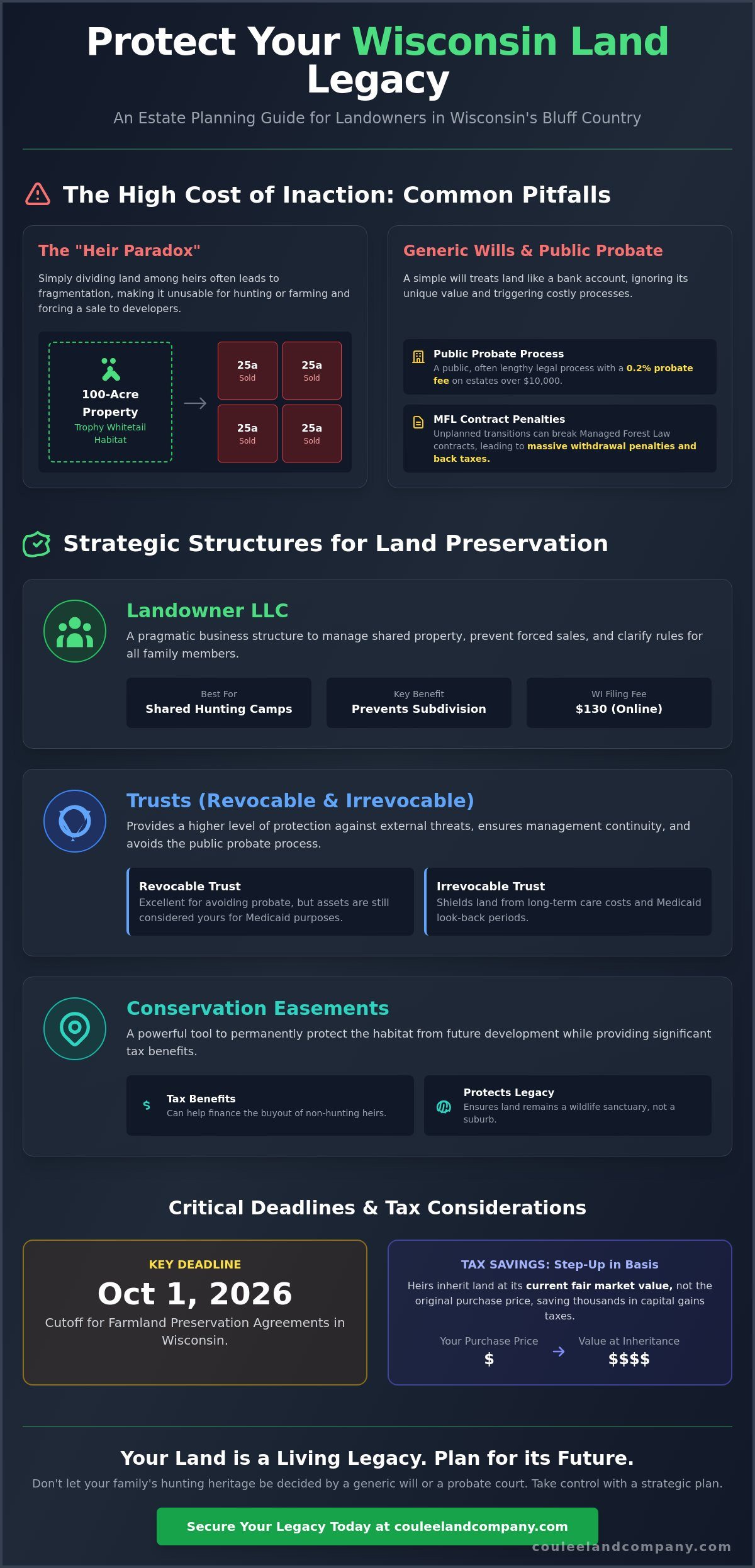
Land estate planning is the strategic process of preparing for the transfer of property ownership while maintaining its conservation and agricultural value. In the heart of Wisconsin’s Bluff Country, where agricultural land values reached an average of $4,263 per acre in 2022, your property is likely your most significant asset. If you rely on a generic plan, you risk the “Heir Paradox.” This occurs when a 100-acre parcel is divided equally among four children. What was once a premier hunting property becomes four 25-acre lots, often too small to manage for trophy whitetails and too expensive for individual heirs to maintain. This fragmentation almost always leads to a forced sale.
To better understand the legal landscape and recent shifts in state policy, watch this helpful video:
Effective estate planning for landowners wisconsin also accounts for the “Step-up in Basis” rules active in 2026. This tax provision allows heirs to inherit land at its current fair market value rather than your original purchase price. If you bought a ridge top in Buffalo County decades ago, this step-up can save your family hundreds of thousands in capital gains taxes. Without a plan that specifically identifies these rural assets, your family might miss these critical financial protections.
The Problem with Generic Wills for Acreage
A simple will treats your land like a bank account, but acreage isn’t liquid. Generic documents don’t protect against developers who target subdivided family plots. They also fail to address Managed Forest Law (MFL) contracts. With 16 million acres of forestland in Wisconsin, many owners are enrolled in MFL for tax relief. If an unplanned transition breaks these contracts, your heirs could face massive withdrawal penalties and back taxes that force them to liquidate the land immediately.
Identifying Your Legacy Goals
You must distinguish between simply “keeping it in the family” and “keeping it as a trophy hunting asset.” If some heirs don’t hunt, they may prefer cash over timber. Using Conservation Easements can protect the habitat from future development while providing tax benefits that help you buy out non-hunting heirs. This ensures the land remains a productive farm or wildlife sanctuary rather than becoming a suburban cul-de-sac. It’s about protecting the dirt, the deer, and the dream.
Choosing the Right Structure: LLCs, Trusts, and Conservation Easements
Selecting the correct legal vehicle is the difference between a thriving family heritage and a messy legal dispute. For most, effective estate planning for landowners wisconsin involves balancing control today with protection tomorrow. While Section 1 highlighted the risks of generic wills, these specialized structures offer the precision needed for complex rural assets. You aren’t just passing down a deed; you’re transferring a management system for ridge tops and valley floors.
The Landowner LLC: A Hunter’s Best Friend?
A Wisconsin LLC is a pragmatic tool for families who share a hunting camp. The online filing fee is just $130, and it allows you to create an operating agreement that dictates guest policies, stand locations, and maintenance costs. This structure prevents one sibling from forcedly subdividing the land. If the family eventually decides to move on, having a clear title within an LLC makes Selling Hunting Land in Wisconsin a much cleaner process for everyone involved.
Trusts for Multi-Generational Legacy
Trusts provide a higher level of protection against external threats like long-term care costs. A revocable living trust is excellent for avoiding the public probate process, but an irrevocable trust can shield the land from Medicaid look-back periods. You can even appoint a “Land Manager” trustee. This person ensures that Wisconsin land management for wildlife continues uninterrupted, funding food plots and timber stand improvements even after you’ve passed the torch.
For those committed to permanent protection, conservation easements offer a way to trade development rights for significant tax breaks. By partnering with Wisconsin’s Alliance for Land Trusts, you ensure your trophy whitetail habitat remains untouched by bulldozers forever. This is especially relevant in 2026, as landowners look toward the May 29 deadline for the Agricultural Conservation Easement Program (ACEP) to secure federal assistance. If you want to understand how these structures affect your specific acreage, our expert land agents can help you evaluate your property’s unique wildlife capabilities.
4 Steps to Preparing Your Wisconsin Property for Transition
Executing a successful transition requires a tactical approach to your dirt. While legal structures provide the framework, these four steps ensure the land remains a high-functioning asset rather than a burden. Effective estate planning for landowners wisconsin requires more than just a signature on a will; it demands a clear roadmap for those who will walk your ridges next.
- Step 1: Get a professional land valuation that accounts for wildlife capabilities and timber value.
- Step 2: Formalize your land management plan, including MFL contracts and food plot locations.
- Step 3: Conduct a family “Land Summit” to gauge interest and set expectations among heirs.
- Step 4: Consult with a specialized land broker and estate attorney to finalize the paperwork.
For a deeper dive into the technical side, A Wisconsin landowner’s guide to conservation-based estate planning provides an excellent educational foundation for protecting your acreage. Using this resource helps you align your conservation goals with the legal tools available in the Badger State.
Accurate Valuation for Bluff Country Properties
Standard residential appraisals are useless for Bluff Country. They treat a ridge top like any other vacant lot, often missing the “trophy value” that defines our region. A standard appraisal fails to capture the true worth of Buffalo County deer hunting potential. You need specialists like Mike Law or Bryan Lemke who understand how a specific funnel or a south-facing slope adds thousands in market value to hunting properties.
Documenting the Knowledge Base
The final piece of estate planning for landowners wisconsin is creating a “Landowner Manual.” You’ve spent years learning where the stands should go, where the property lines sit, and which thickets hold the best bedding areas. If your heirs don’t understand the work required to maintain trails or manage food plots, they won’t be able to preserve the legacy you’ve built. Documenting this knowledge prevents the land from falling into disrepair and ensures the hunting heritage remains intact for generations.
Secure Your Bluff Country Legacy Today
Your land represents years of hard work and a deep connection to the outdoors. We’ve outlined how generic wills often fail rural properties and how specialized tools like LLCs keep your acreage from being subdivided. By documenting your management practices and understanding the “Step-up in Basis” rules active in 2026, you protect your family from unnecessary tax burdens. You’ve spent a lifetime building this heritage; don’t let a lack of preparation dissolve it.
Success in estate planning for landowners wisconsin depends on a partner who knows the dirt as well as the law. Coulee Land Company serves as Wisconsin’s Land & Property Sales Specialists, bringing a deep understanding of Bluff Country land management to every consultation. Our expertise in Buffalo County trophy whitetail land ensures your property is valued for its true wildlife capabilities, not just its soil quality.
Take control of your transition plan now. Contact our Wisconsin Land Specialists for a professional property valuation to start the process. Your legacy is worth the effort of a professional plan.
Frequently Asked Questions
Does Wisconsin have an inheritance or estate tax in 2026?
Wisconsin does not currently impose a state-level inheritance or estate tax in 2026. This allows families to transfer property without a state tax bill immediately coming due upon the owner’s death. However, you must still account for federal estate tax thresholds and the Wisconsin probate fee. For estates valued over $10,000, the court charges a filing fee of 0.2% of the gross estate value minus any liens.
Can I keep my land in the Managed Forest Law (MFL) program after I pass it to my kids?
Yes, the Managed Forest Law status stays with the property when it transfers to your heirs. Your children must file a Notice of Conveyance and a Report of Ownership with the Wisconsin DNR within 30 days of the transfer to avoid contract violations. Maintaining this status is a core part of estate planning for landowners wisconsin because it preserves the property tax benefits you’ve established over decades of management.
What is the best way to prevent my children from selling the family hunting land?
Creating a Limited Liability Company (LLC) with a rigorous operating agreement is often the most effective strategy. You can include right of first refusal clauses that require any sibling wanting to sell their share to offer it to other family members first at a set price. This prevents outside parties from buying into the family ridge. It ensures your trophy whitetail habitat remains a cohesive unit rather than being subdivided by developers.
How much does it cost to set up a land-specific LLC in Wisconsin?
The state filing fee to form a Wisconsin LLC is $130 for online submissions and $170 for mail filings as of May 2026. This is a critical step in estate planning for landowners wisconsin to ensure liability protection and structured management. Beyond the initial setup, you must account for a recurring annual report fee of $25 for online filing. These small costs protect the long term integrity of your hunting camp.