
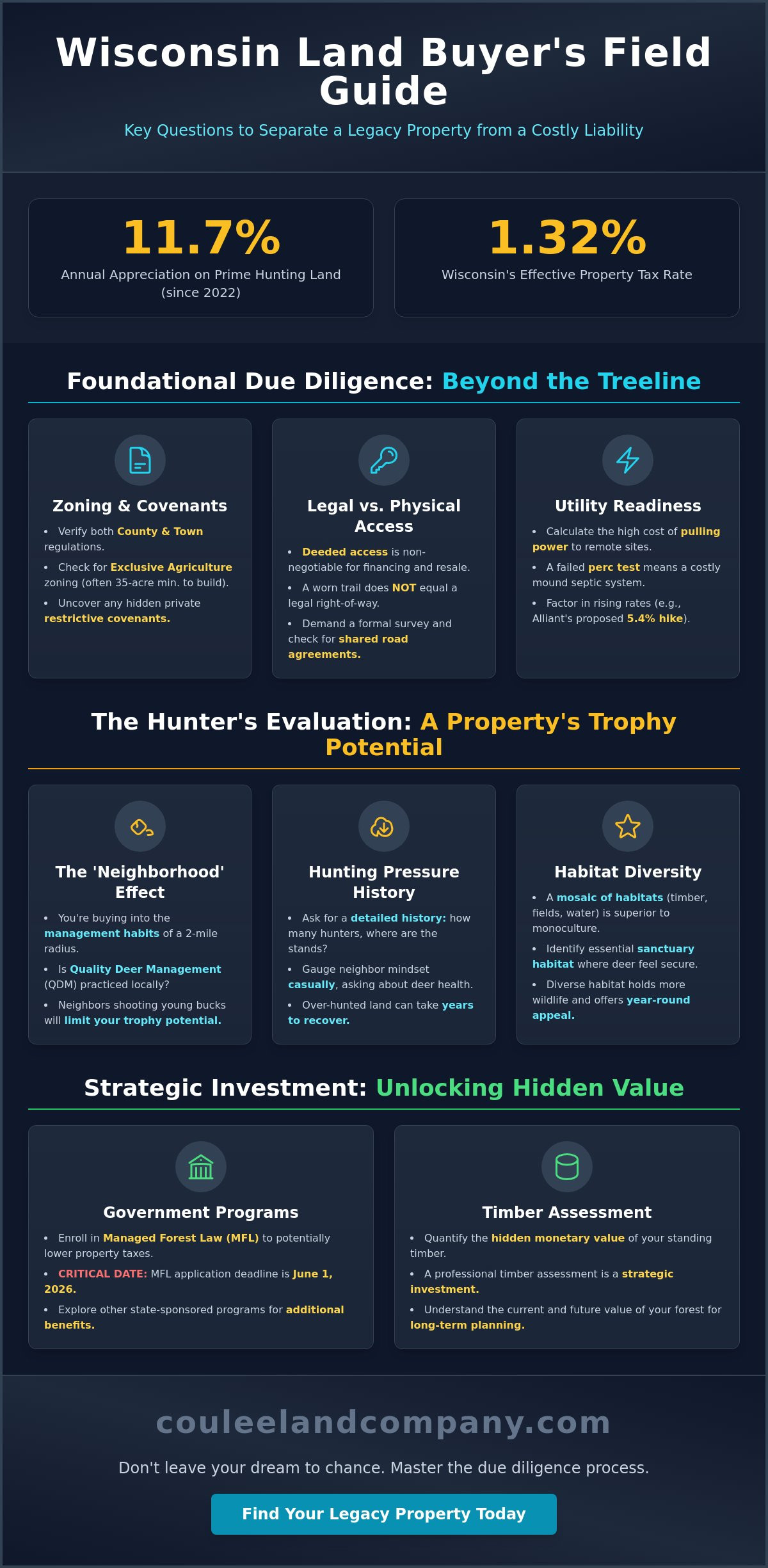
That 80 acre ridge in Buffalo County might look like a whitetail paradise on a satellite map, but without a recorded easement or a passing perc test, it is just an expensive place to park a truck. You have likely spent years dreaming of owning a piece of the Badger State, envisioning crisp November mornings in a stand or a quiet cabin by the water. However, with Wisconsin’s effective property tax rate sitting at 1.32% and prime hunting land appreciating by 11.7% annually since 2022, the stakes for your due diligence have never been higher. Knowing the specific questions to ask when buying land in Wisconsin is the only way to separate a legacy property from a costly liability.
We understand that you are looking for more than just acreage; you are seeking a strategic investment in the outdoors. This guide will help you master the due diligence process by identifying the red flags that many buyers overlook. From the June 1, 2026, Managed Forest Law application deadline to the updated NR 812 well drilling regulations, we provide the expert framework you need. You will learn how to verify ironclad legal access, evaluate trophy potential under current CWD carcass transport rules, and navigate the complexities of use-value assessments to ensure your Wisconsin land dream remains a reality.
Key Takeaways
- Distinguish between physical trails and ironclad legal access to ensure your property remains reachable and valuable for generations.
- Uncover the critical questions to ask when buying land in Wisconsin regarding local zoning limits that could otherwise restrict your ability to build a cabin or home.
- Evaluate a property’s true trophy potential by vetting the hunting pressure of neighboring tracts and identifying essential sanctuary habitat.
- Quantify the hidden value of your investment through professional timber assessments and strategic enrollment in state-sponsored land programs.
- Secure a legacy property by mastering the due diligence steps that separate high-value hunting grounds from “dead” land with no wildlife potential.
Foundational Questions: Zoning, Deeded Access, and Utility Readiness
Securing a legacy tract in the Coulee Region requires more than a handshake and a walk through the timber. You must start with the rigid technicalities that define a property’s true utility. One of the most critical questions to ask when buying land in Wisconsin involves the specific zoning classification. A parcel might look like the perfect spot for a cabin, but local ordinances dictate the reality of your buildable footprint. Professionals in hunting land brokerage often see buyers blinded by a view while ignoring the legal constraints beneath their feet.
To better understand the core elements of land acquisition, watch this helpful video:
Navigating Wisconsin Zoning and Land Use Restrictions
Local control is a hallmark of the Badger State. Zoning authority often rests with both the County and the Town boards; you must verify that your plans align with both jurisdictions. In high-value areas like Buffalo County, Exclusive Agriculture zoning is common. Exclusive Agriculture zoning is a state-certified classification intended to protect farmland that typically requires a 35-acre minimum for any residential construction. Beyond public law, always check for private restrictive covenants. These can exist even on remote acreage. A deep dive into understanding zoning regulations will reveal if your vision for a modern hunting lodge is even legally permissible.
Confirming Legal vs. Physical Access
Never assume a well-worn trail translates to a legal right of way. Physical access is a convenience, but deeded access is a requirement for financing and resale value. Many Wisconsin parcels are landlocked or rely on prescriptive easements, which are notoriously difficult to defend in court. A formal survey is non-negotiable to identify the exact boundaries and any existing maintenance agreements for shared private roads. If you are sharing a driveway with a neighbor, you need to know who is responsible for the gravel and the snow plow before the first blizzard hits.
Utility readiness is the final pillar of this phase. In remote sections of Western Wisconsin, the cost of pulling power to a property line can be staggering. With Alliant Energy proposing a 5.4% increase in electric rates for 2026, operational costs are rising. Additionally, you must assess the soil’s percolation history. A failed perc test means you cannot install a conventional septic system. Instead, you might be forced into a mound system, which often costs significantly more than a standard setup. These technical details are the essential questions to ask when buying land in Wisconsin to ensure your investment is sound.
The Hunter’s Evaluation: Questions to Uncover a Property’s Trophy Potential
A property’s market value is often tied to its buildability, but for the serious outdoorsman, the true worth lies in the genetics and age structure of the local whitetail herd. High-value tracts in Buffalo County command a premium because of a long-standing culture of quality deer management. When vetting a potential purchase, the most vital questions to ask when buying land in Wisconsin center on the “neighborhood” reputation. You aren’t just buying 40 or 80 acres; you’re buying into the management habits of everyone within a two-mile radius. If the neighbors are shooting every yearling buck that crosses the fence, your ability to grow and hold mature trophies is severely compromised.
Analyzing Habitat Diversity and Hunting Pressure
The best hunting properties offer a mosaic of habitat types rather than a monoculture of timber. Ask the seller or agent for a detailed history of hunting pressure. You need to know how many hunters have been in the woods and where the primary stands are located. When meeting neighbors, keep it casual. Ask about their general observations of local deer health rather than specific antler scores to gauge their management mindset. A property that has been over-hunted may take several seasons of total sanctuary status to recover. In the rugged Bluff Country, year-round water sources like hidden springs or limestone creeks are magnets for wildlife. While Wisconsin zoning laws might dictate where you can build your lodge, the presence of mast-producing Red and White Oaks will dictate where the deer spend their time during the 2026 gun deer season, scheduled for November 21 through November 29.
Topography and Wildlife Movement Patterns
In the Coulee Region, topography is your greatest ally or your biggest obstacle. You must ask how the “lay of the land” creates natural funnels and pinch points. Mature bucks use the terrain to move securely, often hugging the upper third of a ridge or utilizing narrow benches. Seek out properties with designated sanctuary areas, thick cover that remains undisturbed to hold mature bucks year-round. South-facing slopes are particularly valuable in Wisconsin as they provide critical thermal cover during the late season when temperatures plummet. Understanding these micro-climates is essential for effective scouting. Vetting these details constitutes the strategic questions to ask when buying land in Wisconsin before signing a contract. If you’re looking to secure a premier tract, our team can help you find land with high trophy potential that matches your long-term goals.
Strategic Investment: Timber, Government Programs, and Expert Guidance
A premier Wisconsin land purchase should function as a high-performing asset that pays dividends beyond the hunting season. One of the most financially significant questions to ask when buying land in Wisconsin involves the Managed Forest Law (MFL) program. For land entered after 2004, the annual tax rate is just $1.90 per acre for “Open” status and $9.49 per acre for “Closed” status. If the property isn’t currently enrolled, the application deadline for 2027 entry is June 1, 2026. Understanding these DNR landowner programs is essential for reducing your carrying costs while maintaining a sustainable forest management plan.
Maximizing Value through Timber and MFL Programs
Timber is the bank account of the land. You should always request a recent timber cruise to quantify the standing volume of high-value hardwoods like Red and White Oak. Enrollment in MFL “Closed” status allows you to maintain private access while benefiting from reduced taxes, though you must adhere to a strict cutting schedule. Strategic Timber Stand Improvement (TSI) increases the long-term value of your hardwood stand while simultaneously creating the thick horizontal cover mature bucks require for bedding. Our sellers page illustrates how we highlight these forest assets to maximize property value during a transition of ownership.
Beyond timber, look for existing agricultural leases or USDA programs like the Conservation Reserve Program (CRP). These can provide immediate passive income or annual rental payments that offset your mortgage. Always check for a history of “use-value” assessments on tillable ground. Converting agricultural land to other uses can trigger a significant conversion charge, which in Dane County can reach $1,329 per acre for small tracts in 2026. These fiscal details are just as important as the deer sign you find in the woods.
Why a Land Specialist is Your Best Asset
The complexities of rural real estate often baffle standard residential agents who don’t understand the nuances of the dirt. A specialist like Mike Law recognizes critical red flags that others miss, such as specific CWD carcass transport regulations or complex wetland delineations. In Buffalo County, for instance, baiting and feeding bans remain strictly enforced in 2026, a detail that directly impacts how you manage your property. For a deeper look at the acquisition process, consult our ultimate buyer’s guide to ensure your next investment is handled with professional precision. Asking the right questions to ask when buying land in Wisconsin ensures you aren’t just buying a property, but securing a legacy.
Secure Your Legacy in the Coulee Region
Owning property in the Badger State is a profound commitment to the land and the lifestyle it provides. By mastering the critical questions to ask when buying land in Wisconsin, you move beyond simple ownership into the realm of elite property stewardship. You now have the framework to verify ironclad deeded access, identify the thermal cover of south-facing slopes, and capitalize on the tax advantages of the Managed Forest Law. These strategic steps ensure your investment is as resilient as the timber standing upon it.
Our team of dedicated land specialists lives and breathes property stewardship in the world-renowned Bluff Country of Western Wisconsin. We leverage expertise backed by industry-standard record books and trophy whitetail statistics to identify high-value tracts that others miss. Whether you seek a prime ridge-top or a secluded valley, we provide the regional authority you need to buy with total confidence. Don’t leave your hunting legacy to chance; partner with peers who understand the land’s intrinsic value as well as the market data.
Take the next step in your search and View Our Exclusive Wisconsin Hunting Land Listings to find a property that meets your highest standards. Your piece of the Wisconsin outdoors is waiting.
Frequently Asked Questions
How do I check if a piece of Wisconsin land is landlocked?
You must verify legal deeded access by conducting a thorough title search and hiring a professional surveyor to identify recorded easements. Never rely on the presence of a physical trail or a neighbor’s handshake. You should visit the County Register of Deeds to confirm that a legal right of way is documented in the property’s chain of title, as landlocked parcels are common in rural areas.
What is the Managed Forest Law (MFL) and should I buy land enrolled in it?
The Managed Forest Law is a state program that offers significant property tax reductions in exchange for following a sustainable forestry plan. For land entered after 2004, the 2026 tax rates are $1.90 per acre for “Open” land and $9.49 per acre for “Closed” land. Buying enrolled land is a smart investment for long-term stewardship, but you must be prepared to follow the DNR’s mandatory timber harvesting schedule.
How much does a “Perc Test” cost in Wisconsin in 2026?
A percolation test in Wisconsin currently ranges from $300 to over $2,000 depending on the soil complexity and the equipment needed. Basic manual tests in some regions cost between $275 and $400, but sites requiring an excavator for deep hole observation will be more expensive. This is one of the vital questions to ask when buying land in Wisconsin to avoid the high costs of a mandatory mound septic system.
Can I hunt on my own land if it is enrolled in a government conservation program?
You can absolutely hunt on your own land, but your specific program designation dictates whether you must share that access with the public. “Closed” MFL status keeps the land private for your use, while “Open” status requires you to allow public hunting and fishing. Always review your CRP or MFL contract to ensure habitat management activities don’t interfere with your primary 2026 gun deer hunting season dates.
What are the most important things to look for in a Western Wisconsin topography map?
Identify elevation “benches” and south-facing slopes that serve as natural travel corridors and thermal bedding areas for mature whitetails. In the rugged Coulee Region, these terrain features act as pinch points that funnel deer movement into predictable patterns. Understanding these topographical nuances is one of the strategic questions to ask when buying land in Wisconsin to ensure the property can hold trophy-class bucks year-round.