
Imagine waking up at 5:00 AM on a crisp November morning, not to the sound of a distant siren on the interstate, but to the crunch of a heavy-racked buck moving through the timber of your own back forty. For thousands of families, escaping the city to rural wisconsin isn’t just a 2026 resolution; it’s a strategic move to reclaim their time and legacy. You’ve likely spent hours scrolling through listings, yet you’re held back by the fear of buying a property with hidden drainage issues or zoning laws that kill your dream of a custom pole barn. It’s frustrating to feel like an outsider when you’re just looking for a place where your neighbors know your name and respect the land.
We understand that trading a skyscraper for a ridge line in Buffalo County requires more than just a down payment. This guide provides the exact roadmap you need to transition to the driftless region without the risk of a money pit. You’ll discover the critical differences between residential and recreational acreage while learning how to navigate rural utilities like a local. We’ll show you how to vet a partner who understands why Western Wisconsin dominates the Boone and Crockett record books. By the time you finish reading, you’ll have the confidence to claim your piece of the Bluff Country.
Key Takeaways
- Understand why the Driftless Area and Bluff Country are becoming the premier destinations for legacy properties and remote work in 2026.
- Learn how to distinguish between a full-time country residence and a seasonal retreat to ensure your property aligns with your long-term lifestyle goals.
- Master the essential logistics of escaping the city to rural wisconsin, from navigating off-grid infrastructure to securing high-speed Starlink internet.
- Discover how strategic land management techniques like Timber Stand Improvement (TSI) can transform raw acreage into a high-ROI trophy whitetail haven.
- Find out why partnering with a specialized “Hunter’s Realtor” provides the diligence and local expertise necessary to secure a superior piece of the Wisconsin wilderness.
Why Escaping the City to Rural Wisconsin is the 2026 Trend
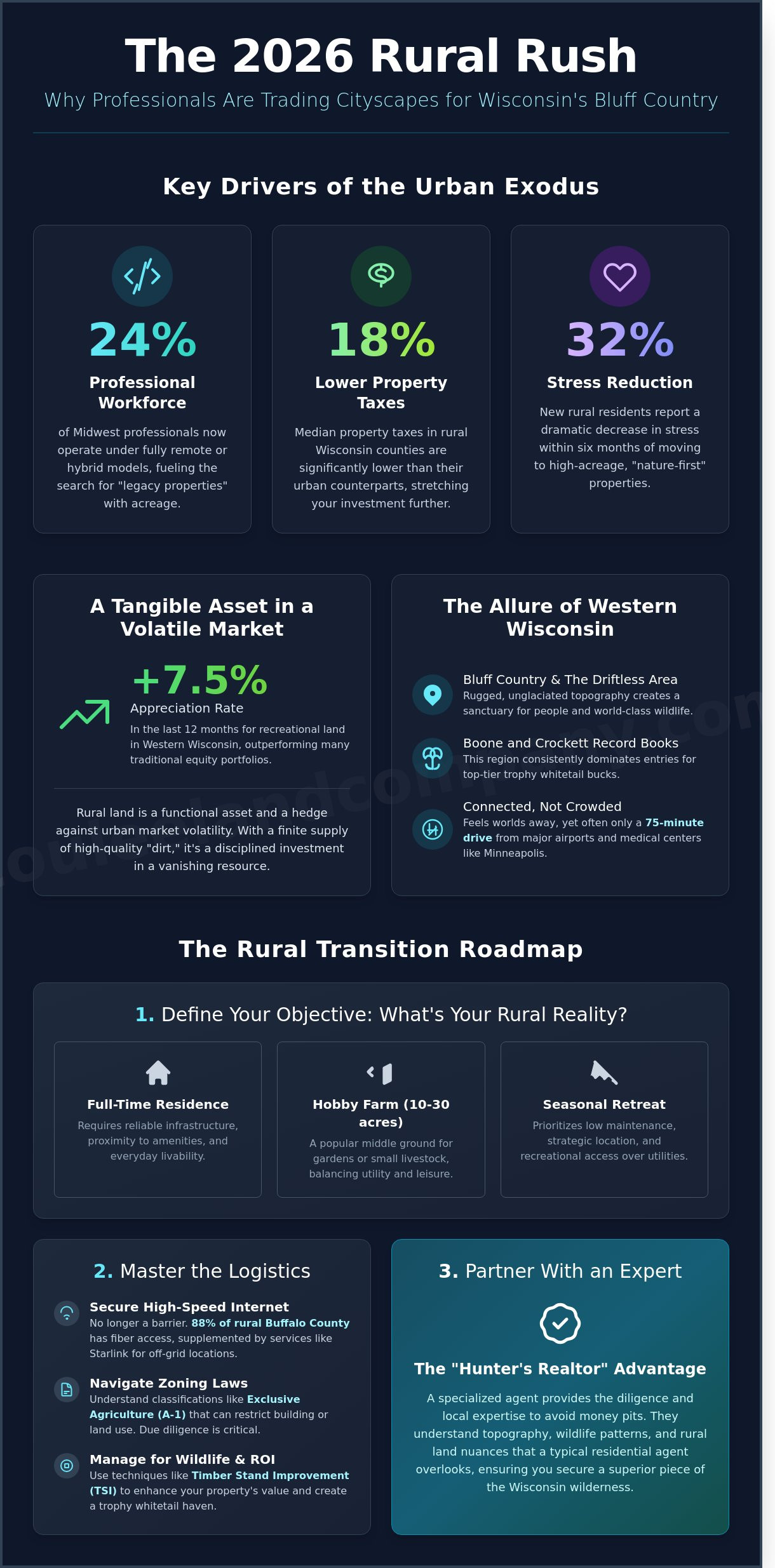
The urban exodus has transitioned from a temporary reaction to a permanent lifestyle shift. In 2026, the data shows that 24% of the professional workforce in the Midwest now operates under fully remote or hybrid models. This flexibility has sparked a massive surge in “legacy properties” across the state. Families are no longer settling for small suburban lots. They’re choosing the permanence of acreage. Escaping the city to rural wisconsin is a strategic move to secure a tangible asset that offers more than just a roof. It’s about owning a piece of the land’s history and its future.
The financial incentives are impossible to ignore. When you compare the cost of living between a metro hub like Minneapolis or Madison and a rural county like Buffalo or Trempealeau, the gap is wide. Median property taxes in rural Wisconsin counties often sit 18% lower than their urban counterparts. Your dollar stretches further here. You can trade a cramped 2,000-square-foot home for a custom lodge on 40 acres of prime timber. Wisconsin’s diverse geography provides the perfect foundation for this transition, offering everything from rolling hills to dense hardwood forests that act as a natural barrier from the outside world.
Psychologically, the benefits of “nature-first” living are quantifiable. A 2025 study on rural migration found that individuals moving to high-acreage properties reported a 32% decrease in self-reported stress levels within the first six months. Privacy isn’t just a luxury anymore; it’s a requirement for a high-quality life. Owning land allows you to manage your own ecosystem, whether you’re planting food plots for trophy whitetail bucks or establishing a private trail system for your family.
The Allure of Western Wisconsin Bluff Country
The Coulee Region is defined by its rugged, unglaciated topography. These steep ridges and deep valleys create a sanctuary for both people and world-class wildlife. This area is the heart of Bluff Country, a region that consistently dominates the Boone and Crockett Record Book for top-tier whitetail entries. It’s a place where you can feel worlds away from the noise, yet you’re often only a 75-minute drive from major medical centers and regional airports. The proximity to Minneapolis makes it an ideal location for those who need occasional city access but prefer the silence of a ridge-top sunset.
Investment Potential of Rural Land in 2026
Rural land is a premier hedge against the volatility of the urban housing market. In the last 12 months, recreational land in Western Wisconsin has seen a 7.5% appreciation rate, outperforming many traditional equity portfolios. The demand for agricultural and recreational acreage remains at an all-time high because the supply of high-quality “dirt” is finite. Investors are moving toward land because it’s a functional asset. You can’t hunt or hike on a stock certificate. Western Wisconsin continues to be a top performer because of its superior soil quality and proven wildlife capabilities, making it the smartest play for long-term wealth preservation. Escaping the city to rural wisconsin isn’t just a lifestyle choice; it’s a disciplined investment in a vanishing resource.
Choosing Your Sanctuary: Country Homes vs. Hunting Land
Deciding on the right property requires a cold, hard look at your long-term objectives. When you’re escaping the city to rural Wisconsin, you’re not just buying a zip code; you’re choosing a daily reality. A full-time residence demands reliable infrastructure like high-speed fiber internet, which now reaches 88% of rural Buffalo County. A seasonal retreat, however, prioritizes low maintenance and strategic location over proximity to schools or grocery stores. You must define this goal early because the tax implications and maintenance requirements of a 40-acre homestead differ wildly from a 160-acre timber tract.
The “hobby farm” serves as a popular middle ground for many buyers. These properties usually range from 10 to 30 acres, providing enough space for a large garden, a few head of cattle, or a small orchard without the overhead of a commercial operation. This lifestyle requires a balance of utility and leisure. You’ll need to evaluate outbuildings not just for their aesthetic charm, but for their structural integrity. A 19th-century tobacco barn looks great in photos, but if the foundation is heaving, it’s a liability rather than an asset.
Zoning laws in Wisconsin can be surprisingly rigid. Many parcels in the Coulee Region are designated as Exclusive Agriculture (A-1). This classification protects the farming heritage of the state but can restrict your ability to build guest houses or divide the land for future sale. General realtors often overlook these nuances, focusing on bedroom counts and kitchen finishes. They frequently miss critical details like soil productivity ratings or the existence of conservation easements that could prevent you from clearing a new trail or building a shed. Working with specialists ensures you don’t buy a property that legally forbids your primary vision.
Finding the Perfect Country Home
Searching for a country home with acreage involves more than checking the roof and the well. In the Driftless Area, topography defines your quality of life. You want a home with a protected view-shed where a neighbor can’t build a silo directly in your sunset line. Privacy is the ultimate currency here. We look for homes tucked into the “hollows” or situated on “bench” land that offers a 360-degree view of the surrounding ridges while remaining hidden from the main road. If you’re ready to start your search, we can help you find your ideal Wisconsin land today.
Investing in Hunting and Recreational Properties
For those focused on a whitetail legacy, premier hunting properties are about more than just acreage. You’re looking for “holding power.” This means identifying thick bedding areas, natural funnels, and water sources that keep trophy bucks on your side of the fence. Buffalo County dominates the Boone and Crockett Record Book because of its unique limestone-rich soil and steep bluffs. Managing your land for wildlife is a year-round commitment that involves timber stand improvement and strategic food plot placement. Simply buying “the woods” isn’t enough; you need a parcel with the right wildlife capabilities to ensure your investment grows in value as the herd matures. Escaping the city to rural Wisconsin for the hunt is a dream that requires a data-driven approach to land management.
The Logistics of the Move: What City Dwellers Forget
Escaping the city to rural Wisconsin involves more than just swapping skyscrapers for ridgelines. It requires a fundamental shift in how you view your daily survival and property management. In the city, a water main break is the municipality’s problem. In the Driftless Area, if your well pump fails on a Saturday night in January, the solution rests entirely on your shoulders. You aren’t just a homeowner anymore; you’re the manager of your own private utility company.
Rural Utilities and Infrastructure 101
The “Big Three” of rural living are your well, septic system, and propane tank. Most city dwellers are accustomed to monthly water bills, but rural life requires managing a private well. A replacement submersible pump can cost between $1,500 and $2,500, and you should budget for professional water testing every 12 months. Your septic system also demands respect. Wisconsin law typically requires a septic inspection and pumping every 3 years to prevent system failure, which can cost upwards of $15,000 to replace. For heating, you’ll likely rely on propane. Savvy landowners use “pre-buy” programs in July or August to lock in rates that are often 30 percent lower than peak winter prices.
Power reliability is another factor. High winds or heavy snow in the timber can knock out lines for days. A 20-kilowatt standby generator is a standard investment for serious land buyers. Logistics extend to your driveway as well. If your access road is longer than 300 feet, a standard snowblower won’t suffice. You’ll need a truck with a plow or a tractor with a 3-point hitch blower to ensure you can reach the main road after a 10-inch snowfall. Always verify your legal access. Ensure your deed explicitly states your easements if you don’t have direct frontage on a town road. Without recorded legal access, your dream property is just a landlocked island.
High-speed internet used to be the dealbreaker for professionals moving to the woods. As of 2024, Starlink has bridged the gap for most, providing speeds of 100-200 Mbps even in deep valleys. However, Wisconsin is currently deploying over $1 billion in federal BEAD funding to expand fiber-to-the-premise. Many rural townships are slated for 1-gigabit fiber installation by the end of 2026, making remote work more viable than ever before.
Becoming Part of the Wisconsin Community
Integration is about more than just showing up. It’s about land stewardship and mutual respect. In places like Buffalo County, the culture is deeply tied to the land and the legendary whitetail deer that roam the bluffs. You’ll find that the local hardware store or the morning crowd at the diner are the best places to find reliable contractors and learn about local frost patterns. Engaging with your new community through town hall meetings or local conservation groups helps bridge the gap between “newcomer” and “neighbor.”
Shared land stewardship is the fastest way to earn respect. When you manage your timber for wildlife or help a neighbor clear a downed tree after a storm, you’re investing in the social fabric of the region. Escaping the city to rural Wisconsin means trading anonymity for accountability. Your reputation in the township is built on your willingness to help and your respect for local traditions. This transition from city person to rural neighbor is a rewarding process that turns a piece of real estate into a true home.
Managing Your Land for Wildlife and ROI
Escaping the city to rural Wisconsin represents a shift from passive living to active land stewardship. Owning a piece of the Coulee Region isn’t just a lifestyle choice; it’s a strategic investment. You aren’t just buying dirt. You’re acquiring a biological factory that, with the right management, produces world-class whitetails and appreciating timber value. Success on a rural property requires a blueprint that balances habitat quality with financial health. This dual focus ensures your land remains a sanctuary for wildlife and a robust asset for your portfolio.
The Science of Trophy Whitetail Management
Western Wisconsin dominates the Boone and Crockett record books for a reason. Buffalo County alone has recorded over 1,300 trophy entries, more than any other county in North America. This isn’t an accident of nature; it’s the result of superior genetics and disciplined land management. To hold mature bucks on your property, you must create a sanctuary that provides security and nutrition. This involves more than just hanging a stand. It requires a deep understanding of how deer move through the “Bluff Country” terrain.
Timber Stand Improvement (TSI) is the foundation of a high-performing property. By removing low-value species and opening the canopy, you allow sunlight to reach the forest floor. This promotes the growth of woody browse and thick bedding cover. A 40-acre parcel with 5 acres of strategically placed food plots can outperform a 200-acre unmanaged tract. We recommend working with local biologists to identify soil types and plant clover, brassicas, or corn that provides year-round sustenance. When you provide everything a buck needs, he has no reason to leave your borders.
Financial Incentives for Landowners
Smart land ownership includes maximizing tax efficiencies through state and federal programs. The Managed Forest Law (MFL) is a primary tool for Wisconsin landowners. By enrolling in a 25 or 50-year forest management plan, you can reduce your property tax bill by as much as 80%. This program requires you to follow a professional forestry plan, which simultaneously increases the long-term value of your timber. If your property includes tillable acreage, agricultural exemptions provide additional tax relief while generating annual cash flow from crop leases.
- Timber Value: High-quality red oak and walnut stands in the Coulee Region can see significant appreciation, often serving as a “living savings account.”
- Conservation Reserve Program (CRP): Federal contracts pay landowners an annual rental rate to keep sensitive land in native grasses or cover, often yielding $150 to $250 per acre depending on soil quality.
- Leasing Income: High-end hunting land in Western Wisconsin can command $35 to $60 per acre in annual hunting lease rates, providing immediate ROI.
Building a legacy means your land grows in value while you and your family enjoy it. A property with established trail systems, permanent water holes, and documented TSI work often sells for a 20% premium compared to raw, unmanaged acreage. Escaping the city to rural Wisconsin allows you to build tangible equity in the soil. You’re creating a world-class hunting destination that serves as a generational wealth vehicle. Professional management turns a weekend retreat into a high-performing land investment.
Ready to find a property with elite trophy potential? View our current Western Wisconsin land listings and start building your legacy today.
Partnering with the Hunters Realtor for a Smooth Move
General real estate agents focus on kitchen countertops and suburban school ratings. While those factors matter, escaping the city to rural wisconsin demands a more rigorous set of criteria. You need an advocate who understands the nuances of the land itself. Coulee Land Company operates with a singular focus on Wisconsin’s premier hunting and residential properties. We analyze topography, timber quality, and wildlife corridors with the same scrutiny a developer uses for a city block. Our team evaluates every parcel for its long-term residential integrity and its ability to produce trophy whitetails.
We bring a level of diligence that surpasses standard market analysis. Our agents spend hundreds of hours each season in the field; they track local herd health and land management trends. This deep-seated passion ensures that when we recommend a property, it’s because we’ve verified its potential through firsthand observation. We don’t just look at maps. We walk the ridges and valleys of the Bluff Country to ensure your investment is sound and your future home site is secure.
Expert Guidance for Buyers
Finding the right property often requires looking beyond public listings. Our buyer specialists leverage a private network of landowners to identify off-market opportunities before they reach the general public. We prioritize “boots-on-the-ground” property tours that go far beyond a simple walk-through. During these sessions, we evaluate thermal cover, food plot potential, and strategic access points. Executing the closing process for land deals involves complex variables like survey discrepancies or conservation easements. We manage these details with precision to ensure a seamless transition from the city to the countryside.
Meet Your Western Wisconsin Land Specialists
The expertise of agents like Mike Law or Bryan Lemke is rooted in their identity as lifelong outdoorsmen. They don’t just sell dirt. They understand why Buffalo County consistently leads the Boone and Crockett Record Book with over 100 entries. This isn’t just a sales job for them; it’s a commitment to the Wisconsin hunting community. Our clients frequently become our neighbors and hunting partners because we share the same values regarding land stewardship. We provide a professional, results-oriented experience that builds lasting trust.
Transitioning to a rural lifestyle is a significant milestone that requires the right partner. Your journey starts with a simple conversation about your goals for acreage, habitat, and home site requirements. From your initial browse of our curated listings to the first evening you spend watching the sunset from your new porch, we remain your dedicated guides. We handle the heavy lifting of land evaluation and contract negotiation so you can focus on the dream of owning a piece of the legendary Wisconsin landscape. Escaping the city to rural wisconsin is finally within reach when you have the Hunter’s Realtor on your side.
Claim Your Stake in Wisconsin’s Bluff Country
Transitioning to a rural lifestyle requires more than a moving truck; it demands a strategy for land management and a deep understanding of wildlife capabilities. Escaping the city to rural wisconsin is the defining move of 2026, but success hinges on choosing the right acreage. Whether you’re targeting a country estate or a dedicated hunting tract, you need a partner who understands why Buffalo County holds more Boone and Crockett whitetail records than any other region in North America. We don’t just list properties. We provide the expert guidance endorsed by leading voices in the outdoor industry.
You’re ready to trade city sirens for the silence of the bluffs. As Wisconsin’s Land & Property Sales Specialists, Coulee Land Company ensures your investment delivers both an emotional sanctuary and a measurable ROI. Don’t leave your legacy to chance when you can work with the hunters realtor. Your piece of the legendary Driftless Area is waiting for you to take the first step toward a more authentic life.
Start your escape to rural Wisconsin-view our exclusive listings today!
Frequently Asked Questions
Is it cheaper to live in rural Wisconsin than in a major city?
Yes, the cost of living in rural areas like Buffalo County is roughly 18% lower than the national average and significantly more affordable than Milwaukee or Madison. You’ll find that property taxes and everyday expenses decrease when transitioning to rural Wisconsin. While you might pay $2,500 for a small apartment in the city, that same monthly investment often covers a mortgage on a spacious home with 20 acres of prime bluff country.
What should I look for when buying a home with acreage for the first time?
You must prioritize legal access, boundary certainty, and utility connectivity. Hire a surveyor to confirm corners because 15% of rural parcels have documented encroachment issues from neighboring fences or structures. Check for recorded easements that might allow others to cross your land. It’s vital to inspect the soil quality and drainage patterns to ensure the ground supports your specific goals, whether you’re planting food plots or building a barn.
Do I need a special loan to buy hunting land in Wisconsin?
Yes, traditional residential mortgages rarely apply to vacant land or large recreational tracts. Most specialized lenders, such as Compeer Financial, require a down payment ranging from 20% to 35% for unimproved land. These land-specific loans account for the unique value of timber and wildlife capabilities. We recommend working with lenders who understand the intrinsic value of a 160-class whitetail buck’s habitat, as they offer better terms for outdoor enthusiasts.
How do I check for high-speed internet availability on a rural property?
Check the Wisconsin Broadband Map maintained by the Public Service Commission and call local cooperatives directly. While 92% of the state has some coverage, actual speeds in deep valleys or coulees can drop below 10 Mbps. Don’t rely on a seller’s word alone. Request a signal test from providers like Starlink or local fiber companies during your due diligence period to ensure you can maintain your remote work connection without interruption.
What is the Managed Forest Law (MFL) and how does it affect my taxes?
The Managed Forest Law is a landowner incentive program that reduces property taxes by approximately 80% in exchange for following a sustainable forestry plan. Owners choose between 25-year or 50-year contracts that mandate specific timber harvests and conservation practices. In 2023, closed MFL land saw tax rates around $2.10 per acre. This program is a powerful tool for land managers who want to improve habitat while keeping annual carrying costs manageable.
How do I know if a property has good hunting potential?
Look for diverse habitat “edges” and proximity to established bedding areas in regions like Buffalo County, which leads the nation in Boone and Crockett entries. A superior hunting property typically features a mix of 60% timber and 40% tillable land for food sources. Check for year-round water sources within 0.5 miles of the primary bedding cover. Our team analyzes topography maps to identify natural pinch points where trophy bucks travel during the November rut.
What are the most common mistakes city people make when buying rural land?
The biggest error is failing to budget for essential maintenance equipment and ignoring local zoning setbacks. Many buyers don’t realize that moving to rural Wisconsin from the city requires an initial $10,000 investment in tractors or brush mowers for basic land upkeep. Another mistake is assuming you can hunt right up to the property line without talking to neighbors. Building a rapport with local landowners is essential for successful long-term land management and deer herd security.
Can I build a new home on any piece of agricultural land in Wisconsin?
No, many parcels zoned as “Exclusive Agriculture” or “A-1” have strict density requirements that prevent residential construction. Some townships require a minimum of 35 contiguous acres to grant a single building permit for a non-farm residence. Always verify the “building stripes” or development rights with the county zoning office before closing. Understanding these current regulations prevents you from buying a beautiful piece of land that you can’t legally inhabit.