
Did you know that listings for net-zero ready homes have jumped by 100% as buyers increasingly prioritize sustainability alongside high-end luxury? In the rugged beauty of Western Wisconsin’s Bluff Country, the most prestigious properties are no longer defined solely by their view but by their ability to protect the river they overlook. It’s time to explore Eco-Friendly Features for Mississippi Riverfront Homes: Sustainable Living Tips and Trends. to safeguard your investment against riverbank erosion while slashing the high energy costs often associated with large country estates.
You likely understand that owning land along the Big Muddy is a privilege that comes with a deep responsibility to the watershed. We’ll show you how to master this balance by leveraging the latest 2026 innovations, including Wisconsin’s 100% state sales tax exemption for solar and the new $600 per kilowatt Focus on Energy rebates. This guide previews the essential 2021 International Energy Conservation Code updates and provides a roadmap for building a legacy home that offers both elite comfort and unmatched environmental stewardship.
Key Takeaways
- Master the “Riverfront Stewardship” model to ensure your home protects the delicate Mississippi River watershed without sacrificing luxury.
- Explore why geothermal systems and advanced insulation are the essential Eco-Friendly Features for Mississippi Riverfront Homes: Sustainable Living Tips and Trends. to implement right now.
- Understand the specific landscape requirements for managing runoff and chemical use in the unique topography of the Coulee Region.
- Discover how these sustainable investments serve as a future-proofing strategy that increases long-term resale value for recreational and country home buyers.
Sustainable Living in the Coulee Region: Why Riverfront Homes Require a Unique Approach
Riverfront living in Western Wisconsin demands a higher standard than typical suburban development. While many homeowners focus exclusively on interior efficiency, true riverfront stewardship shifts the priority toward total ecosystem protection. Riparian stewardship is the active management of the land-water interface to prevent erosion. This approach integrates sustainable building practices with the specific biological needs of the Mississippi River Valley to ensure your legacy home stands the test of time.
The steep topography of the Coulee Region creates a direct conduit between your property and the river. Runoff from traditional lawns often carries fertilizers and chemicals into the water, disrupting the delicate balance of the watershed. By choosing Eco-Friendly Features for Mississippi Riverfront Homes: Sustainable Living Tips and Trends., you ensure that your presence in the valley supports rather than degrades the local environment. It’s a pragmatic strategy that protects the wildlife habitats that make this region so desirable for outdoor enthusiasts.
To see how these concepts translate to modern home design, watch this overview:
Protecting the Mississippi Watershed
Effective watershed protection starts with slowing the flow of water across your lot. Permeable pavers are an excellent solution for driveways and patios, allowing rainwater to soak into the ground rather than rushing over the surface and carrying silt into the river. Rain gardens serve as natural filtration systems, using native plants to trap pollutants and nitrates. Naturalizing your shoreline with woody debris and native vegetation provides critical nesting sites for migratory birds and essential cover for the diverse fish species found in the main channel.
Native Landscaping for Erosion Control
Erosion is the greatest threat to both bluff-side stability and water quality in Western Wisconsin. Deep-rooted native Wisconsin grasses, such as Big Bluestem or Indian Grass, create a subterranean anchor system that holds soil in place far better than traditional turf. Removing invasive species is equally vital. Plants like buckthorn often create weak root structures that lead to bank instability during heavy rains. Investing in these Eco-Friendly Features for Mississippi Riverfront Homes: Sustainable Living Tips and Trends. isn’t just about ethics; it’s about preserving the very ground your home stands on. You can see these principles in action by browsing our current listings of waterfront properties that prioritize land health.
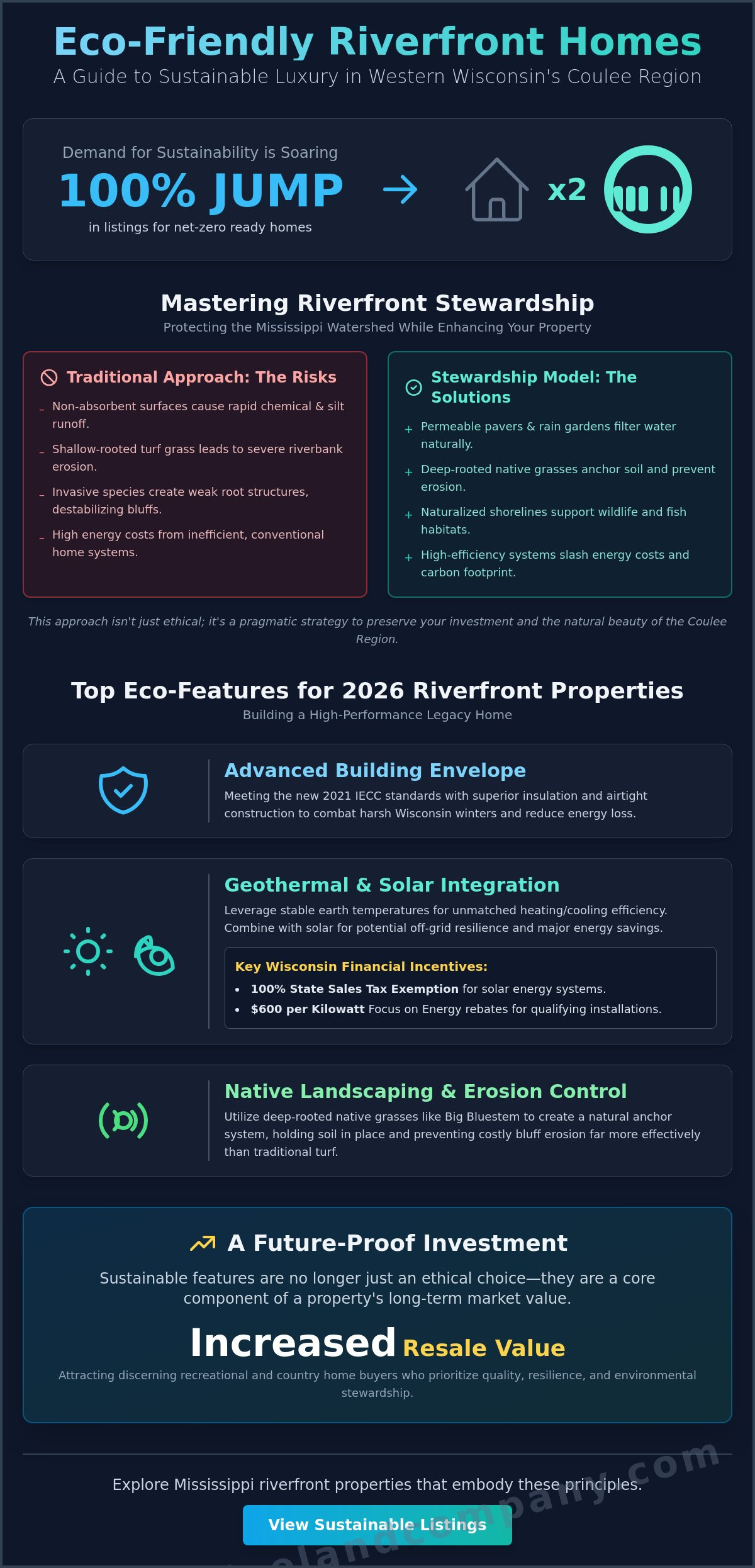
Top Eco-Friendly Features for Mississippi Riverfront Properties in 2026
Modern riverfront estates in the Coulee Region are undergoing a technical revolution. Wisconsin’s adoption of the 2021 International Energy Conservation Code (IECC) in late 2025 has set a new benchmark for high-performance building envelopes. These advanced shells utilize superior insulation and airtight construction to combat the harsh winters of the Mississippi Valley. When paired with geothermal heating and cooling, which taps into the stable temperatures of the earth near the riverbank, homeowners achieve a level of climate control that traditional systems can’t match. Research regarding the market value of green homes confirms that these structural investments pay dividends beyond simple utility savings.
Aesthetic harmony remains a priority for property owners in Bluff Country. Architects now utilize reclaimed barn wood and locally sourced limestone to ensure that new construction blends seamlessly with the rugged landscape. Integrating smart home technology allows for precise energy monitoring and automated lighting, ensuring your estate operates at peak efficiency even when you’re away. If you’re scouting for country homes that already incorporate these high-end finishes, it’s essential to evaluate the integration of tech and terrain.
Off-Grid Resilience and Solar Integration
The 2026 trend for “Invisible Solar” is transforming the Mississippi River Valley. Homeowners are moving away from bulky panels in favor of solar shingles and tiles that preserve the classic silhouette of a high-end riverfront home. These systems are more affordable than ever; the 2026 Focus on Energy rebates have increased to $600 per kilowatt (kW), up to a $2,400 maximum. Combined with Wisconsin’s 100% sales tax exemption and property tax exemption for solar installations, these Eco-Friendly Features for Mississippi Riverfront Homes: Sustainable Living Tips and Trends. provide unmatched energy security during severe weather events.
Advanced Water Stewardship Systems
Luxury and conservation don’t have to be at odds. Advanced greywater recycling systems now allow for the safe reuse of water for landscape irrigation, which is vital for maintaining lush grounds without taxing local aquifers. Low-flow fixtures have evolved to provide a high-pressure, premium experience while significantly reducing total consumption. For rural estates, smart well-monitoring technology provides real-time data on water quality and pump health, ensuring your family’s most vital resource is protected and efficient.
The Market Value of Green Stewardship in Western Wisconsin
In Western Wisconsin, a home’s market value is inextricably linked to the health of the surrounding land. Eco-friendly features serve as a robust future-proofing mechanism, protecting your investment against rising energy costs and evolving environmental regulations. Buyers in the 2026 market aren’t just looking for high-end finishes; they’re looking for ecological resilience. Integrating these features into a property aligns perfectly with broader whitetail land management goals, as a healthy, undisturbed ecosystem is essential for sustaining record-breaking trophy deer. Achieving total energy independence significantly increases the desirability of remote recreational retreats by removing the reliance on traditional grid infrastructure in rugged, hard-to-access terrain.
The modern “conservation-minded” buyer views a property through the lens of stewardship. They recognize that a home that minimizes its footprint on the Mississippi River watershed is a more secure long-term asset. By implementing Eco-Friendly Features for Mississippi Riverfront Homes: Sustainable Living Tips and Trends., you position your property at the top of a competitive niche. It’s a pragmatic approach that merges the dream of riverfront living with the reality of responsible land ownership.
Eco-Features as a Selling Point for Recreational Land
Elite whitetail hunters and outdoor enthusiasts prioritize properties that maintain a minimal environmental footprint to avoid disrupting natural wildlife patterns. In the current market, “turn-key” green homes command a significant premium because they eliminate the need for complex retrofitting in sensitive areas. This trend is particularly evident in Buffalo County, where a deep-seated conservation culture defines the local real estate landscape. Properties that boast verified sustainable systems attract serious buyers who view themselves as guardians of the land.
Finding Your Sustainable Riverfront Retreat
Identifying a property with genuine “green” potential requires a specialized eye for both the structure and the soil. It’s not just about the solar panels; it’s about the orientation of the bluff and the integrity of the shoreline. When interviewing sellers, savvy buyers should ask specific questions about existing geothermal maintenance records and the history of native plant restoration on the banks. To navigate these technical complexities, we recommend connecting with Coulee Land Company agents who specialize in waterfront stewardship and understand the true value of a sustainable riverfront investment.
Lead the Future of Riverfront Stewardship
Owning a home on the Mississippi River is a commitment to the land as much as it is a lifestyle choice. We’ve explored how riparian management and high-performance building envelopes protect the watershed while enhancing property value. By adopting Eco-Friendly Features for Mississippi Riverfront Homes: Sustainable Living Tips and Trends., you ensure your estate remains a resilient asset in the 2026 market. These investments don’t just lower utility costs; they preserve the rugged beauty of the Coulee Region for the next generation of outdoor enthusiasts.
The team at Coulee Land Company brings decades of experience in Western Wisconsin land brokerage to every transaction. Our specialized expertise in Mississippi Riverfront and Bluff Country properties ensures you find land that meets both your luxury standards and your conservation goals. We’re proud to be endorsed by industry-leading conservationists and land managers who trust our deep understanding of the territory.
Find your sustainable riverfront retreat with Coulee Land Company and start building your legacy today. The river is waiting.
Frequently Asked Questions
Do eco-friendly features actually increase the resale value of a riverfront home?
Yes, they do. Modern buyers in Western Wisconsin prioritize “future-proofed” homes that offer long term energy security and lower operating costs. Listings for net-zero ready homes have seen a 100% increase in popularity recently, signaling a massive shift in market demand. These upgrades act as a powerful differentiator for premium waterfront properties, often leading to higher closing prices and a faster sales cycle among conservation-minded buyers.
How can I prevent riverbank erosion on my Mississippi property using sustainable methods?
Sustainable erosion control relies on bioengineering and the strategic use of deep-rooted native vegetation. Unlike traditional hard armoring, which can deflect water energy and cause damage downstream, planting native Wisconsin grasses creates a subterranean root network that binds the soil together. This method adheres to La Crosse County shoreland zoning regulations while providing essential habitat for the diverse wildlife found along the Mississippi flyway.
Is solar power effective in the wooded terrain of Wisconsin’s Bluff Country?
Solar power is highly effective in Bluff Country when arrays are positioned to maximize southern exposure on ridge-tops or cleared slopes. The 2026 “Invisible Solar” technology allows homeowners to harness energy through shingles that maintain the classic aesthetic of a wooded estate. With Wisconsin’s 2026 Focus on Energy rebates increasing to $600 per kilowatt, solar has become a pragmatic choice for achieving energy independence in remote recreational retreats.
What are the most cost-effective green upgrades for an existing country home?
The most immediate returns come from improving the building envelope through advanced insulation and sealing air leaks to combat Wisconsin winters. Integrating smart home technology, such as energy-monitoring systems and smart thermostats, allows you to optimize daily usage without a full-scale renovation. These are essential Eco-Friendly Features for Mississippi Riverfront Homes: Sustainable Living Tips and Trends. that provide a high return on investment while significantly lowering your monthly utility bills.